- 176 pages
- English
- ePUB (mobile friendly)
- Available on iOS & Android
eBook - ePub
About this book
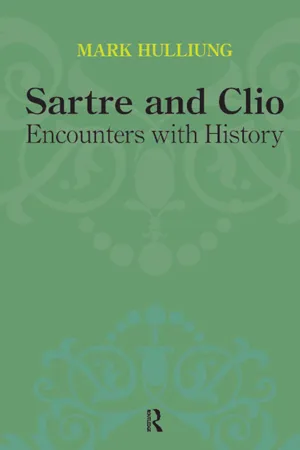
In Nausea, the 1938 novel that made Sartre famous, the protagonist is a historian who abandons the biography he is writing because he comes to believe that all histories are fictional, escapist, and useless. He sought the one and only truth of history; a truth that would revolutionize the world. By the time Sartre published his most mature works, he claimed to have written a biography that was perfectly true. This book examines how and why Sartre's position on the possibility and worth of historical knowledge changed so dramatically. In addition, it illuminates Sartre's unique contribution to the grand debate between Marxist and anarchist revolutionaries-a debate that continues today.
Trusted by 375,005 students
Access to over 1.5 million titles for a fair monthly price.
Study more efficiently using our study tools.
Information
Topic
PhilosophySubtopic
Epistemology in PhilosophyChapter 1
To Historicize or Not to Historicize
The vogue of Jean-Paul Sartre may not be what it once was, but as anyone who teaches undergraduates knows, there is no lack of young people who remain enthusiastic about grappling with his writings. A coterie of scholars, too, seems determined to prove that rumors of Sartre’s intellectual death and irrelevance are greatly exaggerated. Partly this continuing scholarly output is a matter of the successful recovery in recent years of what his biographer Annie Cohen-Solal spoke of in 1985 as the “thousands of his pages scattered around the world.”1 Even more, his refusal to disappear is attributable to the reality that, love him or hate him, one cannot deny him admittance to the ranks of the great minds of his century. Sartre remains a figure of keen interest.
Is there anything new to say about Sartre? There is and will continue to be because new perspectives can always be brought to bear upon familiar materials. What I shall attempt is a study of the changing role of history in his thought, from Nausea in 1938 to his final major efforts, the two-volume Critique of Dialectical Reason and the multivolume study of Flaubert, Idiot of the Family, with many unexpected, perplexing, and fascinating stops, reversals, and zigzags along the way. While many secondary works on Sartre touch on my topic, their focus is elsewhere. Despite the wealth of the secondary literature, I believe there is something to be said about Sartre that is new and significant.
In Nausea, the book that made him famous, Sartre denounced the writing of history as a doubly worthless pursuit, first because it is untruthful and second because it is useless except as an attempt to escape from our very selves. But by the time he published the first volume of the Critique of Dialectical Reason, he dared announce his extraordinary ambition that the second tome “will attempt to establish that there is one human history, with one truth and one intelligibility.”2 He also declared that to write history and to be engaged politically were intimately interrelated activities, a fusion of theory and practice. Sartre began by repudiating Clio and ended by embracing her, eventually asking far more of the study of history, it seems, than any other thinker of his age or more recent times.
It would be a mistake, however, to conclude that a line of development runs straight and true from Nausea in 1938 to the Critique in 1960. Sartre’s encounter with Clio was an on-again, off-again affair, a stormy relationship with many break-ups and an unsatisfying finale. Only posthumously, in 1985, was the long-awaited sequel to volume one of the Critique of Dialectical Reason released, and then in a frustratingly truncated, imperfectly organized form. Of the Critique, it may be argued that of all his unfinished projects this was one he simply had to bring to fruition, that his life’s work was seriously incomplete in its absence. Why two decades after publication of the first volume was the second Critique unfinished and misshapen? How did it happen that a book he had already sketched in 1958, two years before the appearance of volume one, and that he announced in 1959 would be released “within a year,”3 remained incomplete in 1980, the year of his death?
If failure to finish the Critique is one measure of Sartre’s difficulties in coming to terms with historical reason, another is his long record of advancing the study of history in some publications while simultaneously seeking to write history out of his work in others. On the one hand, there is the Sartre who, after elaborating his method of “existential psychoanalysis” in Being and Nothingness (1943), called upon it when he decided to write history in the form of biographies of Baudelaire and Jean Genet, an interest that began during World War II and that he carried with him to his dying day, still working at the end of his life on the finale to his massive biographical study of Flaubert (below, Chapter 2, “From Time to History”).
On the other hand is a contrasting Sartre who is likewise a product of the immediate postwar era and a forceful presence in his thought for many years thereafter. Quite striking is this second Sartre’s protracted fascination with groups that, he believed, have been denied a history: the French during the German occupation, Jews throughout the centuries, the French proletarians of the early 1950s, pre-1959 Cubans, and the victims of Western colonialism in Algeria and elsewhere (below, Chapter 3, “The Historical Search for the Unhistorical”). The reason he was so fascinated with these victims, caught in repetition and denied a past, is perhaps not impossible to discern. Very likely it was because he believed that if anyone was likely to heed the call to “authenticity” it was these groups, facing hopeless or seemingly hopeless odds, yet fortunately denied by their misfortunes the temptation of members of other groups to lose themselves in the past. Unlike the rest of us, members of these groups, standing outside history, were forced to face up to the choice between authentic and inauthentic existence.
In the fourth chapter (“Human History and the Human Condition”), we shall discuss yet another reason why Sartre was sometimes reluctant to follow the path to history and all-out historicity. Along with Albert Camus, Sartre vehemently rejected “humanism” in his earlier writings, only to reinstate it in revised form as World War II drew to a close. Soon, this revisiting of humanism included a reworking of the notion of “the human condition,” which figures prominently in the French intellectual tradition from Montaigne and Pascal to Malraux and beyond. Although there is no human essence or human nature, there is a fixed, static, unchanging human condition in which time may matter, as in Beckett and Sartre, but history does not. A tension in Sartre’s thought arguably exists between his attraction to the notion of the human condition and his desire to solve the problem of history. That tension was fated to be greatly aggravated when Camus called on his understanding of “the human condition” to repudiate the French Communist party, the Soviet Union, and their historicist philosophies at exactly the same time that Sartre was entering his most intense period of “fellow-traveling.”
Chapter 5, “History and Revolution,” marks a new emphasis. In the writings of Sartre that we shall examine in Chapters 3 and 4, he frequently speaks to us in the language of “resistance” and “refusal”: the French who resisted the Nazis, the Jews who resist the anti-Semites, and so forth. But in Chapter 5, where the Critique is one of the foremost primary sources, he consistently speaks the language not of resistance but of “revolution.”
The Sartre who placed history at the top of his agenda in the Critique shared something fundamental with the earlier Sartre who cared little for historical studies: In both cases, his concern was that we should not turn to history to escape into the past. Previously drawn to groups denied a past, he was preoccupied in the Critique with groups that forge a revolutionary new future rather than accept a continuation of the past. The old word “authenticity,” unspoken but implicit, beckons once more.
Also numbered among my objectives in Chapter 5 is the task of showing what Sartre’s commentators have too often neglected or only commented on in passing: How he used his historical reflections to address the long-standing debate between different types of nineteenth and twentieth century revolutionaries, notably Marxists and their anarchist adversaries. Throughout the nineteenth century and well into the twentieth, revolutionary and ideological politics were overwhelmingly anarchist in the “Latin” countries, Spain and Italy; whereas Germany’s leftists, in marked and hostile contrast, were Marxists; and France was the country where both anarchists and Marxists flourished, engaged in endless battles, and also where various forms of anarchist/Marxist hybrids came to the fore, as in the thought of Georges Sorel—and, arguably, that of Jean-Paul Sartre.4 The existing scholarship has much to say about Sartre’s relationship to Marxism but virtually nothing to say about his relationship to anarchism, nor the various crossbreeds of anarcho-Marxism that were so common in France.
In the brief and final Chapter 6 (“History and a Note on Ethics”), we shall examine the hypothesis that, while ostensibly commenting on the French Revolution and Soviet history, Sartre, at times, came very close to injecting into his works a recapitulation of the history of social contract theory in reverse, moving from its most libertarian to its most authoritarian versions of consent, always allowing, however, for the possibility that the downtrodden will reach the moment when they can and must reassert their sovereignty.
Scholars have sought, with only modest success, for an implicit fulfillment in one or another of Sartre’s works of his promise at the close of Being and Nothingness that he would soon offer an ethics. Or they have noted the prominence of the moral language of “authenticity” and “inauthenticity” in his immediate postwar essays, while conceding that he never converted those offerings into a full-fledged ethics.5 Or they have underscored the revolutionary Sartre’s dealings with the dilemma of means and ends in his plays and essays, Dirty Hands, The Devil and the Good Lord, and the introductory essay to Frantz Fanon’s The Wretched of the Earth. In the end, they have often concluded that his ethics awaited the postrevolutionary society.
One other scholarly strategy has been to pore over Sartre’s incomplete, fragmentary utterances on ethics in his final years.6 Unnoticed is how close he came to working out a theory of a historically grounded, transmuting social contract in his discussion of revolution in motion, especially in the Critique of Dialectical Reason, where what he tried to pass off as phenomenological description verges on being something considerably more. It may be worth our while to take stock of what might have been but never was and to ponder why he refused to grasp what was readily at hand.
* * *
At the age of sixty-two, Sartre sat down for an interview during the course of which he remarked, “now I believe that only a historical approach can explain man.”7 He was not always so certain. How far he came, how fundamentally he changed his mind on the question whether “to historicize or not to historicize,” can only be appreciated by revisiting Nausea, published at age thirty-three. Both chronologically and conceptually, Sartre’s novel provides the baseline against which all his subsequent reflections on history must be judged. Revisiting Nausea is a necessary first step if we are to understand how he eventually rebuilt historical reason from the ashes of his attack on historians and historical knowledge in his remarkable novel.
Roquentin, the novel’s protagonist, is a historian whose project it is to write a biography of the Marquis de Rollebon, a figure of the French Revolutionary era. Eventually Roquentin abandons that quest because he has concluded that history is useless: “When you want to understand something you stand in front of it, alone, without help: all the past in the world is of no use.” In the course of encountering the absurdity of human existence, the contingency of our being, the strangeness of a natural universe to which we do not belong and in which we are de trop, out of place, and in the way, he finds that writing history is a futile and inexcusable escape. After abandoning his historical project he writes, “M. de Rollebon had delivered me from myself. What shall I do now?”8
It is all the worse that, unlike Roquentin, the contemptible bourgeois are more than willing to retreat relentlessly into the past. “They would like to make us believe that their past is not lost, that their memories are condensed, greatly transformed into Wisdom.” Around the age of forty, “they christen their small obstinacies and a few proverbs with the name of experience.” Roquentin concludes that “the past is a landowner’s luxury” and soon thereafter jots a cautionary note in his diary: “Must not think too much about the value of History. One runs the risk of being disgusted.”9
We are all storytellers, historians, novelists, whether we recognize it or not, remarks Roquentin. “A man is always a teller of tales, he lives surrounded by his stories [histoires] and the stories of others, he sees everything that happens to him through them; and he tries to live his own life as if he were telling a story.” We are all historians, and all our histories are false because we read the present into the past. The good bourgeois “explain the new by the old—and the old by the older still, like those historians who turn Lenin into a Russian Robespierre, and a Robespierre into a French Cromwell.” Desperately, we seek to convince ourselves that “there is nothing new under the sun.”10
What’s more, Roquentin the historian finds himself “beginning to believe that nothing can ever be proved.” At most, he is offering “hypotheses,” but these “come from me and are simply a way of unifying my own knowledge.” History, Roquentin comes to believe, is more manufactured than recorded by the historian: “this feeling of adventure definitely does not come from events.… It’s rather the way in which the moments are linked together”—and it is the historian who decides how to link them, what tale to tell, what lesson to be passed along to the reader.11
“I’d be better off writing a novel on the Marquis de Rollebon,” decides Roquentin. “I have the feeling of doing a work of pure imagination. And I am certain that the characters in a novel would have a more genuine appearance.” Everyone wants to believe in “true” stories, “as if there could possibly be true stories.” You appear to start at the beginn...
Table of contents
- Cover
- Half Title
- Title Page
- Copyright Page
- Dedication
- Table of Contents
- Preface and Acknowledgments
- Chapter 1 To Historicize or Not to Historicize
- Chapter 2 From Time to History
- Chapter 3 The Historical Search for the Unhistorical
- Chapter 4 Human History and the Human Condition
- Chapter 5 History and Revolution
- Chapter 6 History and a Note on Ethics
- Notes
- Index
- About the Author
Frequently asked questions
Yes, you can cancel anytime from the Subscription tab in your account settings on the Perlego website. Your subscription will stay active until the end of your current billing period. Learn how to cancel your subscription
No, books cannot be downloaded as external files, such as PDFs, for use outside of Perlego. However, you can download books within the Perlego app for offline reading on mobile or tablet. Learn how to download books offline
Perlego offers two plans: Essential and Complete
- Essential is ideal for learners and professionals who enjoy exploring a wide range of subjects. Access the Essential Library with 800,000+ trusted titles and best-sellers across business, personal growth, and the humanities. Includes unlimited reading time and Standard Read Aloud voice.
- Complete: Perfect for advanced learners and researchers needing full, unrestricted access. Unlock 1.5M+ books across hundreds of subjects, including academic and specialized titles. The Complete Plan also includes advanced features like Premium Read Aloud and Research Assistant.
We are an online textbook subscription service, where you can get access to an entire online library for less than the price of a single book per month. With over 1.5 million books across 990+ topics, we’ve got you covered! Learn about our mission
Look out for the read-aloud symbol on your next book to see if you can listen to it. The read-aloud tool reads text aloud for you, highlighting the text as it is being read. You can pause it, speed it up and slow it down. Learn more about Read Aloud
Yes! You can use the Perlego app on both iOS and Android devices to read anytime, anywhere — even offline. Perfect for commutes or when you’re on the go.
Please note we cannot support devices running on iOS 13 and Android 7 or earlier. Learn more about using the app
Please note we cannot support devices running on iOS 13 and Android 7 or earlier. Learn more about using the app
Yes, you can access Sartre and Clio by Mark Hulliung in PDF and/or ePUB format, as well as other popular books in Philosophy & Epistemology in Philosophy. We have over 1.5 million books available in our catalogue for you to explore.