eBook - ePub
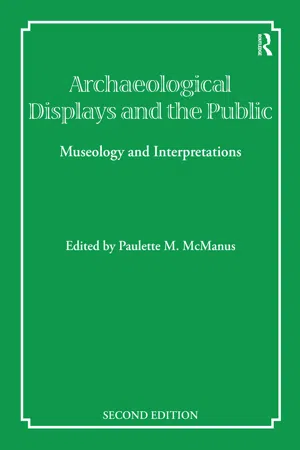
Archaeological Displays and the Public
Museology and Interpretation, Second Edition
- 188 pages
- English
- ePUB (mobile friendly)
- Available on iOS & Android
eBook - ePub
Archaeological Displays and the Public
Museology and Interpretation, Second Edition
About this book
This volume is a set of a dozen case studies of innovative programs designed to attract the public to both archaeological sites and exhibits of archaeological artifacts. Papers deal with general issues of interpretation and presentation and cover British, Australian, European, and American settings.
Trusted by 375,005 students
Access to over 1 million titles for a fair monthly price.
Study more efficiently using our study tools.
Information
The Institutional Setting
Cultural Tourism
DOI: 10.4324/9781315434575-2
To all intents and purposes, museums can be regarded as one of the cornerstones of cultural tourism. Museums have long played an important role in presenting the history and culture of nations or regions to visitors. In recent years cultural attractions have also come to be viewed as an essential means of attracting visitors to urban and rural destinations worldwide. In 1997, 17% of domestic tourists in the UK visited heritage sites of which museums are the largest category. For overseas tourists, the figure rises to 37%. In major European cities tourists can be even more important. In Amsterdam, for example, 75% of museum visitors are tourists (AUB ,1996).
However, the very word 'attraction' is laden with a major semantic problem – it tends to suggest that the museum can somehow act as a magnet for visitors. Just open the doors, and the visitors will flood in. However, as Leiper (1990) has pointed out, the idea of an attraction is misleading – tourists are in fact 'pushed' towards attractions by their own motivations, not magically drawn by some invisible force within the attraction.
Attracting more visitors therefore depends on knowing the visitor and their needs. Many museums know their local audience quite well, but many have little idea of the wider European visitor market. Recent research in the UK by the Museums and Galleries Commission revealed that 25% of museums do not know how many foreign tourists they receive. Only 20% of museums had participated in seminars and workshops on international customers during the past three years. More significantly, only 20% of UK museums outside London have a strategy for attracting foreign tourists. UK museums are not unusual in this respect – in fact they are probably more aware of tourism markets than many of their continental counterparts.
This chapter examines the cultural tourism market, and the position of museums as major suppliers of cultural tourism experiences.
Cultural tourism – hope or hype?
Cultural tourism has been adopted as an element of tourism policy by national and regional governments in all corners of the world. Cultural tourism is popular with policy-makers because it supposedly attracts high-quality, high-spending tourists and at the same time provides economic support for culture. Increasing interest in tourists on the part of cultural attractions is to some extent due to necessity, and also due to the fact that cultural tourism is seen as a major growth market. The World Tourism Organization (WTO) for example has quoted cultural tourism as accounting for 37% of global tourism, with growth rates of 15% per year. According to the European Heritage Group, attendance at museums, historical monuments and archaeological sites has doubled between 1977 and 1997 (European Commission, 1998). In the UK, it was estimated that cultural tourism accounted for 27% of tourism earnings, and in 1997, over 400 million visits to tourist attractions were culturally based (Leslie, forthcoming).
In other cases, however, actual growth has lagged behind the high-blown expectations. Recent data indicate that cultural attractions have not increased their attendances as a proportion of all visits to tourist attractions. Figures on attraction attendance in the UK, for example, show an average growth in attraction visits of 15% between 1989 and 1997, compared with a 9% increase for historic properties and 14% for museums and galleries (Table 1). As a proportion of total visits, museums and galleries slipped from 23.1% in 1991 to 19% in 1997, and historic properties grew slightly from 19.1% to 20% over the same period. Longer term trends for England indicate a slower growth rate for cultural attractions between 1976 and 1991, with historic properties (+24%) and museums and galleries (+23%) lagging behind the growth for all attractions (+35%).
| Attraction type | Constant sample | Total market |
|---|---|---|
| Farms | +65 | +71 |
| Visitor centres | + 17 | +55 |
| Gardens | +26 | +28 |
| Country parks | +22 | +23 |
| Workplaces | + 15 | + 15 |
| Museums and galleries | +11 | + 14 |
| Leisure parks | +6 | +12 |
| Historic properties | +8 | +9 |
| Steam railways | +7 | +9 |
| Wildlife attractions | -8 | -1 |
| Total | +11 | + 15 |
Why do the attendances at individual museums not seem to match up to the apparent high rate of total market growth? One explanation might be that many museums either do not consider themselves to be in the tourism market, or even if they do, they do not promote themselves effectively to that market. Another potential explanation is, however, that the growing supply of cultural attractions in recent years means that there is growing competition for cultural visitors. This is certainly true for the European market as a whole, as Figure 1 indicates.

Growing competition is a particular problem for museums, since the supply of museums has grown faster than that of most other cultural attractions. In Spain, for example, the number of museums has doubled in the last twenty years, largely thanks to a flourishing of regional museums in the post-Franco era. In Catalonia in particular the revival of national identity has had a strong influence on the development of new museums (Dodd, 1999). In the Netherlands, the supply of museums also doubled between 1975 and 1993 (de Haan, 1997). In the UK the supply of museums has also been strongly stimulated by regional development initiatives and more recently National Lottery funding. Some observers have even been prompted to ask if there are not already enough museums in the UK (Glancey, 1999).
In a period of increasing competition for visitors, the 'build it and they will come' philosophy (Richards, 1999a) is not enough – you need to be able to anticipate and meet the needs of the visitor. This in turn entails an understanding of the cultural tourism market and the different visitor segments it contains. The rest of this chapter examines the nature of cultural tourism, and goes on to look at the profile, motivations and behaviour of the cultural tourists.
What is cultural tourism?
Cultural tourism is extremely difficult to define. There are over 300 different definitions of 'culture' in circulation, which indicates why no widely accepted definition of 'cultural tourism' has been produced in the past. This is not just a problem for tourism academics – policy documents across Europe tend to duck the issue of definition as well, tending to make the assumption that everybody knows what cultural tourism is. This explains the heterogeneous assortment of terms which have arisen in the literature and in policy statements in recent years. Cultural tourism, heritage tourism, arts tourism, ethnic tourism and a host of other terms seem to be almost interchangeable in their usage, but it is rarely clear whether people are talking about the same thing.
In order to try to clarify the meaning of cultural tourism, a conceptual definition was proposed by Richards (1996), based on the way in which tourists (people travelling away from home) consume culture. Culture can be viewed as comprising what people think (attitudes, beliefs, ideas and values), what people do (their 'way of life') and what people make (artworks, artifacts, cultural products). Culture is therefore composed of cultural processes and the products of those processes. Looking at culture in this way, cultural tourism is not just about visiting museums and monuments, which has tended to be the 'traditional' view of cultural tourism, but it also involves consuming the way of life of the areas visited. Both of these activities involve the collection of new knowledge and experiences. Cultural tourism can therefore be defined as: 'The movement of persons to cultural attractions away from their normal place of residence, with the intention to gather new information and experiences to satisfy their cultural needs' (Richards, 1996). According to this conceptual definition, cultural tourism covers not just the consumption of the cultural products of the past, but also of contemporary culture or the 'way of life' of a people or region. Cultural tourism can therefore be seen as covering both the material culture found in museums and the 'living culture' of everyday life.
Although in the past most emphasis in the development of cultural tourism was placed on the development of museums and other heritage products, tourism based on 'popular culture' is now becoming an increasingly important part of the cultural tourism product. This partly reflects the broadening concept of culture being used by policy makers, which is increasingly encompassing 'popular' as well as traditional 'high culture'. Some artforms are also becoming more important because arts institutions are beginning to recognise the potential of tourism as a source of income, and partly because of the improved communications and distribution channels available through new technology, which are making arts events more accessible to tourists. Another important factor is the 'experience hunger' that increasingly characterises modern society (Shulze, 1992). People are increasingly looking for an 'experience' when they visit museums and other attractions. Museums have until recently not paid much attention to the visitor experience, and in consequence are losing out to 'new' heritage attractions designed to generate easily consumable experiences.
In order to study the development of cultural tourism, the European Association for Tourism and Leisure Education (ATLAS) launched its Cultural Tourism Research Project in 1992. Initially funded by DGXXIII of the European Commission, the project set out to analyse the cultural tourism market in Europe, and to develop a profile of the European cultural tourist. Reports of the initial phase of the research have been published elsewhere (Richards, 1996). A major feature of the research programme was a survey of visitors to cultural sites across Europe. Almost 6,500 visitors to 26 sites in 9 countries were interviewed in 1992, and the survey was repeated with over 8,000 visitors in 10 European countries in 1997 (Richards, 1998). A total of over 70 cultural sites across Europe has been surveyed, allowing a profile of cultural tourists to be constructed. Further research has been conducted in 1999/2000, expanding the scope to cover key marketing variables. The ATLAS research provides a valuable tool for assessing the cultural visitors market in Europe and examining the way in which cultural visitors experience museums and other cultural attractions.
Who are the cultural tourists?
The pressure on many museums to increase their visitor numbers and/or broaden their visitor profile means that it is important to know who their visitors are. Although many museums undertake surveys of their own visitors, these are very rarely comparable with research undertaken at other museums in the same country, let alone on a European basis. Museums therefore rarely have a clear picture of their own position in the national or international tourism market. The ATLAS research has helped to address this problem to some extent, by using the same research methodology at cultural institutions across Europe. Using these data a reasonable picture of the relationship between cultural tourists and museums can be developed.
One of the first findings to emerge from the ATLAS research was that there are significant differences between 'heritage tourism' and 'arts tourism', both of which are usually lumped together under the label of 'cultural tourism'. In general, heritage attractions such as museums and monuments tend to be more easily accessible and attract a broader audience than arts attractions. This reflects the higher level of 'cultural capital' required for visitors to understand or appreciate certain art forms, such as ballet or opera. Museums and monuments are therefore among the most accessible forms of cultural attraction, in spite of their reputation for lack of visitor-friendliness.
Comparing museums with other cultural attractions, clear differences in the visitor profile emerge. Museums tend to have a much broader appeal as far as tourists are concerned. Over a third of tourists visiting museums surveyed in Europe came from outside Europe, compared with 15% of tourists visiting other cultural attractions. Local residents accounted for only 16% of visitors to surveyed museums, although it should be noted that this high level of tourist visitation is typical of large museums in major cities, and not of museums in general.
Visitors to museums tended to be older than visitors to other sites. Over a third of museum visitors were aged 50 or over, compared with 22% of visitors to other cultural sites. This tends to support the argument that the growth of nostalgia is a particularly important factor in the expansion of demand for heritage tourism. Arts attractions in particular tend to appeal to a younger audience, with a particularly high proportion of student visitors.
The older age profile for museum visitors explains why museums have more visitors with a secondary or further education than other cultural sites. The expansion of higher education in recent decades means that younger visitors generally have higher educational qualifications. This also accounts to some extent for their higher level of cultural capital and their subsequent ability to consume arts attractions. In spite of these differences, the proportion of museum visitors with a higher education qualification is still almost double the European Union average, and the proportion of visitors with a postgraduate education is just as high as for other sites. This underlines the fact that museum visitors are better educated than the population as a whole.
High education levels mean that museum visitors also tend to have hig...
Table of contents
- Cover
- Half Title Page
- Title Page
- Copyright Page
- Contents
- List of contributors
- Foreword
- Introduction
- The Institutional Setting
- Archaeology Indoors: Museum Exhibitions
- Archaeology Outdoors: Site Interpretation and Education
Frequently asked questions
Yes, you can cancel anytime from the Subscription tab in your account settings on the Perlego website. Your subscription will stay active until the end of your current billing period. Learn how to cancel your subscription
No, books cannot be downloaded as external files, such as PDFs, for use outside of Perlego. However, you can download books within the Perlego app for offline reading on mobile or tablet. Learn how to download books offline
Perlego offers two plans: Essential and Complete
- Essential is ideal for learners and professionals who enjoy exploring a wide range of subjects. Access the Essential Library with 800,000+ trusted titles and best-sellers across business, personal growth, and the humanities. Includes unlimited reading time and Standard Read Aloud voice.
- Complete: Perfect for advanced learners and researchers needing full, unrestricted access. Unlock 1.4M+ books across hundreds of subjects, including academic and specialized titles. The Complete Plan also includes advanced features like Premium Read Aloud and Research Assistant.
We are an online textbook subscription service, where you can get access to an entire online library for less than the price of a single book per month. With over 1 million books across 990+ topics, we’ve got you covered! Learn about our mission
Look out for the read-aloud symbol on your next book to see if you can listen to it. The read-aloud tool reads text aloud for you, highlighting the text as it is being read. You can pause it, speed it up and slow it down. Learn more about Read Aloud
Yes! You can use the Perlego app on both iOS and Android devices to read anytime, anywhere — even offline. Perfect for commutes or when you’re on the go.
Please note we cannot support devices running on iOS 13 and Android 7 or earlier. Learn more about using the app
Please note we cannot support devices running on iOS 13 and Android 7 or earlier. Learn more about using the app
Yes, you can access Archaeological Displays and the Public by Paulette M McManus in PDF and/or ePUB format, as well as other popular books in Social Sciences & Archaeology. We have over one million books available in our catalogue for you to explore.