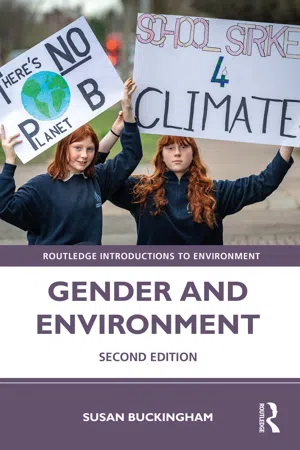
This completely revised second edition of Gender and Environment explains the inter-relationship between gender relations and environmental problems and practices, and how they affect and impact on each other.
Explaining our current predicament in the context of historical gender and environment relations, and contemporary theorisations of this relationship, this book explores how gender and environment are imbricated at different scales: the body; the household, community and city through concepts of work; and at the global scale. The final chapter draws these themes together through a consideration of waste and shows that gender is an important dimension in how we define, categorise, generate and manage waste, and how this contributes to environmental problems. Contemporary examples of environmental activism are juxtaposed with past campaigns throughout the book to demonstrate how protest and activism is as gendered as the processes which have created the situations protested about. The author's experiences of working with both the European Union on gender mainstreaming environmental research and practice, and with environmental groups on gender-based campaigns provide unique insights and case studies which inform the book.
The book provides a contemporary textbook with a strong research foundation, drawing on the author's extensive research, and professional and practice activity on the gender–environment relationship over the past 20 years, in a wide range of geographical contexts.
An image of cypresses flung in paint against a symbol of women’s housework, an ironing board, powerfully represents an intense connection between ‘women’s work’ and a nature beyond (and within) the household.
The first chapter of the first edition of this book opened with the argument that the relationship between women and the environment was best exemplified in the rural global South, where women were primarily responsible for collecting water and firewood, and for subsistence farming. While women in the global North were less obviously directly linked to their environments, there were universally shared experiences between women: through childbirth, caring for children and other vulnerable members of their household and community, undertaking low paid care and domestic work, and through their experiences of sexual violence and intimidation. I was struck, then, by how women across the globe are more likely to be poor than men, and are more likely – especially when they are elderly or a lone parent (women dominate both groups) – to form a greater proportion of a community in poverty. I argued that the income and occupation imbalances ‘seem so resilient to geographical location and to industrial progress that society must be structured in such a way as to perpetuate these inequalities’ (2000: 2).
If I had been asked 20 years ago, when this first edition was published, what changes I would expect in gender relations, I might have been optimistic that greater gender equality would have been achieved. If anything, the spread of the internet and use of social media has provided more opportunities for gendered aggression, as well as opportunities for reporting this through websites such as ‘everyday sexism’ and ‘#MeToo’. These sites demonstrate well entrenched and systematic abusive behaviour by many men towards many women, particularly those women who speak in favour of gender equality and may be seen to threaten the uneven status quo. Despite the Millennium Goals (2000), the Sustainable Development Goals, which replaced them in 2015, and the belated acceptance for the need for gender equality in climate change negotiations and strategies by the United Nations Framework Convention on Climate Change (UNFCCC) from 2011, women continue, on average, to be poorer than men, and suffer the environmental consequences of such inequality. The gender pay gap persists and gender inequality in decision-making remains. Post-millennium research into gender inequality as well as into the relationship between gender and environmental degradation, gives ample evidence for this, as the following chapters demonstrate.
In the global North, paid work continues to be gender segregated horizontally (by sector) and vertically (by position), as will be shown in Chapter 5. The disproportionately negative impact on women’s jobs of the global recession from 2008 suggests the resilience of the ‘reserve army of labour’ concept favoured by Marxist feminists, by which women are encouraged into the workforce when there are shortages of labour, but are the first to be dismissed when jobs are cut. As women are also still most likely to be the main carers of children and elder relatives, their search for work the world over is limited by the need for ‘family-friendly’ hours and accessible locations. Where these options are not possible, women living in the world’s megacities, such as Istanbul and Sao Paulo, face monumental journeys to work from their homes in the outer suburbs to low-paid service jobs in central locations. In almost all sectors, men dominate senior – and consequently higher-paid – positions. This is true in the public sectors which employ high proportions of women (e.g., in schools, and hospitals) as well as in government, private businesses, and non-governmental organisations. However, not all women experience this inequality in the same way, as intersectional critiques of feminism have demonstrated. It is also important to bear in mind that neither women, nor gender disadvantage, can be exclusively defined by women’s ability or potential to reproduce human life. Sherilyn MacGregor’s (2006) work on a gender-sensitive environmental citizenship makes the case for gender difference and environmental sensitivity not to rely on narratives of motherhood. Chapter 3 will question the essentialism which underlies some (though not most) gender discussions, and will explore the role of patriarchy in producing both gender inequality and environmental problems.
Clarifying geographical terms
In these opening pages, I have already referred to the ‘global North’ and ‘global South’ several times, and some clarity about terminology is needed. These terms have been used to describe, respectively, countries which industrialised centuries ago, mostly through the exploitation of land and the populations they controlled, and continue to control in various ways, and those which were so controlled. Geopolitical manoeuvring over the past 30 years – the collapse of the Soviet Union and its sphere of interest, the rise of the BRIC countries (Brazil, Russia, India and, most prominently, China) and the increasing dominance of international corporations – has made the division of the world into rich and poor states increasingly problematic. Categorisations of states have tended to rely on financial metrics such as gross national product (GNP) and gross domestic product (GDP), but the United Nations now, through its Human Development Index, categorises states as having very high, high, medium or low development status, although the concept of ‘development’ is itself problematic. These categories are defined by indices of a decent standard of living (vis Gross National Income), a long and healthy life (life expectancy at birth) and knowledge (measured by schooling) to place countries in these categories. This increasing diversity of experience (and one can note that non-financial exchange and lay or experiential knowledge are disregarded) is compounded by the diversity within countries in which different people experience very different standards of living. For example, The Gini coefficient or index measures income distribution, with a high percentage score indicating large inequalities, and a score of zero representing total equality. Reviewing the countries in which this book is most likely to be read, and from where it draws examples, we can see that while there is greater equality in Sweden (24.9 per cent), Germany (27 per cent) and Finland (21.5 per cent), there is much higher inequality in the USA (45 per cent), China (46.5 per cent) and Brazil (49.7 per cent). The score for the UK is 32.4, similar to Australia (30.3), the EU average (30.4) and, somewhat surprisingly similar to Bangladesh (32.1), Pakistan (30.7) and India (35.2). In common with many other sub-Saharan African countries, South Africa experiences one of the highest inequalities (62.5 percent) (CIA, 2019).
The concept of the ‘Fourth World’ was introduced in the 1970s, initially to describe people effectively disenfranchised within their ‘own countries’ (such as the native North Americans or the Australian aboriginal people) and whose presence undermined the division of the world at that time into the ‘rich’ First World and the ‘poor’ Third World. It was later expanded to include stateless people and people in both rich and poor countries who are significantly impoverished. Manuel Castells (1997: 164) defined the Fourth World as the ‘multiple black holes of social exclusion’, regardless of the wealth of the countries in which these black holes exist: from the slums of Mumbai, rural areas of Latin America, or U.S. inner city ghettos:
The Fourth World is populated by millions of homeless, incarcerated, prostituted, criminalised, brutalised, stigmatised, sick and illiterate persons. They are the majority in some areas, the minority in others, and a tiny minority in a few privileged contexts. But everywhere they are growing in number and increasing in visibility, as the selective triage of information capitalism and the political breakdown of the welfare state intensify social exclusion. In the current historical context, the rise of the Fourth World is inseparable from the rise of informational global capitalism.
Since Castells wrote this, the increase in asylum seekers, refugees and trafficked people has swelled this body of people, further blurring the boundaries between what has previously been defined as rich and poor global regions. As this book will demonstrate, these migrations are gendered just as, amongst countries and populations within countries, those experiencing greatest poverty and therefore greatest exposure to environmental problems are often women. This ‘precariat’ has, Linda Peake argues, been created by neoliberalism, which has stripped away the sharp distinctions between the global North and global South (Peake, 2013).
I also, selectively, use the term ‘Western’ when I am describing the dominant culture and economy, the crucible for which was Europe and the USA. This culture continues to extend its global reach as information and communications technology becomes more sophisticated and available.
How gender intersects
In 1989 the African-American lawyer Kimberlé Crenshaw put forward the argument that race ‘intersects’ with gender to produce more acute experiences of inequality for women of colour. The much referred-to concept of ‘intersectionality’ is described in Box 1.1, and is used in this book as an important way of analysing different gendered experiences, without succumbing to a post-modern focus on identity which can undermine structural understandings of inequality. The reach of intersectionality has since been extended to explore the intersections between women’s gender and dis/abilities, caring responsibilities, religion, sexuality, age and other characteristics. However, it does not explain how women with different backgrounds, at all levels, and in all areas of work, experience a gender pay gap as well as inequalities in position and career advancement. Personal safety and experience of violence by men also crosses boundaries of culture, ethnicity, age, sexuality and so on.
Box 1.1
Intersectionality
Kimberlé Crenshaw (1989) is credited with being the first to write about the concept of intersectionality to explain that inequalities that beleaguer women and people of colour are not independent or mutually exclusive. While race and sex ‘readily intersect’ in the lives of women of colour, she argues, feminist and anti-racist movements tend to ignore that there are particular inequalities that affect women of colour, because of the intersection of their gender and ethnicity. Pertinent to her analysis is how she problematises demands for change as tending to be effective only when the changes reflect the logic of the institutions they are challenging and that ‘[d]emands for change that do not reflect…dominant ideology…will probably be ineffective’ Crenshaw, supra note 3, at 1367. However, Crenshaw argues that despite these obstacles, using an ‘intersectional sensibility…should be a central theoretical and political objective of both antiracism and feminism’ in order to confront the dominant ideology (Crenshaw, 1991: 1243).
Defining gender
More than ever, it is important to look at gender relations beyond dualistic or binary categorisation. Misogyny and the perpetuation of the domination of women by men is a systematic process in which a particular kind of masculinity – defined interchangably as ‘alpha’, ‘hyper’, ‘industrial’ or ‘dominant’ – is valued above all other ways in which men can behave. It takes the extreme characteristics of male dualism – assertiveness, competition, outward-facing, ‘rational’ – and elevates these as the most valued, most powerful and to which those seeking to be successful in this male-defined milieu (including women – reluctantly or not) must aspire. Such a version of masculinity is damaging to men as well as women. As the novelist Tim Winton writes:
…patriarchy is bondage for boys, too. It disfigures them. Even if they’re the last to notice. Even if they profit from it. And their disfigurement diminishes the ultimate prospects of all of us, wherever we are on the gender spectrum.
Conversely, the ‘feminine ideal’ is held to be submissive, cooperative, domestic, ‘emotional’, sexually available, and women are often constrained by this assumption of their characteristics. Indeed, these stereotypes are so powerfully embedded in society that many women have internalised these assumptio...
Table of contents
Cover
Half Title
Series Page
Title Page
Copyright Page
Dedication
Table of Contents
List of figures
List of tables
List of boxes
Preface to Routledge Introductions to Environment Series: Environment and Society Texts
Access to over 1.5 million titles for a fair monthly price.
Study more efficiently using our study tools.
Frequently asked questions
Yes, you can cancel anytime from the Subscription tab in your account settings on the Perlego website. Your subscription will stay active until the end of your current billing period. Learn how to cancel your subscription
No, books cannot be downloaded as external files, such as PDFs, for use outside of Perlego. However, you can download books within the Perlego app for offline reading on mobile or tablet. Learn how to download books offline
Perlego offers two plans: Essential and Complete
Essential is ideal for learners and professionals who enjoy exploring a wide range of subjects. Access the Essential Library with 800,000+ trusted titles and best-sellers across business, personal growth, and the humanities. Includes unlimited reading time and Standard Read Aloud voice.
Complete: Perfect for advanced learners and researchers needing full, unrestricted access. Unlock 1.5M+ books across hundreds of subjects, including academic and specialized titles. The Complete Plan also includes advanced features like Premium Read Aloud and Research Assistant.
Both plans are available with monthly, semester, or annual billing cycles.
We are an online textbook subscription service, where you can get access to an entire online library for less than the price of a single book per month. With over 1.5 million books across 990+ topics, we’ve got you covered! Learn about our mission
Look out for the read-aloud symbol on your next book to see if you can listen to it. The read-aloud tool reads text aloud for you, highlighting the text as it is being read. You can pause it, speed it up and slow it down. Learn more about Read Aloud
Yes! You can use the Perlego app on both iOS and Android devices to read anytime, anywhere — even offline. Perfect for commutes or when you’re on the go. Please note we cannot support devices running on iOS 13 and Android 7 or earlier. Learn more about using the app
Yes, you can access Gender and Environment by Susan Buckingham in PDF and/or ePUB format, as well as other popular books in Social Sciences & Environment & Energy Policy. We have over 1.5 million books available in our catalogue for you to explore.