eBook - ePub
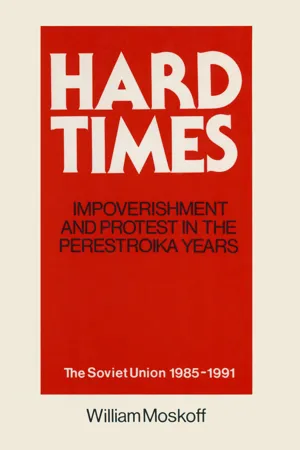
Hard Times: Impoverishment and Protest in the Perestroika Years - Soviet Union, 1985-91
A Guide for Fellow Adventurers
- 296 pages
- English
- ePUB (mobile friendly)
- Available on iOS & Android
eBook - ePub
Hard Times: Impoverishment and Protest in the Perestroika Years - Soviet Union, 1985-91
A Guide for Fellow Adventurers
About this book
The book offers guidance to aspiring historians at every stage and in every walk of life, from practical advice on tackling and organizing projects to recommendations for finding and using resources of all kinds, whether at the local library or historical society or on the world wide web. It is intended to be a serious guide to the best practices for researchers as well as a good read as a collection of research stories. The author includes useful bibliographies, vetted websites, and practical advice on doing research well.
Trusted by 375,005 students
Access to over 1.5 million titles for a fair monthly price.
Study more efficiently using our study tools.
Information
Topic
EducationSubtopic
Teaching History1
The Soviet Economy Under Gorbachev
The deeply troubled economy that Gorbachev inherited was obviously not of his own making. When he was chosen head of the Communist Party of the Soviet Union in March 1985, Gorbachev's legacy had been shaped by the so-called era of stagnation, the name given to the years from 1964 to 1982 when, under Leonid Brezhnev's stewardship, the USSR saw a serious slowing of the economy. Growth rates had been falling for a long time, factor productivity was extremely low, and goods were in short supply.
The stagnation of the economy could be seen in the significant decline in rates of economic growth in the quarter century preceding Gorbachev's ascent to power. Economic growth, which during the decade 1961-70 averaged 4.8 percent annually, fell by fully half, to 2.4 percent a year, from 1971 to 1980, and to a mere 1.7 percent a year from 1981 to 1985.1
Moreover, there was a widening gap between the Soviet Union and its traditional adversaries—the United States, Western Europe, and Japan. An economist from the Soviet Academy of Sciences said that Soviet gross national product was no more than 28 percent of the U.S. level, a remarkable revelation considering the general view in the United States that Soviet aggregate output was about half the American level.2 Soviet industrial equipment was also extremely outmoded. In contrast to the average life span of ten to twelve years in the industrialized west, equipment in the Soviet Union was used on average for twenty years.3 Even more discouraging for the USSR was the fact that the gap was narrowing between it and a number of the newly industrialized nations such as South Korea and Singapore. The world was passing the Soviet Union by. By 1985, it seemed clear that Soviet economic institutions were not only irrelevant, they were dead. So, too, was the quality of economic life.
A nation that was a military superpower and could mount a major space program could not provide adequate housing for its people; nor could it feed them properly. The transportation system in many parts of the country remained in a primitive state, pollution was rampant in the air, on the land, and in the water, and resources were being depleted at frightening rates. The health of the people was literally deteriorating; and quality medical care was rare. The Soviet people had endured a great deal of suffering for a very long time and they had done it with a patience borne of a well-tempered resignation to deprivation, and because terror had ruled so much of their lives. But terror had been largely eliminated as a central feature of Soviet economic life after Stalin's death in 1953. In addition to the serious slowing of its economy during the "era of stagnation," the nation had begun to eat away at its remaining moral fabric; corruption became routine, and the so-called second economy became the supplier of last resort. The fight for scarce goods and resources made most everyone a player in the underground economy. By 1985, the most prominent items produced by the economy were inefficiency and corruption. It was Gorbachev's task to pull the nation out of the quicksand. He dubbed the effort perestroika, or restructuring.
The era of perestroika can be divided into two roughly equal periods. The first period lasted from 1985 to late 1988. If not a honeymoon, these three and a half years were ones during which the population accepted, at times even enthusiastically, the changes Gorbachev was trying to bring about. The second period began toward the end of 1988, when it became apparent that the economy was floundering badly. From that point until the Soviet Union dissolved at the end of 1991, the economy slid downhill at an accelerating rate. It was a bumpy ride to the bottom from the feeling of high hope that people had had in 1985 to the crisis that developed and reached a head at the time of the August 1991 coup attempt and the subsequent unraveling of the USSR.
In fact, from 1985 to 1991, the story of perestroika was one of economic destabilization and crisis. There is simply no other way to describe the state of the Soviet economy at the end of the Gorbachev era. Perhaps the saddest part of all is that for all the sacrifice and hardship experienced during these years, there was nothing to show for it: not the building of a new nation, not a victory over a treacherous enemy, and certainly not the establishment of a new economic system. In a material sense, the people had virtually nothing to show for all their suffering.
The First Phase of Perestroika
In a real sense, in the first phase of perestroika, Gorbachev's efforts to deal with the economy reflected no strategy at all. Indeed, we can say that his initial actions reflected his party roots. This meant that his first efforts were to enhance the party's role in dealing with the economy, to correct the undisciplined behavior of workers, and to eliminate ineptitude. In other words, Gorbachev wanted to wager on the so-called human factor. He mounted an antialcohol campaign two months after he came to office and made efforts to get workers off shopping queues and back to their jobs. But there was no systematic effort at structural change in the economy. A second aspect of the early Gorbachev program was his effort to modernize the country's stock of plant and equipment. By improving the technological base in the economy, Gorbachev hoped for a spurt of growth that would have a self-perpetuating character. At the same time, he called for improved quality, an aspect of production that previously had been secondary to high growth rates in the Soviet system. But Gorbachev sought these goals without changing the incentive system which had always encouraged the economy to attempt to maximize aggregate output and was therefore antithetical to the goals he was enunciating with so much energy. In fact, there was early resistance to Gorbachev's agenda, from both the economic bureaucracy and enterprise managers. For them, quality and quantity were incompatible goals; they were not used to operating in a world of ambiguity.
During the first full year when Gorbachev was in office, economic growth was a quite respectable 4.1 percent, the best overall performance in years. However, much of that growth was attributable to the good weather which had resulted in excellent agricultural production and to a honeymoon period in industry where the impact of Gorbachev's campaign of strict discipline had a positive effect on productivity. The results were much worse in 1987 and 1988, when neither of these factors was present and the growth rate again fell to a low level. Economic growth, according to western estimates, was only 1.3 percent in 1987 and 2.1 percent in 19S8.4 By the All-Union Party Conference in June 1988, Gorbachev recognized that things were going badly. He described the "new economic mechanism" as "spin[ning] its wheels."5
Economic Reform
It is certainly not as if there were no efforts to change the system. There were several years of effort, although they were mostly half-hearted attempts to institute change. There were a number of important reforms introduced in 1988, the key ones being the Law on the State Enterprise and the Law on Cooperatives.
The Law on the State Enterprise went into effect on January 1, 1988.6 Its main objective was to have enterprises shoulder complete responsibility for the economic outcomes of their activities. Investment would no longer be financed by the state, but would come from the enterprise's own resources. Enterprises were also to have much greater freedom in determining what they would produce, and state orders for goods were to comprise a much reduced proportion of total enterprise output. Enterprise inputs were to be distributed through a new wholesale network and only scarce producer goods would be rationed by the old state system. The entire pay structure of the country was to be redone, and, most important, any wage increases were to be determined by an enterprise's capacity to pay and were supposed to be linked to productivity.
In fact, the actual results fell short of the goals. By the end of 1988, about 60 percent of total output was being produced in enterprises that were functioning under self-financing, state orders constituted 86 percent of industrial output, a mere 4 percent of industrial production went through the promised wholesale trade network, and wages well exceeded productivity.7 There were three dysfunctional responses to the law: the state severely diminished enterprise authority; enterprises misused the authority they were given; and the law was incompletely implemented.
The second major piece of legislation was the Law on Cooperatives, passed in May 1988. It was the culmination of a process to create a legal private sector that had begun some eighteen months earlier. The 1986 Law on Individual Labor Activity had been a timid effort to provide the private sector with a framework of support, but was almost hopelessly compromised by official and unofficial interference. The May 1988 law removed a number of barriers and effectively removed the semantic distinction between a capitalist private enterprise and a socialist cooperative or personal business. Capitalism was given a legal status it had not enjoyed since the New Economic Policy of the 1920s. Nonetheless, the economic and political bureaucracies would continue to raise barriers against the new cooperatives' activities.8 In many ways, the substantial roadblocks erected in 1989 by conservatives in the country and the considerable popular hostility that arose as a direct result of the high prices charged by the cooperatives were a useful measure of the standing of private economic activity in the country. There was a definite contradiction between the rhetoric of radical economic reform espoused by the country's leaders and the retrograde legislation and day-to-day intrusions on the activities of the cooperatives. These attitudes were reflected in what happened, or rather did not happen, in 1989,1990, and 1991.
Economic growth slowed during 1987 and 1988 for several reasons. There was an inability to commission about one-third of the priority investment projects. The new reforms created disorder for managers; the Law on the State Enterprise especially differed from the old way of the state providing all investment funds, to which managers were accustomed. Moreover, inflationary pressure began to build as budget revenues declined and expenditures rose. The population also began to voice complaints about the rising shortages.9
In view of the problems that emerged with special force toward the end of 1988, Gorbachev shifted direction in 1989, making a clear effort to please the Soviet people by diverting resources to consumer goods.10 He proposed several schemes to increase the output of consumer goods, lower the budget deficit, and defer any reforms which might impose an undue burden on the population. Thus, consumption was given a higher priority in the 1989 plan, at the expense of investment which declined in absolute terms for the first time since the end of World War II. At the same time, Gorbachev proposed to cut defense spending by more than 14 percent over a two-year period. The increasing popular outrage over rising prices of consumer goods also led Gorbachev to pledge that price reform would be deferred indefinitely.
The search for a reform program lost its momentum in 1989, in part because the government appeared to give more attention to stabilizing consumer goods markets and in part because it was rethinking its next moves. By the end of the year, the only important piece of legislation to emerge from the Supreme Soviet was the Law on Leasing, the government's effort to bolster the economy's dismal performance in agriculture and to supply the population with food.11
But matters only worsened in 1989. Economic growth fell to only 1.5 percent and, while agricultural output rose briskly, industrial output actually fell.12 For the population, it was the first of three consecutive years of severe, crisis-level shortages. At the end of 1989, of 1,200 kinds of goods, the government identified shortages in 1,150 of them.13 Irresponsible increases in wages and the money supply fueled these shortages. These same problems worsened in 1990. In that year, the government said that at existing prices there was a shortage of 250 billion rubles in goods.14 The budget deficit and inflationary pressures escalated, and the recklessness of Soviet policy caused a monetary and fiscal crisis of a proportion that had not existed since the 1920s. Things were falling apart simultaneously in the economic...
Table of contents
- Cover
- Half Title
- Title
- Copyright
- Dedication
- Contents
- List of Tables
- Acknowledgments
- Introduction
- Chapter 1 The Soviet Economy Under Gorbachev
- Chapter 2 The Shortage Economy
- Chapter 3 Prices, Income, and the Falling Standard of Living
- Chapter 4 Unemployment
- Chapter 5 Strikes and the New Labor Militancy
- Conclusion
- Bibliography
- Index
Frequently asked questions
Yes, you can cancel anytime from the Subscription tab in your account settings on the Perlego website. Your subscription will stay active until the end of your current billing period. Learn how to cancel your subscription
No, books cannot be downloaded as external files, such as PDFs, for use outside of Perlego. However, you can download books within the Perlego app for offline reading on mobile or tablet. Learn how to download books offline
Perlego offers two plans: Essential and Complete
- Essential is ideal for learners and professionals who enjoy exploring a wide range of subjects. Access the Essential Library with 800,000+ trusted titles and best-sellers across business, personal growth, and the humanities. Includes unlimited reading time and Standard Read Aloud voice.
- Complete: Perfect for advanced learners and researchers needing full, unrestricted access. Unlock 1.5M+ books across hundreds of subjects, including academic and specialized titles. The Complete Plan also includes advanced features like Premium Read Aloud and Research Assistant.
We are an online textbook subscription service, where you can get access to an entire online library for less than the price of a single book per month. With over 1.5 million books across 990+ topics, we’ve got you covered! Learn about our mission
Look out for the read-aloud symbol on your next book to see if you can listen to it. The read-aloud tool reads text aloud for you, highlighting the text as it is being read. You can pause it, speed it up and slow it down. Learn more about Read Aloud
Yes! You can use the Perlego app on both iOS and Android devices to read anytime, anywhere — even offline. Perfect for commutes or when you’re on the go.
Please note we cannot support devices running on iOS 13 and Android 7 or earlier. Learn more about using the app
Please note we cannot support devices running on iOS 13 and Android 7 or earlier. Learn more about using the app
Yes, you can access Hard Times: Impoverishment and Protest in the Perestroika Years - Soviet Union, 1985-91 by William Moskoff in PDF and/or ePUB format, as well as other popular books in Education & Teaching History. We have over 1.5 million books available in our catalogue for you to explore.