- 254 pages
- English
- ePUB (mobile friendly)
- Available on iOS & Android
eBook - ePub
The Origin of Life
About this book
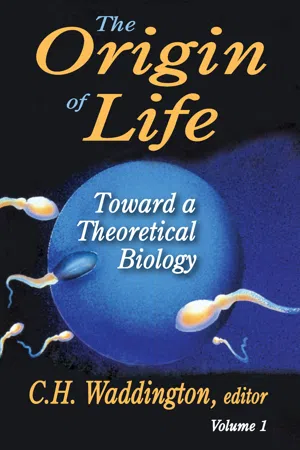
Theoretical biology is still in its early stages as an academic discipline. There is even little agreement as to what topics it should deal with or in what manner it should precede; and it is only recently that philosophers felt called upon to notice the relevance of biological topics as evolution or perception to their traditional problems. This work is a publication of the International Union of Biological Sciences, the central organization of all the branches of biology. The main focus here is to explore the possibility of formulating some frame of concepts and methods around which theoretical biology can grow.The intention of this collective effort was that discussions would be concerned, not with the theory of particular biological processes, such as membrane permeability, genetics, and neural activity, but rather with an attempt to discover and formulate general concepts and logical relations characteristic of living as contrasted with inorganic systems. Further, this project is a consideration of implications these might have for general philosophy. Many well-known scientists contributed to this volume, such as J. Maynard Smith, Ernst Mayr, Brian Goodwin, and Renu Thom.The Origin of Life: Toward a Theoretical Biology explores the character of the problems facing any theory of general biology. It contains a series of chapters and exchanges discussing such topics as the origin of life, cellular differentiation, morphogensis, evolution, and indeterminacy in biological and physical systems, the organization of the brain, the statistical mechanics of non-linear oscillators, and many other topics. This is a pioneering volume by recognized leaders in an emerging field the first of four such works.
Information
Subject Index
acquired characters, 20, 44
activation, 12, 106, 107
active sites, 117, 119
adaptations, 19, 20, 42, 49, 113, 200, 207
adaptation, molecular, 118
aether, 180, 191, 198, 204
allosteric, 68, 87, 117
alpha-rhythm, 140
alternative end states, 10, 17, 108, 166, 170
algorithm, 81, 89
amphibian oocytes, 106
amplification of D N A, 106, 107, 109
analogues, chemical, 108
anthropomorphism, 135, 160
antibodies, 118
anticipation, 208
archetypes, 13, 22, 40, 166
attractor, 33, 37, 41, 155, 161, 162, 163, 165, 169
auditory stimuli, 146
automata, 76, 89, 107, 134, 137, 138, 209
automobiles, 23
axial gradients, 129, 135
basal bodies, 17
bifurcation, 159, 168, 169, 174
biological clocks, 137
biologies, the two, 42
biotonic laws, 8
birds, 44, 45, 48
Boolean logic, 137
brain, 89, 93, 140
bridge, 7
buffering, 12, 13, 14, 16
canalization, 12, 13, 16, 20, 36, 118, 126, 177
cascades, 36
catastrophe, 34, 37, 38, 39, 40, 160, 164, 169
elementary, 155, 157, 158, 159
generalised, 159, 160
Hamiltonian, 160
points, 157
7 types, 157
...Table of contents
- Cover Page
- Title Page
- Copyright Page
- Contents
- preface
- The Basic Idea of Biology
- Cause and Effect in Biology Reprinted from Science, 134, 1501 (1961)
- An Approach Sc a Blueprint for a Primitive Organism
- The Physical Basis of Coding and Reliability in Biological Evolution
- Towards a Physical Theory of Self-organization
- Theoretical Biology and Molecular Biology
- A Note on Evolution and Changes in the Quantity of Genetic Information
- Does Evolution Depend on Random Search ?
- The Counting Problem
- The French Flag Problems A Contribution to the Discussion on Pattern Development and Regulation
- The Division of Cells and the Fusion of Ideas
- Tolerance Spaces and the Brain
- Une Théorie Dynamique de la Morphogenèse
- ‘Boxes’ as a model of pattern-formation
- Note on Topics for the Second Symposium
- Author Index
- Subject Index
Trusted by 375,005 students
Access to over 1.5 million titles for a fair monthly price.
Study more efficiently using our study tools.
Frequently asked questions
Yes, you can cancel anytime from the Subscription tab in your account settings on the Perlego website. Your subscription will stay active until the end of your current billing period. Learn how to cancel your subscription
No, books cannot be downloaded as external files, such as PDFs, for use outside of Perlego. However, you can download books within the Perlego app for offline reading on mobile or tablet. Learn how to download books offline
Perlego offers two plans: Essential and Complete
- Essential is ideal for learners and professionals who enjoy exploring a wide range of subjects. Access the Essential Library with 800,000+ trusted titles and best-sellers across business, personal growth, and the humanities. Includes unlimited reading time and Standard Read Aloud voice.
- Complete: Perfect for advanced learners and researchers needing full, unrestricted access. Unlock 1.5M+ books across hundreds of subjects, including academic and specialized titles. The Complete Plan also includes advanced features like Premium Read Aloud and Research Assistant.
We are an online textbook subscription service, where you can get access to an entire online library for less than the price of a single book per month. With over 1.5 million books across 990+ topics, we’ve got you covered! Learn about our mission
Look out for the read-aloud symbol on your next book to see if you can listen to it. The read-aloud tool reads text aloud for you, highlighting the text as it is being read. You can pause it, speed it up and slow it down. Learn more about Read Aloud
Yes! You can use the Perlego app on both iOS and Android devices to read anytime, anywhere — even offline. Perfect for commutes or when you’re on the go.
Please note we cannot support devices running on iOS 13 and Android 7 or earlier. Learn more about using the app
Please note we cannot support devices running on iOS 13 and Android 7 or earlier. Learn more about using the app
Yes, you can access The Origin of Life by Raymond Aron,C. H. Waddington in PDF and/or ePUB format, as well as other popular books in Philosophy & Biology. We have over 1.5 million books available in our catalogue for you to explore.