- 408 pages
- English
- ePUB (mobile friendly)
- Available on iOS & Android
eBook - ePub
About this book
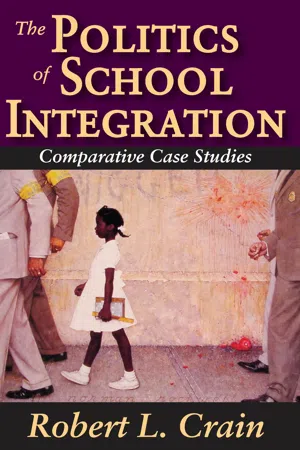
This book discusses desegregation as a community decision, focusing on case studies from the 1960s. Crain uses comparative techniques based on fifteen northern and southern cities. The author seeks a "total" explanation for the decision to desegregate by determining its proximate causes and locating the roots of the decision in the economic, social, and political structure of the community. This work represents the first attempt to conduct a genuinely scientific analysis of the political process by which school systems were desegregated in this period.Robert L. Crain documents the way in which eight non-southern, big-city school systems met community demands to reduce segregation. Reactions varied from immediate compliance to months and years of stubborn resistance, some cities maintaining good relations with civil rights leaders and others becoming battlegrounds. Differences in these reactions are explained and focus is brought to desegregation in the South New Orleans in particular. The situation there is contrasted with six peacefully desegregated southern cities as well as the attitude of its powerful economic elite. The concluding part of the book is a general consideration of the civil rights movement in the cities studied, and the author considers the implications of his findings, both for the future of school desegregation and for studies of community politics.Employing comparative techniques and concentrating upon the outputs of political systems, this is a highly innovative contribution to the study of community power structures and their relationship to educational systems. It remains an effective supplement to courses in sociology, political science, and education, as well as an important source of data for everyone concerned with the history of efforts for national integration.
Information
Part I
Eight Northern Cities
1
Introduction
This is an analysis of the way in which fifteen American city school systems made decisions regarding school integration. Eight of these cities studied are northern ones that were faced with demands for the elimination of de facto segregation. The remaining seven are southern cities that desegregated their systems in compliance with the Brown decision of the Supreme Court.
The reader may wish to know why we collected these facts and ideas about school desegregation. The reasons are rather disparate, and we think that the findings will interest a number of different types of readers.
Politics, however it is defined, is mainly concerned with the process by which groups of people make decisions that are binding on the members of the group. Studies like this one, which focus on a single decision as it is made in different cities, are one way to approach the study of urban politics. Of course, no theory can be derived from studying a single issue, and therefore this sort of study will need to be repeated for other types of decisions. But this disadvantage is more than compensated for by the fact that concentrating on a single decision permits us to examine simultaneously a number of cities and to determine not only how the decision is made in each city, but also what factors cause cities to differ.
School integration is an interesting issue for our purposes because it is a new issue. Rigid decision-making techniques have not yet been developed, and the range of possible outcomes is large. Furthermore, decisions are made in highly ambiguous situations where there are no simple formulas to follow. Thus the decision will vary from one place to another, and we can expect this variation to be caused not by trivial differences in administrative structure, but by differences in basic political style. Our analysis suggests that this is indeed the case. Cities that resemble each other in their handling of school integration have fundamental political similarities. For example, the most important factor determining the behavior of the school boards we studied seems to be the amount of influence in the hands of the civic elite—the businessmen and others who participate in city decision making from outside the government and the political parties. Our analysis suggests partial explanation of why these civic elites have more influence in some cities than in others.
In addition, the study serves a quite different function. It describes one aspect of one of the most important social movements in recent American history. Some writers have seen the 1954 Supreme Court decision as the most important single cause of the “Negro revolution,” and in the northern cities we studied, school integration has frequently been the leading edge of the civil rights movement. A good look at this issue, and the way it has been handled, may help us to understand and anticipate the future course of race relations in America.
In the past, most of our information about school integration has come from newspapers and news magazines, and they have presented a highly distorted picture. The national press usually portrays the school system and the civil rights movement as two uncompromising opponents. Newspapers report the conflicts in detail—the picketing, the boycotts, the resignations of superintendents, and the role of race in school board election campaigns. Conflict is news. Peace is not. The newspapers have not given the public a systematic picture—a census of where the news is good as well as where it is bad. This is also a goal of our study.
The fifteen cities studied give at least a preliminary picture of the state of school integration in the big cities throughout the country. The picture is not quite as dismal as might be expected. Of the eight northern cities, three have resolved the school integration issue in one way or another; demonstrations, if they ever occurred, are a thing of the past. In two cities, plans are now being implemented which show promise of settling the issue for a few years. In another, the issue has not been resolved, but at this writing is simmering quietly. Two other cities are facing demonstrations. There is a great deal of conflict in these cities, but it is clear that conflict is not unavoidable. And if Negro education has not changed radically, it is also true that each of our eight cities has taken some steps to improve the education of its Negro students. A social revolution of considerable importance is being handled gracefully in at least some cities.
But in this study we try to be more than systematic journalists. We also want to spell out more precisely the nature of the school desegregation issue. The prevailing myths—that civil rights leaders want total integration immediately and that they would rather demonstrate than negotiate, that school superintendents are narrow-minded autocrats, that school boards are representatives of a segregationist power structure, that white voters will rise up in arms at the first sign of a school bus—are, we think, simply not true. One of our main concerns is to estimate precisely what civil rights leaders expect from the schools and what they are willing to accept and how school boards, school administrators, and voters feel about the issue. Perhaps we only reflect the social scientist’s faith that things look simpler when we understand them, but we think that the school integration issue is less complicated and less irrational than it has been made to look.
Another goal of the study is to explain differences between cities. Why was there so much controversy in San Francisco and so little in Baltimore? Since school desegregation decisions are made by groups of people (school boards) which are influenced by other groups of people (the civil rights movements), it therefore follows that differences in the kinds of decisions made will depend upon differences in the composition and interests of these groups. From this common-sense perspective, school integration is merely one of the many issues handled by local government. This study can then add to our general knowledge of the community and, conversely, the recent renaissance in the study of local governments and community structure can provide some conceptual tools to look at civil rights and the schools. This returns to the first goal of the study—by understanding the way in which many cities handled a common issue we can develop some general ideas about how American public schools and American cities are governed.
The Research Design
Unfortunately, there has been little systematic research on the politics of school integration. Williams and Ryan (1954) provided a valuable analysis of desegregation in border cities before the Brown decision; but the changes in the national climate since that time have been so great that school integration is in many ways not the same issue that it was then. Our reading of research done in schools of education has generally not been as useful as we had hoped. There are two reasons for this: first, the school system is seen from the administrator’s perspective and in the frame of reference of the educational profession; second, much of the work consists of disparate research which has not been put into a useful conceptual scheme. One valuable exception is Kimbrough (1964).
Since we did not feel that the literature provided us with a set of hypotheses that we could test, we were forced to fall back on a case study technique. The great advantage of the case study is that it makes minimal restrictions on the research. The observer can feel free to pursue a particular hypothesis as far as his imagination and the cooperation of his respondents will permit. In each city, we tried to answer seven very general questions:
- What is the issue? Who wants integration, and what do they mean? Who is opposed? Why? (Can we distinguish between the demands publicly made by the civil rights leaders and the philosophy which lies behind the demands? Similarly, can we find fundamental attitudes behind the position held by the other actors?)
- Who are the actors? How many persons participate in developing a demand for integration? Who are the actors who decide how to reply to the demand? (Was the decision made by the school board, the superintendent, the power elite, the mayor?)
- What are the channels of communication and influence that connect the actors to each other and to the holders of various kinds of power? (Is poor communication an important factor in the creation of controversy? Does the school board tend to go to influential persons for help?)
- What resources did the various actors have at their disposal (votes, prestige, money, etc)?
- What are the factors that placed the particular men in decision-making positions? (Does an appointed school board differ from an elected one? Under what conditions do militants take over leadership of a civil rights organization?)
- Is there a relationship between the behavior of the actors in the school integration issue and the general structure of politics in the city?
- What is the relationship between the behavior of elites and that of the masses? To what extent do the masses depend upon the leadership for cues concerning when a “spontaneous” protest for or against desegregation should occur?
The other advantage to the case study approach is that it permits a “total analysis” of the particular issue. Since we were restricting ourselves to the study of only a particular aspect of desegregation, we set as the final goal of the project the complete explanation of the differences between cities on this issue—not only as complete a list of causal factors as possible, but also an estimate of the relative importance of each factor. We concluded, for example, that not only are the personal attitudes of school board members toward the civil rights movement important in determining the extent to which the school system will move to integrate schools, these attitudes seem to be by far the most important factor. Similarly, we concluded that the willingness and ability of the civil rights movement to engage in demonstration has relatively little effect on what the school board does. This is part of what we mean by total analysis.
We also tried to trace the causes of variation in school integration decisions back to fundamental characteristics of the city: its population composition, its economy, and its political structure. This would have been impossible if we had restricted ourselves to highly specific data. But instead, we tried to collect as much related, miscellaneous information as possible about each city.
The great disadvantage of the case study is that it is time consuming, and in the past this has meant that one social scientist studied only one city. The single case study has some serious drawbacks, since it is impossible to know whether the conditions reported are unique or whether they are representative. For this reason, it has outlived its usefulness. The three most valuable recent monographs on community decision-making all are based on comparisons between cities. Banfield and Wilson (1963) based their work on data collected by their students in a number of large cities. Williams and Adrian (1963) studied four middle-sized Michigan cities in an effort to match certain aspects of the cities in order to minimize unimportant differences. Agger, Gold-rich, and Swanson (1964) also based their study on research in four communities.
Empirical research on the community is fundamentally no different from empirical research in any other area; it simply aims to establish relationships that exist between variables. To note that both competitive politics and large public expenditures for projects such as urban renewal are present in New Haven is not very helpful. We need to know whether these two variables are systematically linked in most cities. Even if we do not wish to establish correlations, but only to describe the American city, a comparative study is necessary. We cannot answer the question, “How militant is the northern civil rights movement?” while looking only at New York City.
Our research budget would have permitted a complete case study of one or two cities; but two cities would not be sufficient for this purpose. There would be a great risk of selecting a biased sample. We could have studied one hundred cities, if we had limited ourselves to the study of two or three variables. But we could not take chances on our ability to guess which were the crucial variables. Our solution to the dilemma was a rather novel research design. We selected fifteen cities, eight in the North and seven in the South, by a modified random sampling scheme, which is described in Appendix 1. In each city we made a case study. We then selected what we thought were the key variables and assigned each city scores on each variable, so that survey-style statistical analysis could be used. This design gave us the advantage of the case study, since we could search for the most important factors in each case, and also permitted at least a tentative demonstration that these factors were important in all our cities. We were able to stay within a research budget by taking the smallest number of cities that would permit comparative analysis and then economizing on data collection techniques.
The data were collected by a team of two or three interviewers who usually spent one week in each city. During that time they interviewed most of the members of the school board, the leaders of the civil rights movement, local informants such as newspapermen or social scientists who were familiar with the local situation, and, where possible, key elites such as the mayor or the most influential businessmen. We collected, on the average, twenty-two interviews per city, ranging from thirty minutes to eight hours in length. The interviews focused upon determining what was demanded by the civil rights movement, what the school system did in response, and what actions (demonstrations, suits, countersuits, etc.) took place or were threatened. In the process of collecting this data, we found out who the most important actors were. We interviewed these men to determine the pattern of communication and the channels of influence that connected them and to determine their personal characteristics—in particular their social origins and their political ideology. We then began tracing the reasons why these particular men were in decision-making positions by trying to find out how persons are recruited to these roles and obtaining information about the community’s general political and civic structure. Finally, in each city the interviewers gathered several pounds of printed documents—school board minutes, reports, complete sets of newspaper clippings, and even copies of private correspondence.
Our fears that a week of interviewing in each city would not be enough time proved to be unfounded. We had no difficulty in learning the detailed story of the decision; there may be some well-kept secrets that we did not uncover, but we think that in almost every city we have a story complete enough for analysis. In addition, we found, as other researchers have noted, that a clear impression of the particular “tone” or “style” of a city is immediately apparent, although sometimes we were not successful in identifying all the factors that make up a city’s “style” of action.
It would be pleasant to pretend that we had conducted a total analysis—one that considered every possible factor and then developed the relationship of each variable to the outcome of the integration controversy. Of course, one cannot design research that will do this. However, by the use of open-ended interviewing, a flexible data collection schedule, and a willingness to rewrite the questionnaires repeatedly, we were able to keep in mind many possible hypotheses. In addition, we often found that when a hypothesis developed from our study of one city, we could search the files and our memories for the necessary data to make at least a rough test of the hypothesis in the cities we had visited earlier.
School desegregation in the North may seem to have much in common with desegregation in the South; and this is no doubt true. However, from the point of view of this study, which is concerned solely with the way in which decisions were made—the political process—the two issues have almost nothing in common. For this reason, this volume is divided into five parts. In Part I, we report the case studies of the northern cities. Part II draws these case studies together into a comparative analysis. In Part III, we turn to the southern cities, and use six of our studies as a matrix in which to locate the one southern city in our sample that suffered severe disruption when it was called upon to desegregate. In Part IV, we turn our attention to the civil rights movement, and look at northern and southern civil rights movements in successive chapters. Part V contains two concluding chapters.
The case studies of the eight northern cities are presented very briefly in Chapters 2, 3, 4, 5, 6, 7, 8 and 9. Each chapter is simply a description of how the desegregation issue was raised, how it was debated, and how it was finally resolved. In writing the description, we have not attempted a thorough account of every action; instead we have stressed the key actions, and those that seemed particularly significant in setting that story apart from the others. In general, there is little in the stories which an informed resident of the city might not already know. We have also speculated about the factors that might have caused the city to take the particular course that it did, but mainly these chapters are descriptive, and most of the analysis is postponed to Part II. We have added brief descriptions in some cases of some of the actors, where we think this is helpful to the reader. Of course, we are not interested in singling out persons for praise or blame; but one of the reasons why cities differ in their actions is that they place different types of men in leadership positions.
We are not concerned with the technicalities of actions taken by schools to meet the demands of the civil rights movement. We do not intend to describe in detail or evaluate particular plans for school integration or various techniques for upgrading education of the “culturally deprived.” Rather, our focus is upon the school integration issue as a political matter. Our concern is with the problems of communication, perception, influence, power, and ideology which are part of this story, just as they are part of any political decision.
After each chapter was written, copies were given to our respondents. They made many important criticisms. In two cases, a school board or a school superintendent objected str...
Table of contents
- Cover Page
- Half title Page
- Title Page
- Copyright Page
- Contents
- Preface
- Acknowledgments
- List of Tables
- List of Illustrations
- Part I. Eight Northern Cities
- Part II. An Analysis of School Policy-Making
- Part III. Desegregation in New Orleans
- Part IV. The Community and the Civil Rights Movement
- Part V. Conclusion
- Appendix 1. The Selection of the Sample of Northern Cities
- Appendix 2. Measuring School Segregation
- References
- Index
Trusted by 375,005 students
Access to over 1.5 million titles for a fair monthly price.
Study more efficiently using our study tools.
Frequently asked questions
Yes, you can cancel anytime from the Subscription tab in your account settings on the Perlego website. Your subscription will stay active until the end of your current billing period. Learn how to cancel your subscription
No, books cannot be downloaded as external files, such as PDFs, for use outside of Perlego. However, you can download books within the Perlego app for offline reading on mobile or tablet. Learn how to download books offline
Perlego offers two plans: Essential and Complete
- Essential is ideal for learners and professionals who enjoy exploring a wide range of subjects. Access the Essential Library with 800,000+ trusted titles and best-sellers across business, personal growth, and the humanities. Includes unlimited reading time and Standard Read Aloud voice.
- Complete: Perfect for advanced learners and researchers needing full, unrestricted access. Unlock 1.5M+ books across hundreds of subjects, including academic and specialized titles. The Complete Plan also includes advanced features like Premium Read Aloud and Research Assistant.
We are an online textbook subscription service, where you can get access to an entire online library for less than the price of a single book per month. With over 1.5 million books across 990+ topics, we’ve got you covered! Learn about our mission
Look out for the read-aloud symbol on your next book to see if you can listen to it. The read-aloud tool reads text aloud for you, highlighting the text as it is being read. You can pause it, speed it up and slow it down. Learn more about Read Aloud
Yes! You can use the Perlego app on both iOS and Android devices to read anytime, anywhere — even offline. Perfect for commutes or when you’re on the go.
Please note we cannot support devices running on iOS 13 and Android 7 or earlier. Learn more about using the app
Please note we cannot support devices running on iOS 13 and Android 7 or earlier. Learn more about using the app
Yes, you can access The Politics of School Integration by Robert Crain in PDF and/or ePUB format, as well as other popular books in Education & Education General. We have over 1.5 million books available in our catalogue for you to explore.