![]()
Chapter One
First Steps
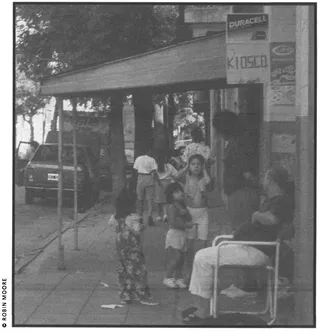
A child in Buenos Aires, Argentina, gives a tour of her neighbourhood, showing where she goes and the things she likes and dislikes. © ROBIN MOORE
We have not yet made this city what it could be or should be just by painting some houses and planting some gardens for free...we have created hope that didn't exist before. We know what the future could be and we have the desire to make it come into being.
JULIA POINTER, Youth Volunteer, Detroit Summer1
This manual is a tool to help you to design and implement projects that involve young people as partners in the community development process. Ultimately, its goal is to improve the quality of young people's lives as well as the quality of the places where they live.
Achieving this goal will require commitment, energy, patience and resilience. In the end, as well as along the way, it will be a rewarding journey with valuable results.
This chapter outlines the essential ideas on which the manual is based, and the factors that help to make cities good places — or not such good places — for young people. These first steps, which culminate with an evaluation of your own city as a place for young people (at the end of this chapter), will help to establish a framework for what lies ahead.
Starting Points
Young people are valuable members of the community, both now and in the future.
Young people represent a significant portion (if not the majority) of most urban populations. They are affected in both the short and long term by today's decisions and actions. They will also be important actors in the local community for many years to come. Investments made in developing their knowledge, skills and social responsibility are the best investments we can make towards creating a better future.
The local environment can help, or hinder, young people's development.
The local environment encompasses all those factors that contribute to an area's uniqueness as a place, including its physical, social, economic, political and historical characteristics. It can pose significant threats to young people's physical, mental, emotional and social development, or it can provide positive development opportunities for them to explore, grow and engage with the world, helping to develop valuable skills as well as self-identity and self-confidence. While the local environment is not the only factor in young people's development, it is often an overlooked and underappreciated factor. Planners, designers and managers of cities must understand the impact that development decisions have on young people's lives.
Global initiatives require local implementation.
The United Nations Convention on the Rights of the Child (1989) and other important UN initiatives such as Agenda 21 and the Habitat (UN Centre for Human Settlements) Agenda have established a global policy framework in support of sustainable cities and participatory development practices. While this global framework provides critical policy support, change in the local environment and in young people's lives must be implemented at the local level. If the lofty goals set forth by these global initiatives are to be realized, we must support real change in local policy and practice.
Local research and knowledge are the foundation for policy and action.
Policy-making, development decisions and other actions are too often based on an inadequate or inaccurate understanding of the local situation. This is especially true when dealing with children and youth in complex urban environments. The world of urban childhood today is changing rapidly, and the complexities of today's cities do not lend themselves to simplistic generalizations. Policies and actions that respond to community issues must be based on a thorough understanding of those issues and their context. Quality research that draws upon local knowledge is an essential first step in effective policy-making.
Young people should be partners in community development.
Young people should be considered as legitimate participants — along with other groups in the community — in the development process. They are intimately familiar with the local environment and are the most knowledgeable on how the local environment and development decisions impact on their lives. They should be active and valued partners in efforts towards positive community change.
Everybody learns and grows through young people's participation.
Young people's participation in community development is a powerful vehicle for social transformation. Through participatory community evaluation, planning, design and management, they are exposed to a wide range of people and ideas, and develop valuable new skills. Adult professionals, government officials and local decision-makers also grow and learn through participation, developing a more comprehensive and accurate understanding of local issues and a greater appreciation of the perspectives and insights of young citizens.
Creating better cities will require a multi-tier, long-term approach.
The creation of urban environments that truly support children's development must address a wide range of issues at the local, national and global levels. While no single project will magically result in an urban environment that meets young people's needs, each will be an important step in the right direction, affecting change not only in the physical environment, but also in the lives of those who participate in bringing about change, and creating opportunities to move on to new issues.
Physical environmental issues and actions provide a good starting point.
The physical environment is multi-sensory, real and concrete. This makes it easier to understand than more abstract policy issues. Young people's experience in transforming the physical environment — seeing real change that is a direct result of their own initiatives — can be a valuable exercise in community empowerment. It is an important step on the road to greater structural and systemic change in the creation of sustainable, healthy and liveable cities.
Places that are better for young people are better for everyone.
When a city, town, neighbourhood or suburban area becomes a better place for young people to live, it becomes a better place for everyone. A more humane, people-supportive environment is in everyone's interest.
What Makes a City a Good Place for Young People?
How do we determine whether a city does or does not support human development? What makes a city a good place in which to grow up?
The following is a list of child-generated indicators of a good place, based on young people's own evaluations of their local communities.2
Young people express satisfaction with their communities when there are high levels of social integration, strong community and cultural identity, extended family and peer networks, access to green spaces, and a variety of interesting activity settings.
- Social integration. Young people feel welcome throughout the community, and interact with other age groups in public and semi-public places. They have a sense of belonging and of being valued.
- Variety of interesting activity settings. There is a variety of places for young people, including places where they can meet friends, talk or play informal games; play sports; join in community work; shop an...