Athlone: 1900–1923 is perhaps the most detailed analysis ever carried out for an Irish town during these tumultuous times. It is a meticulously researched study of how the developing fortunes of Irish nationalism played out on a local stage, a study that helps the modern reader to appreciate just how the momentous political changes affected the lives of the town's citizens. Throughout this work, the motivations and ideologies of the local personalities that lent colour to much of what occurred are analysed, as are the effects of national and international events on Athlone's development.
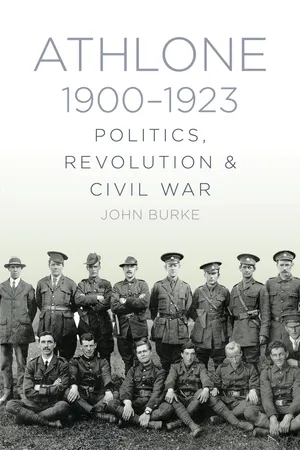
- 400 pages
- English
- ePUB (mobile friendly)
- Available on iOS & Android
eBook - ePub
About this book
Trusted by 375,005 students
Access to over 1.5 million titles for a fair monthly price.
Study more efficiently using our study tools.
Information
1
Athlone, the United Irish League and Parliamentary Politics
After the reunification of the Irish Parliamentary Party under John Redmond, Ireland’s constitutional nationalists focused their efforts on concerns outside the party. Though Home Rule was its overriding goal, the issue of land distribution and property ownership, the ‘surrogate for nationalism’,1 preoccupied the IPP for the first decade of the twentieth-century. In the case of Athlone, and other provincial Irish towns, there were both urban and rural aspects to the issue. The substantial number of lease-holding urbanites wanted fairer tenancy arrangements, while land purchase preoccupied most rural tenant farmers whose acres bordered the town, and whose produce supplied its markets. Both groups relied primarily on the IPP’s grass-roots organisation, the United Irish League (UIL), to progress their claims, yet, in Athlone, tensions were to arise as both the league and IPP concentrated on rural issues. Such tensions could not but impact on the support for constitutional nationalism in the town, with factors such as the efforts of individual activists, local MPs and the effect of new legislative changes all influencing the relationship between Athlone’s populace and constitutional nationalist organisations.
As already noted, the issue of property ownership in Ireland had both urban and rural resonances. In towns such as Athlone, urban tenants’ rights were greatly attenuated by existing legislation, which provided landlords with much freedom in rental agreements. Tenants had no guarantee of tenure, no say in rent increases or power of compulsion over landlords with regard to maintenance or upgrading of properties and, given their fiscal situation, no real hope of purchasing their dwellings. The issue of providing suitable housing for local labourers was a contentious topic in the late nineteenth and early twentieth centuries and while there had been an improvement in the quality of some dwellings, it was still recognised that the deficiencies were such that they handicapped the economic development of the town and its people.2 The nineteenth-century Land League’s aversion to dealing with disaffected urban dwellers had really set the tone; politicians concentrated on the pursuit of rural land redistribution as it offered greater political benefits.3
Outside Athlone’s urban boundary, rural dwellers were dealing with a different basic problem: a minority of people, landlords and graziers, controlled the majority of the land. Tenant farmers in south Westmeath and south Roscommon were expected to eke out a living on plots whose economic viability was at best uncertain. The region around the town had not seen an appreciable fall in the proportion of large farms since the end of the Famine, when depopulation allowed landowners and large farmers to retain or consolidate their land holdings.4 Small farmers were also frustrated in their efforts to enlarge their holdings by the existence of numerous part-time farmers. Census returns show that among the latter were auctioneers, grocers, magistrates, merchants, publicans, shopkeepers, blacksmiths and carpenters.5 These men often leased lands from men such as Lord Castlemaine and Charles O’Donoghue, neither of whom appeared interested in selling any portion of their estates.6 There was also a minority of small established landholders around Athlone who had, over a protracted period, purchased small tracts of land, thus becoming more extensive landowners. These men were considered even less likely to sell.7 Existing land legislation brought in after the Land War of 1879-82 was deficient, Home Rule and internal conflict had preoccupied the IPP since then, and it was not until the establishment of the UIL in 1898 that an influential political body again made the land issue its main focus.
Formed in Mayo mainly through the work of forme...
Table of contents
- Cover
- Title
- Acknowledgements
- Contents
- List of Abbreviations
- Introduction Athlone, 1900-23: Politics, Revolution and Civil War
- 1 Athlone, the United Irish League and Parliamentary Politics
- 2 Supplementing the Nationalist Debate
- 3 The Search for Home Rule and the Development of Militancy
- 4 The Opportunities of War
- 5 Confirmation of Change: The Move to Sinn Féin
- 6 Recourse to War: Politics and Conflict 1919-21
- 7 Former Allies, Future Foes: Civil War
- Conclusion
- Bibliography
- Copyright
Frequently asked questions
Yes, you can cancel anytime from the Subscription tab in your account settings on the Perlego website. Your subscription will stay active until the end of your current billing period. Learn how to cancel your subscription
No, books cannot be downloaded as external files, such as PDFs, for use outside of Perlego. However, you can download books within the Perlego app for offline reading on mobile or tablet. Learn how to download books offline
Perlego offers two plans: Essential and Complete
- Essential is ideal for learners and professionals who enjoy exploring a wide range of subjects. Access the Essential Library with 800,000+ trusted titles and best-sellers across business, personal growth, and the humanities. Includes unlimited reading time and Standard Read Aloud voice.
- Complete: Perfect for advanced learners and researchers needing full, unrestricted access. Unlock 1.5M+ books across hundreds of subjects, including academic and specialized titles. The Complete Plan also includes advanced features like Premium Read Aloud and Research Assistant.
We are an online textbook subscription service, where you can get access to an entire online library for less than the price of a single book per month. With over 1.5 million books across 990+ topics, we’ve got you covered! Learn about our mission
Look out for the read-aloud symbol on your next book to see if you can listen to it. The read-aloud tool reads text aloud for you, highlighting the text as it is being read. You can pause it, speed it up and slow it down. Learn more about Read Aloud
Yes! You can use the Perlego app on both iOS and Android devices to read anytime, anywhere — even offline. Perfect for commutes or when you’re on the go.
Please note we cannot support devices running on iOS 13 and Android 7 or earlier. Learn more about using the app
Please note we cannot support devices running on iOS 13 and Android 7 or earlier. Learn more about using the app
Yes, you can access Athlone 1900-1923 by John Burke,Dr John Burke in PDF and/or ePUB format, as well as other popular books in History & Irish History. We have over 1.5 million books available in our catalogue for you to explore.