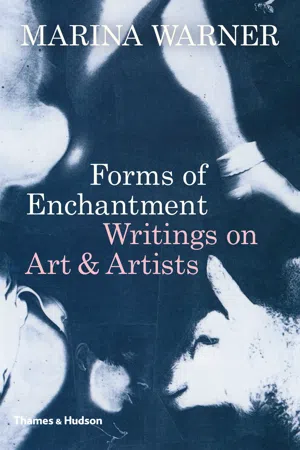
Art-writing at its most useful should share the dynamism, fluidity and passions of the objects of its enquiry, argues Marina Warner. In this new anthology of some of her most compelling work, she captures the visual experience of the work of several artists with a notable focus on the inner lives of women through an exploration of the range of stories and symbols to which they allude. Metamorphosis features vividly in the imagery, stories and media of the art that Warner has chosen to write about: in connection with animals in the work of Louise Bourgeois, for instance; with the Catholicism of Damien Hirst; and with performance as a medium of memory and resistance in the installations of Joan Jonas. Rather than drawing on connoisseurship, the authors approach grows principally out of anthropology and mythology. She argues that art and aesthetics increasingly fulfil a magical social function a principle that runs through these writings to give the collection a quality that is polemical as well as coherent. With an introductory essay and illustrations throughout, Marina Warner investigates how artists noted for their treatment of disturbing, uncanny material have reached beyond the visible, to express interior states. Truly inspiring, her writing unites the imagination of artist, writer and reader, creating a reading experience parallel to the intrinsic pleasure of looking at art.
- English
- ePUB (mobile friendly)
- Available on iOS & Android
eBook - ePub
About this book
Trusted by 375,005 students
Access to over 1.5 million titles for a fair monthly price.
Study more efficiently using our study tools.
Information
Topic
ArtSubtopic
Artist Monographs1. PLAYING IN THE DARK

Paula Rego, Secrets and Stories, 1989
But all the story of the night told over,
And all their minds transfigured so together,
More witnesseth than fancy’s images,
And grows to something of great constancy1
WILLIAM SHAKESPEARE, A MIDSUMMER NIGHT’S DREAM
Detractors often scorn art as child’s play, and it is true that many artists play – in various senses of the word. Of course, they acquire skills and improvise with materials and methods far beyond children’s reach; but many also choose to move to those inner fiery waves in the brain that generate and combine images and light up games of make-believe. Ancient and supposedly innocent childhood activities, from lullabies to fairy tales, are brimful with nightmares. As Theseus comments in A Midsummer Night’s Dream, ‘such tricks hath strong imagination.../how easy is a bush supposed a bear’ (5.1.19–23). We are partly the heirs of the Romantics, who saw the child’s state of mind as visionary and unfettered and longed to regain those powers of fantasy – as the hallucinatory paintings of the artist Henry Fuseli reveal (he is rumoured to have eaten strong meats at night to stimulate his dreams).
In modern times, the importance of imagination has received support from a less fevered angle. The paediatrician D. W. Winnicott, in his pioneering book Playing and Reality (1971), argued for the role of imagination in growing up sane and happy – or at least well-enough happy. He writes of play as an essential form of life practice, crucial to the developing child. In games of make-believe and let’s pretend, with dolls or toy soldiers, castles and cars, animals that really exist as well as dragons and goblins, a child at play is building ways of orienting himself or herself. ‘Playing is reality,’ Winnicott declares.2
Artists do not usually acquiesce in putting away childish things. They peer into the dark and make images about what they find there: memory and imagination acting in concert. Artists are like birds sent out from the Ark to assess the state of the rising flood waters, and they return with messages about the continuing danger – or, sometimes, hope.
PAULA REGO
Giving Fear a Face

Baa, Baa, Black Sheep 1989
Paula Rego’s first solo exhibition opened at London’s Serpentine Gallery in 1988, when Alister Warman was the director. He was a consistent advocate of women artists – in those days, his interest and commitment were unusual. Rego was showing some small, freely painted drawings of scenes involving monkeys and dogs – the animals weren’t entirely animal, nor were the children entirely childlike; but they all seemed to be at play. Similar, larger paintings, unfurling over the walls, were seething with vigorous gaggles of little girls, creatures and adults in conjunctions which implied that the artist was seeing through the appearance of things and the experience of living in the world, and moving into another zone of feeling and knowledge.
I first met Paula there – she was smiling and wearing a wonderful dress, full and richly coloured. Both the smile and the clothes are entirely typical. Her smile is like her work: it is exuberant and infectious, open and warm, but mysterious, too, and sometimes unsettling. The dress, the brilliance, the lavishness goes with the art as well; Paula Rego has the energy, the wildness and the discipline of a fierce Olympic athlete, and she transmutes all this furious power into a racing imagination that now, after several decades of inspired images, has swept into unexamined corners of experience, leaving thrilling and sometimes terrifying twisters of insight on the canvas.
As a child, she used to draw on the floor. She maintains that making images is a form of play in the strongest sense of the activity, as Winnicott conveys in Playing and Reality. In Paula’s art, reality appears through her play on what she sees, what she imagines, what she concocts. Her studio is a theatre, where models take up roles, where masks, dummies, costumes, sets, props – mysterious, eerie, often perturbing – lie heaped around her; it is a scene of intensive play where the worlds that lie inside her are pressed out to take form and become manifest externally. Through assiduous, concentrated, prolonged acts of drawing and painting, they materialize on paper or canvas or sometimes in three-dimensional figures. The artist has commented that she ‘paints to give fear a face’, and her work looks deeply into the depths; but if she is giving fear a face she does so fearlessly, and the results have a raw honesty that can be shattering and sharply awakening to those of us who are admitted into these recesses. Singular and unflinching, Rego explores sexual fantasy and tension; the inner lives of women are her principal interest. If she were a medieval poet, you’d say she expressed the sorrows of the daughters of Eve. She loves fairy tales and myths, old stories, ballads and folklore, and she sees, in this mostly anonymous literature, a vivid record of experience transmuted by imagination.
In the Nursery Rhymes prints she made in 1989 (see Secrets and Stories, p. 16), she pictures the enigmas of children’s nonsense songs as part of a storytelling tradition, transmitted orally and confidentially from woman to woman, from women to children. These powerful, original illustrations catch the darkness and the comedy of the original nonsense verses, in which everyday banality meets mystery. Mother Goose’s Melody, the first printed collection, appeared c. 1768; the name Mother Goose was borrowed from the French, specifically from Charles Perrault’s 1697 collection of fairy tales, Contes du temps passé, ou Contes de ma mère l’oye. Mother Goose is Granny, Nan, nursemaid and governess, remembered from childhood. She can be comical – like a goose – and sinister, like a crone or a witch; she’s a mother, who feeds her flock with stories and nonsense; she’s female because speech is the realm of those who cannot read and write, like children and like peasants and women in the past. When Iona and Peter Opie collected skipping rhymes and other nonsense verse in playgrounds up and down England for their great work on children’s play, The Singing Game (1985), they found that it is only little girls between the ages of four and fourteen who transmit skipping and hopscotch rhymes and invent new ones. Paula Rego has taken up their tradition and turned it into images.
At the age of ten, Paula Rego was sent to an English school in Lisbon, where she learned to recite the nonsense rhymes. Although her father was opposed to the Church and the school was secular, she was imprinted all the same, and in many ways, she has combined the cruel comedy of the verses with Catholic miracle stories, their goriness and excesses, colour, passion and matter-of-factness. In an interview for BBC Radio Four in 1988, she said, ‘It goes with being punished for doing the wrong thing – not hit or anything like that, but experiencing a more subtle sort of forbidding. A mix up of all sorts of sentiments can follow: pain and pleasure get confused.’
When her first grandchild – a girl – was born, Rego rediscovered the nursery rhymes of her own childhood and began the series of etchings which she drew, as a child might, spontaneously on to the plate without preparatory planning of any kind.
The twin régimes of the Catholic church and Salazar’s dictatorship during the artist’s upbringing created a structure of sexual oppositions which emerge powerfully in the riddling pairs of her images: Miss Muffet and the spider, Baa Baa Black Sheep and the questioner, Polly and her officers’ tea party, even Old King Cole and his fiddlers three. In the pictures, the uniforms of post-war Portugal return, costuming her soldier mannikins and imperturbable aproned Misses like national dolls. By remembering the separation of men and women’s spheres in her birthplace, and the performances of machismo and womanhood demanded of the sexes, Rego has reinterpreted these familiar, innocent verses with a post-Freudian mordancy. The very meaninglessness of the rhymes gives them fluid and multiple meanings, which the artist has fixed in her work with a certain, unmistakable atmosphere: they have become a theatre where the child anticipates ambiguous dramas of sexual curiosity and conflict.
The nursery rhyme is a form of verse that’s almost unknown in the rest of Europe, and the meanings of most have been forgotten, though the inspired sleuthing undertaken by folklorists such as the Opies has solved some enigmas. When we discover who ‘Mary Mary quite contrary’ might be (Mary Queen of Scots), or which King is in the counting house counting out his money, we realize that the spell of the rhyme lies elsewhere. The classic nursery rhyme’s simplicity is funny (‘The cow jumped over the moon’) and can raise goosebumps (those ‘three blind mice’). The very ordinariness of the verse attaches it to general experience, brings it into everyone’s back garden, as it were, where it flips over into the oracular. To be uncanny – unheimlich – there has to be trust in the idea of home – heimlich – in the first place – but a home that’s become odd, prickly with desire.
Rego has often returned for her subject matter to stories told her by her grandmother and aunt and the family’s maid in Cascais, on the sea near Lisbon where she grew up. Her stern heroines – little girls with bows in their hair intent on their household tasks – recall female saints and martyrs as well as Julie and other heroines of the moral tales of the Comtesse de Ségur, which she was read when she was their age. She likes to step into that disturbing gap between the portrayal of the protagonist’s perfections and the wicked feelings stirring inside the child reading about them. Rego’s little girls also owe something to the Surrealists’ cult of the femme-enfant, to Max Ernst’s heroine in his collage novel, Histoire d’une petite fille qui voulut entrer au Carmel, and to Balthus’s spectacle of young girls’ intimacies. She is supremely able to draw out perverse ambiguities in banal popular imagery: ‘When you see Max Ernst’s book on the little girl entering the convent,’ she has said, ‘…it isn’t so far away – the transformation isn’t so great after all, is it? The same spooky feeling. It is sex, sex that comes into the Ernst images.’
But she does not come as a voyeur to the scene, nor as a seducer. The artist Victor Willing, whom Paula Rego married in 1959, and who died in 1988, identified her characteristic themes as ‘domination and rebellion, suffocation and escape’, recognizable conditions of childhood, and especially of girlhood in 1950s Portugal. Rego has always identified with the least, not the mighty, has taken the child’s-eye view and counted herself among the commonplace and the disregarded, by the side of the beast, not the beauty. She’s commented on her approach: ‘suddenly it’s as if a dog were to tell its own story’. For she is speaking from the inside, telling tales she knows, from a place – a home base – generally overlooked: the female child’s. She not only hears the ‘dog’, she turns into one. Nursery rhymes are populated with fabulous, talking creatures, with wooing frogs and talking horses, and children and animals have always liked one another, have even been confused by their elders, subjected alike to maltreatment on the one hand, petting and spoiling on the other. But Rego has also confronted, even celebrated, the powers emanating from this quarter: hers are not simplistic tales of victims and oppressors at all, but full of reversals and surprises. The universe of children is subject to adults’ authority and brimful of the potency ascribed to instinct, to irrationality, to pre-social (anti-social?) behaviour. Her sympathy with naïveté, her love of its double character, its weakness and its force, has led her to supposed children’s materials such as Nursery Rhymes and Swan Lake as sources for her imagery. In 1987, she made a picture of a young girl (The Soldier’s Daughter) plucking a goose with concentrated energy, yet at the same time caught up in a dream; the intense, intimate pose recalls the embrace in Baa Baa Black Sheep (see p. 18).
In 2002, Paula Rego was commissioned by the President of Portugal to create a series of images from the Virgin Mary’s life, and she moved her into scenes of ordinary female experience, represented with realistic intensity – terrible suffering in childbirth, for example – and consequently scandalized and repulsed many viewers. Fairy tales, folk tales and saints’ lives aren’t only scripts of superstition and ignorance, and Paula Rego has drawn on them for their confrontation with abuses of power, their honesty about opportunism and injustice and rivalry. That is why thinkers like Walter Benjamin and Antonio Gramsci and writers like Italo Calvino and Pier Paolo Pasolini were attracted to the form. The unsparing painting simply called War (2003; see frontispiece), inspired by the carnage in Iraq, creates a Goya-like scene of disaster, casting cadaverous floppy pink bunnies and other soft toy-like creatures, disfigured and hybridized, as the heroes and victims: the substitution raises the scathing temperature of the image. In 2008–09, Rego made a series of aquatints on the subject of trafficking: little girls in the charge of their mothers, grandmothers or madams are lying listless, spectre-thin, chained, poppets horribly on display. She does not hold back, and she sees how women sometimes collude in their abuse. She is an artist-activist; but her consummate technical skills translate the power of her imagination, her generous rage and sympathy, so richly that her works, though they hit hard, surpass gritty agit-prop.
The mark of her hand is versatile and experimental, but in every mode she remains consummately skilled – she is one of the greatest living draughtsmen and nobody else since Goya has used the subtleties of aquatint more expressively. Indeed, the ghost of Goya haunts the grotesque and often savage quality of her scenes. She captures the dark capriccio-like themes of her chosen rhymes and communicates them with disturbing glee. She has also never distanced herself from illustration. She wants to retrieve what is usually considered a humble artistic category and pay tribute to precursors she admires greatly: the 18th-century cartoonists and illustrators James Gillray and Thomas Rowlandson, and Victorian artists such as Kate Greenaway, John Tenniel, the goblin painter Arthur Rackham and Beatrix Potter, who also loved animals and took their part against gardeners. Like them, Rego treats the fantastic realistically, dresses animals in human costume and introduces dream-like dislocations of scale.
Her appreciation of graphic artists – Max Klinger, Gustave Doré and [Théophile] Steinlen – has been part of her independent-mindedness. Her work has changed, retroactively, our way of thinking about art and figuration, and British art in particular. But there is another aspect to the affinity she feels for these jobbing artists, these feuilletonistes: Rego’s fierce delving into the dark places of the psyche unfolds in continuous engagement with ordinary things happening in the world. As in O Vinho (2007), the bittersweet, existential cry of the writer João de Melo, her...
Table of contents
- Cover
- Title Page
- Dedication
- Contents
- Preface
- 1. Playing in the Dark
- 2. Bodies of Sense
- 3. Spectral Technologies
- 4. Iconoclashes
- Notes
- Further Reading
- List of Sources
- Picture Credits
- Acknowledgments
- Index
- Copyright
Frequently asked questions
Yes, you can cancel anytime from the Subscription tab in your account settings on the Perlego website. Your subscription will stay active until the end of your current billing period. Learn how to cancel your subscription
No, books cannot be downloaded as external files, such as PDFs, for use outside of Perlego. However, you can download books within the Perlego app for offline reading on mobile or tablet. Learn how to download books offline
Perlego offers two plans: Essential and Complete
- Essential is ideal for learners and professionals who enjoy exploring a wide range of subjects. Access the Essential Library with 800,000+ trusted titles and best-sellers across business, personal growth, and the humanities. Includes unlimited reading time and Standard Read Aloud voice.
- Complete: Perfect for advanced learners and researchers needing full, unrestricted access. Unlock 1.5M+ books across hundreds of subjects, including academic and specialized titles. The Complete Plan also includes advanced features like Premium Read Aloud and Research Assistant.
We are an online textbook subscription service, where you can get access to an entire online library for less than the price of a single book per month. With over 1.5 million books across 990+ topics, we’ve got you covered! Learn about our mission
Look out for the read-aloud symbol on your next book to see if you can listen to it. The read-aloud tool reads text aloud for you, highlighting the text as it is being read. You can pause it, speed it up and slow it down. Learn more about Read Aloud
Yes! You can use the Perlego app on both iOS and Android devices to read anytime, anywhere — even offline. Perfect for commutes or when you’re on the go.
Please note we cannot support devices running on iOS 13 and Android 7 or earlier. Learn more about using the app
Please note we cannot support devices running on iOS 13 and Android 7 or earlier. Learn more about using the app
Yes, you can access Forms of Enchantment by Marina Warner in PDF and/or ePUB format, as well as other popular books in Art & Artist Monographs. We have over 1.5 million books available in our catalogue for you to explore.