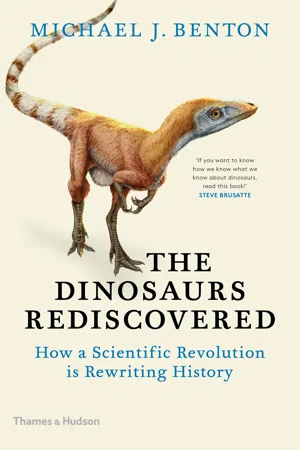
Giant sauropod dinosaur skeletons from Patagonia; dinosaurs with feathers from China; a tiny dinosaur tail in Burmese amber complete down to every detail of its filament-like feathers, skin, bones and mummified muscles. Dinosaurs continue to regularly cause a media sensation. Remarkable new fossil finds are the lifeblood of modern palaeobiology, but it is the advances in technologies and methods that have allowed the revolution in the scope and confidence of the field. Over the past twenty years, the study of dinosaurs has become a true scientific discipline. New technologies have revealed secrets locked in the prehistoric bones in ways that nobody predicted we can now work out the colour of dinosaurs, their bite forces, top speeds and even how they cared for their young. The Dinosaurs Rediscovered gathers together all the latest palaeontological evidence and takes us behind the scenes on expeditions and in museum laboratories, tracing the transformation of dinosaur study from its roots in antiquated natural history to a highly technical, computational and indisputably scientific field today. Michael J. Benton explores what we know of the world of the dinosaurs, how dinosaur remains are found and excavated, and how palaeontologists read the details of the lives of dinosaurs from fossils their colours, their growth, feeding and locomotion, how they grew from egg to adult, how they sensed the world, and even whether we will ever be able to bring them back to life. Dinosaurs are still very much a part of our world.
eBook - ePub
The Dinosaurs Rediscovered
How a Scientific Revolution is Rewriting History
- English
- ePUB (mobile friendly)
- Available on iOS & Android
eBook - ePub
About this book
Trusted by 375,005 students
Access to over 1.5 million titles for a fair monthly price.
Study more efficiently using our study tools.
Information
Subtopic
Ancient HistoryIndex
HistoryChapter 1
Origin of the Dinosaurs
One thing is known for sure: the dinosaurs originated during the Triassic period, between 252 and 201 million years ago. Nearly everything else is uncertain. For example, just when did they originate, in the Early or Late Triassic? What was the world like as they emerged on the scene? Did they force their way to dominance of global ecosystems by fighting hard for their place against other beasts, or did they achieve their position by good luck? When I began my career as a palaeontologist, back in the 1980s, these were all hot topics of discussion. Solving the questions has been my life’s work, but I can’t say everything is sorted out: whenever one problem is resolved, further questions are raised. It’s a story of changing ideas about evolution, new fossils, and new analyses.
As part of my doctoral studies I tried to work out an ecological model for the origin of the dinosaurs. The ‘standard’ model then was a three-step process. First, the synapsids, ancestors of mammals, were the key herbivores and carnivores. Then, the synapsids were replaced by rhynchosaurs as herbivores, and early archosaurs as carnivores. Archosaurs include birds and crocodiles today, and dinosaurs and their ancestors. Finally, the rhynchosaurs and early archosaurs gave way to dinosaurs. We will encounter all these animals shortly, especially the rhynchosaurs and the first dinosaurs.

The classic model for dinosaur origins by progressive competitive replacements in the Triassic.
These three steps were said to form an ecological relay, in which one group gives way to another, which in turn gives way to another. This ecological-relay model for dinosaur origins had been presented by the two great American palaeontologists at the time, Al Romer and Ned Colbert, who were the authors of all the standard textbooks, so their ideas were widely distributed and widely read. Importantly, the Romer–Colbert relay model assumes competition between all these animals, and that the dinosaurs in some way fought their way through to dominance. How did they do it? Possibly because they had erect or upright posture, and so could run faster than their unsuccessful neighbours. In broader evolutionary terms, the Romer–Colbert ecological-relay model was firmly framed within an assumption that large-scale evolution was progressive.
I presented an entirely opposing view in a 1983 publication, as a cheeky young research fellow. I argued that the dinosaurs had exploded onto the scene about 230 million years ago, not after a long competitive struggle, but following an extinction event. The rhynchosaurs and early archosaurs had been killed off by climate change, which had led to drying conditions and the prevalence of different kinds of plants, notably conifers. The rhynchosaurs chomped unhappily at the unforgiving needles and cones of the new arid-land conifers; they were, in fact, adapted to feeding on equally tough, but more nutritious, vegetation such as seed ferns, but these plants required damper climates. Perhaps the drying climate and spread of conifers led to the rapid demise of the seed ferns, and then of the rhynchosaurs. In their heyday, the rhynchosaurs had been hugely abundant, making up as much as 80 per cent of the entire fauna. After their extinction, the dinosaurs took their chance and expanded into empty ecospace – this, I argued back in 1983, is opportunism, rather than progress.
This new idea of mine was probably quite annoying for the established palaeontologists. Indeed, I had a somewhat heated, and unexpected, discussion with the doyen of Triassic dinosaur studies in Britain, Dr Alan Charig, head of the dinosaur section at the Natural History Museum in London. He buttonholed me at a conference in Manchester in 1985 and we had a serious discussion – in the showers. (In those days conferences were typically housed in university halls of residence with communal shower facilities.) I was trying to convince Charig that we should use numerical, phylogenetic methods to resolve big questions in macroevolution, but he could not agree; we agreed to differ, and parted on good, if slightly damp, terms.
This is a story, then, of evolution on the large scale, but it depends also on a good knowledge of the fossils, the rocks, and the models of large-scale evolution. We shall look at the ecology of Triassic beasts, then the rhynchosaurs (an odd, but endearing, group of Triassic animals that are key in many ways), then the question of the very first dinosaurs, and how we can put together the story of fossils, changing climates, and mass extinctions to see how dinosaurs rose to dominate the Earth.
Ecology and the origin of dinosaurs
So why did Romer, Colbert, and Charig argue that dinosaurs outcompeted their rivals? It was partly that progress was assumed in evolution – dinosaurs replaced their inferior competitors (the synapsids, rhynchosaurs, and early archosaurs), and were in turn replaced by mammals, 180 million years later. Each step along the way marked an improvement of some sort, by which the animals became faster, smarter, or at least better competitors.
This is in some ways pure Darwin – survival of the fittest, constant improvement. We have learned since 1980, however, that evolution is not unidirectional or relentless. In fact, the physical environment keeps changing, as, for example, climates become warmer or cooler, continents move positions, mountain ranges emerge, and sea levels rise and fall. As conditions change, the plants and animals embedded in them keep adapting in a purely Darwinian evolutionary way, but they never quite attain perfection. Environmental changes are unpredictable, and somewhat random, so species are on the whole good at what they do, but probably never perfect.
The focus in the 1980s was on posture. Today, reptiles such as turtles, lizards, and crocodiles are sprawlers: that is, they hold their arms and legs quite a bit out to the side. When they walk, if you view them from above, each arm and leg describes a wide arc, and the backbone bends from side to side. Sprawling reptiles keep their belly close to the ground, and can generally only scuttle fast for short distances. Mammals, on the other hand, have erect gait, meaning their arms and legs are tucked right under their body. When they walk they use the whole length of the arm and leg in making a stride, and there isn’t much lateral movement of the limbs or the body. Famously, many mammals, such as horses or wolves, can run fast for very long distances, which generally sprawlers cannot do.

Key stages in the origin of dinosaurs through the Triassic.
The argument, then, was that there had been a major transition in the posture of reptiles during the Triassic. The synapsids and rhynchosaurs were mainly sprawlers, so it was argued, and the dinosaurs were erect, and this gave them the competitive edge. The dinosaurs lived life at a faster pace than their synapsid and rhynchosaur precursors, and they won out in a kind of biological arms race that lasted through the entire 50 million years of the Triassic.
This theory seemed clear and it explained the data. However, I found it unsatisfactory, and this came from my realization that the fossils and rocks told a different story. The dinosaur takeover was rapid, not gradual, and there was no evidence for direct competition. This grew out of my doctoral studies on rhynchosaurs, a group of reptiles that were ecologically dominant worldwide just before the dinosaur explosion.
Rhynchosaurs
Starting my doctoral studies in 1978, I was assigned the topic of working on Hyperodapedon (see overleaf), a rhynchosaur from the Late Triassic of Elgin in Scotland, by my supervisor, Alick D. Walker, at the University of Newcastle-upon-Tyne. My job was to examine the twenty or so specimens of this rather odd, four-legged, bulky herbivorous reptile. The specimens had been collected since the 1850s in yellow sandstones around Elgin, an attractive market town in northeast Scotland.
The fossils were annoying because they were holes in the rock. At some point in the 230-million-year history of that corner of Scotland, the rocks had been buried, squeezed, baked, and then uplifted. The bone material was still there, but awkwardly putty-like. In Victorian times, the museum preparators had laboured hard with hammer and chisel to remove the fine-grained sandstone from these squishy bones, but the results were generally disappointing.
Alick Walker had had the insight in the 1950s, when he began his life’s work on the Triassic fauna near Elgin, to remove any remaining bone scrap and then make high-fidelity casts from the natural rock moulds. By some means that I never discovered, he selected PVC as his moulding material of choice. This is the stuff of rubber gloves, starting out as a thick liquid that can carry colour, which is poured into a mould, baked to cure, and then pulled out again. The extreme flexibility and strength of a PVC rubber glove was what we wanted – after pouring and baking, the PVC had infiltrated deep into every cavity and crack within the rock.
Sometimes, I had to round up three or four fellow students to help me haul a PVC cast of a leg bone or a skull out of the rock. It was worth it, though, because the sandstone retained very fine details, revealing, for example, the tear duct of the eye, major blood vessels, and bone sutures in the skull of Hyperodapedon.
Now, rhynchosaurs could be up to 1.5 metres (5 feet) long, and they have a very recognizable skull, with a hooked snout, a sort of grin when viewed in side view, and a very broad skull at the back. The breadth of the skull created a huge space between the (small) braincase in the middle of the skull and the jaws, which in life was filled with several powerful jaw muscles. The diameter of a muscle gives a measure of its power, and there was no doubt that rhynchosaurs had amazingly powerful jaws. Their dentition bore this out, consisting of several rows of teeth, being emplaced at the back of each jawbone, and expanding the tooth row as the animal grew larger. Teeth near the front were worn flat by close wear against those of the opposite jaw. Indeed, one of the first palaeontologists to describe rhynchosaurs, the famous Victorian supporter of Darwin, Thomas Henry Huxley, compared their jaw action to the closing of a penknife – the lower jaw is the blade, and it fits snugly into the deeply grooved upper jaw. This shows that the only jaw action they were capable of was to cut the food precisely, as if with a strong pair of fabric scissors, an action technically termed ‘shearing’. The jaws could not move sideways, so they could not chew their food.

The rhynchosaur Hyperodapedon from Elgin in Scotland – a page from my doctoral thesis.
Genus: | Hyperodapedon |
Species: | gordoni |

Named by: | Thomas Huxley, 1859 |
Age: | Late Triassi... |
Table of contents
- Cover
- Title Page
- Dedication
- About the Author
- Other titles of interest
- Contents
- Geological Timeline
- Introduction: How Scientific Discoveries are Made
- Chapter 1: Origin of the Dinosaurs
- Chapter 2: Making the Tree
- Plate One
- Chapter 3: Digging Up Dinosaurs
- Chapter 4: Breathing, Brains and Behaviour
- Chapter 5: Jurassic Park? (Or Not…)
- Chapter 6: From Baby to Giant
- Chapter 7: How Did Dinosaurs Eat?
- Chapter 8: How Did They Move and Run?
- Plate Two
- Chapter 9: Mass Extinction
- Afterword
- Appendix
- Extinction Hypotheses
- Further Reading
- Illustration Credits
- Index
- Copyright
Frequently asked questions
Yes, you can cancel anytime from the Subscription tab in your account settings on the Perlego website. Your subscription will stay active until the end of your current billing period. Learn how to cancel your subscription
No, books cannot be downloaded as external files, such as PDFs, for use outside of Perlego. However, you can download books within the Perlego app for offline reading on mobile or tablet. Learn how to download books offline
Perlego offers two plans: Essential and Complete
- Essential is ideal for learners and professionals who enjoy exploring a wide range of subjects. Access the Essential Library with 800,000+ trusted titles and best-sellers across business, personal growth, and the humanities. Includes unlimited reading time and Standard Read Aloud voice.
- Complete: Perfect for advanced learners and researchers needing full, unrestricted access. Unlock 1.5M+ books across hundreds of subjects, including academic and specialized titles. The Complete Plan also includes advanced features like Premium Read Aloud and Research Assistant.
We are an online textbook subscription service, where you can get access to an entire online library for less than the price of a single book per month. With over 1.5 million books across 990+ topics, we’ve got you covered! Learn about our mission
Look out for the read-aloud symbol on your next book to see if you can listen to it. The read-aloud tool reads text aloud for you, highlighting the text as it is being read. You can pause it, speed it up and slow it down. Learn more about Read Aloud
Yes! You can use the Perlego app on both iOS and Android devices to read anytime, anywhere — even offline. Perfect for commutes or when you’re on the go.
Please note we cannot support devices running on iOS 13 and Android 7 or earlier. Learn more about using the app
Please note we cannot support devices running on iOS 13 and Android 7 or earlier. Learn more about using the app
Yes, you can access The Dinosaurs Rediscovered by Michael J. Benton in PDF and/or ePUB format, as well as other popular books in History & Ancient History. We have over 1.5 million books available in our catalogue for you to explore.