The art and architecture of Egypt during the age of the pharaohs continue to capture the imagination of the modern world. Vivid, graceful forms decorating monuments that emanated ambition and authority spark our wonder about this distant culture. Ever youthful and elegant men and women encounter odd, animal-headed gods and monsters amid scenes of work and leisure, in a paradise of plain, bright colours, where hieroglyphic texts hint at grand ideas. The tombs and temples of ancient Egypt seem to reveal how art and monumental building first flowered at the heart of civilization, and the many ways in which they may adorn and articulate the human condition, and our relationships with the eternal and our time on earth.
Among the great creative achievements of ancient Egypt we discover a set of constant forms: archetypes in art and architecture, which state clearly and concisely the contemporary view of authority, divinity, beauty and meaning. Whether adapted to fine, delicate jewellery or colossal statues, these forms maintain a human face with human ideas and emotions as their explicit inspiration. These artistic templates, and the ideas they articulated, were refined and reinvented through dozens of centuries, until scenes first created for the earliest kings, around 3000 BC, were eventually used to represent Roman emperors and the last officials of pre-Christian Egypt. Bill Manleys account of the art of ancient Egypt draws on the finest works of a uniquely successful and enduringly compelling civilization through more than 3,000 years, including celebrated masterpieces, from the Narmer palette to Tutankhamuns gold mask, as well as their contexts of origin in the tombs, temples and palaces of the pharaohs and their citizens.
Note: best viewed on a colour device
Trusted by 375,005 students
Access to over 1.5 million titles for a fair monthly price.
‘Giving Stone to Its Lord’: Offerings and Monuments
This book is about the visual art produced in Egypt when the land was ruled by the god-kings, whom we have come to call the ‘pharaohs’ (albeit the word originally meant ‘the palace’). Consequently, it covers thousands of years from the first pharaohs, roughly about 3000 BC, until pharaonic authority dissolved in the national conversion to Christianity, between AD 300 and 350. Visual art, of course, may mean any crafted or decorated objects or surfaces we could sensibly understand as art, which in regard to ancient Egypt includes monumental painting, reliefs and sculpture, as well as smaller items of jewelry, furniture, decorated tiles, dishes and the like. Such artworks were fashioned in wood, ceramics, faience (glazed composite) or glass, and metals, including bronze and gold. Most of all, however, ancient Egyptians worked using stone of many kinds and qualities.
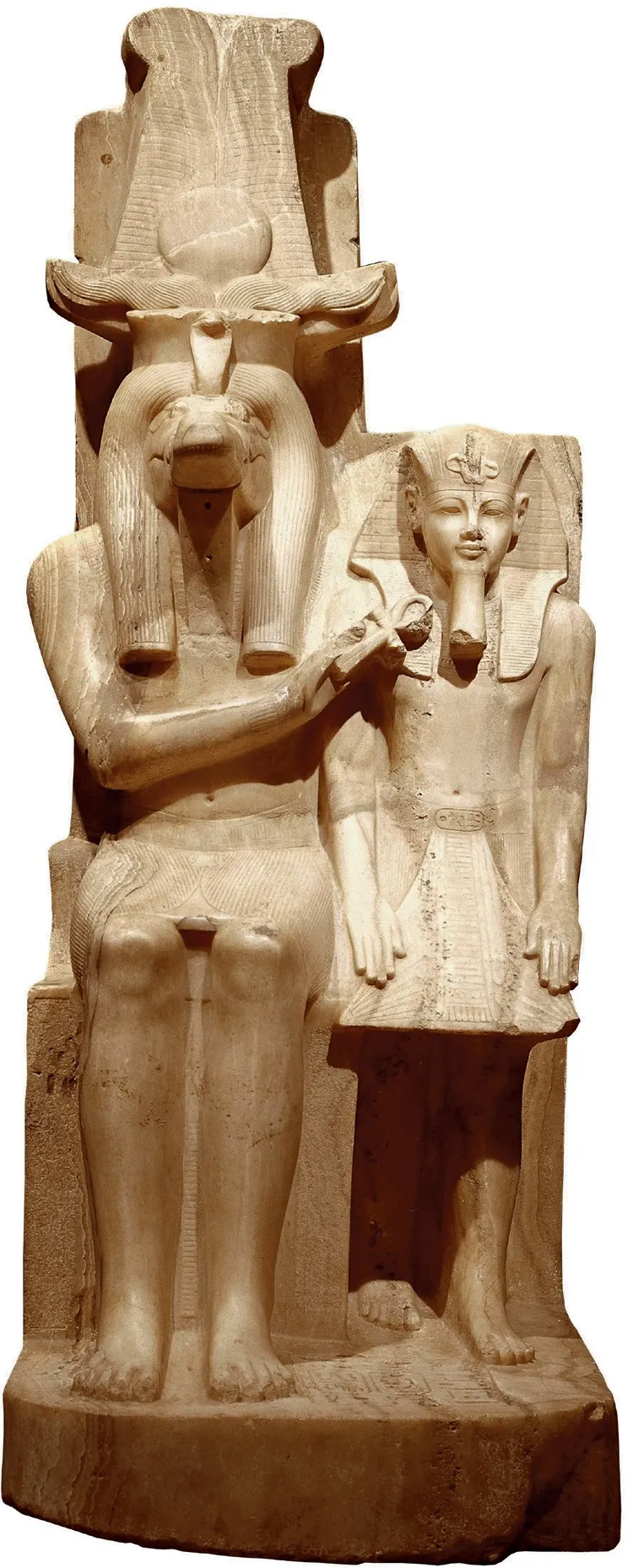
3 Calcite statue of king Amenhotep III and the god Sobk-Ra. Found near Gebelein. 2.57 m (8 ft 5 in.) high. 18th Dynasty.
The subject may seem too vast and disparate for a single book, and in points of detail it certainly is. However, even a quick survey of ancient Egyptian artworks reveals how the majority come from a handful of contexts, principally tombs and temples. These are contexts we may characterize as sacred places, where humans attended gods, the living considered the dead, and where minds contemplated the eternal. Of course, there is art from other places that must also be considered, especially art from domestic contexts. However, we have surprisingly little, as we shall see in Chapter 14. Moreover, some contexts where we would expect to find art are mostly not relevant to ancient Egypt, including art from public spaces or official buildings. Even the wealth of jewelry surviving from pharaonic times on closer inspection turns out to have come down to us in burials. So we may begin by suggesting that ancient Egyptian art – at least as it survives today – is a subject brimful of antiquity but more modest in scope.
Initial observations
The finest art of ancient Egypt may fairly be described – even in our modern, sophisticated age – using words such as beauty, elegance and grace. To take an example, in 1967 a human-sized, calcite statue of the god Sobk-Ra was discovered by accident among the remains of his temple, near modern Gebelein in the deep south of Egypt [3, 4]. The statue shows the massive, crocodile-headed god embracing the relatively diminutive, yet solid and elegant, figure of the once mighty pharaoh, Amenhotep III (c. 1390–c. 1353 BC). Despite the god’s reptilian face, there is neither horror nor disgust in the composition, but serenity. The god has a human body, and is able to embrace the king like a proud father posing for a photograph. Although there is no sparing the outlandish details of his face, each individual tooth finely scored in the stone helps form the half-smile of the Mona Lisa. The king smiles likewise, and his arms have settled upon his kilt in a gesture of greeting (to us?). He is evidently not intimidated by his companion, and, we may note, his face is as handsome as the other’s is monstrous. Individual barbs in the god’s high-plumed crown, the folds of the king’s iconic headcloth (or nemes) and the ever-present coiled uraeus-cobra on his brow, even the lines of his make-up, have been worked distinctly into the soft-stone surface. The god’s solid knees and legs are shapely and muscular, and give the impression he may stand up at any moment, so fluid and precise is the modelling. The waxy stone has been carved into forms so plastic as to seem lifelike, and almost flawless after three and a half millennia.
What does a statue so beautifully carved tell us? Undoubtedly the relationship between the two characters – god and pharaoh – is crucial, intimate, and presented in human terms (family, serenity, touching, welcome). We see the crowned king, but beside him the god – more massive and enthroned – holds still greater authority. Both of them look towards the viewer, revealing no specific attitude nor emotion, though the confrontation is not hostile. As we look at the king, whose height the sculptor has arranged to meet our eye-line, the god’s gaze remains slightly above the engagement. What does this engagement have to do with the function of the statue? Who was its intended audience?
Looking more closely, we see how the god’s far hand is pressing the ancient hieroglyph
reading ‘life’ onto his companion – in fact raising it to his face. His crown carries the same coiled uraeus-cobra as the king’s, so whatever the uraeus represents (‘domination’, actually) applies to both of them. His throne takes a simple form, barely more than a cube with a step for the base and a back pillar rising to support the massive plumed crown, and it is covered at the sides with hieroglyphs that elaborate on the subject of the statue. In fact, where the statue is now on display, in the Luxor Museum of Ancient Egyptian Art, it is possible to walk round and see that the back too is formally plain but entirely covered with columns of clearly cut hieroglyphs. Through them, Sobk-Ra is made to speak to the king (not us) and state that he is, indeed, Amenhotep’s father and he does, indeed, love him. Specifically, he has made his son’s ‘perfection’, given him the festivals of kingship a million times over, and established him in the world according to the pattern of the Sun in the sky, so he may rise in splendour each day and endure until the end of time.
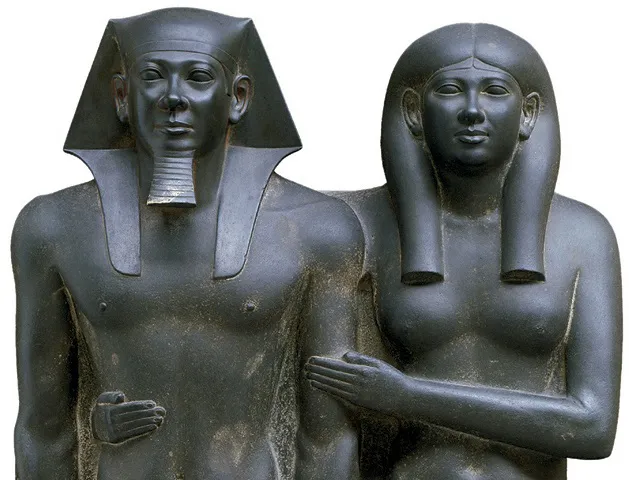
4 Close-up view of the king in [3].
Accordingly there is so much in this image that seems recognizable, human and accessible, but there are also ideas and beliefs far from our own. Gather your thoughts for a moment, and the statue reverts to a crocodile-headed monster embracing a pint-sized ‘king like the Sun’. In other words, we may respond to the humanity, beauty and even authority of the art, but we will not truly understand it until we appreciate specific ancient values, such as the eminence of kings and gods, the functions of statues and the meaning of crowns, gestures or hieroglyphs.
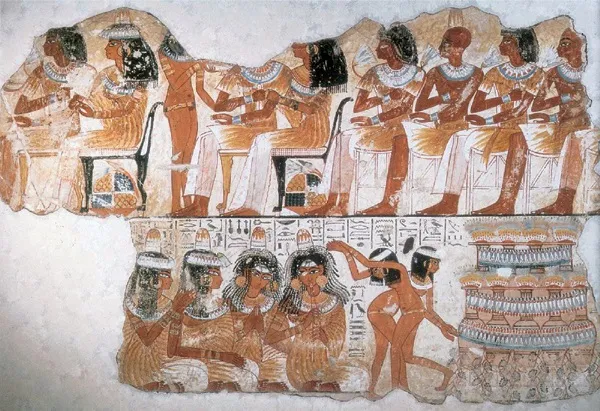
5 Scenes of guests at a sumptuous meal with musical entertainment, from the tomb chapel of Nebamun. West Thebes. Painted plaster. 0.61 m (2 ft) high. 18th Dynasty.
The challenge of ancient Egyptian art
However exotic the ideas and however bizarre the god’s form, the statue of Sobk-Ra is first and foremost a thing of beauty. Art from the time of the pharaohs has captivated Western imaginations since Classical times, and has become familiar to museum-goers all over the globe, from Australia and Japan to America. In AD 130, the Roman emperor Hadrian became only the latest Westerner to drink in the sights along the grand highway that is the River Nile, while more recent emperors in thrall to the art of the pharaohs included Maximilian of the Germans and Napoleon of France. Small wonder perhaps that, when scholars of a modern, critical bent comment on the imagery of the pharaohs and ancient gods, the words used are often measured, utilitarian words, such as ‘convention’, ‘fiction’ and ‘propaganda’. It is as though a sophisticated eye must beware, because it is liable to be enchanted by a deceit – the deceit that an ancient, African culture could offer modern audiences substance along with style, and meaningful ideas wrapped in bizarre, ‘old time’ religion.
At the heart of this disquiet is a seeming paradise of images, populated mostly by human subjects with sublime, serene faces, for whom the wisdom of the ages seems allied to eternal youth. It is commonplace to find gaiety, excitement and colour in their artworks, and it is found most of all in their tombs. A lively party from the tomb of Nebamun – a man who probably lived during the reign of Amenhotep III – is a fine example [5]. Perhaps this is the nub of our fascination: the tension that exists between analysing the remains of a ‘primitive’ ancestor in critical terms, on the one hand, and on the other a nagging suspicion that their art is addressing problems so ‘big’ they still evade us today. They are problems of meaning, ideals, beauty, faith and death in the story of humanity. Any critical comment on the statue of Sobk-Ra or Nebamun’s party seems bound to miss the point, since modern thinking can barely countenance bright colours in death, or the embraces of gods, or the nearness of ancient history, can it?
The challenges we face in making sense of ancient Egyptian art are of various different kinds. There are obvious, practical matters, such as finding out how artists went about their business, what tools they used or who their patrons were. As noted above, there are also matters of use and context: where and when did ancient Egyptians resort to art, which audiences might have experienced it, what changes became apparent through the centuries? Not least, however, are questions of meaning: what are they trying to say in their art, and could we possibly learn from it?
The king and the gods
Let us begin by establishing one basic use of art in pharaonic Egypt. Readers of this book no doubt identified the statue of Sobk-Ra as being ‘ancient Egyptian’ immediately because something about its style is distinctive and familiar. Similarly, a scene of the pharaoh Sety I (c. 1290–c. 1279 BC), who reigned two or three generations after Ame...
Table of contents
Cover
Title Page
Dedication
Contents
Part I Art & Creation
Part II Art & The Artists
Part III Art in Context
Postscript
Notes
Select Bibliography
List of Illustrations
Acknowledgments
Index
Copyright
Frequently asked questions
Yes, you can cancel anytime from the Subscription tab in your account settings on the Perlego website. Your subscription will stay active until the end of your current billing period. Learn how to cancel your subscription
No, books cannot be downloaded as external files, such as PDFs, for use outside of Perlego. However, you can download books within the Perlego app for offline reading on mobile or tablet. Learn how to download books offline
Perlego offers two plans: Essential and Complete
Essential is ideal for learners and professionals who enjoy exploring a wide range of subjects. Access the Essential Library with 800,000+ trusted titles and best-sellers across business, personal growth, and the humanities. Includes unlimited reading time and Standard Read Aloud voice.
Complete: Perfect for advanced learners and researchers needing full, unrestricted access. Unlock 1.5M+ books across hundreds of subjects, including academic and specialized titles. The Complete Plan also includes advanced features like Premium Read Aloud and Research Assistant.
Both plans are available with monthly, semester, or annual billing cycles.
We are an online textbook subscription service, where you can get access to an entire online library for less than the price of a single book per month. With over 1.5 million books across 990+ topics, we’ve got you covered! Learn about our mission
Look out for the read-aloud symbol on your next book to see if you can listen to it. The read-aloud tool reads text aloud for you, highlighting the text as it is being read. You can pause it, speed it up and slow it down. Learn more about Read Aloud
Yes! You can use the Perlego app on both iOS and Android devices to read anytime, anywhere — even offline. Perfect for commutes or when you’re on the go. Please note we cannot support devices running on iOS 13 and Android 7 or earlier. Learn more about using the app
Yes, you can access Egyptian Art by Bill Manley in PDF and/or ePUB format, as well as other popular books in History & History of Ancient Art. We have over 1.5 million books available in our catalogue for you to explore.