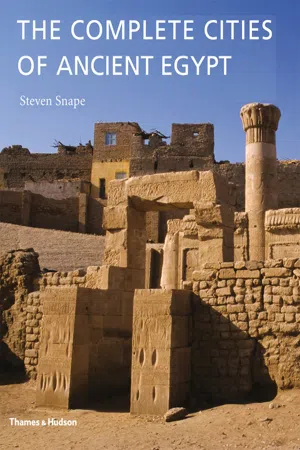
Our knowledge of urban life in ancient Egypt is being transformed by new research and excavations. This is the first book to provide a comprehensive overview of what we know about settlements during the dynastic period, describing the sophistication of daily city life under the Pharaohs with a range and depth beyond any other publication on the subject. Stunning illustrations, authoritative text and helpful maps bring the urban landscape of ancient Egypt to life. This is the perfect book for all those wanting to look beyond the tombs and temples to the urban life of those who made their homes along the Nile.
Includes a detailed gazetteer of sites cities such as Hierakonpolis, Alexandria, Memphis, Thebes, Amarna, and Giza as well as Kahun and Deir el-Medina - the village of the artisans who built and decorated the tombs of the Valley of the Kings. Note: The ebook edition includes the complete text of the printed book with a reduced number of illustrations.
- English
- ePUB (mobile friendly)
- Available on iOS & Android
eBook - ePub
The Complete Cities of Ancient Egypt
About this book
Trusted by 375,005 students
Access to over 1.5 million titles for a fair monthly price.
Study more efficiently using our study tools.
Information
Subtopic
Residential ArchitectureIndex
HistoryPART I
The Rise of the City
What is a City?
In a famous article in 1960, John Wilson, Professor of Egyptology in the Oriental Institute at Chicago University, described ancient Egypt as a ‘civilisation without cities’. Even at the time he wrote these words they were not literally true: the monuments of Thebes were clearly part of a significant urban centre, Amarna had been the subject of many decades of archaeological excavation that had uncovered everything a city could need and Memphis showed the fragmentary remains of perhaps the most long-lasting metropolis in the world. In known ancient texts, too, the greatness of ancient Egyptian cities was celebrated, including a city that (in 1960) was not yet known: Pr-Ramesses, founded by Ramesses II as a new royal city in the Eastern Delta.
So what did Wilson mean? He was, essentially, overstating what he thought to be a fundamental aspect of human settlement in ancient Egypt, which was that, unlike Mesopotamia with its individual city states, where the typical pattern was a single major urban centre and a relatively limited agricultural hinterland, Bronze Age Egypt (the largest country of its time) basically consisted of vast tracts of agricultural land, inhabited by a low-density population that had no need for major urban centres. This view was predicated on Egypt having an economy that was fundamentally agricultural.
In fact, at a basic level, this seems to be true. Although it is difficult to be precise about population in the ancient world, whether using percentages or absolute numbers, it is accurate to say that the vast majority of the population of dynastic Egypt worked on the land. Compared with other wealth-producing activities, agriculture was overwhelmingly dominant – much more so than in Mesopotamia where the production and trade in finished goods was of greater significance as an economic activity and as an occupation of the population at large.
Egypt as a Non-urban State
With such an economic basis, it is tempting to think that in Egypt major centres of population were not necessary, since the requirements of an agrarian population could be catered for locally, with relatively few concentrations of non-agricultural activity (i.e. towns and cities) that housed a relatively tiny elite who would, essentially, be both landowners and members of the royal court and government. This picture does, to some degree, seem to characterize Old Kingdom Egypt. At that time, the only real ‘city’ seems to have been Memphis, which was the centre of government, the residence city of king and elite, and the location of elite burials, including that of the king himself. The elite tombs seem to represent the most obvious way in which national resources (both men and goods) were brought together for the benefit of king, court and capital. However, although this urban picture may hold good in broad terms, in detail there may be additional complexities. First, the natural advantages presented by the Nile meant that Egypt, in most periods of its history, was an agriculturally superabundant state, with relatively little effort on the part of its inhabitants. Per capita yields for agricultural workers are likely to have been enormous compared with those in Mesopotamia, where the less reliable natural irrigation necessitated much more labour-intensive farming methods. Egypt’s agricultural superabundance meant that it could ‘grow’ a large population owing to the high carrying capacity of the super-fertile Nile floodplain. It is possible to imagine a situation where the rural population of Egypt was significantly larger than the numbers of active farmworkers required to produce its food. It may well be the case that the Egyptian countryside was far from underpopulated. Indeed one could argue that what the centre (i.e. the king and court, based in Memphis) required from the rural areas was, in addition to the remittance of rents, taxes and other revenues, the provision of human labour on a very significant scale for the building projects of Old Kingdom Egypt.

With much settlement remains destroyed, the most obvious visible identifier of an ancient Egyptian city is either its cemeteries or its surviving temple buildings, illustrated here by Luxor Temple. GlowImages/Alamy.
So perhaps the question should be, not ‘Did Egypt have cities?’, but ‘What is the nature of those cities?’ What is the difference between a village, a town and a city, and to what extent are these divisions relevant to us and to the ancient Egyptians? Perhaps most interesting of all, and it is a question we shall attempt to answer in this book, is whether, away from the major and obvious urban centres such as Thebes, Amarna and Memphis, there existed major population centres that contained within them areas for specialized functions that might mark them out as urban communities rather than simply huge dormitories for an agricultural population.
The Nature of an Egyptian City
How do we define a city? Size of population is important, but this might be relative; in sparsely populated Norway a centre with a population of 20,000 (e.g. Tromso) can be regarded as a city, while in Britain a centre with a population in excess of 100,000 (e.g. Bolton) can be regarded as a large town. Functions are important too: a city is generally regarded as a population centre with a cluster of assets that relate to a region larger than its own immediate hinterland – government is perhaps the most important example of this, but so too (to use examples from medieval England) are economic institutions (e.g. trade guilds or holding a royal charter recognizing the city as the location of an important market) and cultural institutions (e.g. universities and seats of religious authority such as cathedrals). A capital city is something else again, being defined, generally, as the place where the main centre of government resides. Because of the somewhat peripatetic nature of government in Egypt (not unlike the Tudor rulers on their royal progresses round England) this is not as simple a definition as it might appear. In the Old Kingdom, Memphis was obviously the capital of Egypt. It was the largest – perhaps the only – city, the centre of royal government and elite residence, the hub of specialized functions.
The New Kingdom capital city is more difficult to define: both Memphis and Thebes were centres of royal administration, but for the north and south (including Nubia) of Egypt respectively – and each had an elite population of administrators who served both secular institutions and major religious foundations. Neither could be said to be the ruling centre of the country as a whole, apart from during the few periods when one or other became the place of fixed royal residence. In general, though, the immediate royal court was very mobile and royal progression (in the Tudor sense) through Egypt was the norm. The big exception here is Amarna, as we shall see.
The Middle Kingdom presents the rather odd phenomenon of Itj-Tawy, a ruling centre for 12th-Dynasty kings – some of the most powerful and active rulers in Egyptian history – but whose location is still unknown. It is probable that Itj-Tawy represents a ‘disembedded capital’ comprising a small population of administrators attached to the central royal administration while major economic and religious activity took place elsewhere, especially at Memphis and Thebes. This separation of the ‘ruling function’ of capital cities from major centres of population/economic activity/cultural activity may seem odd if the models of, say, London or Paris are used as comparators, but not if Washington DC, Ottawa or Canberra are.
The features that designate a city have been discussed by a number of scholars, some of whom (e.g. Bruce Trigger and David Wengrow) have produced what might be considered convenient ‘checklists’ for designating ‘citiness’. These attributes include:
1 The presence of an elite who are not directly involved in agricultural production.
2 A relatively high density of permanent population.
3 A significant level of participation in trade/exchange, including river/sea ports/harbours.
4 A concentration of crafts (and other) specialization.
5 A concentration of administrative functions over a territory greater than the city itself.
6 Control over an agricultural hinterland whose surplus maintains the city.
7 Institutions that promote a sense of specific civic identity.
Rather than ‘capital city’ the term ‘royal city’ is often used for ancient Egypt. This is a centre that is established not through natural population growth but by royal edict, for specific reasons. Amarna and Pr-Ramesses are the clearest examples of royal cities because they essentially sprang up during the lifetime of a king at his bidding (not unlike the foundation by royal decree of the Russian city of St Petersburg in the 18th century). While there may be good practical reasons behind the creation of a royal city (Pr-Ramesses was near Egypt’s eastern border at a time when relations with Western Asia dominated Egyptian international politics) they can also be seen as somewhat egotistical projections of royal identity – the Akhenaten/Aten relationship for Amarna, and the elevation of a smallish home town to national prominence in the case of Ramesses II. Thebes is also a ‘royal city’ inasmuch as it owes its status, particularly its monumental appearance, to the specific relationship between the rulers of the Middle and New Kingdoms and the god Amun(-Re) at his major cult centre. On the other hand, while benefiting from royal patronage, it is hard not to think of cities such as Bubastis in the Eastern Nile Delta or Hermopolis Magna in Middle Egypt as being anything other than organically evolved centres of population, administration and specialized functions within a regional context, making it clear that cities come about both as royal foundations and through organic development.
The Origins of Urbanism in Egypt
Like the term ‘city’, ‘urbanism’ and ‘urbanization’ are not words that are easy to define in very strict terms. The classic definition of urbanization was proposed in 1942 by American demographer Hope Tisdale as
‘… a process of population concentration. It proceeds in two ways: the multiplication of points of concentration and the increase in size of individual concentrations.’
In 1965 the American sociologist Philip Hauser added to this definition the concept that as a result of this process the ‘proportion of the population living in urban places increases’, to avoid the definition covering a situation where the non-urban population grows even faster than the urban population – not what most people think of as the process of urbanization. For ancient Egypt the question of what proportion of the population were city- or town-dwellers at any given period of history is not easy to answer. However, the rise of the city as an important institution can perhaps more confidently be identified as an aspect of ancient Egyptian civilization.
Urbanization and State Formation in Upper Egypt
The first cities in Egypt came out of a background of increasing state formation in the Late Predynastic Period (3500–3000 BC). The best examples of this are in Upper (southern) Egypt and these are also the best-known cities from the period (although Lower (northern) Egypt also had important centres of population before unification). Archaeologically, the settlements at Nagada and Hierakonpolis are the best preserved from this period and other aspects of t...
Table of contents
- Cover
- Title Page
- About the Author
- Other titles of Interest
- Dedication
- Contents
- Introduction: Urban Life in Ancient Egypt
- Part I: The Rise of the City
- Part II: Cities for Kings and Gods
- Part III: Cities for People
- Part IV: Graeco-Roman Egypt
- Part V: Gazetteer of Cities and Towns of Ancient Egypt
- Epilogue – Lost Cities
- Glossary
- Further Reading
- Acknowledgments
- Index
- Copyright
Frequently asked questions
Yes, you can cancel anytime from the Subscription tab in your account settings on the Perlego website. Your subscription will stay active until the end of your current billing period. Learn how to cancel your subscription
No, books cannot be downloaded as external files, such as PDFs, for use outside of Perlego. However, you can download books within the Perlego app for offline reading on mobile or tablet. Learn how to download books offline
Perlego offers two plans: Essential and Complete
- Essential is ideal for learners and professionals who enjoy exploring a wide range of subjects. Access the Essential Library with 800,000+ trusted titles and best-sellers across business, personal growth, and the humanities. Includes unlimited reading time and Standard Read Aloud voice.
- Complete: Perfect for advanced learners and researchers needing full, unrestricted access. Unlock 1.5M+ books across hundreds of subjects, including academic and specialized titles. The Complete Plan also includes advanced features like Premium Read Aloud and Research Assistant.
We are an online textbook subscription service, where you can get access to an entire online library for less than the price of a single book per month. With over 1.5 million books across 990+ topics, we’ve got you covered! Learn about our mission
Look out for the read-aloud symbol on your next book to see if you can listen to it. The read-aloud tool reads text aloud for you, highlighting the text as it is being read. You can pause it, speed it up and slow it down. Learn more about Read Aloud
Yes! You can use the Perlego app on both iOS and Android devices to read anytime, anywhere — even offline. Perfect for commutes or when you’re on the go.
Please note we cannot support devices running on iOS 13 and Android 7 or earlier. Learn more about using the app
Please note we cannot support devices running on iOS 13 and Android 7 or earlier. Learn more about using the app
Yes, you can access The Complete Cities of Ancient Egypt by Steven Snape in PDF and/or ePUB format, as well as other popular books in History & Residential Architecture. We have over 1.5 million books available in our catalogue for you to explore.