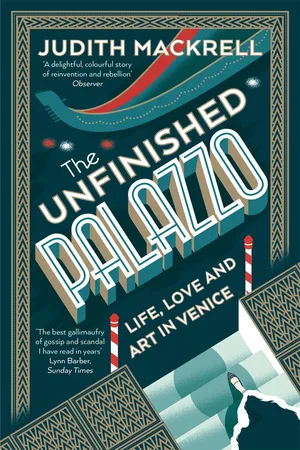
Abandoned unfinished and left to rot on Venices Grand Canal, il palazzo non finito was once an unloved guest among the aristocrats of Venetian architecture. Yet in the 20th century it played host to three passionate and unconventional women who would take the city by storm. The staggeringly wealthy Marchesa Luisa Casati made her new home a belle epoque aesthetes fantasy and herself a living work of art; notorious British socialite Doris Castlerosse (née Delevingne) welcomed film stars and royalty to glittering parties between the wars; and American heiress Peggy Guggenheim amassed an exquisite collection of modern art, which today draws visitors from around the world.
Each in turn used the Unfinished Palazzo as a stage on which to re-fashion her life, with a dazzling supporting cast ranging from DAnnunzio and Nijinsky, through Noël Coward, Winston Churchill and Cecil Beaton, to Yoko Ono. Individually sensational and collectively remarkable, these stories of modern Venice tell us much about the ways women chose to live in the 20th century.
- English
- ePUB (mobile friendly)
- Available on iOS & Android
eBook - ePub
About this book
Trusted by 375,005 students
Access to over 1 million titles for a fair monthly price.
Study more efficiently using our study tools.
Information
Topic
ArchitectureSubtopic
Architecture GeneralPEGGY GUGGENHEIM
THE COLLECTOR
CHAPTER 8
‘To live in Venice, or even to visit it, means that you fall in love with the city itself. There is nothing left over in your heart for anyone else. After your first visit you are destined to return at every possible chance or with every possible excuse.’1
When Peggy bought the Venier palace in 1948 she was fulfilling a long-held dream. She’d been to Venice several times previously, and on each occasion had fallen under the spell of what she called her ‘miracle city’. She was entranced by the quality of ‘floatingness’ that seemed to pervade its every aspect: it was a city ‘sprung from the sea’, she wrote, where ‘no time exists’.2 And like so many before her, she’d fantasized about finding a refuge there, imagining it as a world away from the conflict and noise of modern life, and from her own private difficulties.
Peggy had been twenty-six, a troubled, self-doubting but determined young woman, when she’d first lost her heart to Venice. It was the autumn of 1924 and she’d arrived in the city with her husband Laurence Vail, hoping to carve out an interlude of tranquil family life from a marriage already grown chaotic and quarrelsome. Laurence knew the city well, having lived there as a child, but Peggy had only known it as a tourist, and she was determined now to discover her own ‘authentic’ version of Venetian life. Rather than renting the floor of a palazzo or a suite at the Danieli, she took rooms for herself and Laurence, their infant son Sindbad and their nanny Lilly in an old-fashioned hotel on the shabby end of the Riva degli Schiavoni. To complete the fantasy of a bohemian dolce vita, she’d also paid for an artisan studio where Laurence could work on his current novel.
Peggy described in her memoir, many years later, how she had come to Venice determined to imprint her senses with ‘every painting and stone’. Every day, either alone or with Laurence, she trekked the city on foot, learning to distinguish each of its six sestieri, the small neighbourhoods that could still be distinguished by their own dialects. She made favourites of the secluded campi, where locals still drew their water from a central well. She learned the pleasures of getting herself lost: the unexpected glimpse of a leafy garden or medieval cloister; the dead end of an alleyway that forced her eye upwards to a vista of tall chimney pots or a wooden altana flowering with late geraniums. Raised in Manhattan, she was beguiled by architecture that, even in the poorest areas, could spring the surprise of a gothic staircase, a building decorated with ancient carvings of a camel, a turbaned Turk or a Madonna.
Peggy collected impressions of Venice with the same diligence she would later apply to the collecting of art. She became a connoisseur of the city’s changing light: the mother-of-pearl softness of dawn, the kingfisher blue of the late afternoon, the crimson theatre of sunset, the silvered sharpness of a full moon. She learned to appreciate the city’s distinctive smell, the tangy ozone of sea that overlaid the brackish odours of drain and canal. And as Peggy discovered Venice, she was stirred by the idea of owning a small part of it. Although she was not as spectacularly rich as many assumed a Guggenheim heiress must be, she was wealthy enough to buy and maintain a modest canalside property.

Venice in the 1920s: Peggy collected impressions of the city with the diligence that she would later apply to collecting art.
Had she come to the city six months earlier, when the Palazzo Venier dei Leoni was on the market, Peggy might have looked it over with an acquisitive eye. She’d heard about Luisa Casati and her Venetian life though the gossip of mutual friends. In Paris, too, their social circles had overlapped a little; Peggy had attended Natalie Barney’s salon on a few occasions, she could claim acquaintance with Jean Cocteau, and she’d had her own photograph taken by Man Ray. But by the time she arrived in Venice, Marcell Nemes had already acquired the palazzo; and in any case, the trust that controlled Peggy’s inheritance might not have allowed her such an extravagance. All she could do, in 1924, was shop for a few beautiful objects with which she might one day furnish a Venetian home. Aided by an old friend of Laurence’s (an art forger called Favai, whose long, elegant face and beard reminded Peggy of an El Greco), she scoured the city for beautiful antiques, acquiring a 13th-century chest carved with religious scenes and a 15th-century oak buffet with shreds of its original upholstery still clinging to its metal decoration. Twenty-five years later, after many moves and many upheavals, these pieces would end up in the dining room of the Venier palace, arranged among Peggy’s prized Cubist paintings.
*****
That first stay in Venice had not been a completely straightforward idyll, despite Peggy’s rose-tinted expectations. As a native New Yorker, she’d been confused by the slow and, to her, inefficient pace of daily life. She’d disliked having to haggle for goods, the nanny had got pneumonia, and Laurence had grumbled and stalled over his writing. Yet still she yearned to come back some day: ‘I have never been in a city that gave me the same sense of freedom,’ she wrote. Venice seemed so ancient and unjudging a place to her, so serene in its attitude of dolce far niente, that she – no less than Luisa and Doris – imagined it as a city where she could refashion her life as she’d always wanted it to be.3
The actual life into which Peggy had been born had left her, she claimed, with ‘no pleasant memories of any kind’.4 She’d been cursed, she believed, with the misfortune of a neurotic, unhappy mother and an absent, philandering father. But she had also grown up within the insular community of the New York Jewish rich, and that world had felt to her both dully claustrophobic and anxiously pressured. Money – the obligation and the status of it – had been a burden that Peggy understood from an early age. Like the rest of her generation of Guggenheims, she’d grown up under the shadow of her grandfather Meyer, a small, square, energetically whiskered man who in 1848 had braved a long and dangerous crossing from Europe to make his fortune in America. Starting out as a peddler, Meyer Guggenheim had founded his first small enterprise on the marketing of a new type of stove polish; but having expanded into the smelting and mining industries, he’d ended up with a business that in 1914 handled roughly 75 per cent of the world’s copper, silver and lead output, and earned annual profits of over one million dollars.
It was expected of Meyer’s seven surviving sons that they would not only manage the business, but use their father’s wealth to advance the family’s position in society. As rich as the Guggenheims were, they were Jewish immigrants, and as such they remained excluded from New York’s gilded élite. To families like the Vanderbilts, whose Protestant ancestors had arrived in America back in the 17th century, the Guggenheims, like the Loebs, the Liebermans and other wealthy Jewish clans, still carried the taint of the European ghetto. Even though anti-Semitism wasn’t legally sanctioned in America, they were effectively excluded from the wealthiest schools, clubs, hotels and drawing rooms.
Peggy’s maternal relatives, the Seligmans, were socially a cut above the Guggenheims, having arrived in America slightly earlier and having ploughed the profits of their own businesses (trading in precious metals and manufacturing military uniforms) into the more respectable sphere of banking. Peggy’s mother Florette was regarded as lowering herself somewhat when she fell in love with Benjamin in 1894 and married into the ‘smelting Guggenheims’. Yet even the Seligmans, with their connections to high finance, remained defined and confined by the stigma of their faith. They remained part of the privileged ghetto which the Jewish rich had been forced to create for themselves: educating their children in the same schools, attending the same temples, socializing among those they arrogantly and defensively referred to as ‘our crowd’. When Peggy was old enough to understand the limitations of the community in which she’d been raised, she not only became impatient to escape, but developed a confused and often angry relationship with her own Jewishness.
Marguerite Guggenheim (the diminutive ‘Peggy’ came later) was born on 26 August 1898, and along with her two sisters, spent much of her early childhood in the grandeur of the Upper East Side. Their family home was an immense limestone mansion on 72nd Street that properly reflected the Guggenheim and Seligman wealth. Its large, high-ceilinged rooms were decorated with a clutter of expensive ornaments and artworks, and it was scrupulously maintained by a large resident staff. Yet to Peggy, the house was always hideous. When she was very small it seemed to her a place of menace, filled with booby traps to spook her childish imagination: the mysterious maze of servants’ attics at the top of the house; the stuffed eagle that loomed over the front hall; even the old bearskin rug whose dead, dry muzzle was studded horribly with broken teeth. More terrifying still was the nanny who for years held tyrannical sway over the nursery; an inventively malevolent woman who threatened to cut out Peggy’s tongue if ever she complained to her mother about the punishments she suffered.
There were few opportunities to escape from either the house or the nanny because, like all girls of her class, Peggy was educated at home. She had no friends of her own age, certainly none who came to the house – in fact, the only visitors she ever recalled at East 72nd Street were the select crowd of middle-aged matrons who came once a week to take tea with Florette. Despite daily outings to the park and annual family holidays, it was a small, isolated life. And while Peggy worshipped her sister Benita, who was almost three years older, she frankly disliked their younger sister Hazel, resenting her as the petted baby of the family.
It was the tensions between the adults, though, that made life in the Guggenheim mansion so ‘excessively unhappy’.5 Florette was a loving mother, but she was prone to gloominess and to a streak of obsessive-compulsive behaviour that manifested itself in a terror of germs (she insisted on the house being sprayed daily with a disinfectant called Lysol) and in an agitated tic of repeating certain words three times over. There was a genetic history of instability within the family: Florette’s mother and her siblings suffered from varying degrees of hypochondria and delusion, and Peggy herself came close to a nervous collapse at several points during her adult life. But Florette’s anxieties were principally caused by her husband Benjamin, who, having turned her head with his smooth-skinned handsomeness and college-educated conversation, had proved to be an incorrigible adulterer.
Benjamin had grown up with different expectations from most of his Guggenheim relatives. In 1901, just six years after marrying Florette, he’d retired from the family business, sacrificing his multi-million-dollar share of its profits. His plan was to live the life of a cultured gentleman, dabbling in his own investments while indulging his taste for art and women. He made little attempt to conceal his infidelities, and Peggy recalled that from a very early age she felt miserably divided between her parents: ‘I adored my father because he was fascinating and handsome and because he loved me. But I suffered very much because he made my mother unhappy…I was perpetually being dragged into my parents’ troubles and it made me precocious.’6 She was only seven when, over dinner, she blurted out angrily to her father: ‘Papa, you must have a mistress since you stay out so many nights.’7 Even though she didn’t fully understand the concept of a mistress, she knew enough to consider Benjamin both wicked and glamorous for having one, and to pity and resent Florette for being unable to intervene.
The battleground between her parents taught Peggy to believe that love was a contest – something to be competed for, rather than given – and this belief sowed the seeds for what she later described as her mass of ‘inferiority complexes’. She was a quick little girl, eager and curious, with fine bones, thick chestnut hair and lively green-blue eyes; yet from an early age she regarded herself as the ugly duckling of the family, eclipsed by Hazel’s blonde cuteness and Benita’s more classically refined beauty. By the time she was a teenager, her appearance became even more of a disappointment to her as, alone of the three girls, she began to develop the long, bulbous nose of her grandfather Meyer. Peggy considered her Guggenheim nose to be a hideous infirmity; even as an adult, she felt disqualified from the love and admiration that other, more beautiful women enjoyed. Yet no less damaging to her teenage confidence was the sudden and traumatic death of her father.
By the time she was thirteen, Peggy had grown used to Benjamin’s frequent absences from home. He’d invested capital in a French steam pump company and used his business as an excuse to spend months away in Paris where, as Peggy now knew, he kept several mistresses. But Benjamin always came home to see his girls, and in the spring of 1912 he was due back to celebrate Hazel’s ninth birthday. There was a last-minute hitch when the crossing onto which he’d initially been booked was cancelled; however, he believed his luck had turned when he managed to secure a first-class berth on the RMS Titanic, the new steamship that was making its maiden voyage across the Atlantic and was promising its passengers a journey of unparalleled luxury and speed.
Benjamin’s body was never recovered after the catastrophic collision that sunk the Titanic, and all of its superior ambitions, on the morning of 15 April; and it was four days before Florette and the girls knew for certain that he was dead. One of the ship’s surviving stewards eventually came forward to report his last sightings of Benjamin, and to confirm that his final hours had been heroic; still dressed in his evening clothes, he’d refused to take his place in a lifeboat and instead had helped load women and children to safety. He and his secretary Giglio had declared that they ‘were prepared to go down like gentlemen’, and it was the glamour of Benjamin’s heroism that made his death all the more damaging to Peggy. From that point onwards he became a romantic ideal for her – the template of the perfect man – and she would seek to replicate him over and over again in her choice of lovers and husbands. Even in middle age she would write, ‘It took me…years to get over the loss of my father….In a sense I really have never recovered as I suppose I have been searching for a father ever since.’8
Peggy did not waver in her idealization of Benjamin even once it was discovered that the combination of his poor business sense and extravagant lifestyle had got him deeply into debt. The Guggenheim uncles rallied round, securing what capital he had left, paying off his creditors and pitching in with money of their own. But still Florette and the girls had to relocate to a modestly scaled apartment on the corner of Fifth Avenue and 58th Street and sell off the more valuable family assets, the artworks and the jewels. Over time a succession of legacies, including a chunk of the Seligman fortune, would restore them to some degree of wealth; yet by the standards of the Guggenheims, they’d become the poor relations. Peggy felt the difference acutely: ‘[F]rom that time on I had a complex about not being a real Guggenheim….[I] suffered great humiliation thinking how inferior I was to the rest of the family.’9
Florette was stoically resigned to the drop in her fortunes, but Peggy grew into a rebellious and restless teenager, and when she was fifteen and final...
Table of contents
- Cover
- Title Page
- About the Author
- Other Titles of Interest
- Contents
- Introduction
- Luisa Casati: The Living Work of Art
- Doris Castlerosse: The Salonnière
- Peggy Guggenheim: The Collector
- Epilogue
- Notes
- Bibliography
- Acknowledgments
- Author’s Note
- Sources of Illustrations
- Index
- Copyright
Frequently asked questions
Yes, you can cancel anytime from the Subscription tab in your account settings on the Perlego website. Your subscription will stay active until the end of your current billing period. Learn how to cancel your subscription
No, books cannot be downloaded as external files, such as PDFs, for use outside of Perlego. However, you can download books within the Perlego app for offline reading on mobile or tablet. Learn how to download books offline
Perlego offers two plans: Essential and Complete
- Essential is ideal for learners and professionals who enjoy exploring a wide range of subjects. Access the Essential Library with 800,000+ trusted titles and best-sellers across business, personal growth, and the humanities. Includes unlimited reading time and Standard Read Aloud voice.
- Complete: Perfect for advanced learners and researchers needing full, unrestricted access. Unlock 1.4M+ books across hundreds of subjects, including academic and specialized titles. The Complete Plan also includes advanced features like Premium Read Aloud and Research Assistant.
We are an online textbook subscription service, where you can get access to an entire online library for less than the price of a single book per month. With over 1 million books across 990+ topics, we’ve got you covered! Learn about our mission
Look out for the read-aloud symbol on your next book to see if you can listen to it. The read-aloud tool reads text aloud for you, highlighting the text as it is being read. You can pause it, speed it up and slow it down. Learn more about Read Aloud
Yes! You can use the Perlego app on both iOS and Android devices to read anytime, anywhere — even offline. Perfect for commutes or when you’re on the go.
Please note we cannot support devices running on iOS 13 and Android 7 or earlier. Learn more about using the app
Please note we cannot support devices running on iOS 13 and Android 7 or earlier. Learn more about using the app
Yes, you can access The Unfinished Palazzo by Judith Mackrell in PDF and/or ePUB format, as well as other popular books in Architecture & Architecture General. We have over one million books available in our catalogue for you to explore.