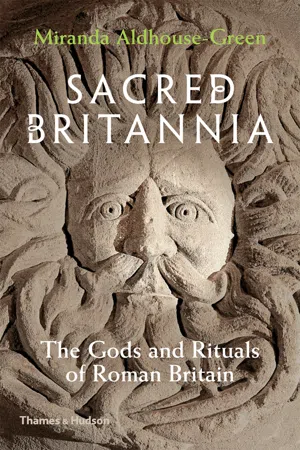
Two thousand years ago, the Romans sought to absorb into their empire what they regarded as a remote, almost mythical island on the very edge of the known world Britain. The expeditions of Julius Caesar and the invasion of ad 43 brought fundamental and lasting changes to the island. Not least among these was a pantheon of new Classical deities and religious systems, along with a clutch of exotic eastern cults including Christianity. But what of Britannia and her own home-grown deities? What cults and cosmologies did the Romans encounter and how did they in turn react to them? Under Roman rule, the old gods were challenged, adopted, adapted, absorbed and re-configured. In this fresh and innovative new account, Miranda Aldhouse-Green balances literary, archaeological and iconographic evidence (and scrutinizes their shortcomings and how we interpret them) to illuminate the complexity of religion and belief in Roman Britain, and the two-way traffic of cultural exchange and interplay between imported and indigenous cults. Despite the remoteness of this period, on the threshold between prehistory and history, many of the forces, tensions, ideologies and issues of identity at work are still relevant today, as Sacred Britannia skilfully draws out.
- English
- ePUB (mobile friendly)
- Available on iOS & Android
eBook - ePub
About this book
Trusted by 375,005 students
Access to over 1 million titles for a fair monthly price.
Study more efficiently using our study tools.
Information
Subtopic
British HistoryIndex
HistoryCHAPTER ONE
The Druids Priesthood, power and politics
‘But, we all owe a debt beyond measure to the Romans because they destroyed these horrible activities in which human sacrifice was thought to please the gods, and eating the victim thought to be good for one’s health.’
PLINY THE ELDER1
Pliny compiled his monumental Naturalis Historia in the 1st century AD. He collected information from all over the then known world, mining the writings of hundreds of previous authors, some of his resultant work factually accurate, but much of it warped by an overactive imagination and a certain credulousness. In this quotation, the author was referring to the Druids, the high priests in charge of religion in Gaul and Britain in the last few centuries BC and still highly influential at the time of the Claudian invasion of Britannia in AD 43. Pliny was by no means alone in his literary condemnation of the Druids as savage, barbarous and wildly uncivilized, but his testimony takes intolerance to a whole new level: Pliny was unable to resist the temptation to add a further layer of shock and disgust to his comment about human sacrificial practices, laying the charge of cannibalism at the Druids’ door. This has interesting parallels with similar charges levelled at early Christians, whose Eucharistic rituals were interpreted by some of their pagan contemporaries as involving the literal consumption of a person’s flesh and blood.2
The Druids’ arena was Iron Age Britain and Gaul, particularly during the 1st centuries BC and AD (though there is literary testimony for their presence in Gaul as late as the 4th century AD), and they are crucially important to the story of early Roman Britain because they represented an organized, well-educated religious opposition to the imposition of Roman rule on the island, one capable of causing very real problems to the invading army, and the new administration and governance introduced by Rome. The Druids thus played a significant role in the shaping of the new province of Britannia during its first decades. The seismic shift in British society caused by the new order threatened to take away the Druids’ power base and, indeed, their raison d’être. So, in opposing romanitas, they were fighting for their very survival.
Human sacrifice
‘The Gauls believe the power of the immortal gods can be appeased only if one human life is exchanged for another, and they have sacrifices of this kind regularly established by the community. Some of them have enormous images made of wickerwork, the limbs of which they fill with living men; these are set on fire and the men perish, enveloped in the flames. They believe that the gods prefer it if the people executed have been caught in the act of theft or armed robbery or some other crime, but when the supply of such victims runs out, they even go to the extent of sacrificing innocent men.’ CAESAR3
The Romans took the moral high ground when it came to ritual murder, even though such practices only became illegal in Rome as late as 97 BC. Accusations of such barbarous rites as endemic within the Druid-ridden societies of Britain and Gaul could therefore be used as a convenient smoke-screen in order to justify the annihilation of a dangerously nationalistic priesthood. The reality of human sacrifice in late pre-Roman Britain is difficult to evaluate. Some of the human bodies buried in disused grain silos at Danebury, Hampshire, may well have been sacrificial victims. Heads, complete bodies and separated body parts were carefully interred here, and at least some of the skeletons show evidence of having been bound.4 At Alveston, near Bristol, human remains bearing evidence of violence and dating to the late 1st century BC were found in a sinkhole, and may have been victims of ritual murder.5 But the bias of foreign texts, coupled with the ambiguity of archaeological testimony, presents a stiff challenge to objective considerations. Of the various possible candidates for such ritual killings, two Roman-period deaths are especially persuasive: those of the bog-man from Lindow Moss in Cheshire, who died in the mid-1st century AD,6 and a young boy whose defleshed skull shows signs of wear on the base, indication that it was mounted on a pole and displayed in front of a shrine at Folly Lane in 2nd-century AD Verulamium. ‘Lindow Man’ underwent a complicated and prolonged death that involved at least three fatal injuries – blows to the head, strangulation and throat-slitting – before he was pushed head-first, naked, into a remote marsh pool. It is hard to interpret such a calculated series of acts as having any other than a ritual purpose. The adolescent boy from the Roman city of Verulamium – killed by a massive head-injury – may also have been a ritual victim and, if so, proves that such practices were not entirely stamped out by the Roman presence. The child’s head was carefully stripped of its flesh, using a thin, sharp-bladed knife, placed on display outside a temple and then interred in a deep pit together with the body of a puppy and a whetstone, used for sharpening tools.7 This burial is itself interesting in as much as the items accompanying it appear to reinforce both the boy’s youth and the manner of his head’s defleshing, with a sharpened knife. Bearing in mind the Classical literary testimony linking the Druids with human sacrifice, it is possible – maybe even likely – that they were involved in these British ritual killings, even though their spheres of influence would have declined sharply following the Roman occupation.

The body of Lindow Man, a young adult male ritually killed and placed in a peat-bog at Lindow Moss, Cheshire, in the mid-1st century AD.
Druids’ footprints: material remnants of an ancient priesthood
‘Hailing the moon in a native word that means “healing all things”, the Druids prepare a ritual sacrifice and banquet beneath a tree and bring up two white bulls, whose horns are bound for the first time on this occasion. A priest arrayed in white vestments climbs the tree and with a golden sickle cuts down the mistletoe, which is caught in a white cloak.’ PLINY THE ELDER8
If we believe the testimony of ancient authors such as Caesar and Pliny, the Druids were a hugely dominant force within Britain and Gaul before and during the process of bringing these western regions into the fold of the Roman Empire. If so, such a group might be expected to have left tangible traces of their ritual activities within later Iron Age material culture, even if they were to all intents and purposes emasculated under imperial rule. The reality is that, despite a wealth of archaeological material relating to cult matters, there is virtually nothing that can be linked unequivocally to the Druids. However, there is some persuasive circumstantial evidence both for Druidic presence in Britain and, even more so, in Gaul.
Anglesey: the sacred isle of Mona
‘The groves devoted to Mona’s barbarous superstitions he demolished. For it was the Druids’ religion to drench their altars in the blood of prisoners and consult their gods by means of human entrails.’ TACITUS9
The ‘he’ mentioned here is Suetonius Paulinus, Roman governor of Britain in AD 60, and the occasion to which Tacitus refers is Paulinus’s strategic attack on Anglesey, a remote island off the northwest coast of Wales reputed to be the Druids’ holy of holies. No archaeological evidence for such a sanctuary survives, which is not altogether surprising, given that Paulinus’s army burned it to ashes. However, there is a site on Anglesey that was clearly of major religious importance during the later Iron Age: Llyn Cerrig Bach.
In 1942, the military airbase at RAF Valley in northwest Anglesey underwent construction work. As part of the operation, a peat-bog was excavated and a large amount of Iron Age metalwork came to light.10 The material was deliberately deposited by the ancient island inhabitants on a dry islet within the swamp, and included high-status martial equipment, such as swords, spears and parts of shields, and horse-gear and chariot-fittings, including iron nave-hoops for the wheels. Some of the copper-alloy objects were decorated with La Tène designs.11 These abstract and animal- and plant-based motifs, named after the site on the shore of Lake Neuchâtel in Switzerland where they were first recognized on hundreds of Iron Age metal objects in the late 19th century, are found across Britain and non-Mediterranean Europe dating between c. 500 BC and the early years of the Roman period. Recent research at Anglesey has identified a number of phases of deposition, between the 4th century BC and the early 2nd century AD, suggesting that people visited the site over a long period, perhaps as pilgrims.
The practice of deliberately placing valuable objects in watery places has long been recognized as a sacrificial rite widespread in Bronze Age and Iron Age Britain and Europe.12 Bogs, pools, lakes and rivers were persistently chosen as foci for sacred activities, offerings often being made to the gods perceived as dwelling therein. Water seems to have been regarded as special, and charged with supernatural energy. The ancient Greek geographer Strabo, writing in the late 1st century BC and early 1st century AD, describes the practice of sinking great masses of gold and silver treasure into sacred lakes. He explains that nobody dared to profane these watery offering-places by trying to steal their contents.13 At Llyn Cerrig Bach, the first phase of religious expression appears to be represented by animal sacrifice; unfortunately, during excavation only a very few animal bones were collected, and the majority of those thrown away without proper assessment or recording, but a pony, sheep, cattle and dogs were among the beasts whose remains were found at the site – though sadly no evidence survives as to how they met their deaths.14 In any case, this practice was later replaced with the destruction and offering of prestigious metal goods.


Late Iron Age iron slave-gang chain (top) and bent iron sword from a sacred lake at Llyn Cerrig Bach, Anglesey.
The site of Llyn Cerrig Bach may have been purposely chosen because of its extreme remoteness from the rest of Britannia: Anglesey is off the northwest coast of Wales, and the sanctuary itself lies on the far northwest of the island. While there can be no direct connection between this rich deposition site and the Druids, it is nonetheless tempting to imagine a link with Tacitus’s sacred Druidi...
Table of contents
- Cover
- Title Page
- Dedication
- About the Author
- Other titles of interest
- Contents
- Prologue: Introducing a Sacred Isle
- Chapter 1 The Druids Priesthood, power and politics
- Chapter 2 Foreign Conquest and Shifting Identities New cults and old traditions
- Chapter 3 Marching as to War Religion and the Roman army
- Chapter 4 Town and Country Urban devotions and rural rituals
- Chapter 5 Cosmology in Roman Britain: Sky, earth and water
- Chapter 6 Gut-Gazers and God-Users: Divination, curing and cursing
- Chapter 7 Subverting Symbols: Heads, horns and seeing triple
- Chapter 8 Candles in the Dark and Spice from the Orient: Mystery cults
- Chapter 9 The Coming of Christ: From many gods to one
- Chapter 10 Journey into Avernus: Death, burial and perceptions of afterlife
- Chapter 11 Worshipping Together: Acceptance, integration and antagonism
- Epilogue: Closing the Curtain: Reflecting on things past
- Notes
- Bibliography
- Acknowledgments
- Picture Credits
- Plates
- Index
- Copyright
Frequently asked questions
Yes, you can cancel anytime from the Subscription tab in your account settings on the Perlego website. Your subscription will stay active until the end of your current billing period. Learn how to cancel your subscription
No, books cannot be downloaded as external files, such as PDFs, for use outside of Perlego. However, you can download books within the Perlego app for offline reading on mobile or tablet. Learn how to download books offline
Perlego offers two plans: Essential and Complete
- Essential is ideal for learners and professionals who enjoy exploring a wide range of subjects. Access the Essential Library with 800,000+ trusted titles and best-sellers across business, personal growth, and the humanities. Includes unlimited reading time and Standard Read Aloud voice.
- Complete: Perfect for advanced learners and researchers needing full, unrestricted access. Unlock 1.4M+ books across hundreds of subjects, including academic and specialized titles. The Complete Plan also includes advanced features like Premium Read Aloud and Research Assistant.
We are an online textbook subscription service, where you can get access to an entire online library for less than the price of a single book per month. With over 1 million books across 990+ topics, we’ve got you covered! Learn about our mission
Look out for the read-aloud symbol on your next book to see if you can listen to it. The read-aloud tool reads text aloud for you, highlighting the text as it is being read. You can pause it, speed it up and slow it down. Learn more about Read Aloud
Yes! You can use the Perlego app on both iOS and Android devices to read anytime, anywhere — even offline. Perfect for commutes or when you’re on the go.
Please note we cannot support devices running on iOS 13 and Android 7 or earlier. Learn more about using the app
Please note we cannot support devices running on iOS 13 and Android 7 or earlier. Learn more about using the app
Yes, you can access Sacred Britannia by Miranda Aldhouse-Green in PDF and/or ePUB format, as well as other popular books in History & British History. We have over one million books available in our catalogue for you to explore.