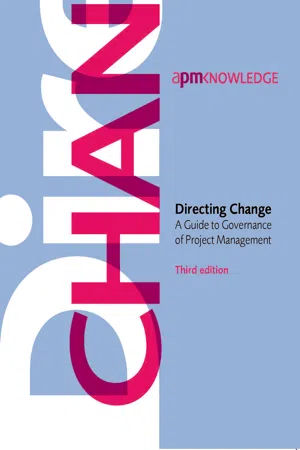
The latest edition has been fully updated to include:New codes of governance and lessons of governance success and failures.Feedback from practitioners, including a new section on culture and ethics.Descriptions and checklists for key governance roles and activities.Written by experience change practitioners from APM's Governance SIG, the guide is designed to help all those with governance roles, from boards of directors and sponsors to project managers and independent reviewers.First published in 2004, Directing Change quickly established a reputation as the go-to reference for the governance of complex change. The third edition continues that tradition, remaining concise, but 'even more relevant and user-friendly'.
- English
- ePUB (mobile friendly)
- Available on iOS & Android
eBook - ePub
Directing Change, 3rd edition
About this book
Information
1
Purpose
Governance has been shown to have the most significant impact on the successful outcomes of complex organisational change and projects.
The purpose of the guide is to enable those with corporate governance roles to adopt optimal practices for the governance of complex change.
Good governance involves aligning the interests of boards, directors, portfolio, programme and project teams and wider stakeholders. Governance has been shown, both in research and practice, to have a significant impact on the successful outcomes of complex change. This applies to both internal investments by organisations and contracts for supply. Improving governance should be a strategic imperative for all organisations.
Adherence to this guide will help those with governance roles (e.g. boards of directors, sponsors, project managers, independent reviewers and others with governance responsibilities) to:
■assure themselves and others that robust governance requirements are applied across all the complex change in their organisation;
■optimise their portfolio of change to maximise achievement of strategic objectives;
■maximise the benefits realised from complex projects and programmes;
■improve accountability, engagement with stakeholders and relationships with staff, customers, suppliers and regulators;
■minimise risks to the organisation arising from complex change and support the sustainable development of the organisation;
■avoid many of the common failures in portfolio, programme and project performance and gain increased visibility of progress.
As the focus of this document is the achievement of coherence between corporate governance and governance of complex change, it is necessary to clarify activities not specifically covered by this guide. This document does not seek to:
■duplicate or replace existing guidance and standards on corporate governance;
■provide guidance on ‘business as usual’ or other non-project based activities of organisations;
■provide guidance on project or change management methods, other than those directly related to the purposes of sound governance;
■provide guidance on detailed methods that can be used to manage individual projects;
■prescribe how to implement this guidance across the enterprise – that will depend on factors specific to each organisation;
■provide governance improvement methods, plans and approaches.
2
Introduction
A glossary of key terms used in this guide can be found in appendix 1.
2.1 Context
“Corporate governance involves a set of relationships between a company’s management, its board, its shareholders and other stakeholders. Corporate governance also provides the structure through which the objectives of the company are set, and the means of attaining those objectives and monitoring performance are determined.”
OECD Principles of Corporate Governance 2015
OECD Principles of Corporate Governance 2015
The Organisation for Economic Cooperation and Development (OECD) principles of corporate governance (2015) includes example phrases such as:
■efficient allocation of resources;
■consistent with the rule of law;
■support effective supervision and enforcement;
■provide sound incentives throughout the investment chain;
■effective monitoring of management by the board;
■the board’s accountability to the company;
■the board should apply high ethical standards;
■overseeing the process of disclosure and communications.
These definitions and phrases apply equally to the governance of complex change as to an organisation’s on-going business.
For brevity this guide uses the terms:
■complex change to refer to transformation, major change initiatives, projects, programmes and portfolios, and;
■complex change management for the management of complex change;
■governance to mean that applied to complex change management. The guide uses the term corporate governance specifically where it applies to governance of the organisation as a whole;
■‘board’ to refer to top management boards, typically the board of directors and their equivalents in the public sector and to councils in companies limited by guarantee. It specifically does not refer to project boards.
Different organisations employ different governance frameworks; and different types of governance may exist within an organisation. In preparing this guide, the requirements of all medium to large organisations, listed and private companies, government organisations and charities have been considered. The principles underlying the effective governance of complex change are common to all such entities. Hence, in this guide we refer to ‘the organisation’ or ‘enterprise’ rather than ‘the company’.
Codes of corporate governance have been developed primarily for listed com-panies. The UK codes specifically refer to shareholders and investors as the ultimate body to which organisational boards are accountable. There is a growing acceptance of a more ‘enlightened’ view that the directors and the board should also take into account wider stakeholder interests in promoting the success of the company. Equally public-sector and charity-sector organisations hav...
Table of contents
- Cover
- Half-Title Page
- Copyright
- Contents
- Foreword
- Acknowledgements
- 1 Purpose
- 2 Introduction
- 3 Key governance roles
- 4 Components of effective governance
- 5 Principles of effective governance
- Appendix 1 Glossary of key terms
- Appendix 2 Role-based checklists
- Appendix 3 References and further reading
- Appendix 4 Cross-reference to UK Corporate Governance Code
Trusted by 375,005 students
Access to over 1.5 million titles for a fair monthly price.
Study more efficiently using our study tools.
Frequently asked questions
Yes, you can cancel anytime from the Subscription tab in your account settings on the Perlego website. Your subscription will stay active until the end of your current billing period. Learn how to cancel your subscription
No, books cannot be downloaded as external files, such as PDFs, for use outside of Perlego. However, you can download books within the Perlego app for offline reading on mobile or tablet. Learn how to download books offline
Perlego offers two plans: Essential and Complete
- Essential is ideal for learners and professionals who enjoy exploring a wide range of subjects. Access the Essential Library with 800,000+ trusted titles and best-sellers across business, personal growth, and the humanities. Includes unlimited reading time and Standard Read Aloud voice.
- Complete: Perfect for advanced learners and researchers needing full, unrestricted access. Unlock 1.5M+ books across hundreds of subjects, including academic and specialized titles. The Complete Plan also includes advanced features like Premium Read Aloud and Research Assistant.
We are an online textbook subscription service, where you can get access to an entire online library for less than the price of a single book per month. With over 1.5 million books across 990+ topics, we’ve got you covered! Learn about our mission
Look out for the read-aloud symbol on your next book to see if you can listen to it. The read-aloud tool reads text aloud for you, highlighting the text as it is being read. You can pause it, speed it up and slow it down. Learn more about Read Aloud
Yes! You can use the Perlego app on both iOS and Android devices to read anytime, anywhere — even offline. Perfect for commutes or when you’re on the go.
Please note we cannot support devices running on iOS 13 and Android 7 or earlier. Learn more about using the app
Please note we cannot support devices running on iOS 13 and Android 7 or earlier. Learn more about using the app
Yes, you can access Directing Change, 3rd edition by Association for Project Management (APM) in PDF and/or ePUB format, as well as other popular books in Business & Project Management. We have over 1.5 million books available in our catalogue for you to explore.