- 180 pages
- English
- ePUB (mobile friendly)
- Available on iOS & Android
eBook - ePub
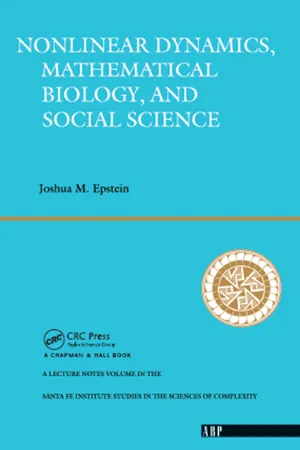
Nonlinear Dynamics, Mathematical Biology, And Social Science
About this book
This book is based on a series of lectures on mathematical biology, the essential dynamics of complex and crucially important social systems, and the unifying power of mathematics and nonlinear dynamical systems theory.
Trusted by 375,005 students
Access to over 1.5 million titles for a fair monthly price.
Study more efficiently using our study tools.
Information
LECTURE 1
On The Mathematical Biology of Arms Races, Wars, and Revolutions
In this opening lecture, I will attempt a unifying overview of certain social phenomena—war, arms racing, and revolution—from the perspective of mathematical biology, a field which, in my view, must ultimately subsume the social sciences.[3] Unfortunately, few social scientists are exposed to mathematical biology, specifically the dynamical systems perspective pioneered by Alfred Lotka, Vito Volterra, and others. In turn, few mathematical biologists have considered the application of mathematical biology to problems of human society.[4]
Particularly in areas of interstate and intrastate conflict is there a need to explore formal analogies to biological systems. On the topic of animal behavior and human warfare, the anthropologist Richard Wrangham observes,
“The social organization of thousands of animals is now known in considerable detail. Most animals live in open groups with fluid membership. Nevertheless there are hundreds of mammals and birds that form semi-closed groups, and in which long-term intergroup relationships are therefore found. These intergroup relationships are known well. In general they vary from benignly tolerant to intensely competitive at territorial borders. The striking and remarkable discovery of the last decade is that only two species other than humans have been found in which breeding males exhibit systematic stalking, raiding, wounding and killing of members of neighboring groups. They are the chimpanzee (Pan troglodytes) and the gorilla (Pan gorilla beringei) (Wrangham, 1985). In both species a group may have periods of extended hostility with a particular neighboring group and, in the only two long-term studies of chimpanzees, attacks by dominant against subordinate communities appeared responsible for the extinction of the latter.
“Chimpanzees and gorillas are the species most closely related to humans, so close that it is still unclear which of the three species diverged earliest (Ciochon & Chiarelli, 1983). The fact that these three species share a pattern of intergroup aggression that is otherwise unknown speaks clearly for the importance of a biological component in human warfare” (Wrangham, 1988, p.78).
Although man has engaged in arms racing, warring, and other forms of organized violence for all of recorded history, we have comparatively little in the way of formal theory. Mathematical biology may provide guidance in developing such a theory. Wrangham writes, “Given that biology is in the process of developing a unified theory of animal behavior, that human behavior in general can be expected to be understood better as a result of biological theories, and that two of our closest evolutionary relatives show human patterns of intergroup aggression, there is a strong case for attempting to bring biology into the analysis of warfare. At present, there are few efforts in this direction.”[5] I would like to see more effort, specifically more mathematical effort, in this direction and hope to stimulate some interest among you. To convince you that there might conceivably be some “unified field theory” worth pursuing, I want to share some observations with you. To set them up, a little background is required.
The fundamental equations in the mathematical theory of arms races are the so-called Richardson equations, named for the British applied mathematician and social scientist Lewis Frye Richardson, who first published them in 1939.[6] The fundamental equations in the mathematical theory of combat (warfare itself, as against peacetime arms racing) were published in 1916 by Frederick William Lanchester.[7] The formal theory of interstate conflict, to the extent there is one, rests on these twin pillars, if you will. Meanwhile, the classic equations of mathematical ecology are the Lotka-Volterra equations.
In light of the remarks above, I find the following fact intriguing: The Richardson and Lanchester models of human conflict are, mathematically, specializations of the Lotka-Volterra ecosystem equations.
Before proceeding, I must make one point unmistakably clear. I do not claim that any of these models is really “right” in a physicist’s sense. They are illuminating abstractions. I think it was Picasso who said, “Art is a lie that helps us see the truth.” So it is with these simple models. They continue to form the conceptual foundations of their respective fields. They are universally taught; mature practioners, knowing full-well the models’ approximate nature, nonetheless entrust to them the formation of the student’s most basic intuitions. And this because, like idealizations in other sciences—idealizations that are ultimately “wrong”—they efficiently capture qualitative behaviors of overarching interest. That these ecosystem and, say, arms race equations should look at all alike is unexpected. That, on closer inspection, they are virtually identi...
Table of contents
- Cover
- Half Title
- Title Page
- Copyright Page
- Dedication
- Table of Contents
- Introduction
- LECTURE 1: On The Mathematical Biology of Arms Races, Wars, and Revolutions
- LECTURE 2: An Adaptive Dynamic Model of Combat
- LECTURE 3: Imperfect Collective Security and Arms Race Dynamics: Why a Little Cooperation Can Make a Big Difference
- LECTURE 4: Revolutions, Epidemics, and Ecosystems: Some Dynamical Analogies
- LECTURE 5: A Theoretical Perspective on The Spread of Drugs
- LECTURE 6: An Introduction to Nonlinear Dynamical Systems
- References
- Index
Frequently asked questions
Yes, you can cancel anytime from the Subscription tab in your account settings on the Perlego website. Your subscription will stay active until the end of your current billing period. Learn how to cancel your subscription
No, books cannot be downloaded as external files, such as PDFs, for use outside of Perlego. However, you can download books within the Perlego app for offline reading on mobile or tablet. Learn how to download books offline
Perlego offers two plans: Essential and Complete
- Essential is ideal for learners and professionals who enjoy exploring a wide range of subjects. Access the Essential Library with 800,000+ trusted titles and best-sellers across business, personal growth, and the humanities. Includes unlimited reading time and Standard Read Aloud voice.
- Complete: Perfect for advanced learners and researchers needing full, unrestricted access. Unlock 1.5M+ books across hundreds of subjects, including academic and specialized titles. The Complete Plan also includes advanced features like Premium Read Aloud and Research Assistant.
We are an online textbook subscription service, where you can get access to an entire online library for less than the price of a single book per month. With over 1.5 million books across 990+ topics, we’ve got you covered! Learn about our mission
Look out for the read-aloud symbol on your next book to see if you can listen to it. The read-aloud tool reads text aloud for you, highlighting the text as it is being read. You can pause it, speed it up and slow it down. Learn more about Read Aloud
Yes! You can use the Perlego app on both iOS and Android devices to read anytime, anywhere — even offline. Perfect for commutes or when you’re on the go.
Please note we cannot support devices running on iOS 13 and Android 7 or earlier. Learn more about using the app
Please note we cannot support devices running on iOS 13 and Android 7 or earlier. Learn more about using the app
Yes, you can access Nonlinear Dynamics, Mathematical Biology, And Social Science by Joshua M. Epstein in PDF and/or ePUB format, as well as other popular books in Mathematics & Mathematics General. We have over 1.5 million books available in our catalogue for you to explore.