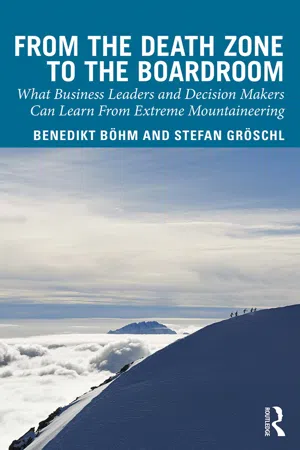
This book explores experiences and reflections of an extreme sports athlete within the context of business, the latest scholarly works and research on topics that are relevant and timely for today's managers and business leaders, and the daily challenges they face.
Conviction, discipline, managing fear in high stakes situations, leading, working with teams and making decisions in extreme conditions - what will help you in extreme sports can also get you to your goals in business. In From the Death Zone to the Boardroom, speed ski mountaineer Benedikt Boehm tells gripping and inspirational stories about his fears, pain, suffering and facing death during his expeditions to some of the world's highest mountains. Throughout, his co-author and professor of leadership and management, Stefan Gröschl integrates scholarly ideas and works beyond traditional business boundaries providing you with unusual insights and thought-provoking alternatives for managing your business.
The combination of extreme athlete, company leader, and business school scholar is unique, and ensures the relevance and timeliness of the selected themes, and the pellucidity of the conceptual context to a readership beyond academic boundaries. The result is advice that is both highly personal and empirically tested; a combination that makes for an absorbing read and unparalleled advice for you and your career.
SUBTEXT: The interests of a writer and the interests of his readers are never the same and if, on occasion, they happen to coincide, this is a lucky accident1
We hope that our book is one of these lucky accidents described by American English poet W.H. Auden, and that you find this book as interesting, informative, and entertaining as we intended it to be. Our book explores Ben’s experiences and reflections as an extreme sports athlete within the context of selective scholarly works and research from a wide range of disciplines beyond the general business and management literature.
Over the years, business schools and management scholars have been producing research in insulation from the business world.2 Many scholars have developed ‘knowledge of business rather than for business’.3 They write in an all-exclusive academic writing style verbosing arguments and complexifying discussions. The turgidities blur what matters to business men and women. Those management ideas which seep through are often short lived due to today’s rapidly changing technologies and social developments. One day, strategic thinking gives ‘the competitive edge in business’,4 the next day it is all about execution.5
In this textbook, we focus on topics and concepts that are independent from technological and social changes. We discuss aspects that matter to every business leader and decision maker. Facing great uncertainties and unpredictability are only some of the commonalities extreme sport athletes and business leaders share, and that are addressed in this book. Our chapters about fear, pain, suffering, and failure introduce themes that are not your ‘usual suspects’ in business and management textbooks. They provide uncommon insights and alternative perspectives about managing yourself and leading others. They are illustrative and thought-provoking alternatives that challenge traditional business mentalities and business as usual modes.
Each chapter starts with Ben’s experiences and reflections from the world of extreme skiing and mountaineering relevant to the chapter’s theme. Ben’s accounts are at times funny, sad, upsetting, shocking, exciting, or tense. They reflect and illustrate the many ups and downs that come with speed mountaineering in extreme conditions. They are moving and inspiring; and they all have commonalities, parallels, or emblematic and literal connotations to the business world.
Photo 1.1 Ski touring in the upper glaciers at a height of 6300m on Manaslu (8163m).
In the second part of each chapter, Stefan puts Ben’s experiences and reflections into a business context and makes bisociative connections to businesses and their leaders. Stefan refers to scholarly works from a wide range of disciplines including economics, philosophy, psychology, physiology, and sociology, highlighting their managerial and organizational implications for leaders and decision makers. Despite the complexity of some of the concepts, we have tried to maintain a writing style that is inclusive, pellucid, and to the point.
The combination of extreme athlete, company leader, and business school scholar as our professional backgrounds is unique. We met for the first time in the late 1990s at Oxford Brookes University in England. Ben was a freshman and Stefan was about to finish his PhD. Our paths split when Stefan took on a faculty post in Canada and Ben went to the USA for a student exchange program. In 2013 our paths crossed again after Stefan had read Ben’s book about his experiences on Manaslu where an avalanche killed and wounded numerous mountaineers. By then Stefan had increasingly used sport cases as a means to teach management practices and organizational behaviours. And Ben had established himself as a successful keynote speaker presenting his adventures and sharing his experiences in companies across Germany. It did not take much thinking for us to recognize the synergies that could emerge from a joint collaboration.
Our different professional backgrounds ensure the relevance and timeliness of the selected themes, and permit the pellucidity of the conceptual context to a readership beyond academic boundaries. Our different backgrounds also strengthen the bisociative associations between extreme sports, and concepts and ideas framing and shaping human behaviours and organizational practices and processes. Finding parallels and connecting the seemingly different worlds of extreme sports and business makes our book unusual and different to most other textbooks in (extreme) sports and business. Studies that have used mainstream sports data to advance management theory are still embryonic. And although extreme context research is growing and matters, its fragmentation ‘risks limiting its potential for advancing management and organization studies’.6
Our book can be considered as a starting point and orientation for business men and women wanting to advance their own development and that of their peers and organizations. This is why we address each chapter theme from an individual and organizational perspective. Although many textbooks like to propose a five or ten-steps-to-success fits all approach, we provide detailed endnotes and suggestions for further readings instead, and takeaways summing up the key learning points at the end of each chapter. Chapters are written independently from each other, which means that certain terms or scholars are briefly reintroduced.
Following this introduction we start the adventure in Chapter 2 by exploring how to achieve the seemingly unthinkable and how to reach exceptional goals. It is not only a decisive process in extreme adventure performances but one that is also critical for every business man and woman and their career development. In Chapter 3 we discuss how to deal with uncertainty and the unknown. Even though decision makers and organizations operate today in a world that has become increasingly uncertain, most companies and their leaders continue to be hugely unprepared for the unpredictable. In Chapter 4 we explore the many facets and implications of fear of the known and unknown – fear as a warning signal, as a self-analytical tool, and as a motivational method. Chapter 5 addresses a topic against which companies are profoundly biased. We show that failure is an opportunity for personal and professional self-development and growth, for learning and change instead of one of blaming.
Despite the evidence that death awareness is an integral part of the aging process, and despite that there are numerous professions and businesses in which death and mortality play salient roles in the daily routines of their decision makers and employees, organizational scholars have rarely addressed and explored the role of death awareness, death, and mortality in organizational life. In Chapter 6 we make up for this scholarly shortcoming. And similar to the case of mortality, we want to show you some of the positive implications of suffering – our theme for Chapter 7. Whereas organization scholars have largely focused on the negative consequences of mental and physical suffering at the workplace, we show how suffering for a particular goal and reason can positively influence your willpower, self-control, and state of mind. In Chapter 8 we expand the understanding of leadership and decision making in extreme conditions and contexts. Much has been written about leadership and decision making in a general business and management context, however, in extreme conditions such as the death zone the two topics start to show very different dynamics. So far, however, within the leadership field, leadership in extreme contexts has been one of the least researched areas, whereas decision making under extreme conditions has been predominantly discussed in specialized fields such as the military.
In our final chapter we explore speed and lightness. As has been the case for many of the themes that we address throughout this book, there are only few management and organization studies, texts, or concepts which have addressed lightness and speed in the conventional sense or in the way described by Ben in the context of mountaineering. This came as a surprise to us; and we hope we can show you why in Chapter 9. The final chapter is about Ben. In times in which work life balance is on everybody’s mind, Stefan felt that Ben should share how he manages to train and prepare for an 8000m speed ascent, run a global business, and have a family with three little kids and a wife at the same time. Of course this last Chapter 10 also addresses some other key issues that are on many business men and women’s minds including topics such as sustainability and responsible leadership. Enjoy the book, and may this become one of Auden’s lucky accidents.
Photo 1.2 Working dinner at Ben’s place in Munich
NOTES
1Reading –An essay by W. H. Auden.
2 Bouchikhi, H. and Kimberly, J. 2015. Soapbox: Why business schools are running in place? Financial Times. At http://www.ft.com/cms/s/2/2707b720-2007-11e5-ab0f-6bb9974f25d0.html#axzz3iVtkIxwk.
3 Starkey, K. and Stempest, N. 2008. A clear sense of purpose? The evolving role of the business school. Journal of Management Development, 27(4), 379.
4 Dixit, A. and Nalebuff, B. 1991. Thinking strategically. New York: W.W. Norton & Company.
5 Interview with Carlos Ghosn, CEO of Renault-Nissan at Stanford Business School. 2014. Carlos Ghosn: Five percent of the challenge is the strategy. Ninety-five percent is the execution. At https://www.gsb.stanford.edu/insights/carlos-ghosn-five-percent-challenge-strategy-ninety-five-percent-execution
6 Hannah, S., Uhl-Bien, M. Avolio, B. and Cavarretta, F. 2009. A framework for examining leadership in extreme contexts. The Leadership Quarterly, 20, 897–919.
CHAPTER TWO
About the unthinkable
SUBTEXT: To realize your unthinkable goals you have to set yourself unthinkable goals
On August 4, 2006, at 12:31pm an unthinkable goal of mine came true. I ski mountaineered my first 8000m mountain, Gasherbrum 2, at 8035m. Ski mountaineering is a skiing discipline in which you climb the mountain either on skis with removable climbing skins or when too steep by carrying the skis, and then ski down. Together with my friend Sebastian ‘Basti’ Haag we speed climbed Gasherbrum 2 in 12.5 hours and then skied back down to advanced Basecamp (ABC). Neither when I started cross country skiing in 1988 as an 11-year-old boy, nor as a ski touring athlete in my early 20s did I imagine to speed climb and stand up on an 8000m mountain peak one day.
It was not until the ski mountaineering world championship in 2004 in Vall d’Aran, Spain, and during my races at the famous ‘Patrouille des Glaciers’,1 that I discovered my true passion for expeditions and for shifting the methodology of ski mountaineering racing into higher altitudes. It was also during that time that I sta...
Table of contents
Cover
Half Title
Title Page
Copyright Page
Table of Contents
Chapter 1 About the Book and the Authors
Chapter 2 About the Unthinkable
Chapter 3 About Uncertainty
Chapter 4 About Fear
Chapter 5 About Failure
Chapter 6 About Death and Mortality
Chapter 7 About Suffering
Chapter 8 About Leading Teams and Making Decisions in Extreme Conditions
Chapter 9 About Speed and Lightness
Chapter 10 About Managing My Many Lives
Index
Frequently asked questions
Yes, you can cancel anytime from the Subscription tab in your account settings on the Perlego website. Your subscription will stay active until the end of your current billing period. Learn how to cancel your subscription
No, books cannot be downloaded as external files, such as PDFs, for use outside of Perlego. However, you can download books within the Perlego app for offline reading on mobile or tablet. Learn how to download books offline
Perlego offers two plans: Essential and Complete
Essential is ideal for learners and professionals who enjoy exploring a wide range of subjects. Access the Essential Library with 800,000+ trusted titles and best-sellers across business, personal growth, and the humanities. Includes unlimited reading time and Standard Read Aloud voice.
Complete: Perfect for advanced learners and researchers needing full, unrestricted access. Unlock 1.4M+ books across hundreds of subjects, including academic and specialized titles. The Complete Plan also includes advanced features like Premium Read Aloud and Research Assistant.
Both plans are available with monthly, semester, or annual billing cycles.
We are an online textbook subscription service, where you can get access to an entire online library for less than the price of a single book per month. With over 1 million books across 990+ topics, we’ve got you covered! Learn about our mission
Look out for the read-aloud symbol on your next book to see if you can listen to it. The read-aloud tool reads text aloud for you, highlighting the text as it is being read. You can pause it, speed it up and slow it down. Learn more about Read Aloud
Yes! You can use the Perlego app on both iOS and Android devices to read anytime, anywhere — even offline. Perfect for commutes or when you’re on the go. Please note we cannot support devices running on iOS 13 and Android 7 or earlier. Learn more about using the app
Yes, you can access From the Death Zone to the Boardroom by Benedikt Boehm,Stefan Groschl in PDF and/or ePUB format, as well as other popular books in Business & Business General. We have over one million books available in our catalogue for you to explore.