- 192 pages
- English
- ePUB (mobile friendly)
- Available on iOS & Android
eBook - ePub
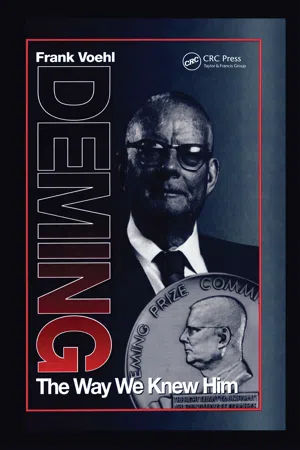
Deming The Way We Knew Him
About this book
Perhaps no other person in the history of modern business has so profoundly affected the methods of quality improvement in industry than W. Edwards Deming. The subject of many books, articles, and television documentaries, Dr. Deming has become the world-recognized leader of the quality movement in industry.
Tools to learn more effectively

Saving Books

Keyword Search

Annotating Text

Listen to it instead
Information
Part One
THE CORNERSTONES

Deming’s Fourteen Points System Diagram
Chapter One
Adopt the New Philosophy
“America must adopt the new philosophy. We are in a new economic age. Western management must awaken to the challenge, must learn to take responsibility and leadership for change.”
Dr. Deming often reminded us that quality is like a new religion. As such, it requires a complete transformation of mind and heart—a metanoia, as he sometimes called it—starting with management. He constantly reminded us that between thirty and forty percent of an American business may be lost in what Dr. Armand Feigenbaum refers to as the so-called “hidden plant,” that is, a factory that exists to perform rework on unsatisfactory parts, reinspect or retest rejected parts, and rework field returns. In other words, the part of the business that operates to process the defects, rework, and scrap—the junk.
The problem begins with attitude—on the part of both management and the company. Accepting defective materials, poor workmanship, and inattentive service eventually leads to poor quality and lower productivity, and only a dismantling of the structures of current management practice will do, Dr. Deming taught. He often said that we have to undergo a complete demolition of the American style of management which had spread in some form or another to the entire Western world. Best efforts and hard work will not suffice, nor will new machinery, computers, automation, or gadgets, he argued. The central idea that he taught and believed is that we are being ruined by best efforts put forth with the best of intentions but without the guidance of a new philosophy—a theory of management—for the optimization of a system. One of his favorite expressions was, “there is no substitute for knowledge.”
In his seminars and lectures, he pointed out over and over again that the cost of living is inversely dependent upon the goods and services that a given amount of money will buy. On more than one occasion, I had the opportunity to discuss this paradox with Dr. Myron Tribus, often at 1 p.m. in his study, with a final pot of coffee on the stove. Myron helped to explain Dr. Deming’s ideas on this subject as follows: In a competitive situation, profits for many companies come by mortgaging the future and cutting the costs of R&D, training, and other forms of competitive marketing research. In many cases, management is convinced that the installation of some new and complex equipment is the solution to their productivity problems. Paradoxically, however, by increasing the capital investment per worker, productivity is often lowered, instead of raised, because of poor management. This is due to the tremendous influence and leveraging effect of the management cycle. The greater the capital investment, the lower the productivity—a vicious cycle.
To help us better understand this principle, in Chapter 6 of her first book, The Deming Management Method, Mary Walton relates a story that Dr. Deming tells, about a “beer manufacturer who boasted that he had no problem with beer cans because his suppliers replaced those that were defective. It never occurred to him that he was paying for the defective cans, because their cost was included in the wholesale price. Deming strongly believed, and lived his belief, that consumers of goods and services end up paying for delays and mistakes, which ultimately reduce their standard of living and that of society as a whole.”
Mary Walton first heard of Dr. Deming on a trip to Japan in the early 1980s while researching a story for the Philadelphia Inquirer. The subject was workers at Kawasaki Heavy Industries, which had recently won a contract to build subway cars for the Philadelphia mass transit system. She tells how she thought that Deming had passed away years ago or drifted out of sight after educating the Japanese, as his name was not exactly a household word in America at the time. She was surprised to find him alive and well and coming to Philadelphia in 1984 to conduct a four-day seminar for Maureen Glassman of PACE. The story of that first meeting and the relationship that ensued is a compelling one, as only Mary can tell it.
A Journalist Remembers Dr. Deming
by Mary Walton
No, Cecelia Kilian told me, she could not possibly arrange an interview with her boss, W. Edwards Deming. He simply did not have time. No, I could not ride the plane with him from Philadelphia to San Diego. He needed to rest and reflect. Yes, however, I could sit through his seminar, although I would have to arrange it with George Washington University and pay whatever they asked.
Didn’t these people know how the game was played? I was a reporter for the Sunday magazine of The Philadelphia Inquirer, whose story would reach a million households. The magazine was under constant pressure from press agents seeking coverage such as I proposed, that is to say, a long profile, possibly even a cover story. There were people who would do anything for this kind of publicity. And I couldn’t even get an interview?
This was my introduction to the unorthodox world of Dr. Deming and the beginning of a ten-year association until his death in December 1993- Knowing him would change my life, both personally and professionally, as it did that of so many others. I would write two books with his support and become known, to my amazement, as an expert in quality.
The beginning seemed anything but auspicious. It was January 1984, and Dr. Deming had emerged just over three years earlier from the obscurity that had dogged him for decades in the United States despite his distinguished reputation in Japan. He was coming to Philadelphia at the invitation of the Chamber of Commerce to give a three-hour preview of his four-day seminar scheduled a few months hence in the spring of 1984. Deming arrived in Philadelphia with a Ford Company vice-president and several other executives to bear witness to the advances his method offered. After Philadelphia, his schedule called for a seminar in San Diego, which I had made arrangements to attend. My mission was to write a story in advance of his spring appearance, which would kick off the quality and productivity campaign that later became institutionalized as PACE (the Philadelphia Area Council for Excellence).
Mary Walton is a well-known journalist and author who has published two books about the Deming Method. She holds an MBA from Harvard University and is considered by many to be a quality guru in her own right.
When Dr. Deming arrived in Philadelphia, I introduced myself and said I would see him in San Diego. “That’s wonderful,” he boomed. “Why don’t you ride the plane with me?” So there, Ceil!
I would come to understand that in turning down my request for an interview, his loyal secretary Ceil was merely trying to protect him from a stream of desperate petitioners who waylaid him at every turn, for every reason imaginable for advice on their business, not to mention others who sought his endorsement for any number of projects.
Airborne for California, I managed to sit at Deming’s side in the first-class section for two hours, until the flight attendant directed me back to my coach seat. He introduced me to the principles of Statistical Quality Control, expounding on common causes and special causes of variation, management responsibility for quality, the futility of performance ratings, and so on. I had no idea what he was talking about.
In San Diego things became somewhat more clear. I wrote the story, a cover story as it turned out, “W. Edwards Deming Wants to Make America Work Again.” It was published on March 11, 1984 and generated some fifty calls and letters the first week, which was more reader response than anything I had written to date. (The previous record-holder was an article entitled “Why Women Hate Their Gynecologists.” In both cases, it was clear I had touched a chord.)
Thus encouraged, I proposed to Dr. Deming that we do a book on his method. “By W. Edwards Deming and Mary Walton” was how I saw it. He had liked the article and thought a book was a good idea. I contacted an agent, who said that the proposal was worth a $200,000 advance. To a $40,000-a-year reporter, this was a fortune. I called Dr. Deming with the good news. “An agent? I never deal with an agent,” he rumbled in that deep, raspy voice I was getting to know so well. I learned that he had his own publisher, thank you very much, an academic press, and that in our discussion he had meant only that he would help me. Moreover, he was then in the midst of his own book, the forthcoming Out of the Crisis.
For a book not by but about Deming and his method, the price dropped to $15,000. Even at that, many publishers turned down the proposal. “Too smokestacky,” one said, voicing the common objection. This was the mid-1980s, and quality was something that seemed relevant only to cars, electronics, steel, and other industrial products.
Dr. Deming made good on his pledge of support. I attended additional seminars and traveled with him to several clients, including Ford. He loaned me a mimeographed copy of his diaries from Japan and provided introductions to people he thought would be helpful. He also granted his scarcest resource: time.
My visits to him on occasional Saturdays always followed the same pattern. I would arrive at his Washington home by train from Philadelphia in late morning. We would spend several hours talking, and then we would go to the Cosmos Club for an early dinner. The Cosmos Club was a genteel men’s establishment with an aging clientele and a Southern ambiance from the days when a more insular Washington mirrored its geographical location. Black waitresses in white aprons served popovers before dinner. Dr. Deming pressed martinis on his guest and, after dinner, hazelnut ice cream. Once we were accompanied by his wife, Lola and my daughter, Sarah, a budding teenager. Afterward, he often asked about her by name. I marveled that he remembered.
Despite his failing eyesight, in those days he still piloted his massive 1969 white Lincoln Continental through Washington’s snarled streets with blissful disregard for other traffic. After one harrowing ride in the rain, I called his daughter Linda Haupt. “You’ve got to stop him from driving,” I told her. “I’ve tried,” she wailed. It was not easy even for a family member to make Dr. Deming do anything. One time we rode the bus. “I ride for twenty-five cents,” he said with satisfaction.
Following dinner, I would take a cab to Union Station and a train back to Philadelphia. Dr. Deming always called the next day to make sure I had arrived home safely.
In writing the book, the first hurdle was to secure Dr. Deming’s approval for my interpretation of his philosophy. We started with what it means to “Adopt the New Philosophy.” We proceeded word by word, chapter by chapter, through each of his Fourteen Points, one by one, and then on to the Deadly Diseases and Obstacles. The problem was that he was no more patient with me than with those unfortunate people who raised their hands at his seminars, only to be unceremoniously dismissed. “Weren’t you listening?” he would sometimes say, or, “I don’t understand what you mean.” Along the way, I discovered that Dr. Deming disliked certain words intensely, one of which was “implement.” “A farming tool,” he scrawled in the margin where he had crossed it out. He disapproved of contractions, and eliminated them throughout the manuscript—in his and other people’s quotations.
Once we had an acceptable manuscript, I faced another hurdle. His publisher, Massachusetts Institute of Technology’s Center for Advanced Engineering Study, then under the direction of Myron Tribus, would not grant permission to quote from his book of seminars, claiming copyright of both. Perhaps they believed mine to be a competitive work. Not until my publisher, Dodd, Mead & Company, halted publication of my book, plunging me into despair, did Dr. Deming step in and personally sign the permission forms. Then a difficulty arose with Dr. Deming’s foreword, which was written in old-fashioned prose. The editor drastically revised it against my advice. An irate Dr. Deming withdrew the foreword. With it went his stamp of approval for the book. The editor immediately yielded, but it was I who had to beg for its reinstatement.
As the book neared publication, I was beset by other difficulties, one of which was that Dodd, Mead was in financial trouble. The company first fired my editor and then the art director and marketing director. Within a year of the book’s appearance in 1986, the whole company went belly up. Fortunately, Putnam Publishing Group bought The Deming Management Method. Once rescued, the book escalated in sales, reflecting its subject’s growing popularity.
Three years later I approached Dr. Deming for help with a second book on quality, a study of companies that were laboring to follow his teachings. “People would read my first book, then go to your seminars, but they feel lost,” I told him. “They say,” This sounds wonderful, but tell me where it’s working. Who else can I talk to? Where can I find out what companies are adopting the new philosophy?’”
Dr. Deming snapped, “Well, that’s a joke. There aren’t any.” He conceded, however, that “bits and pieces” of his philosophy were finally being implemented. We started with Florida Power and Light, Hospital Corporation of America, Bridgestone Tennessee (Tri-Cities, Tennessee), the U.S. Navy, and Globe Metallurgical Inc. The book became known as Deming Management at Work. As he did for our first book, he did for this one also. He ended the foreword with a challenge:
The change required is transformation, change of state, metamorphosis, in industry, education, and government. The transformation will restore the individual by the abolishment of grades in school on up through the university; by abolishment of the annual appraisal of people on the job, MBO, quotas for production, incentive pay, competition between people, competition between divisions, and other forms of sub-optimization. The transformation is not stamping out fires, solving problems, nor cosmetic improvements. The transformation must be led by top management.
We were off and running. As I listen to his voice on that tape from 1989, I feel even more sadness than I did on learning of his death. I had not seen much of him in recent years. Our last encounter was in July 1993, five months before he died, at a seminar in Detroit. I arrived unannounced and I don’t believe he recognized me. But thinking of him again brings back memories of his brilliance, his eccentricity, and his kindness to a journalist who had stumbled into the new philosophy of the quality movement and whose life would never be the same.
A conjurer may pull a rabbit out of a hat, but he cannot pull quality out of a hat. The biggest problem that most any company in the western world faces is not its competitors nor the Japanese. The biggest problems are self-inflicted, created right at home by management that are off course in the competitive world of today. To get back on track a new philosophy is needed—a philosophy of continuous improvement, starting with management.W. Edwards Deming
From the Foreword to
The Deming Management Method
Chapter Two
Institute Leadership
“America must institute leadership. The aim of leadership should be to help people and machines and gadgets do a better job. Leadership of management is in need of overhaul as well as leadership of production workers.”
Dr. Deming taught that the job of the supervisor is not to tell people what to do or to punish, but to lead. To him, leading consisted of helping people do a better job and learning by objective methods wh...
Table of contents
- Cover
- Half Title
- Title Page
- Copyright Page
- Dedication
- Table of Contents
- Foreword
- Preface
- Credits
- Prologue
- Part One. The Cornerstones
- Part Two. The Stepping Stones
- Part Three. The Milestones
- Epilogue
Frequently asked questions
Yes, you can cancel anytime from the Subscription tab in your account settings on the Perlego website. Your subscription will stay active until the end of your current billing period. Learn how to cancel your subscription
No, books cannot be downloaded as external files, such as PDFs, for use outside of Perlego. However, you can download books within the Perlego app for offline reading on mobile or tablet. Learn how to download books offline
Perlego offers two plans: Essential and Complete
- Essential is ideal for learners and professionals who enjoy exploring a wide range of subjects. Access the Essential Library with 800,000+ trusted titles and best-sellers across business, personal growth, and the humanities. Includes unlimited reading time and Standard Read Aloud voice.
- Complete: Perfect for advanced learners and researchers needing full, unrestricted access. Unlock 1.4M+ books across hundreds of subjects, including academic and specialized titles. The Complete Plan also includes advanced features like Premium Read Aloud and Research Assistant.
We are an online textbook subscription service, where you can get access to an entire online library for less than the price of a single book per month. With over 1 million books across 990+ topics, we’ve got you covered! Learn about our mission
Look out for the read-aloud symbol on your next book to see if you can listen to it. The read-aloud tool reads text aloud for you, highlighting the text as it is being read. You can pause it, speed it up and slow it down. Learn more about Read Aloud
Yes! You can use the Perlego app on both iOS and Android devices to read anytime, anywhere — even offline. Perfect for commutes or when you’re on the go.
Please note we cannot support devices running on iOS 13 and Android 7 or earlier. Learn more about using the app
Please note we cannot support devices running on iOS 13 and Android 7 or earlier. Learn more about using the app
Yes, you can access Deming The Way We Knew Him by Frank Voehl in PDF and/or ePUB format, as well as other popular books in Business & Business General. We have over one million books available in our catalogue for you to explore.