eBook - ePub
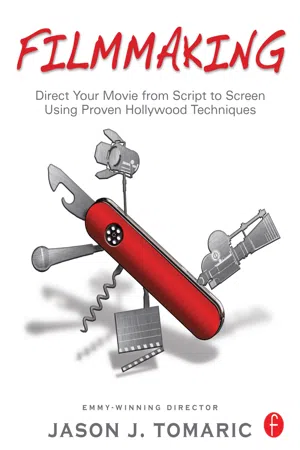
Filmmaking
Direct Your Movie from Script to Screen Using Proven Hollywood Techniques
- 520 pages
- English
- ePUB (mobile friendly)
- Available on iOS & Android
eBook - ePub
About this book
Filmmaking the definitive resource for filmmakers, blows the doors off the secretive film industry and shows you how to adapt the Hollywood system for your production. Full of thousands of tips, tricks, and techniques from Emmy-winning director Jason Tomaric, Filmmaking systematically takes you through every step of how to produce a successful movie - from developing a marketable idea through selling your completed movie. Whether you're on a budget of $500 or $50 million, Filmmaking reveals some of Hollywood's best-kept secrets. Make your movie and do it right. The companion site includes: Over 30 minutes of high-quality video tutorials featuring over a dozen working Hollywood professionals. Industry-standard forms and contracts you can use for your production Sample scripts, storyboards, schedules, call sheets, contracts, letters from the producer, camera logs, and press kits
45-minute video that takes you inside the movie that launched Jason's career. 3,000 extras, 48 locations, 650 visual effects-all made from his parent's basement for $25,000.
Trusted by 375,005 students
Access to over 1.5 million titles for a fair monthly price.
Study more efficiently using our study tools.
Information
Subtopic
Film & VideoUNIT 1 Development


CHAPTER 1 The Script
DOI: 10.4324/9780240817019-2
Introduction
The script is the blueprint for the story and contains dialog, character movements, and scene descriptions. Like the old adage says, “If it ain’t on the page, it ain’t on the stage.”
Every good movie is produced around a well-written script, and it doesn’t matter how big the budget is, how good the actors are, how incredible the explosions are, or how dynamic the visual effects are if the story isn’t moving, engaging, and believable. Films with high production values have been known to flop because the script was poorly written, and rarely has a bad script been made into a good movie. Writing a script is a craft that takes time to learn and requires a tremendous amount of discipline and understanding of story structure, psychology, human dynamics, and pacing.
Not only is writing a script is the most important aspect of making a movie; it’s also the cheapest. Whereas Hollywood studios spend hundreds of millions of dollars on visual effects, great actors, explosions, and car chases, the materials involved in writing a script cost little more than a few dollars – the cost of a pencil and paper.

In embarking on the journey to the perfect script, there are three paths you can take. You can write the script yourself, you can option a script that has already been written, or you can hire a writer to write the script for you. This chapter will look at these three options and determine which may be the best choice for your production.
Working with a Writer
Writers tend to be stronger in either structure or dialog and character, so finding a writing partner who complements your skills can lead to a much better script. Finding a competent writing partner can be as easy as contacting local writing organizations, colleges, or university programs with writing courses or seeking writers online or through industry contacts. When looking for a good writing partner:
- Ask for a writing sample. Read through the writer’s past works to see if his style, ability to write dialog, pacing, dramatic moments, structure, and plot twists are on par with the nature of the story. To get an idea of the writer’s ability, read the first 20 pages of one of his previously written screenplays and see if the script engages you. If so, keep reading. If not, consider finding another partner.
- Find a partner whose strengths are your weaknesses. If you are good at structure, then find a writer who is good at dialog and characterization. A good writing partner will bring additional talents to the table and balance your skill set.
- Talk with your potential writing partner about the story and make sure she likes the genre, story, and characters before working with her. For example, if you are writing a romantic comedy, look for partners who specialize or have an interest in writing romantic comedies.
- Make sure your partner has the time and commitment to work on the script, especially if it’s being written on spec (for free). It’s difficult to complete a screenplay if your partner has to drop out in the middle of the project or has obligations that may interfere with his ability to work on the project. Write and sign a contract that outlines the details of your working relationship together. Understand that when working with a writer, you both own 50% of the script, so if any problems occur during the relationship, the project may go unproduced.
- Work out the credit your partner will receive as well as payment terms if the screenplay is sold, optioned, and/or produced. It’s vital to work out the details of your business relationship before beginning work on a script, should any problems arise during or after the writing process.
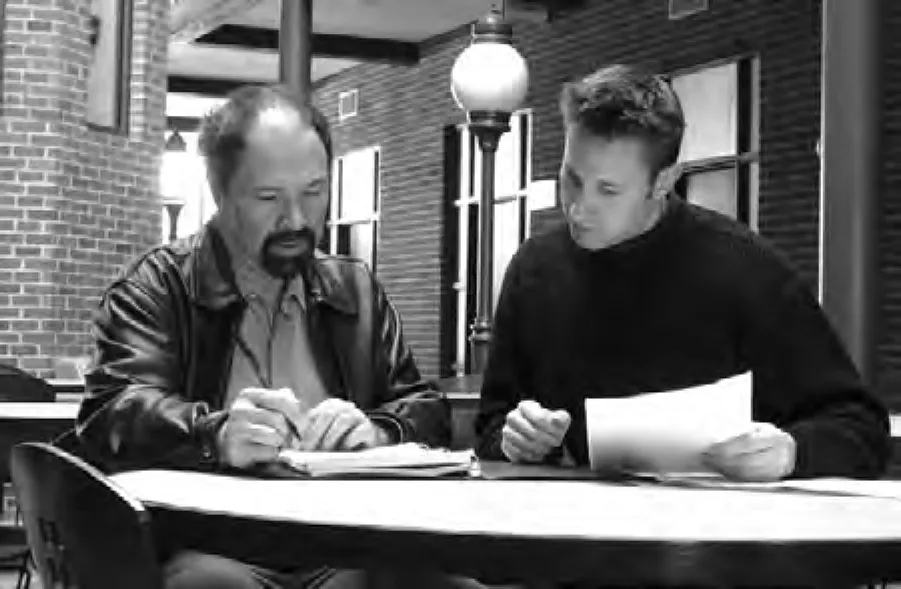
Ultimately, a compatible partnership is as much about chemistry as it is about artistry: find a person with the same goals as yours, who compliments your vision but completes your skill set. A rewarding writing partner can be both inspiring and motivating, both traits that have a positive impact on the script.
Writing your Own Script
Developing the Idea
The first step to writing a movie script is to have a solid idea, but before you settle on a concept for your film, it’s important to decide what you want the project to do for you once it’s finished. Are you going to make a movie for art’s sake – to explore your vision and style, or maybe just to learn the process of filmmaking? Or are you looking to produce a commercially viable movie that can be sold and hopefully generate a profit?
Contrary to the popular belief of many filmmakers, these two options are almost always mutually exclusive. Most commercially produced movies tend to rely on a time-proven, revenue-generating formula designed to appeal to the widest possible audience. Because the marketing budget for most Hollywood movies is significantly higher than the production budget, the industry has to sell as many tickets as possible to cover not only the film’s production and marketing costs, but also the costs of movies that fail to recoup their initial investment. Unfortunately, this commercialization tends to discriminate against artistic films that play to a smaller audience, leaving those productions to run, at best, in local art theaters and small film festivals.
Jason's Notes
So here’s how Hollywood works. A young movie executive, whose job depends on the financial success of the movie he greenlights, has the choice between two scripts. The first is an emotional, awe-inspiring drama that captivates the reader with tales of entrancing human drama, riveting conflict, and heart-wrenching feeling. The second script is Garfield: The Movie. Which is he going to pick? The second one, of course – wouldn’t you? With an existing fan base, practically guaranteed return on investment, and years of branding, Garfield is a sure shot. To this young executive, the choice was about the financial future of his next project and his career. This is how Hollywood works.
Making a movie is an expensive and time-consuming process, so think smart when choosing the type of story to tell. Carefully consider what you want the movie to do for you:
- Do you want the movie to make money? Then develop a concept around the industry standard formula, with marketable actors, clearly defined genre, a tight three-act structure, and high production values. This can be the most expensive option.
- Do you want to make a movie for the educational experience? If you want to learn filmmaking or practice your craft, produce a short film and know that you won’t recoup your investment.
- Do you want to make art? Producing an artistic film that defies traditional Hollywood convention is risky because distributors tend to shy away from films they can’t easily describe explain to viewers. If picked up for distribution, most art films will find homes in small art theaters and possibly on home video, although the odds of generating a profit are slim.
Jason's Notes
One of the biggest tricks to developing a strong idea is to work backward. Look at the types of movies that are selling in both the domestic and international marketplace, determine how much money you have, and list the resources you have access to before you settle on an idea for your movie.
The statistics are grim for filmmakers who produce feature films. I’ve read numbers that place the number of features produced in the United States every year at around 7,000. Less than 10% get picked up for distribution, and an even smaller percentage makes a profit. One of the biggest reasons is the lack of market research to determine the commercial viability of the film. Filmmakers often develop an idea and produce the movie without researching what distributors are looking for and what’s selling in the international market, so they end up in massive debt with a movie that sits on the shelf.
The first real step of making a movie is to start at the end by contacting distributors and researching what types of productions DVD distributors and TV broadcasters are interested in buying. Find out what genres sell the best, the best format to shoot on, the ideal length, and which actors have the most international appeal.
Jason's Notes
Don’t think of these boundaries as creative restrictions. Instead, use them as a guide to writing a marketable screenplay. Remember, the goal is to get your movie seen, and distributors are the gatekeepers that stand between you and the audience. They are looking for a product that can make them money, so give them what they can sell.
Writing What You Know
When it comes to developing a story, I find that it always helps to write what you know. The best piece of advice I ever received was to write what I’ve seen, what I have experienced, and what I’ve lived in life. Filmmaki...
Table of contents
- Cover Page
- Half Title Page
- Title Page
- Copyright Page
- Dedication
- Websiteaccess
- Contents
- Acknowledgements
- UNIT 1 Development
- CHAPTER 1 The Script
- UNIT 2 Preproduction
- CHAPTER 2 Preproduction
- CHAPTER 3 Budgeting
- CHAPTER 4 Breakdowns and Scheduling
- CHAPTER 5 Insurance
- CHAPTER 6 Locations
- CHAPTER 7 Casting the Roles
- CHAPTER 8 The Crew
- CHAPTER 9 Equipment
- CHAPTER 10 Production Design
- UNIT 3 Production
- CHAPTER 11 Production
- CHAPTER 12 Directing
- CHAPTER 13 Cinematography
- CHAPTER 14 Audio Recording
- CHAPTER 15 Hair and Makeup
- CHAPTER 16 Craft Services and Catering
- UNIT 4 Postproduction
- CHAPTER 17 Editing
- CHAPTER 18 Visual Effects
- CHAPTER 19 Postproduction Audio
- CHAPTER 20 Music
- UNIT 5 Distribution
- CHAPTER 21 Distribution
- Index
Frequently asked questions
Yes, you can cancel anytime from the Subscription tab in your account settings on the Perlego website. Your subscription will stay active until the end of your current billing period. Learn how to cancel your subscription
No, books cannot be downloaded as external files, such as PDFs, for use outside of Perlego. However, you can download books within the Perlego app for offline reading on mobile or tablet. Learn how to download books offline
Perlego offers two plans: Essential and Complete
- Essential is ideal for learners and professionals who enjoy exploring a wide range of subjects. Access the Essential Library with 800,000+ trusted titles and best-sellers across business, personal growth, and the humanities. Includes unlimited reading time and Standard Read Aloud voice.
- Complete: Perfect for advanced learners and researchers needing full, unrestricted access. Unlock 1.5M+ books across hundreds of subjects, including academic and specialized titles. The Complete Plan also includes advanced features like Premium Read Aloud and Research Assistant.
We are an online textbook subscription service, where you can get access to an entire online library for less than the price of a single book per month. With over 1.5 million books across 990+ topics, we’ve got you covered! Learn about our mission
Look out for the read-aloud symbol on your next book to see if you can listen to it. The read-aloud tool reads text aloud for you, highlighting the text as it is being read. You can pause it, speed it up and slow it down. Learn more about Read Aloud
Yes! You can use the Perlego app on both iOS and Android devices to read anytime, anywhere — even offline. Perfect for commutes or when you’re on the go.
Please note we cannot support devices running on iOS 13 and Android 7 or earlier. Learn more about using the app
Please note we cannot support devices running on iOS 13 and Android 7 or earlier. Learn more about using the app
Yes, you can access Filmmaking by Jason Tomaric in PDF and/or ePUB format, as well as other popular books in Medien & darstellende Kunst & Film & Video. We have over 1.5 million books available in our catalogue for you to explore.