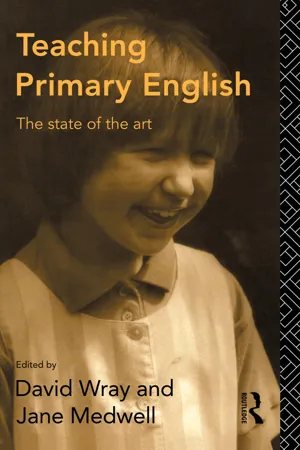
In this stimulating collection of specially commissioned essays, teachers and researchers in the forefront of thinking in this area consider both the controversies and the day-to-day realities of teaching primary English. The book's four sections reflect the organisation of the National Curriculum for English: Speaking and Listening, Reading, Writing, with a final section on issues that confront the teacher across the English curriculum. Particular attention is paid to assessment within the three strands of the National Curriculum and, throughout, the contributors combine the latest research with practical suggestions about what it means for the teacher in the classroom. Teaching Primary English takes up and develops the themes of David Wray and Jane Medwell's very successful Literacy and Language in the Primary Years. Students, teachers and everyone with an interest in how children acquire the skills of literacy will want to read it.
eBook - ePub
Teaching Primary English
The State of the Art
- 224 pages
- English
- ePUB (mobile friendly)
- Available on iOS & Android
eBook - ePub
About this book
Information
Speaking and listening
Editors’ introduction
In the National Curriculum for English it is the Profile Component Speaking and Listening which is, perhaps, closest to the hearts of many ‘language’ specialists. Since the pioneering work of Douglas Bames in the late 1960s and early 1970s and the strong recommendations of the Bullock Report (DES, 1975) much theoretical attention has been given to the important role of talking in the learning process in all curriculum areas. Some of the key ideas now generally accepted about talk in the learning process were outlined in Chapter 1 of Literacy and Language in the Primary Years where we also examined the characteristic patterns of talk in classrooms. That these patterns appear, from a wide variety of research (Edwards and Westgate, 1987), to apply equally to contemporary classrooms as to pre-Bullock settings suggests that there are powerful forces operating to create a kind of classroom inertia in so far as classroom talk is concerned. These forces may include the self-perpetuating influence of ‘classroom ecology’ (Doyle, 1983) or ‘continuity’, in Mercer’s terms (Mercer, 1990), which in turn is centrally derived from the belief systems of the participants in classroom discourse.
The beliefs held by many primary teachers are, suggests Martin Hughes in his chapter in this part, often characterised by a fairly negative perception of the linguistic capabilities of the children they teach, especially children from lower working-class backgrounds. Hughes found in his study that, despite an exposure to and knowledge of the findings of recent research into young children’s language, which, by and large, contradicts the ‘deficit model’ of linguistic development, teachers persisted in their beliefs that this research did not apply to the children in their schools. Hughes’ strategy for changing these teacher beliefs, which has a wide applicability in many educational contexts, was to involve them in action research with their children. The personally important evidence obtained during this process led to a marked shift in their attitudes towards their children’s language capabilities and the classroom contexts and activities they subsequently devised.
In the final part of Chapter 1 of Literacy and Language in the Primary Years we went on to discuss the uses of group talk and to suggest some activities and contexts for it in the primary classroom. Terry Phillips’ chapter here takes this much further. After surveying some of what is currently known about small group talk in educational settings he highlights some of the problematic areas in this knowledge and in its applications. He goes on to suggest several ground rules for strategies that teachers might use to enhance group talk in the classroom. Among these, most interestingly, is included the need to engage children in ‘talking about their talk’. This metalinguistic approach finds echoes in several other chapters in this book.
Alongside an enhanced emphasis upon the place of speaking and listening in planned classroom activity goes, quite naturally, an awareness of the need to make useful assessments of children’s abilities and progress in oracy. This would be true even without the requirements of the National Curriculum but, of course, these demands give an extra urgency to attempts to devise a workable approach to assessment in this area. The chapter by Greg Brooks is of significant help here. It reviews the findings and methodology of national approaches to the assessment of speaking and listening, and as well as suggesting that there is significantly more that teacher assessment can contribute to this process than has perhaps been realised, especially by teachers themselves, the chapter also suggests that there is mileage in involving the children in the process of assessing their own oracy. Brooks also discusses some of the common objections which are made to the assessment of oracy. As with other areas, it appears that assessment is not the overwhelming problem it is often taken to be, although it does clearly need some careful thinking on the part of teachers if it is to become more than just a set of ‘bolt on’ procedures and assume its most useful place as central to all classroom curriculum decisions.
References
DES (1975) A Language for Life. London: HMSO.
Doyle, W. (1983) ‘Academic work’, Review of Educational Research, 53 (2), pp. 159–199.
Edwards, A. and Westgate, D. (1987) Investigating Classroom Talk. Lewes: Falmer.
Mercer, N. (1990) ‘Context, continuity and communication in learning’, in Potter, F. (ed.) Reading, Learning and Media Education. Oxford: Basil Blackwell.
Chapter 1
The oral language of young children
Introduction
The last few years have seen a renewed and rapidly increasing interest in the spoken language of young children. This is most clearly shown in the prominent place accorded to Speaking and Listening as a profile component of English within the National Curriculum, with the same weighting as Reading and Writing. At the same time, the value of oracy has been stressed by major national initiatives, such as the National Oracy Project and the Language in the National Curriculum (LINC) Project, which have emphasised the role of spoken language in helping children to make sense of their learning. The message for teachers is clear: developing children’s oral language is now an essential part of their work.
It seems to be important, therefore, that teachers should have a clear understanding of the abilities which children already possess in the area of oral language when they first arrive in school at the ages of 4 and 5. For as Margaret Donaldson (1978) points out: ‘teachers need to be clear not only about what they would like children to become under their guidance but about what children are actually like when the process is begun’ (p. 15).
This point seems to be particularly appropriate to children’s oral language, given that almost all children learn to talk long before they start school. It thus seems fairly uncontentious to hope that teachers have a clear understanding of what is known about children’s spoken language when they first start school, and that they should draw on this understanding in their daily practice. As we shall see in this chapter, however, the issue is by no means as straightforward as it might appear. Indeed, there seems to be a gap of major significance between what many teachers believe about children’s spoken language and what is known from recent research. This chapter first sets out the evidence that such a gap exists, and then attempts to understand how it has arisen. The chapter ends by looking at ways by which the gap might be reduced.
Teachers’ Perceptions of Children’s Oral Language
A rich source of evidence concerning teachers’ perceptions of children’s language comes from the Early Years Language Project, a project recendy undertaken in the South West of England by the University of Exeter and a local LEA. This project grew out of concerns expressed to the LEA about children’s language by a group of headteachers from infant and primary schools in a large city in the region. Essentially, the headteachers claimed that children were increasingly entering their schools with spoken language insufficientiy developed to benefit from what the school was providing. In response, the LEA seconded two local teachers and one advisory teacher to join a team of two LEA advisers and two university lecturers to investigate the issue more closely. More details of the project and its findings can be found in Cousins, 1990; Hughes and Cousins, 1988; Hughes, 1989; Goldsbrough, 1990; Hubbard, 1990; and Hughes and Cousins, 1990.
The first step taken by the project team was to carry out in-depth interviews with the headteachers and reception teachers of all schools in the city which admitted children at the age of 5. Altogether 69 headteachers and 88 reception teachers were interviewed. The interviews were concerned with the difficulties experienced by reception teachers, with the link between these and children’s spoken language, with the nature and presumed cause of the children’s language problems and with possible remedies.
When asked to outline the main problems facing them, the reception teachers made clear that language problems were high on their list of concerns. The most common problem, mentioned by nearly half the teachers and over a third of the headteachers, was that the children had limited spoken language. These limitations were said to take a number of forms. It was frequently stated that the children were unable to give explanations, to ask questions, to express themselves effectively, or to take their language above the level of mundane day-to-day requests. In addition, over a third of the teachers and headteachers said that the children were unable to listen: they did not seem to understand what the teacher was saying or were unable to carry out simple instructions. The teachers also commented on the children’s poor vocabulary, the immaturity of their speech and their use of ‘baby-talk’. About a quarter of the teachers expressed concern about the children’s poor articulation, and it was remarked several times that many children had heavy accents or spoke with a strong local dialect. There were also a number of comments about the children’s apparendy poor grammar. These criticisms were illustrated by comments such as the following:
‘The children have no language.’
‘They use signs, grunts or gestures to express their needs.’
‘I never presume they understand what I’m saying.’
‘They do not talk in complete sentences, which makes it difficult to read and write.’
‘They use signs, grunts or gestures to express their needs.’
‘I never presume they understand what I’m saying.’
‘They do not talk in complete sentences, which makes it difficult to read and write.’
The teachers were asked what they thought were the causes of the children’s language problems. By far the most common answer, given by around four-fifths of both the teachers and headteachers, was that the causes lay in the children’s home environment. A large degree of concern was expressed about the amount and type of communication which took place at home, and several teachers commented that the parents just shouted or swore at their children. Many teachers felt they were battling against the unhelpful influence of the home environment, and particularly that of TV. Typical commments were:
I feel that time at home with the parental model negates my teaching.’
‘The parents can’t construct a sentence properly, so it’s not surprising the children can’t either.’
‘TV makes children unable to listen to a voice without a screen attached.’
‘The parents can’t construct a sentence properly, so it’s not surprising the children can’t either.’
‘TV makes children unable to listen to a voice without a screen attached.’
More than half the teachers and headteachers related these linguistic limitations in the home environment to other apparent deficiencies in the quality of family life. Parents were frequently seen as neglectful and uncaring, and many were thought to have little interest in their children. However, such comments were by no means universal: about a third of the teachers made positive comments about the parents. This evident sympathy for the parents nevertheless placed many teachers in something of a predicament when asked to account for the language problems which they were encountering, a predicament which was summed up by one teacher as follows: ‘I don’t like to blame the parents – they try very hard – but we do get them straight from home, so what else can we blame it on?’
Recent Research into Children’s Oral Language
These interviews indicated that the great majority of reception teachers and headteachers subscribed to what is often termed the language-deficit model. They believed that large numbers of children were starting school severely deficient in their spoken language, and that these deficiencies had their roots in the limited spoken language being used in the children’s homes. These problems were most likely to be present in children from working-class homes, or from families suffering some kind of deprivation.
Such deficit theories of language are by no means new. Evidence presented in 1921 to the Newbolt Committee of Enquiry into the Teaching of English shows similar concerns to those expressed above:
Many children, when they first come to school, can scarcely talk at all. Sometimes, a witness told us, they cannot even name their eyes, ears, toes and so forth … the great difficulty of teachers in Elementary Schools in many districts is that they have to fight against the powerful influence of evil habits of speech contracted in home and street.
(Newbolt, 1921: 59, 68)
The language-deficit model became particularly prominent in the 1970s. At that time its proponents drew inspiration from the influential work of Bernstein (eg 1971), Tough (eg 1976), and the Bullock Report (DES, 1975), although none of these authors would necessarily agree to being labelled in this way. At the same time, the model was being questioned by other theorists. Linguists such as Labov (1972) argued that the language of urban lower-class black children in America was not so much deficient as different from that of their middle-class counterparts. Further support for Labov’s views came from several British research studies which looked more closely at the language actually being used in the homes of young children (eg Wells, 1978, 1984, 1986; Tizard and Hughes, 1984). These studies painted a very different picture from that of the language-deficit theorists. Thus Wells (1978) concluded from his extensive recordings of children’s language at home that:
All but a very small minority of children reach the age of schooling with a vocabulary of several thousand words, control of the basic grammar of the language of their community, and an ability to deploy these resources in conversations arising from the many and varied situations that occur in their everyday lives.
(Wells, 1978: 16)
Similarly, Tizard and Hughes reported from their study of 4-year-olds at home and at nursery school that:
the conversation...
Table of contents
- Cover Page
- Half Title page
- Title Page
- Copyright Page
- Contents
- IIIustrations
- Contributors
- Introduction
- Part I Speaking and listening
- Part II Reading
- Part III Writing
- Part IV Other themes and issues
- Name index
- Subject index
Trusted by 375,005 students
Access to over 1.5 million titles for a fair monthly price.
Study more efficiently using our study tools.
Frequently asked questions
Yes, you can cancel anytime from the Subscription tab in your account settings on the Perlego website. Your subscription will stay active until the end of your current billing period. Learn how to cancel your subscription
No, books cannot be downloaded as external files, such as PDFs, for use outside of Perlego. However, you can download books within the Perlego app for offline reading on mobile or tablet. Learn how to download books offline
Perlego offers two plans: Essential and Complete
- Essential is ideal for learners and professionals who enjoy exploring a wide range of subjects. Access the Essential Library with 800,000+ trusted titles and best-sellers across business, personal growth, and the humanities. Includes unlimited reading time and Standard Read Aloud voice.
- Complete: Perfect for advanced learners and researchers needing full, unrestricted access. Unlock 1.5M+ books across hundreds of subjects, including academic and specialized titles. The Complete Plan also includes advanced features like Premium Read Aloud and Research Assistant.
We are an online textbook subscription service, where you can get access to an entire online library for less than the price of a single book per month. With over 1.5 million books across 990+ topics, we’ve got you covered! Learn about our mission
Look out for the read-aloud symbol on your next book to see if you can listen to it. The read-aloud tool reads text aloud for you, highlighting the text as it is being read. You can pause it, speed it up and slow it down. Learn more about Read Aloud
Yes! You can use the Perlego app on both iOS and Android devices to read anytime, anywhere — even offline. Perfect for commutes or when you’re on the go.
Please note we cannot support devices running on iOS 13 and Android 7 or earlier. Learn more about using the app
Please note we cannot support devices running on iOS 13 and Android 7 or earlier. Learn more about using the app
Yes, you can access Teaching Primary English by David Wray, Jane Medwell, David Wray,Jane Medwell in PDF and/or ePUB format, as well as other popular books in Education & Education General. We have over 1.5 million books available in our catalogue for you to explore.