Design beautiful, professional-level animated effects with these detailed step-by-step tutorials from former Disney animator and animated effects expert Joseph Gilland. Filled with beautiful, full-color artwork, Elemental Magic, Volume II, breaks down the animated effect process from beginning to end-including booming explosions, gusting winds, magical incantations, and raging fires. He also breaks down the process of effects "clean-up," as well as timing and frame rates. The companion website includes real-time footage of the author lecturing as he animates the drawings from the book. In these videos, he elucidates the entire process from blank page to final animation. See it all come to life like never before. Throughout the book, Joseph refers to and includes examples from his own professional work from feature films such as Lilo & Stitch and Tarzan.
- 315 pages
- English
- ePUB (mobile friendly)
- Available on iOS & Android
eBook - ePub
About this book
Information
Chapter 1
Introduction to the Elements
For the last two years, since writing my first book, Elemental Magic: The Art of Special Effects Animation, I have been traveling a great deal, conducting special effects workshops based on many of the ideas I put forth in that initial volume. I have been bowled over by the warm reception that my first book has received, and I am deeply grateful to know that it has been inspirational to many animation artists, students, and fans around the world. I would like to especially thank you, the readers of my first book, who have made it a great success. I wrote it for you. Thank you for embracing it so wholeheartedly!

However, it frequently comes up in the conversations I have about the first book that the subject matter is so vast, that it was virtually impossible for me to cover everything in the kind of detail that I really would have liked to offer.
To really delve deeply into each specific type of effects animation in minute detail would have taken a book of a thousand pages or more. An entire encyclopedia could be written about special effects animation. Entire books could be written just on animating a splash, or a house on fire. Whenever I look closely at my first book, I always find myself wishing there was more. More specifics on how to actually animate effects, starting with a blank sheet of paper. More of the real stuff or the nitty-gritty, as it were, to borrow from John Canemaker’s generous endorsement of my first book. I decided to take a cue from John, and from my actual teaching experiences in the past. The more I have tried to teach special effects animation by talking and showing students still images, diagrams, and whatever reference material I could find, the more I have realized how important it is to teach by example. After conducting only a few classes, I felt like I was wasting my breath, babbling for hours about something that takes action to actually do.
So I decided to animate “live” in front of my effects classes, starting with a blank sheet of paper and walking the class through the process as I drew. This was somewhat daunting at first, because I was putting myself on the spot, forcing myself to animate from a cold start, with a group of expectant, enthusiastic students staring at my every move, and every line I put down was open to scrutiny. It was nerve-wracking, but ultimately it worked out fabulously, as I was able to dig deep and draw on three decades of experience and spill it out on the pages.
As I took on animating a simple water splash, I limited the amount of time I had to one hour, to complete all of the drawings and then capture them digitally for playback. This way I was forced to draw fast, and with energy, demonstrating the very principles that I put down in my first book and was constantly emphasizing in my lectures: to always animate drawing fast, sketching roughly with energy and abandon, and not worry about making every line perfect but just going for it. From pages full of seemingly messy scribbles, the students would see a piece of flowing special effects animation emerge. Not flawless by any stretch of the imagination, but animating sweetly nonetheless, with all the timeless animation principles of energy, intent, exaggeration, and dynamics clearly demonstrated in real time.
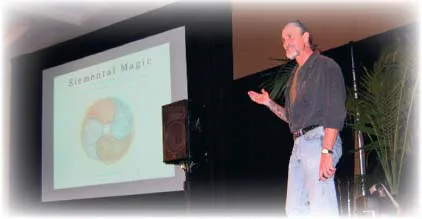
And so, in this my second book, Elemental Magic, Volume II: The Technique of Special Effects Animation, I decided that while I would still try to write a lot more about specific details involved in animating special effects, the real deal is to teach by live demonstration. That is why, if you are reading this, you also have access to the accompanying website www.elementalmagicbook.com, complete with clips of me drawing and animating live. This is where the real magic comes to life.
I didn’t animate complex special effects in feature films by talking about it. Where the rubber hits the road is when the animator flips the pages and quickly roughs in his or her next drawing.
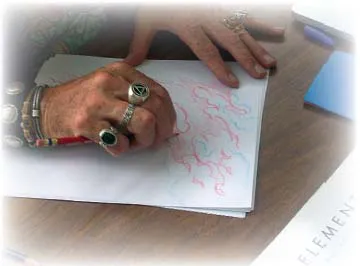
I believe that that is what anyone who is interested in the technique of special effects animation really wants to see. I sincerely hope that by creating this second volume as such, I will be able to deliver to you an unparalleled and intimate look into how special effects animation evolves and emerges from the imagination of an effects artist to a blank piece of paper, in real time.
At various stages throughout this book, I will go through many of the very same stages of explaining effects animation that I did in the first Elemental Magic volume. There is definitely some repetition and overlap, but with every word and page in this book, I have strived to take another, far more in-depth look at a variety of aspects of creating hand-drawn special effects from scratch. There is also a great deal to be said for the repetition of key principles in any advanced learning process. The idea is to truly ingrain the intuitive feelings and detailed knowledge of fluid shapes, design, and animation principles into yourself so that they become natural and flowing, and can spill out of you as naturally as water spills out of a bucket.
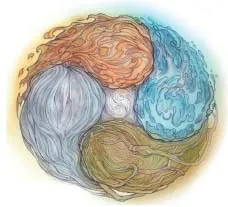
Initially, I had set out in this book to try to cover the full range of elemental effects elements that are embodied in the very common “Earth, Wind, Fire, and Water” phrase. However, as this book has evolved, I have narrowed the focus of the material, and the elements I will cover in great detail in this volume are water, fire, smoke, explosions, and certain “magic” elements.
Chapters 2 and 3 cover water waves and water splashes, respectively. The written and illustrated pages in the book will cover for you in extreme detail the creative and practical processes involved in understanding how to approach animating these elements. Then in the accompanying video footage available on the book’s website, I will animate and explain more specific and narrowly focused examples of these elements. For the study of wave animation, we will be looking at animating a cross-section of a wavy body of wind-blown water representing something roughly the size of a swimming pool, which is a great way to get a grasp on the most simple and fundamental principles behind animating a wave.
The splash we will study will be a medium-sized splash like one we would see if we dropped something roughly the size of a baseball into a calm body of water. I find this to be a great jumping-off point for someone learning to animate a splash.
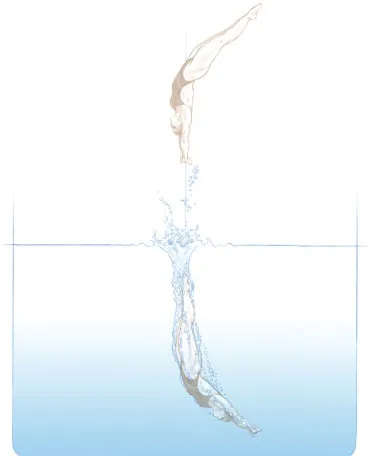
Chapters 4 and 5 will deal with animating fire and smoke, and explosions, respectively, which can contain elements not only of fire and wind but also earth and water. In the written and illustrated sections of these chapters, I will delve into great detail on a wide range of variations of fire and smoke: not only with step-by-step examples of the animating process, but also with the underlying creative thought process, as well as the observational and research process that I consider to be the very cornerstone of my success as a special effects animator.
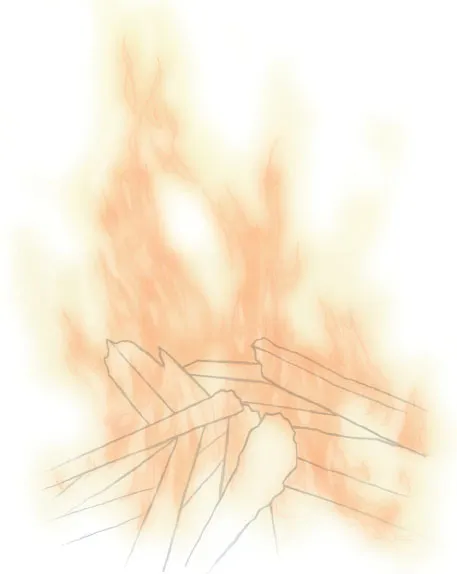
The fire I will use to demonstrate with in the accompanying live footage to be found on the website will be an “average-sized” fire, if there is such a thing, approximately the size of the average campfire. This is an element that most people are familiar with, and it’s a great place to start for us to understand what goes into animating a fire. What child is not mesmerized by a campfire, staring for hours into its hypnotic dance of light and pure energy? The smoke we will explore animating, just to be practical and consistent, will be the same kind of smoke we might see coming from such a medium-sized campfire. For an explosion I will animate something relatively small and manageable, roughly the size of a large firecracker exploding.
Only Chapter 6 does not fall readily into the four elemental categories. In Chapter 6 we will play with magic, and I will attempt to cover as much ground as possible. But since magic is such an infinitely broad and by its very nature undefined creative endeavor, I will focus for the most part on some of the thought processes and practical considerations that go into creating the classical “pixie dust” magic featured in so many of our most beloved animated films in the history of the art form. On the book’s accompanying website, I’ll be animating pixie dust in the classical way, as it appeared in early Disney films, like Fantasia (1940) and Peter Pan (1953). These types of effects draw their inspiration from the elements, and understanding how smoke, fire, and water behave will help us to create far more dynamic and beautiful magic effects.

It is extremely important to note again here that when thinking about special effects, there is a great deal of crossover from one category to another. The elements are inextricably linked together in many respects.
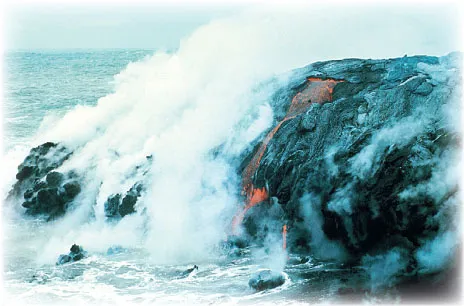
Take wind, for example. Essentially, wind is invisible, and we see it only when it affects another element. Wind blowing in the trees, waves on a water surface, dust storms, the reaction of fire and smoke to wind conditions, all of these are wind elements interacting with other elements to create an effect. Another good example is a rockslide or avalanche crashing into trees or tumbling into a body of water. Another even more exciting and dynamic example is when volcanic lava flows directly into the ocean, a fantastic phenomenon, and one of the most compelling natural special effects on our planet, which can be seen on the big island of Hawaii on a fairly regular basis. This creates an incredible show of special effects, as the lava splashes hissing into the ocean creating heaving waves and belching out enormous clouds of billowing steam.
Under the water, bubbles and currents swirl wildly in the waves, with extreme temperature changes creating swirling eddies of activity. As the steam rises and dissipates, it is whipped around by even more swirling vortices of energy, caused by the super-heated lava and the cooler surrounding air.
For the moment, I’ll take a preliminary look at the effects elements I will cover in this book, discussing some of their most important attributes, and keeping an eye out for when and where the different elements interact and overlap.

This drawing could be either smoke, or steam, or dust that has somehow been kicked up. In their initial stages, these three effects can look identical. But they are completely different elements, and their molecules will react and resolve differently to the forces acting upon them, and each will resolve in its own unique way.
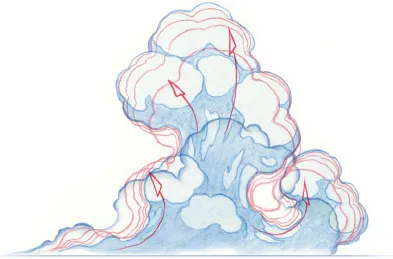
Smoke will usually continue to move upward, unless there is a hard wind that pushes it in another direction. Smoke is still being propelled by heated air, and in fact the particles in the smoke may be extremely hot themselves. Of these three element...
Table of contents
- Cover
- Halftitle
- Title
- Copyright
- Dedication
- Table of Contents
- Foreword
- Preface
- A Message from Cyberspace
- Acknowledgements
- Chapter 1. Introduction to the Elements
- Chapter 2. The Wave
- Chapter 3. The Splash
- Chapter 4. Lighting a Fire
- Chapter 5. Blowing It Up
- Chapter 6. Magic: The Art of Animating Pixie Dust
- Index
Trusted by 375,005 students
Access to over 1.5 million titles for a fair monthly price.
Study more efficiently using our study tools.
Frequently asked questions
Yes, you can cancel anytime from the Subscription tab in your account settings on the Perlego website. Your subscription will stay active until the end of your current billing period. Learn how to cancel your subscription
No, books cannot be downloaded as external files, such as PDFs, for use outside of Perlego. However, you can download books within the Perlego app for offline reading on mobile or tablet. Learn how to download books offline
Perlego offers two plans: Essential and Complete
- Essential is ideal for learners and professionals who enjoy exploring a wide range of subjects. Access the Essential Library with 800,000+ trusted titles and best-sellers across business, personal growth, and the humanities. Includes unlimited reading time and Standard Read Aloud voice.
- Complete: Perfect for advanced learners and researchers needing full, unrestricted access. Unlock 1.5M+ books across hundreds of subjects, including academic and specialized titles. The Complete Plan also includes advanced features like Premium Read Aloud and Research Assistant.
We are an online textbook subscription service, where you can get access to an entire online library for less than the price of a single book per month. With over 1.5 million books across 990+ topics, we’ve got you covered! Learn about our mission
Look out for the read-aloud symbol on your next book to see if you can listen to it. The read-aloud tool reads text aloud for you, highlighting the text as it is being read. You can pause it, speed it up and slow it down. Learn more about Read Aloud
Yes! You can use the Perlego app on both iOS and Android devices to read anytime, anywhere — even offline. Perfect for commutes or when you’re on the go.
Please note we cannot support devices running on iOS 13 and Android 7 or earlier. Learn more about using the app
Please note we cannot support devices running on iOS 13 and Android 7 or earlier. Learn more about using the app
Yes, you can access Elemental Magic , Volume 2 by Joseph Gilland in PDF and/or ePUB format, as well as other popular books in Media & Performing Arts & Digital Media. We have over 1.5 million books available in our catalogue for you to explore.