- 96 pages
- English
- ePUB (mobile friendly)
- Available on iOS & Android
eBook - ePub
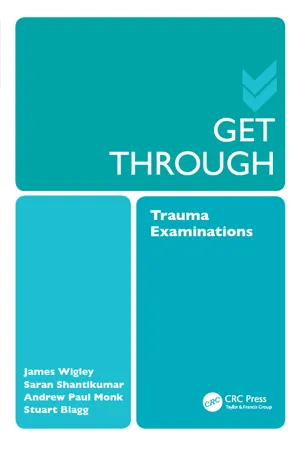
Get Through Trauma Examinations
About this book
Providing over 150 single best answer questions, this comprehensive question and answer guide provides candidates with the practice material necessary to successfully pass trauma examinations such as the ATLS or EMST. ? The only SBA practice question title specifically for trauma examination revision? Detailed answer explanations ensure thorough un
Information
1 | PAPER 1 QUESTIONS |
Question 1
An oropharyngeal airway should be sized according to which one of the following descriptions?
A. The measurement between the canines and the angle of the jaw
B. The measurement between the labial commissure and the external auditory meatus
C. The approximate diameter of the patient’s little finger
D. By a combination of the patient’s sex and approximate size (big or small)
E. The measurement between the hyoid and the chin
Question 2
Before intubating a 28-year-old man, you aim to assess him for ease of intubation. Which of the following features would be suggestive of a difficult intubation?
A. Long neck
B. Distance of four fingers between the incisors with the mouth opened
C. Mallampati class I
D. An inability to rule out cervical spine fracture
E. Distance of two fingers between the thyroid notch and floor of the mouth
Question 3
A 41-year-old man has been attacked and has multiple stab wounds to the abdomen. He is pale and sweaty, and you see pools of blood collecting on the floor. His pulse is 140/min. His systolic blood pressure is 85 mmHg.
On arrival into the emergency department what is your first priority?
A. Insert large bore peripheral cannula to each antecubital fossa
B. Check his airway
C. Elevate his legs in order to increase venous return
D. Apply pressure to the laceration that you see is contributing to the blood loss
E. Quickly turn the patient over to see if there are further wounds
Question 4
A 32-year-old man is brought into the emergency department following a high-speed collision with a truck. He is complaining of severe left-sided chest pain.
You note he is breathless, tachycardic and hypotensive. On examination there is reduced air entry on the left side and the trachea is deviated to the right.
Which of the following is the most appropriate course of action?
A. Insert a chest drain into the fifth intercostal space left-hand side
B. Insert a wide bore cannula into the second intercostal space left-hand side
C. Request an urgent chest X-ray
D. Request an urgent ECG
E. Perform a pericardiocentesis
Question 5
A 21-year-old woman is admitted following a road traffic collision. She is dyspnoeic and has haemoptysis. On examination there is reduced air entry on the left with hyperresonance to percussion and evidence of subcutaneous emphysema. No penetrating wound is apparent.
Which of the following is the most likely underlying cause of her symptoms?
A. Aortic disruption
B. Diaphragmatic injury
C. Haemothorax
D. Tracheobronchial tree injury
E. Pulmonary contusion
Question 6
Which of the following ECG changes are commonly found following a myocardial contusion?
A. Atrial fibrillation
B. Multiple ventricular ectopics
C. Right bundle branch block
D. Sinus tachycardia
E. All of the above
Question 7
A 67-year-old man is being evaluated for brain death. The following features are noted: the gag reflex is absent, the GCS is 3, the core temperature is 34°C, the pupils are not reactive and there is no spontaneous ventilatory effort.
Which of the documented features preclude a diagnosis of brain death being given?
A. The gag reflex is absent
B. The GCS is 3
C. The core temperature is 34°C
D. The pupils are not reactive
E. There is no spontaneous respiratory effort
Question 8
Which of the following statements is FALSE with regard to cerebral blood flow?
A. Cerebral perfusion pressure is equal to mean arterial blood pressure minus intracranial pressure
B. Mean arterial blood pressure is equal to diastolic blood pressure plus 1/3 (systolic blood pressure–diastolic blood pressure)
C. A reduction in intracerebral pressure can be caused by raising the partial pressure of carbon dioxide
D. A normal intracranial pressure is equal to approximately 10–15 mmHg
E. Secondary brain injury is preventable
Question 9
A heavy goods vehicle ploughs into the rear of a car. Inside the car is a 72-year-old female who, following the crash, develops these clinical signs: power in the upper limbs 2/5, power in the lower limbs 4/5.
What is the most likely diagnosis?
A. Central cord syndrome
B. Anterior cord syndrome
C. Brown-Séquard syndrome
D. Complete transection of the cervical spinal cord
E. More information is required to make a diagnosis
Question 10
The immediate management of displaced fractures requires which of the following?
A. Realignment without splintage
B. Realignment and splintage
C. Immobilization in the most comfortable position
D. Splinting in the position they are found
E. Applying compression dressings
Question 11
A pregnant woman of 35 weeks has been assaulted. She has been stabbed in the left anterolateral abdominal wall. The appropriate steps have been made with regard to managing her airway and breathing. She remains hypotensive.
What should be the next step in her management?
A. Log roll the patient to the left and insert a wedge on the right-hand side so she remains at a tilt of 15 degrees in the supine position
B. Obtain a CTG to ensure the health of the foetus
C. Elevate the legs
D. Transfer the patient to the theatre immediately
E. Consider the use of vasopressors
Question 12
The hangman’s fracture involves which of the following vertebral areas?
A. Occipito-cervical junction
B. C1
C. C2
D. C3
E. Cervico-thoracic junction
Question 13
A 70-year-old man has been involved in a cyclist versus car collision. He has sustained a fracture to his ...
Table of contents
- Cover
- Half Title
- Title Page
- Copyright Page
- Table of Contents
- Preface
- ① Paper 1: Questions
- ② Paper 1: Answers
- ③ Paper 2: Questions
- ④ Paper 2: Answers
- ⑤ Paper 3: Questions
- ⑥ Paper 3: Answers
Trusted by 375,005 students
Access to over 1.5 million titles for a fair monthly price.
Study more efficiently using our study tools.
Frequently asked questions
Yes, you can cancel anytime from the Subscription tab in your account settings on the Perlego website. Your subscription will stay active until the end of your current billing period. Learn how to cancel your subscription
No, books cannot be downloaded as external files, such as PDFs, for use outside of Perlego. However, you can download books within the Perlego app for offline reading on mobile or tablet. Learn how to download books offline
Perlego offers two plans: Essential and Complete
- Essential is ideal for learners and professionals who enjoy exploring a wide range of subjects. Access the Essential Library with 800,000+ trusted titles and best-sellers across business, personal growth, and the humanities. Includes unlimited reading time and Standard Read Aloud voice.
- Complete: Perfect for advanced learners and researchers needing full, unrestricted access. Unlock 1.5M+ books across hundreds of subjects, including academic and specialized titles. The Complete Plan also includes advanced features like Premium Read Aloud and Research Assistant.
We are an online textbook subscription service, where you can get access to an entire online library for less than the price of a single book per month. With over 1.5 million books across 990+ topics, we’ve got you covered! Learn about our mission
Look out for the read-aloud symbol on your next book to see if you can listen to it. The read-aloud tool reads text aloud for you, highlighting the text as it is being read. You can pause it, speed it up and slow it down. Learn more about Read Aloud
Yes! You can use the Perlego app on both iOS and Android devices to read anytime, anywhere — even offline. Perfect for commutes or when you’re on the go.
Please note we cannot support devices running on iOS 13 and Android 7 or earlier. Learn more about using the app
Please note we cannot support devices running on iOS 13 and Android 7 or earlier. Learn more about using the app
Yes, you can access Get Through Trauma Examinations by Saran Shantikumar,Andrew Paul Monk,James Wigley in PDF and/or ePUB format, as well as other popular books in Medicine & Emergency Medicine & Critical Care. We have over 1.5 million books available in our catalogue for you to explore.