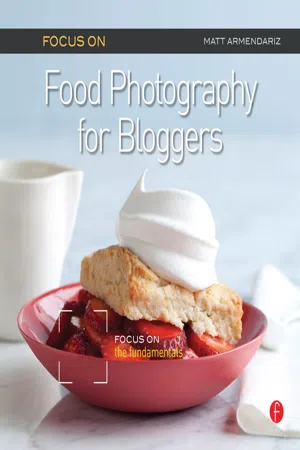
Focus on Food Photography for Bloggers
eBook - ePub

Focus on Food Photography for Bloggers

Focus on the Fundamentals

  1. 160 pages
  2. English
  3. ePUB (mobile friendly)
  4. Available on iOS & Android
eBook - ePub

Focus on Food Photography for Bloggers

Focus on the Fundamentals

About this book

Sharing your kitchen concoctions on your personal food blog has never been as popular as it is right now, but if you've ever had trouble getting your tasty temptations to look like pretty plates on camera, you know how difficult it can be to take amazing pictures of food. Matt Armendariz, of Mattbites food blog fame, shares his experiences and best practices for creating wonderful food photos in Focus On Food Photography for Bloggers. Written specifically for you the blogger, Matt discusses the ins and outs of equipment, lighting, composition, propping, sparking your inspiration, and getting creative, all with what you have on hand at home! Learn how to avoid common pitfalls with foods that are notoriously camera shy, how to successfully snap your dinner at a restaurant as well as on your kitchen table, and how to style your food with what you have in your cupboards. He also includes advice on post-processing, posting, and protecting your prized images.

As well as on his blog, Matt's photography has been featured in The Skinny Bitch Cookbook, on Martha Stewart, Paula Deen's Best Dishes, and Gordon Ramsay's Hell's Kitchen, along with numerous food magazines and newspapers. Let this seasoned blogger give your food photography the boost it needs to really make your readers salivate!

Frequently asked questions

Yes, you can cancel anytime from the Subscription tab in your account settings on the Perlego website. Your subscription will stay active until the end of your current billing period. Learn how to cancel your subscription.
No, books cannot be downloaded as external files, such as PDFs, for use outside of Perlego. However, you can download books within the Perlego app for offline reading on mobile or tablet. Learn more here.
Perlego offers two plans: Essential and Complete
  • Essential is ideal for learners and professionals who enjoy exploring a wide range of subjects. Access the Essential Library with 800,000+ trusted titles and best-sellers across business, personal growth, and the humanities. Includes unlimited reading time and Standard Read Aloud voice.
  • Complete: Perfect for advanced learners and researchers needing full, unrestricted access. Unlock 1.4M+ books across hundreds of subjects, including academic and specialized titles. The Complete Plan also includes advanced features like Premium Read Aloud and Research Assistant.
Both plans are available with monthly, semester, or annual billing cycles.
We are an online textbook subscription service, where you can get access to an entire online library for less than the price of a single book per month. With over 1 million books across 1000+ topics, we’ve got you covered! Learn more here.
Look out for the read-aloud symbol on your next book to see if you can listen to it. The read-aloud tool reads text aloud for you, highlighting the text as it is being read. You can pause it, speed it up and slow it down. Learn more here.
Yes! You can use the Perlego app on both iOS or Android devices to read anytime, anywhere — even offline. Perfect for commutes or when you’re on the go.
Please note we cannot support devices running on iOS 13 and Android 7 or earlier. Learn more about using the app.
Yes, you can access Focus on Food Photography for Bloggers by Matt Armendariz in PDF and/or ePUB format, as well as other popular books in Media & Performing Arts & Digital Media. We have over one million books available in our catalogue for you to explore.

Information

PART 1: THE NUTS AND BOLTS

Chapter 1: A Brief History of Food Photography

DOI: 10.4324/9780240823843-1
My ode to a still-life food painting, shot digitally.
For thousands of years, people have been documenting their food through art. The ancient Romans painted beautiful still-life images while artists throughout centuries have been painting markets, hunts, and religious ceremonies all centered around food.
The invention of photography changed the way people looked at food. No longer only painted in oils on canvas or sketched with pen and ink, food began to appear in photographs at the beginning of the 19th century. As reported by the New York Times, the first reported photograph of food was created by Joseph Nicéphore Niépce in 1832. His black-and-white still life of a bowl, bread, and goblet set the stage for a new world of food images.
Fast forward to the 1930s and 1940s. Commercial colour food photography was utilized in advertising and publishing, with many photographers pioneering the way we look at food. In a sense, you could say this began the era of food photography as we know it, with food images appearing in cookbooks and magazines, on packages and posters. This doesn’t mean that food photography hasn’t changed in 80 years, though; aesthetics, styling, and technology have made sure of that.
The world of food photography went through two big recent shifts: the first was the advent of digital photography for professional photographers, and the second was food blogging and affordable digital cameras. The result has been an explosion of food images, both online via blogs and food sites as well as in print through books and magazines. At no point in history have we looked at more images of food and drink as we are looking at now, and I happen to think it’s exhilarating!
And when we look at some quick numbers (yes, there are thousands and thousands of food blogs out there, although finding an exact number is difficult), it’s easy to see that food blogging is here to stay.
And considering you eat with your eyes first, photography for food blogs isn’t an afterthought. It’s a way to share our hearts and our kitchens with the world.

Chapter 2: Lenses, Cameras, and File Types

DOI: 10.4324/9780240823843-2
A collection of various cameras—certainly not a comprehensive visual, as there are so many varieties!
Before jumping into this chapter, I’ll answer the question you might be thinking right now:
“Which camera should I use?”
I only start off this chapter with this because it’s probably the question I get asked the most when discussing food photography.
And my response?
“The one that works for you.”
Okay, I know that sounds like a cop out, but it’s really not. It’s just that the question is much like asking me which kind of car you should drive. Where is it you want to go? Will you be driving on freeways or city streets primarily? Will you need to drive off road on ice towing a snowmobile? How many passengers will be with you? Do you like minivans or sports cars? Do you like all the bells and whistles or just the basics? Satellite radio? A navigation system? Traction control? All-wheel drive? Parking assist? The newest, hottest model or an old beater? Because really, any car can get you from point A to point B, it just depends on how you want to get there and what challenges you might face.
I’m making the comparison between camera type and car model because it all comes down to this: What are your needs? Although we are talking about pictures here, there are a million and one ways to go about the same thing when it comes to photography.
Identifying what type of food photography you’ll be making will help identify your equipment needs. Taking close-ups of tiny intricate candies? You’ll need a camera with a macro feature. Photographing expansive dining rooms as you travel the world? A wide-angle lens might be right for you. Getting down ‘n’ dirty and only want some quick snapshots of dinner before you gobble it down? A simple point-and-shoot (or your phone) will work. Again, figuring out your needs helps you make a wise decision when purchasing a camera. Your wallet will thank you.

A quick primer

I won’t be addressing film cameras in this book, although the same best practices for shooting food would apply to almost any camera. For the sake of discussion, I will be referring to digital only.

Point-and-Shoot (Compact)

A point-and-shoot camera is most likely what folks think of when discussing automatic cameras. They’re compact, relatively simple to use, and run the gamut from fully automatic to having more advanced features like the ability to shoot RAW files. Available in a variety of price points, these cameras are geared for simple point and shooting moments, hence the name. They tend to have smaller sensors inside which makes for smaller file size and less dynamic images.

dSLR

dSLR stands for digital single-lens reflex. It’s a camera system that uses a mirror system and pentaprism to capture an image on its sensor. The mirror reflects the image into the viewfinder, and when you’re ready to create your image it flips up to allow the light to pass to the camera sensor. All this is fancy talk f...

Table of contents

  1. Cover Page
  2. Half-Title Page
  3. The Focus On Series
  4. Title Page
  5. Copyright Page
  6. other
  7. Table of Contents
  8. Introduction
  9. Focus On Food Photography for Bloggers
  10. Part 1: The Nuts and Bolts
  11. Part 2: Creativity
  12. Part 3: Styling
  13. Part 4: Tips and Tricks: The Real World
  14. Index
