- 502 pages
- English
- ePUB (mobile friendly)
- Available on iOS & Android
eBook - ePub
About this book
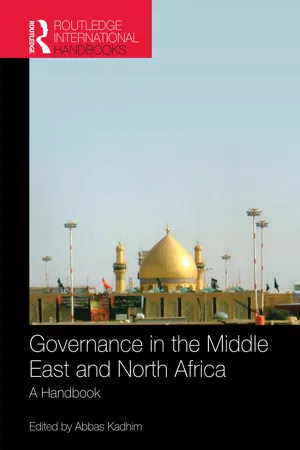
Governance in the Middle East is topic of interest to scholars, activists and policy makers. The currently proposed book is intended to present the first comprehensive framework of the question of governance in the Middle East in its various forms and manifestations: political, economic, and government performance.
Tools to learn more effectively

Saving Books

Keyword Search

Annotating Text

Listen to it instead
Information
Edition
1Subtopic
Comparative PoliticsPart 1
Overview
Chapter 1
Governance-constrained growth in the MENA region
I would suggest that the rate at which countries grow is substantially determined by three things: their ability to integrate with the global economy through trade and investment; their capacity to maintain sustainable government finances and sound money; and their ability to put in place an institutional environment in which contracts can be enforced and property rights can be established. I would challenge anyone to identify a country that has done all three of these things and has not grown at a substantial rate.1
The importance of institutions to a country’s economic growth and development has become almost axiomatic. Indeed you would be hard-pressed to find a recent research paper on economic growth and development which does not spotlight institutions—the set of rules that govern the relationships between actors in the economy—as fundamental for economic performance, through their influence on the incentives for saving, investment, production and trade.2
when the ambition of regimes tends to be overwhelmingly the perpetuation of the current system of government, longer-term exigencies are often relegated to a secondary order of importance. As we found under any totalitarian system, these tendencies eventually lead to broad under-performance in the [MENA] region’s economies with real incomes failing to grow at anything comparable to the experience of other emerging markets.3
Introduction
The acknowledged importance of good governance and institutions in supporting growth and development around the world is beginning to have a marked impact on economic thinking across the Middle East and North Africa (MENA) region. While their intrinsic value as ends of development in their own right is now universally accepted, it has been only recently that improved governance, together with sound institutions, have been seen by the region’s policy-makers as having a central role to the process of economic growth and development.
Still, there are many gaps in understanding the growth and development process. Despite the new focus on governance and institutions as a means to better growth performance, it is not entirely clear how this prescription translates into short- to medium-term policy priorities and actions, especially for the MENA region’s institutionally weaker and low-income countries. Is the MENA region unique in its pattern of governance? If so, do these differences together with the region’s high levels of defence expenditure and violence alter many of the governance growth patterns found elsewhere?
The objective of this chapter is to partially fill this gap in the literature by examining the governance-growth relationship in the MENA region. It begins with a brief overview of MENA’s recent growth experience relative to other parts of the world. As a prelude to our examination of the role played by governance in affecting these growth patterns, the next section provides a brief review of the theoretical literature linking governance to economic growth and deployment. This is followed by an examination of the region’s progress made to date in improved governance. After a discussion of the existing empirical literature on the governance-growth linkages in the MENA region, a framework is developed for identifying governance constraints. A final section sums up the role of governance reform as a means of possibly sustaining the region’s growth and development.
Economic growth in the MENA region
In assessing the linkages between governance and growth performance in the MENA region, it is important to note first that the countries in this part of the world share a number of common features. These include the effects of the Arab-Israeli conflicts, the Iran-Iraq War, the Gulf War, the post-Saddam conflict in Iraq, oil price volatility, the rise of Islamist fundamentalism, and Islamic-based institutions setting rules for a wide variety of practices.4
However, the region’s countries also differ in a number of important respects, all of which will affect individual country growth patterns irrespective of the level of governance. Key differences include: geographic size; population density; amount of cultivable land; extent of globalization; extent of reserves of oil and other natural resources; income and wealth; ethnic, religious and linguistic diversity; and vulnerability to civil and international wars and other conflicts.5
MENA countries also vary tremendously in their scores on numeral institutional indexes. For example, in the World Economic Forum’s competitiveness reports,6 countries are ranked with respect to technological infrastructure, the quality of public institutions and the macroeconomic environment, all of which affect the environment for business competitiveness and economic growth. Significantly, MENA countries score relatively low in these critical areas. In particular, the larger MENA countries all score below the average of the 102 countries listed in the index.
In the last several decades these sets of forces have combined to produce sub-optimal patterns of economic growth.7 Despite MENA’s generous endowment of natural resources, the area as a whole has experienced the weakest real per capita growth performance of all regions in the world, with the possible exception of sub-Saharan Africa. Not only has growth been disappointing, given the region’s potential, but it has also contained an element of instability due in part to the high volatility of oil and commodity prices.
Still, there are encouraging signs. Real per capita gross domestic product (GDP) growth rates (see Figure 1.1 and Figure 1.2) have picked up over the past decade. However, in the period since 1998, emerging market economies in Asia and in Central and Eastern Europe have continued to perform significantly better, while sub-Saharan Africa has achieved an even more impressive acceleration in real per capita GDP growth.8 As the sections below attempt to demonstrate, many of these differences in the regional patterns of growth are linked to the relative progress made in improved governance.

Figure 1.1 GDP per capita (%)
Source: World Bank, World Development Indicators database

Figure 1.2 GDP per capita growth rate (%)
Note: ALG = Algeria, EGY = Egypt, PAK = Pakistan, JOR = Jordan, LBN = Lebanon, MAR = Morocco,
SYR = Syria, TUN = Tunisia, WBG = West Bank and Gaza.
Source: World Bank Development Indicators database
Governance and the deep determinants of growth
The increased interest in the economics literature over the role of governance and institutions can be viewed as part of an ongoing search for the ‘deep determinants’ of economic growth and development. To a large extent, this can be traced to a growing dissatisfaction beginning in the late 1980s with what was until then the preeminent ‘neoclassical’ paradigm introduced independently in the 1950s by Robert Solow9 and Trevor Swan.10 This model assumes that growth is caused by capital accumulation and exogenous rates of change in population and technological progress. These factors alone are assumed to account for the observed patterns of long-run national economic growth.11
A unique feature of the neoclassical model is that it predicts all market-based economies will eventually reach the same constant growth rate if they have the same rate of technological progress and population. Most importantly, in the current context, the model assumes that the long-run growth rate is out of the reach of policy-makers. The main limitation of the neoclassical model is its inability to account for a large share of observed growth—the residual. This difficulty led to a reconsideration of the concept of the ‘factors of production’ to include human capital,12 and in the late 1980s and early 1990s the development of endogenous growth models to incorporate the level of technology and the rate of innovation.13
The proliferation of endogenous growth models began with the work of Romer. 14 Romer observed that the neo-classical growth models failed to reconcile its predictions of convergence (lower per capita income countries experiencing higher rates of growth than high per capita incomes), with the empirical observations that over the long run countries appear to have accelerating growth rates and among countries growth rates differ substantially.
Endogenous growth theories are based on the idea that long-run growth is determined by economic incentives. A popular variant of this model maintains that inventions are intentional and generate technological spill-overs that lower the cost of future innovations. As might be expected, factors such as an educated workforce play a special role in these models in determining the rate of technological innovation and long-run growth.
At a more fundamental level, however, it can be said that the mainstream growth models, including the exogenous group noted above, fail to answer trul...
Table of contents
- Cover
- Half Title
- Title Page
- Copyright Page
- Contents
- List of illustrations
- Preface
- List of contributors
- List of abbreviations
- Part I Overview
- Part II Country studies
- Index
Frequently asked questions
Yes, you can cancel anytime from the Subscription tab in your account settings on the Perlego website. Your subscription will stay active until the end of your current billing period. Learn how to cancel your subscription
No, books cannot be downloaded as external files, such as PDFs, for use outside of Perlego. However, you can download books within the Perlego app for offline reading on mobile or tablet. Learn how to download books offline
Perlego offers two plans: Essential and Complete
- Essential is ideal for learners and professionals who enjoy exploring a wide range of subjects. Access the Essential Library with 800,000+ trusted titles and best-sellers across business, personal growth, and the humanities. Includes unlimited reading time and Standard Read Aloud voice.
- Complete: Perfect for advanced learners and researchers needing full, unrestricted access. Unlock 1.4M+ books across hundreds of subjects, including academic and specialized titles. The Complete Plan also includes advanced features like Premium Read Aloud and Research Assistant.
We are an online textbook subscription service, where you can get access to an entire online library for less than the price of a single book per month. With over 1 million books across 990+ topics, we’ve got you covered! Learn about our mission
Look out for the read-aloud symbol on your next book to see if you can listen to it. The read-aloud tool reads text aloud for you, highlighting the text as it is being read. You can pause it, speed it up and slow it down. Learn more about Read Aloud
Yes! You can use the Perlego app on both iOS and Android devices to read anytime, anywhere — even offline. Perfect for commutes or when you’re on the go.
Please note we cannot support devices running on iOS 13 and Android 7 or earlier. Learn more about using the app
Please note we cannot support devices running on iOS 13 and Android 7 or earlier. Learn more about using the app
Yes, you can access Governance in the Middle East and North Africa by Abbas Kadhim in PDF and/or ePUB format, as well as other popular books in Politics & International Relations & Comparative Politics. We have over one million books available in our catalogue for you to explore.