eBook - ePub
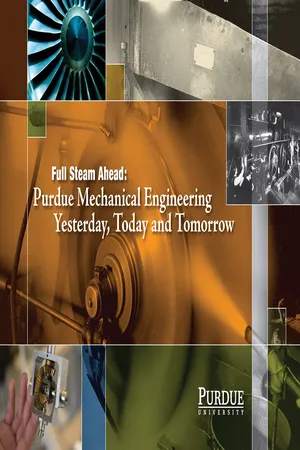
Full Steam Ahead
Purdue Mechanical Engineering Yesterday, Today and Tomorrow
- 104 pages
- English
- ePUB (mobile friendly)
- Available on iOS & Android
eBook - ePub
About this book
Mechanical Engineering was the first school of engineering to be established at Purdue University in 1882. From just 120 students, the School has grown over the last 130 years to serve over 1,800 undergraduate and graduate students annually. Originally located in Mechanics Hall, a one-story red brick building, Mechanical Engineering now has extensive facilities that include two major satellite research laboratories, Ray W. Herrick Laboratories and Maurice J. Zucrow Laboratories, named in honor of the first director. There are more than 30 additional instructional and research laboratories, including the Roger B. Gatewood wing, which opened in 2011, and increased the space available to students and faculty by 44,000 square feet. Full Steam Ahead tells the story of the School of Mechanical Engineering and looks to a future where Purdue engineers are leading the world and making advances in biotechnology, nanotechnology, robotics, design and manufacturing, and renewable energy. Distinguished alumni included in this publication range from astronauts, like Gus Grissom and Jerry Ross, to Bob Peterson, lead writer and co-director for the Oscar-winning animated film, Up.
Trusted by 375,005 students
Access to over 1.5 million titles for a fair monthly price.
Study more efficiently using our study tools.
Information

Bird’s eye view of the city of Lafayette,
Tippecanoe County, Indiana 1868
Tippecanoe County, Indiana 1868
Drawn by A. Ruger. Library of
Congress, Geography and Map
Division
Congress, Geography and Map
Division
12
A Story of Purdue Mechanical Engineering

Full Steam Ahead:
Purdue Mechanical Engineering
Yesterday, Today and Tomorrow
The Beginning
On April 15, 1869, John Purdue sat at his
desk in Lafayette and penned a letter to
“His Excellency” Conrad Baker, Governor of
Indiana. Purdue believed he had never made
a bad business decision in his life. He was
about to take the most momentous
step of his career.
desk in Lafayette and penned a letter to
“His Excellency” Conrad Baker, Governor of
Indiana. Purdue believed he had never made
a bad business decision in his life. He was
about to take the most momentous
step of his career.
In his letter to the governor, Purdue
offered $150,000 of his own fortune
toward a new college for the state
of Indiana, provided that: it would
be located in his home county of
Tippecanoe; he would be appointed
to its board of trustees; and “an irrepealable
law” would seal its name as Purdue.
offered $150,000 of his own fortune
toward a new college for the state
of Indiana, provided that: it would
be located in his home county of
Tippecanoe; he would be appointed
to its board of trustees; and “an irrepealable
law” would seal its name as Purdue.
Within three weeks Baker and the Indiana
General Assembly had accepted the proposal,
and May 6, 1869, has ever since been marked
as the founding of Purdue University.
General Assembly had accepted the proposal,
and May 6, 1869, has ever since been marked
as the founding of Purdue University.
It was a bold decision in a state and a
community that were just several generations
beyond the nation’s frontier. Lafayette had
community that were just several generations
beyond the nation’s frontier. Lafayette had
only been platted 44 years earlier. The
landmark Battle of Tippecanoe—where
future U.S. President William Henry Harrison
defeated a coalition of Native
American forces—had taken place
only 58 years earlier. With a population
of 33,515 in the 1870 census, Lafayette
landmark Battle of Tippecanoe—where
future U.S. President William Henry Harrison
defeated a coalition of Native
American forces—had taken place
only 58 years earlier. With a population
of 33,515 in the 1870 census, Lafayette
was not the center of commerce
in a state of 1.7 million people.
in a state of 1.7 million people.
But Lafayette was a growing,
prosperous community, located
on railroad lines and a navigable
river. And it was home to a
visionary, though egocentric man, who
prosperous community, located
on railroad lines and a navigable
river. And it was home to a
visionary, though egocentric man, who
believed in education and wanted to link his
name in perpetuity with learning.
name in perpetuity with learning.
Purdue succeeded beyond his greatest
dreams and launched a university that is now
recognized globally, especially for its excellence
in engineering and its School of Mechanical
Engineering. He never could have imagined the
impact engineering and his Purdue University
would have on life, business and technology,
now reaching into a third century. 15 u
dreams and launched a university that is now
recognized globally, especially for its excellence
in engineering and its School of Mechanical
Engineering. He never could have imagined the
impact engineering and his Purdue University
would have on life, business and technology,
now reaching into a third century. 15 u
The Purdue water sculpture,
often called the Engineering
Fountain, with the Bell Tower
and Hovde Hall.
often called the Engineering
Fountain, with the Bell Tower
and Hovde Hall.
John Purdue
Michael Golden
Tucked behind Knoy Hall of Technology, a short walk
from the Mechanical Engineering Building, is the
Michael Golden Engineering Laboratories and Shops.
It’s a facility that holds a special place in the history of
Purdue Mechanical Engineering.
from the Mechanical Engineering Building, is the
Michael Golden Engineering Laboratories and Shops.
It’s a facility that holds a special place in the history of
Purdue Mechanical Engineering.
Used for multidisciplinary work today, it was part of
a larger facility at the intersection of Northwestern
Avenue and Grant Street.
Built in 1910, it was
originally named the
Practical Mechanics Building,
but was renamed at the
request of alumni to honor
one of the University’s most
colorful and loved faculty
members—Michael Golden.
a larger facility at the intersection of Northwestern
Avenue and Grant Street.
Built in 1910, it was
originally named the
Practical Mechanics Building,
but was renamed at the
request of alumni to honor
one of the University’s most
colorful and loved faculty
members—Michael Golden.
Practical Mechanics
Building in 1918
Building in 1918
The name of the facility was changed in
1920 to Michael Golden Shops and in 1950
to Michael Golden Laboratories. Students
called the building “Mike’s Castle.” In 1982
the main portion of the building was taken
down to make way for Knoy Hall, but
laboratories attached to the original building
have been remodeled and remain in use.
1920 to Michael Golden Shops and in 1950
to Michael Golden Laboratories. Students
called the building “Mike’s Castle.” In 1982
the main portion of the building was taken
down to make way for Knoy Hall, but
laboratories attached to the original building
have been remodeled and remain in use.
Who was this popular professor,
remembered so fondly by his former students?
remembered so fondly by his former students?
Professor Michael Golden was serious and all business
in the classroom. He also was known to challenge
argumentative students to a boxing match if they crossed
him. In 26 years at Purdue University, not one student
in the classroom. He also was known to challenge
argumentative students to a boxing match if they crossed
him. In 26 years at Purdue University, not one student
was foolish enough to accept the challenge. 15 u
Michael
Golden
Golden
MICHAEL GOLDEN
13

Aerial view of campus
14
A Story of Purdue Mechanical Engineering

q ME Story—The Beginning
Purdue alumnus Neil Armstrong, commander
of the Apollo 11 space mission that
accomplished the first moon landing, wrote
a foreword for A Century of Innovation, the story
of the greatest engineering achievements
of the 20th century, as determined by the
National Academy of Engineering.
of the Apollo 11 space mission that
accomplished the first moon landing, wrote
a foreword for A Century of Innovation, the story
of the greatest engineering achievements
of the 20th century, as determined by the
National Academy of Engineering.
“If any of (the achievements) were removed,
our world would be a very different and less
hospitable place,” Armstrong said. “Each
of these achievements has been important
to the transformation of society in the past
hundred years. These are technologies that
have become inextricable parts of the fabric
of our lives—some spectacular, some nearly
invisible, but all critically important.”
our world would be a very different and less
hospitable place,” Armstrong said. “Each
of these achievements has been important
to the transformation of society in the past
hundred years. These are technologies that
have become inextricable parts of the fabric
of our lives—some spectacular, some nearly
invisible, but all critically important.”
The automobile, the airplane, spacecraft,
air conditioning and refrigeration are only
a few of the transformational 20th-century
achievements that were led by developments
in mechanical engineering—
and Purdue Mechanical
Engineering, in particular.
air conditioning and refrigeration are only
a few of the transformational 20th-century
achievements that were led by developments
in mechanical engineering—
and Purdue Mechanical
Engineering, in particular.
Morrill Land
Grant Act
Grant Act
Purdue University began
with a focus on engineering,
and Mechanical Engineering
was the star...
with a focus on engineering,
and Mechanical Engineering
was the star...
Table of contents
- Cover
- Title
- Copyright
- Contents
- The Gatewood Wing
- Mechanical Engineering History
- Our People
- References and Acknowledgements
Frequently asked questions
Yes, you can cancel anytime from the Subscription tab in your account settings on the Perlego website. Your subscription will stay active until the end of your current billing period. Learn how to cancel your subscription
No, books cannot be downloaded as external files, such as PDFs, for use outside of Perlego. However, you can download books within the Perlego app for offline reading on mobile or tablet. Learn how to download books offline
We are an online textbook subscription service, where you can get access to an entire online library for less than the price of a single book per month. With over 1.5 million books across 990+ topics, we’ve got you covered! Learn about our mission
Look out for the read-aloud symbol on your next book to see if you can listen to it. The read-aloud tool reads text aloud for you, highlighting the text as it is being read. You can pause it, speed it up and slow it down. Learn more about Read Aloud
Yes! You can use the Perlego app on both iOS and Android devices to read anytime, anywhere — even offline. Perfect for commutes or when you’re on the go.
Please note we cannot support devices running on iOS 13 and Android 7 or earlier. Learn more about using the app
Please note we cannot support devices running on iOS 13 and Android 7 or earlier. Learn more about using the app
Yes, you can access Full Steam Ahead by John Norberg in PDF and/or ePUB format, as well as other popular books in Technology & Engineering & North American History. We have over 1.5 million books available in our catalogue for you to explore.