- 160 pages
- English
- ePUB (mobile friendly)
- Available on iOS & Android
eBook - ePub
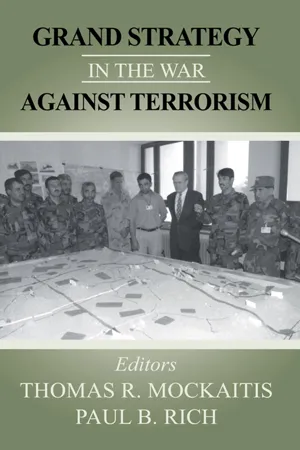
Grand Strategy in the War Against Terrorism
About this book
This collection of essays examines the strategic dimensions of contemporary terrorist threats. It evaluates the changing nature of modern terrorism in the light of the events of September 11 2001. The collection argues that terrorism now promises to enter the terrain of global "grand strategy".
Information
Introduction
The terrorist attacks of 11 September 2001 and subsequent activities of Al Qaeda and its allies have given vent to considerable debate over the nature and role of international terrorism in the post-Cold War global order. Al Qaeda is one of several of examples of what some analysts see as a new form of ‘new’ or ‘postmodern’ international terrorist organisation which is neither securely linked to any one particular state patron nor especially constrained by any limits on the use of violence.1
Al Qaeda has proved to be a remarkable and highly adaptive international network of terrorist organisations which, since 11 September 2001, have been capable of regrouping into a series of looser organisations that have launched a series of smaller bomb attacks, of which the most spectacular to date has been the bombing in the island of Bali in October 2002.2 Al Qaeda has shifted its focus to smaller scale operations using a large number of new recruits and has shown itself capable of responding to the US-led campaign that overthrew the Taliban regime in Afghanistan, depriving it of its major base of operations.
The surprise and ferocity of the attacks have ensured that Al Qaeda and its supposed ‘leader’ Osama bin Laden a status verging on the mythological in contemporary media portrayals of terrorism. Perhaps much of this is due to a general combination in many Western journalistic circles of fear and fascination. In reality it is likely, as the interior minister of Saudi Arabia, Prince Nayef, has suggested, that bin Laden is really the instrument of a much wider organisation and is only at the ‘top’ of Al Qaeda from the mass media’s point of view.3 A similar view has been expressed by some Western writers, including the novelist Gore Vidal who has suggested that the figure of a lone crazy man bin Laden has been chosen by a ‘Bush junta’ in Washington to help persuade the US public to support a war in Afghanistan.4
There are certainly some Scarlet Pimpernel qualities to bin Laden who appears to have the capacity to disappear and then miraculously resurface in some new region of the world. Even if bin Laden is eventually killed and Al Qaeda defeated, the organisation will in all likelihood continue to have the capacity to reproduce itself—like a magic broom—and create a whole new series of terrorist organisational networks in the Middle East and| Islamic world that will continue to threaten Western interests and security.
There are then some fantastical qualities to this otherwise grim new pattern in international terrorism. Some analysts have concluded that the September 11 attacks mark a major transformation in the nature of world politics. Fred Halliday, for example, has seen 9/11 as ‘two hours that shook the world’ and ranked it in historical importance with the assassination of the Archduke Franz Josef in Savajevo in 1914 or the Japanese attack on Pearl Harbor in December 1941.5 Similarly John Lewis Gaddis has seen the September 11 crisis as destroying the brief post-Cold War order that begun in 1989 with the fall of the Berlin Wall and creating a new international order in which the geographical position and political power of the US can no longer be assumed capable of securing even its own domestic security.6
These assessments come in the wake of a series of bleak assessments by terrorism specialists, who have been predicting for some years the growing saliency and threat from international terrorism. Before September 11 the US Department of State’s Patterns of Global Terrorism indicated that the number of deaths from terrorism world wide was on the increase from 233 in 1999 to 405 in 2000, while casualties rose from 706 to 791. These are of course tiny figures and can be used to justify the view that international terrorism cannot be taken seriously as a major threat to central western strategic interests. However the figures do not reveal the changing pattern of international terrorism by the late 1990s as state-sponsored terrorism by rogue regimes significantly decreased and terrorist groups were forced to search for private forms of sponsorship such as Al Qaeda.7
What the September 11 crisis really laid bare was general weakness in Western, and especially US, strategic thinking which still refused to take international terrorism all that seriously and was still hidebound by strategic conceptions derived from the Cold War era. As Gaddis has argued, there was a basic failure of strategic vision in the US and an inability to see how the parts of one administration’s policy needed to combine into a larger and more coherent whole.8 The reasons for this are complex, but relate in part to the evolution of strategy within the central organ of Western Cold War security, NATO, as well as the reluctance of the US to employ military force in the wake of the debacle in Vietnam in the late 1960s and early 1970s.
US strategic thinking during the Cold War was shaped by two dominant imperatives: air power and nuclear power. In both instances US strategy is highly influenced by the cost benefit analysis that underpins the logic of deterrence doctrine. Defence for the US is tightly focused on an enemy’s capabilities and directed towards raising the costs for the enemies and lowering those for the US and its allies either by deterring any threatened use of force or responding with overwhelming force when aggression did occur.
This strategic mindset is ill-suited to engaging with modern global terrorism of the kind manifested by Al Qaeda. It is very difficult to raise the costs of terrorism; asymmetric warfare, by its very nature, is war waged on the cheap by people who are willing, if necessary, to die or commit suicide in pursuit of their aims. For Al Qaeda the symbolic value derived from the events of September 11 far outweighs any rational calculus of cost.9 However it is also evident that calculation of a kind did occur in the planning of the attacks for bin Laden later said in an interview ‘we calculated in advance the number of casualties from the enemy, who would be killed based on the position of the tower. We calculated that the floors that would be hit would be three or four.’10 However this suggests that cost-benefit calculus for terrorists is limited to means rather than ends whereas for conventional Western strategy the calculus links means with ends.
Since the end of the Cold War there has been a slow shift in US strategic thinking away from the gradual projection of military force (as had occurred unsuccessfully in the Vietnamese case) towards a doctrine of decisive force to ensure compellance from recalcitrant regimes. In the process, the conventional distinctions between the political and the military as well as the operational levels between strategic and tactical began to dissolve. Modern warfare took on a fourfold complexion of tactical, operational, strategic and political.
This doctrine—widely known as the Powell Doctrine after the then General Colin Powell’s successful employment of it in the 1991 Gulf War against Iraq—was a reflection of the use of new military technologies that included precision strike weapons that could make the projection of force both more decisive and more credible.11 It was to be confirmed again in Bosnia and Kosovo in the 1990s, though had not been used with any serious purpose against international terrorism before September 11 with the notable exception of the rather disastrous use of cruise missiles against Al Qaeda installations in Afghanistan and Sudan in the wake of the East African embassy bombings in August 1998.12
Grand Strategy
It is clear that Western strategic thinking is at an impasse in the wake of September 11 and this collection seeks to contribute to the debate over the nature and course of Western ‘grand strategy’ in response to the terrorist challenge presented by Al Qaeda and its extremist Islamic allies and supporters. Grand strategy is a contested concept and can have a variety of different meanings. It is rather poorly understood among scholars of International Relations, though on a wider plane there are signs that it is increasingly intruding into public debate.13 In a conventional nineteenth century sense it is closely linked to a state’s ability to project power and force in international relations and is the overall strategy that informs and underpins this.
This conception of grand strategy is still very visible in strategic studies and is reflected, for instance, in the work of the US strategic theorist Edward Luttwak. Luttwak has defined grand strategy in terms of encapsulating ‘the highest level of interaction between any parties capable of using unregulated force against one another’.14 This covers clearly a wide field of interaction between states, international bodies and private organisations in so far as these intrude into major strategic fields dominated by the ability to project military force. However it obviously does not cover all the field of international politics. Relations between states may for long periods not be governed by the dictates of grand strategy. For instance, the relations between the US and Qatar and the other Gulf states throughout the post-war period were not dictated by grand strategy. In the aftermath of the revolution in Iran in 1979, however, this rapidly changed and may again be confirmed if the US chooses to invade Iraq.
This conventional definition of grand strategy has begun to be questioned by academic analysts who have sought to widen its area of compass from narrow military force projection towards a wide range of human activities. These include international institutions, non-governmental bodies, private business and multinational corporations which in many cases play a more significant role in international politics than many states. This has been the approach for instance of the Grand Strategy Project at Yale University in the late 1990s involving such figures as John Ikenberry and Michael Doyle.15 Ikenberry has in turn initiated a wide debate in the US on the nature of its grand strategy in the post-Cold War context, pointing out that since the 1940s the US has had in effect two grand strategies: one heavily realist in orientation organised around deterrence, containment and the maintenance of a global balance of power and a second one that is broadly liberal in orientation and directed towards the reconstruction of the world economy.
The first grand strategy is mainly concerned with a balance of global military power and is concerned with the adequate projection by the US of military force to secure its long term security. The second on the other hand has a rather wider definition of what ‘security’ really is and is orientated towards working through the Bretton Woods institutions such as the World Bank and the World Trade Organization (WTO)—successor of the General Agreement on Tariffs and Trade (GATT) that were set up after the Second World War to stabilise the global economy. It was the second of these grand strategies that generally prevailed under the two Clinton administrations in the 1990s at a time when there was no really coherent US military grand strategy rather a series of ad hoc reactions to individual crises such as Somalia, Bosnia and Kosovo.
The two grand strategies stem from different intellectual traditions, though this did not prevent them from more co-existing during the Cold War. They became in effect two component parts of something like an overall US strategy towards the Eastern bloc and underpinned what Ikenberry has seen as two ‘historical bargains’ that the US struck with its European and Asian allies: one a security bargain in which the US afforded its allies security protection and access to American markets and technology and a second ‘liberal bargain’ in which these same allies agreed to accept US leadership or hegemony and operate within an agreed politico-economic system.16
This grand strategy was beginning to unravel in the immediate aftermath of the Cold War in the 1990s. It has taken the crisis of September 11 to crystallise the broader strategic dilemma the US now faces as it seeks to forge a new global strategy against terrorism The emergence of the US as the sole superpower in a unipolar global order has made Washington less willing to strike the same sort of strategic bargains that it made during the Cold War. The overwhelming superiority of the US compared to its other allies encourages it towards a unilateralist strategy of going it alone. Such a new grand strategy is likely to be far less concerned with international stability as America seeks to isolate and if need be dismantle ‘rogue states’ such as North Korea and Iraq which it sees as threats to world peace.17
Neither of the two grand strategies that saw the US through the Cold War are likely to have the same importance in the post-Cold War period, though a debate rages in Washington over just how much use they may still have. If the central reality is one of global apocalyptic violence then both may need to be seriously downgraded as the US faces up to the prospect of waging global war. There are, though, clearly huge dangers in what Ikenberry calls a new ‘neo imperial grand strategy’ based on the US unilateralism. ‘America’s well meaning imperial strategy’, he writes ‘could undermine the principled multilateral agreements, institutional infrastructure, and cooperative spirit needed for the long-term success of non-proliferation goals.’18
The US faces the prospect indeed of ‘imperial overstretch’ if it seeks to take on by itself a global war against terror without bringing its allies on board as well. If it is to be involved in peacekeeping and state or ‘nation building’ in failed or weak states which have been breeding grounds for terrorist and insurgent groups then it may find that the older grand strategies still have some relevance. It may still be able to use a limited form of deterrence strategy against states that harbour terrorists while, similarly, it will need the support of global economic institutions to rebuild failed states. So it is not by any means the case that the post-Cold War world is tota...
Table of contents
- Cover
- Halftitle
- Title
- Copyright
- Contents
- Preface
- 1. Introduction
- 2. Winning Hearts and Minds in the ‘War on Terrorism’
- 3. Al Qaeda and the Radical Islamic Challenge to Western Strategy
- 4. Operation ‘Enduring Freedom’: A Victory for a Conventional Force Fighting an Unconventional War
- 5. United States Special Operations Forces and the War on Terrorism
- 6. Warfare by Other Means: Special Forces, Terrorism and Grand Strategy
- 7. Muslims, Islamists, and the Cold War
- 8. An Ambivalent War: Russia’s War on Terrorism
- 9. 11 September 2001 and the Media
- 10. Bringing it All Back Home: Hollywood Returns to War
- 11. Information Age, Terrorism and Warfare
- 12. Conclusion: The Future of Terrorism Studies
- Abstracts
- About the Contributors
- Index
Trusted by 375,005 students
Access to over 1.5 million titles for a fair monthly price.
Study more efficiently using our study tools.
Frequently asked questions
Yes, you can cancel anytime from the Subscription tab in your account settings on the Perlego website. Your subscription will stay active until the end of your current billing period. Learn how to cancel your subscription
No, books cannot be downloaded as external files, such as PDFs, for use outside of Perlego. However, you can download books within the Perlego app for offline reading on mobile or tablet. Learn how to download books offline
Perlego offers two plans: Essential and Complete
- Essential is ideal for learners and professionals who enjoy exploring a wide range of subjects. Access the Essential Library with 800,000+ trusted titles and best-sellers across business, personal growth, and the humanities. Includes unlimited reading time and Standard Read Aloud voice.
- Complete: Perfect for advanced learners and researchers needing full, unrestricted access. Unlock 1.5M+ books across hundreds of subjects, including academic and specialized titles. The Complete Plan also includes advanced features like Premium Read Aloud and Research Assistant.
We are an online textbook subscription service, where you can get access to an entire online library for less than the price of a single book per month. With over 1.5 million books across 990+ topics, we’ve got you covered! Learn about our mission
Look out for the read-aloud symbol on your next book to see if you can listen to it. The read-aloud tool reads text aloud for you, highlighting the text as it is being read. You can pause it, speed it up and slow it down. Learn more about Read Aloud
Yes! You can use the Perlego app on both iOS and Android devices to read anytime, anywhere — even offline. Perfect for commutes or when you’re on the go.
Please note we cannot support devices running on iOS 13 and Android 7 or earlier. Learn more about using the app
Please note we cannot support devices running on iOS 13 and Android 7 or earlier. Learn more about using the app
Yes, you can access Grand Strategy in the War Against Terrorism by Thomas R. Mockaitis,Paul B. Rich in PDF and/or ePUB format, as well as other popular books in Politics & International Relations & Military & Maritime History. We have over 1.5 million books available in our catalogue for you to explore.