- 176 pages
- English
- ePUB (mobile friendly)
- Available on iOS & Android
eBook - ePub
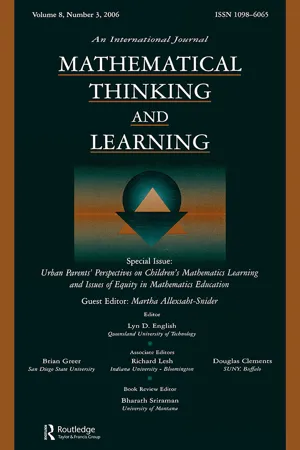
Urban Parents Perspectives Children'S Math. Mtl V8#3
About this book
First published in 2006. This is a special issue of Mathematical Thinking and Learning, Volume 8, Number 3 from 2006 that focuses on Urban Parents' Perspectives on Children's Mathematics Learning and Issues of Equity in Mathematics Education.
Information
Mathematics Learning and Participation as Racialized Forms of Experience: African American Parents Speak on the Struggle for Mathematics Literacy
Danny Bernard Martin
College of Education and Department of Mathematics, Statistics, & Computer Science University of Illinois at Chicago
College of Education and Department of Mathematics, Statistics, & Computer Science University of Illinois at Chicago
This article draws on 3 ethnographic and participant observation studies of African American parents and adults from 3 northern California communities. Although studies have shown that African American parents hold the same folk theories about mathematics as other parents, stressing it as an important school subject, few studies have sought to directly examine their beliefs about constraints and opportunities associated with mathematics learning for both themselves and their children. I argue that, as they situate the struggle for mathematical literacy within the larger contexts of African American, political, socioeconomic, and educational struggle, these parents help reveal that mathematics learning and participation can be conceptualized as racialized forms of experience. As they attempt to become doers of mathematics and advocates for their children's mathematics learning, discriminatory experiences have continued to subjugate some of these parents, whereas others—as demonstrated in their oppositional voices and behaviors—resisted their continued subjugation based on a belief that mathematics knowledge, beyond its role in schools, can be used to change the conditions of their lives. The characterization of mathematics learning as racialized experience put forth in this article contrasts with culture-free and situated perspectives of mathematics learning often found in the literature.
As a result of their experiences with oppression in this society, the concept of race has historically played a major role in the lives of African Americans. Although race has dubious value as a scientific classification system, it has had real consequences for the life experiences and life opportunities of African Americans in the United States. Race is a socially constructed concept which is [a] defining characteristic for African American group membership. (Sellers, Smith, Shelton, Rowley, & Chavous, 1998, p. 18)
Does race1 really matter? Although some scholars have argued for its "declining significance" (D'Souza, 1995; Wilson, 1978), the sentiment expressed in the previous quote by Sellers, Smith, Shelton, Rowley, and Chavous (1998) suggests that because race permeates so many areas of African American life—an assertion that is supported in the sociological, psychological, and critical studies literatures, in the mass media, as well as in the everyday accounts of ordinary folks—those contexts where mathematics learning and the struggle for mathematics literacy assume primacy offer no exception. In light of this claim, I address three questions in this article. First, in what ways can mathematics learning, participation, and the struggle for mathematics literacy be conceptualized as racialized forms of experience—that is, as experiences where race and the meanings constructed around race become highly salient? Second, based on their desires for equal treatment and meaningful participation in all aspects of life, and their frequent experiences to the contrary, what do the narratives of African American parents and caregivers reveal about their struggles for themselves and for their children in the context of mathematics? Finally, how do African American parents respond to these racialized constructions of their own and their children's mathematical experiences?
Race Problems and Problems with Race
The questions just posed are provocative ones, capable of stirring emotions, as is often the case when issues of race enter a dialogue. Given the backdrop of disproportionately low mathematics achievement and persistence of African American students (Johnson, 1989; Tate, 1997; U.S. Department of Education, 2000), however, the need to develop interventions and solutions that are in the best interests of these students (Delpit, 1988,1995), and the increasingly political nature of mathematics education that empowers some parents and silences others (Anhalt, Al lexsaht-Snider, & Civil, 2002; Civil, Andrade, & Anhalt, 2000; Civil, Bernier, & Quintos, 2003; Civil, Quintos, Bernier, & Bratton, 2004; Gutstein, 2004; Martin, 2002, 2003, 2004; Peressini, 1997, 1998), there is an urgency that demands the stirring of emotions. In my view, disregarding race in discussions of education in America would be dishonest and sloppy science (Bonilla-Silva, 2001; Bulmer & Solomos, 2004; Connoly & Troyna, 1998; Gunaratnam, 2003; N. Lopez, 2002; Steele, 1992).2 Moreover, to disregard issues of race for the sake of less controversial, but far less meaningful, analyses would essentially silence the voices of African American parents and others who take seriously their advocacy roles for African American children (Delpit, 1995; Lareau, 1987; Lareau & Horvat, 1999).
Admittedly, the dialectic between racialized experience on one hand and adaptive responses by African American parents on the other is both interesting and complicated. Within the broader literature on African Americans and schooling, this dialectic is one that has often received ineffectual or controversial treatment (e.g., Ogbu, 1978, 1988, 1990, 2003). Discussions are typically framed within a deficit perspective, finding fault with those cultural norms and adaptive behaviors that do not conform to a single, normative notion of good parenting and advocacy. Moreover, these same studies of African American parental practices and family socialization rely on frameworks that are related, explicitly or implicitly, to one of two questions: Do the supposedly deviant cultural norms and parenting behaviors give rise to differential treatment and subjugation, or does racism and differential treatment give rise to so-called deviant cultural norms and parental behaviors? In my view, both of these questions do a disservice to African American parents. The first question leads to answers that "blame the victims" for the treatment that they endure. The second question fails to address within-group variations in the responses of African American parents, ignoring the fact that, despite negative experiences, many African American parents exhibit positive agency and advocacy on behalf of their children, historically and in contemporary times (J. Anderson, 1988; Clark, 1983; Harding, 1981; Lareau, 1987; Lareau & Horvat, 1999; Martin, 2000).
Within mathematics education, research on African American parents is scarce. Although recent educational (e.g., Rutherford, Anderson, & Billig, 1997) and math education reform documents (Nation Council of Teachers of Mathematics, 2000) have identified increased parental involvement as an important goal to be achieved, I argue that underlying these calls is a normative notion of White, middle-class parents as all parents. I make this claim knowing that extant mathematics education research, with a few notable exceptions, has failed to present sufficiently detailed characterizations of the mathematical beliefs, experiences, and advocacy practices of parents of color. What are their theories of mathematics learning and participation? In my view, it would be incorrect to suggest that what a majority of White, middle-class, or politically powerful parents want for their children is what they also desire for African American, Latino, Native American, and poor children (e.g., Becker & Jacob, 2000). I argue that what most of these parents want for their children's mathematical educations are those things that are better than what is provided to African American, Latino, Native American, and poor children to maintain any advantages that their children might enjoy. Consider the following statement by Gilmer (2001):
People who receive status from their kids performing well in school do not like the idea that other kids' performance might be raised to the level of their own kids (Kohn 1998). They are not concerned that all children learn but that their children learn. They see school not as a place for learning but as a place for accumulating credentials. Often these are predominately white, middle-class parents of high achieving students. These parents might be some of the community's most outspoken and influential members .... With their substantial political power, they fight efforts to create more heterogeneous and inclusive classrooms—preferring instead ability grouping, gifted and talented programs, honours courses and a tracking system that keeps virtually every child of colour out of advanced classes .... Arguably, their agenda has little to do with meeting children's needs, (p. 86)
Although not specific to mathematics, a recent example from the San Francisco Unified School District also sheds some light on this issue. According to a June 28, 2004, article in the San Francisco Chronicle (Knight, 2004), more than 50% of the students at Newcomer High School, located in the wealthy Pacific Heights neighborhood of San Francisco, are Chinese or Chinese American. During a recent Board of Education meeting, discussion focused on the sharing of the Newcomer building with students from another high school. After listening to a string of Newcomer parents express their unwillingness to share the school with the incoming students—mostly African American and Latino—the African American superintendent, Arlene Ackerman, chastised the parents. According to the Chronicle:
It was just the latest rebuke from Ackerman to those she sees as promoting racist agendas, however subtle. She says racist motivations undermine her mission of improving the achievement of all students, especially African American and Latino children, and she refuses to sit back and say nothing. "This is my perspective as an African American living in this country for some five decades, OK? ... I understand racist behaviors and racist policies when I see them. It's the elephant in the room that none of us will talk about. I'm really disappointed, and the minute you bring it up, everybody gets offended ... .I'm now saying enough is enough. I'm going to call it the way I see it." (pp. B1, B5)
What this episode and Gilmer's example demonstrate is that African American parents often do not control the political discourse on education, nor do those at the forefront of reform actively seek out African American parents (Becker & Jacob, 2000). Rather, their voices are often marginalized. Moreover, many policies and practices that are developed in the name of being race-neutral and color-blind can be detrimental to African American parents and their children because such policies often assume that everyone is starting off in the same place when, in fact, race is often used as a factor to keep some groups farther behind (Bonilla-Silva, 1997, 2001).
It is true that race has been highlighted as an important "variable" in many reports on differential mathematics achievement and persistence among various student groups. These studies, however, often fail to unpack the term race beyond its use as a descriptor for group membership (e.g., Campbell, Hombo, & Mazzeo, 2000; Johnson, 1989; Lubienski, 2001,2002; Reyes & Stanic, 1988; Secada, 1992; Tate, 1997). Race rarely, if ever, appears as a social construct open to contestation, resistance, and agency (Auerbach, 2002; Lewis, 2003a, 2003b). Few studies in mathematics education consider the interaction of race, as a social construct, with documented causal variables (Holland, 2001). Another reason that race remains undertheorized in mathematics education is that most studies of achievement and persistence focus on children and adolescents, many of whom cannot, or do not, provide articulate or detailed perspectives on issues of race and mathematics. Moreover, many survey studies, for example, do not probe far enough beneath the "surface talk" to uncover the deeper meanings and beliefs that reflect experiences of differential treatment and denied opportunity in school mathematics.
In this article, I address some of the theoretical and practical limitations of the concept of race as it has been dealt with in mathematics education research. First, rather than consider race as merely a label for group membership, I explore the socially constructed meanings for race and the consequences of these meanings in the daily lives of African American parents and their children. I pay particular attention to how racialization processes (Ginwright, 2004; Haynes & Comer, 1990; Lewis, 2003a, 2003b; Lipman, 1998; Omi & Winant, 1994) operate and are contested in school and nonschool contexts where knowledge of mathematics is central. That is, rather than focus on race as the central category of analysis, this article centers on an analysis of its consequences: racism, racialized experience, and racialized inequality. Second, I show, via the parents in my research, that the social devaluing of their African American status and their subsequent treatment makes African American status a salient marker for participation in mathematics. Elsewhere, I further explain how this social devaluation, and responses to it, influence the formation of identities of participation and nonparticipation in mathematics (Martin, in press).
In proposing my conceptualization of mathematics learning and participation as racialized forms of experience, I am well aware that it is potentially subject to the same kind of resistance from the larger mathematics education community that has been well-documented among many White preservice and in-service teachers (e.g., Sleeter, 1993) when issues of race are introduced into conversations about students of color. Although my discussion in this article is confined to African Americans, elsewhere (Martin, under review) I discuss how White, Latino, Native Americans, and Asian American subgroups also experience mathemetics learning and participation as racialized forms of experience. Characteristically, research that focuses on race is often viewed as nonrigorous, inflammatory, and ideological, whereas research that is vested in subject matter concerns or curriculum and that ignores the murkiness and complexity of sociocontextual forces is often canonized. As a result, the idea that teaching and curriculum design can contribute to these racialized experiences and that disparate achievement and persistence outcomes merely reflect this racialization (e.g., Oakes, Joseph, & Muir, 2001; Solór zano & Ornelas, 2002, 2004; Tate, 1995a, 1995b) is rarely considered by many mainstream math education researchers. This, in turn, can lead to the belief that differential outcomes in mathematics achievement and persistence are best remedied by focusing on "good teaching" and reform-oriented curriculum.
Key Themes and Conceptual Frameworks
In the following, I f...
Table of contents
- Cover
- Contents
- Copyright
- Editorial: Urban Parents' Perspectives on Children's Mathematics Learning and Issues of Equity in Mathematics Education
- Mathematics Learning and Participation as Racialized Forms of Experience: African American Parents Speak on the Struggle for Mathematics Literacy
- Old Math, New Math: Parents' Experiences with Standards-Based Reform
- Home to School: Numeracy Practices and Mathematical Identities
- Navigating Schooled Numeracies: Explanations for Low Achievement in Mathematics of UK Children From Low SES Background
- Exploring Images of Parental Participation in Mathematics Education: Challenges and Possibilities
- "The Real World As We Have Seen It": Latino/a Parents' Voices On Teaching Mathematics For Social Justice
Trusted by 375,005 students
Access to over 1.5 million titles for a fair monthly price.
Study more efficiently using our study tools.
Frequently asked questions
Yes, you can cancel anytime from the Subscription tab in your account settings on the Perlego website. Your subscription will stay active until the end of your current billing period. Learn how to cancel your subscription
No, books cannot be downloaded as external files, such as PDFs, for use outside of Perlego. However, you can download books within the Perlego app for offline reading on mobile or tablet. Learn how to download books offline
Perlego offers two plans: Essential and Complete
- Essential is ideal for learners and professionals who enjoy exploring a wide range of subjects. Access the Essential Library with 800,000+ trusted titles and best-sellers across business, personal growth, and the humanities. Includes unlimited reading time and Standard Read Aloud voice.
- Complete: Perfect for advanced learners and researchers needing full, unrestricted access. Unlock 1.5M+ books across hundreds of subjects, including academic and specialized titles. The Complete Plan also includes advanced features like Premium Read Aloud and Research Assistant.
We are an online textbook subscription service, where you can get access to an entire online library for less than the price of a single book per month. With over 1.5 million books across 990+ topics, we’ve got you covered! Learn about our mission
Look out for the read-aloud symbol on your next book to see if you can listen to it. The read-aloud tool reads text aloud for you, highlighting the text as it is being read. You can pause it, speed it up and slow it down. Learn more about Read Aloud
Yes! You can use the Perlego app on both iOS and Android devices to read anytime, anywhere — even offline. Perfect for commutes or when you’re on the go.
Please note we cannot support devices running on iOS 13 and Android 7 or earlier. Learn more about using the app
Please note we cannot support devices running on iOS 13 and Android 7 or earlier. Learn more about using the app
Yes, you can access Urban Parents Perspectives Children'S Math. Mtl V8#3 by Martha Allexsaht-Snider in PDF and/or ePUB format, as well as other popular books in Pedagogía & Educación general. We have over 1.5 million books available in our catalogue for you to explore.