Globalisation is widely understood as a set of processes driven by technological, economic and cultural change. Few have successfully defined the changing character and role of politics in global change. Political institutions such as the nation-state have been seen as undermined by globalisation, or needing to respond to it. This book clarifies the tensions which global change has provoked in our understanding of politics. Politics and Globalisation suggests that globalisation is a process which is politically contested and even politically constituted. The volume presents five key intellectual and political contests in globalisation:
· the extent and political significance of globalising changes in economy and society · how and how far the relations and forms of nation-state organisation are transformed
· whether the given concepts and methods of political science as a discipline can be applied to global and regional politics, and whether they require radical reformulation;
· the role and significance of ethical questions in global change
· whether global change is constituted by, or denies, radical political agency
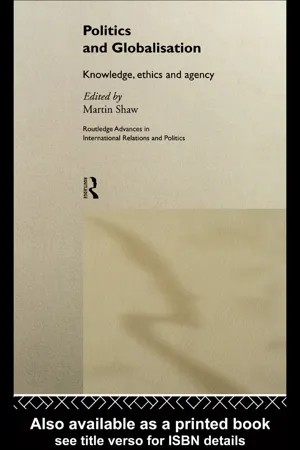
- 240 pages
- English
- ePUB (mobile friendly)
- Available on iOS & Android
eBook - ePub
About this book
Information
Part I
CONTESTING
GLOBALISATION
1
GLOBALISATION: PROSPECTS FOR A PARADIGM SHIFT
Globalisation calls into question the adequacy of comparative politics and international relations as methods to understand the organisation and exercise of power in social life. The growth of a global dimension of social relations can even cast doubt on the very project of political science and the academy’s practice of disciplinary divisions more generally. Contemporary accelerated globalisation gives ample cause for a paradigm shift in social analysis toward what might be called ‘world system studies’. That said, entrenched intellectual traditions and institutional forces exert substantial resistance to such a change.
This argument is elaborated below in seven steps. The first section distinguishes three common but redundant notions of ‘the global’. The second elaborates a distinctive conception, namely, globality as supraterritoriality. The third locates the rise of supraterritoriality in (mainly recent) history, while the fourth stresses that this trend brings with it continuities as well as changes. The fifth section suggests that contemporary globalisation (as deterritorialisation) requires us to abandon the methodological territorialism that has underlain conventional social science. The sixth section proposes an alternative methodology of world system studies. The seventh identifies some of the intellectual and institutional forces that stand in the way of this reorientation.
Globalisation as old hat
The vocabulary of ‘globalisation’ is quite new. Not until the 1890s did English speakers begin regularly to use the adjective ‘global’ to designate ‘the whole world’ in addition to its earlier meaning of ‘spherical’ (OED 1989:VI, 582). The terms ‘globalise’ and ‘globalism’ were introduced in a treatise published fifty years later (Reiser and Davies 1944:212, 219). Before the 1980s, no one spoke of ‘global governance’, ‘global political economy’, ‘global environmental change’, and so on. The noun ‘globalisation’ first appeared in a dictionary (of American English) in 1961 (Webster 1961:965). Subsequently, similar words have surfaced in many other languages: e.g., globalización in Spanish; globalizare in Romanian; globalisaatio in Finnish; globalisasi in Indonesian; bishwavyapikaran in Nepali; Quan Qiu Hua in Chinese; and so on.
Yet what core idea do these new words capture? The implications of ‘globe talk’ for social knowledge hinge very much on how one conceives of the central notion ‘global’. Approached in certain senses, ‘globality’ and ‘globalisation’ open no insights that have not been available through preexistent terminology and methodology. Sceptics (such as Michael Nicholson in this volume) can with good reason reject such usages as jargon. However, other constructions of ‘global-ness’ offer a qualitatively different understanding of social relations and cannot be so readily dismissed as old hat. The following paragraphs identify three redundant notions of ‘the global’. The next section then advances an alternative conception which can prompt a paradigm shift in social enquiry.
One common conception has equated globalisation with universalisation. In this usage, a ‘global’ phenomenon is one that is found all over the world, and ‘globalisation’ is the process of spreading various objects and experiences worldwide. We could in this sense have a ‘globalisation’ of asphalt roads, decolonisation, Disney films, and much more.
Globalisation of this kind has certainly transpired in the late twentieth century, and on quite a substantial scale; however, impulses toward universalisation are hardly new to the present day. Indeed, the prehistoric transplanetary spread of the human species could be seen as the initial instance of this sort of ‘globalisation’ (Gamble 1994). Several world religions, too, have for a thousand years and more extended across large tracts of the earth. Transoceanic trade has for centuries distributed various goods in ‘global’ (read world-scale) markets. Yet the pre-existent vocabulary of ‘universality’ and ‘universalisation’ is quite adequate to describe these age-old trends. This first formulation of ‘globalisation’ offers nothing distinctive and new.
A second common usage has equated globalisation with internationalisation. From this perspective, ‘global’ is simply another adjective to describe cross-border activity between countries, and ‘globalisation’ designates a growth of international interaction and interdependence. Evidence of such ‘globalisation’ is purportedly to be found in enlarged movements between countries of people, goods, money, messages, ideas, etc.
Globalisation of this second kind has indeed occurred on a substantial scale in the late twentieth century; however, exchanges between country units have also increased in various earlier periods during the 500-year history of the modern states-system. In particular, as many analysts have noted, the late nineteenth century witnessed levels of cross-border migration, direct investment, finance and trade that, proportionately, are broadly comparable with those of the present (Hirst and Thompson 1996; Wade 1996). No vocabulary of ‘globalisation’ was needed on previous occasions of internationalisation, and the terminology of ‘international relations’ arguably remains quite sufficient to examine contemporary transactions and interlinkages between countries.
A third widely employed conception has equated globalisation with liberalisation. Used in this sense, ‘globalisation’ refers to a process of removing officially imposed restrictions on movements between countries in order to create an ‘open’ and ‘integrated’ world. Contemporary evidence for such a trend can be found in the widespread and large-scale reduction or even abolition of regulatory trade barriers, foreign-exchange restrictions, capital controls, and (for citizens of certain states) visas.
Yet, like the first and second conceptions, notions of globalisation as liberalisation are redundant. The long-established liberal discourse of ‘open’ markets and ‘free’ trade is already available to convey these ideas. ‘Global-speak’ was not needed in earlier times of widespread liberalisation like the third quarter of the nineteenth century, and there seems little need now to invent a new vocabulary for an old story.
The remarks in this first section endorse the sceptics’ position that ‘globalisation’ tends to be a social scientist’s jargon, a journalist’s catchphrase, a publisher’s sales pitch, a politician’s slogan, and a businessperson’s fetish. Indeed, the three understandings outlined above between them cover most academic, official, corporate and popular discussion of things ‘global’. Critics are right to assail the conceptual imprecision, historical illiteracy and empirical shallowness that mark most claims of novelty associated with globality.
Globalisation as new idea
However, should we dismiss as fad and hype all talk of ‘global’ governance, ecology, gender relations, communications, trade, finance, consciousness and the like? Are ideas of globalisation always reducible to universalisation, internationalisation and/or liberalisation? Should we not ponder why a new terminology would spread so far and stick for so long if it did not reflect an appreciation (perhaps still largely inchoate) of some kind of unprecedented change?
Important new insight into relatively new circumstances is available from a fourth perspective which identifies globalisation as deterritorialisation. Each of the three conceptions of globality discussed above assume a world of territorialist geography, where macro-level social space is wholly a question of territorial locations, territorial distances, and territorial borders. (I specify ‘macro-level’ insofar as the present discussion concerns large-scale social contexts rather than micro-level spaces such as buildings and views.) Territoriality involves tracts on the earth’s surface separated by distance and (in many cases) borders. In a territorialist world, the length of territorial distances between locations and the presence or absence of territorial (especially state) borders between places generally determines the possibility, frequency and significance of contacts between people at the different sites.
Yet current history has witnessed a proliferation of social connections which are at least partly—and often quite substantially—detached from territorial space. Take, for instance, telephone networks, electronic finance, multilateral institutions, the depletion of atmospheric ozone, markets for many pharmaceuticals, and much contemporary textile production. Such phenomena cannot be situated at a fixed and limited territorial location. They operate largely without regard to territorial distance. They substantially bypass territorial borders. The geography of these global conditions cannot be understood in terms of territoriality alone; they also reside in the world as a single place.
Globality thereby marks a distinct kind of space-time compression, and one that is more or less unique to contemporary history. To be sure, the world has long been ‘shrinking’, as territorial distances have been covered in progressively shorter time intervals. Whereas Marco Polo took years to complete his journey across Eurasia in the thirteenth century, by 1850 a sea voyage from south-east Asia to north-west Europe could be completed in 59 days. In the late twentieth century, motorised ships and land vehicles take much less time again to link places. Nevertheless, such transport still requires measurable time spans to cross territorial distances, and these movements still face substantial controls at territorial frontiers. Although speed has markedly increased, proximity in these cases remains a function of distance (as measured using euclidean geometry on a three-dimensional grid) and borders.
For global transactions, in contrast, territorial locations are not fixed, territorial boundaries present no particular impediment, and territorial distance is covered in effectively no time. Satellite television, the United States dollar, the women’s movement, the anthropogenic greenhouse effect, and many other contemporary conditions all have a pronounced supraterritorial quality. Globality (as supraterritoriality) describes circumstances where territorial space is substantially transcended. Phenomena like Coca-Cola and faxes are ‘global’ in this sense because they can extend anywhere in the world at the same time and can unite locations anywhere in effectively no time. The geography of, for instance, Visa credit cards and world service broadcasts has little to do with territorial distances and substantially transcends territorial borders. Likewise, using specific and fixed territorial coordinates, where could we situate Special Drawing Rights, the Rushdie affair, the magazine Elle, the debt of the Brazilian government, karaoke, the production of a Ford automobile, and the law firm Clifford Chance?
All such circumstances reside at least partly in the world as one more or less seamless sphere. Global conditions can and do surface simultaneously at any point on earth that is equipped to host them, e.g. Internet connections. Global phenomena can and do move almost instantaneously across any distance on the planet, e.g. a news flash.
Place, distance and borders only retrieve vital significance in respect of global activity when the earth is contrasted to extraterrestrial domains. Thus, for example, the ‘border’ of the New York Stock Exchange lies at the earth’s outer atmosphere, and time again becomes a significant factor in respect of radio signals when they have to cross the solar system. However, within the domain of our planet, location, distance and borders place no insurmountable constraints on global relations.
Various social researchers across a range of academic disciplines have discerned a rise of supraterritoriality in contemporary history. Already at mid-century, for example, the philosopher Martin Heidegger proclaimed the advent of ‘distancelessness’ and an ‘abolition of every possibility of remoteness’ (1950:165–6). More recently, the geographer David Harvey has described ‘processes that so revolutionise the objective qualities of space and time ‘that we are forced to alter, sometimes in quite radical ways, how we represent the world to ourselves (1989:240). The sociologist Manuel Castells has distinguished a ‘network society’, in which a new ‘space of flows’ exists alongside the old ‘space of places’ (1989:348; 1996). The international relationist John Ruggie has written of a ‘nonterritorial region’ in contemporary world affairs (1993a:172).
Hence globality in the sense of transworld simultaneity and instantaneity— in the sense of the singularity of the world—refers to something distinctive that other vocabulary does not cover. The difference between globality and internationality needs in particular to be stressed. Whereas international relations are interterritorial relations, global relations are supraterritorial relations. International relations are cross-border exchanges over distance, while global relations are transborder exchanges without distance. Thus global economics is different from international economics, global politics is different from international politics, and so on. Internationality is embedded in territorial space; globality transcends that geography.
In addition, global (as transborder) relations are not the same as openborder transactions. Contemporary liberalisation has often occurred in tandem with globalisation. This large-scale removal of statutory restrictions on transactions between countries has both responded to and facilitated the rise of supraterritoriality. However, the two trends remain distinct. Liberalisation is a question of regulation, whereas globalisation (as deterritorialisation) is a question of geography.
Global events are also distinct from universal circumstances. Universality means being spread worldwide, while globality implies qualities of transworld concurrence and coordination. Universalisation has sometimes transpired in tandem with globalisation, both encouraging and being encouraged by the growth of supraterritoriality. However, the two trends remain distinct. Universality says something about extent, whereas globality says something about space-time relations.
To stress this key point once more: globalisation as understood here is not the same thing as Universalisation, internationalisation or liberalisation. It is crucial to note that analysts who reject the transformative character of ‘globalisation’ have almost invariably conflated the term with internationalisation, liberalisation and/or universalisation. Yet the potential for a paradigm shift lies in the idea and practice of deterritorialisation, not in the other three notions. To appreciate the present argument in its own terms, the logic and the evidence must be assessed in the light of a fourth, different definition.
Globalisation in history
Like universalisation, internationalisation and liberalisation, the spread of supraterritoriality has some antecedents in earlier times. For example, we can trace intimations of global consciousness—i.e., conceptions of the earthly world as a single place—back half a millennium. From the fourteenth century onwards, certain intellectuals contemplated the possibility of transborder government (cf. Hinsley 1963: ch. 1). In literature, Shakespeare’s Puck thought to ‘put a girdle round about the earth in forty minutes’ (1595–6:38). During the eighteenth century a number of London-based transatlantic traders considered themselves to be ‘citizens of the world’ (Hancock 1995). Roland Robertson has suitably characterised such developments as the ‘germination phase’ of globalisation (1992:58).
Globality began to take more material form in the second half of the nineteenth century. These decades saw the early development of telecommunications, including intercontinental telegraph cables. The first overseas plant of a manufacturing enterprise appeared in 1852. A few products like Remington typewriters and Campbell tinned soups began to acquire global markets in the late nineteenth century. The same period witnessed the creation of the first regulatory agencies with a worldwide remit, such as the International Telegraph (now Telecommunication) Union in 1865 and the General (now Universal) Postal Union in 1874. Transborder peace, labour, anarchist and women’s movements also became active at this time. Further growth of global consciousness was encouraged with events such as world fairs, first staged in 1851, and the modern Olympic Games, first held in 1896.
That said, on the whole the scale of nineteenth-century globalisation was vastly smaller than that of the present day. The thousands of telegraph messages that moved between countries each year a hundred years ago cannot be compared in scale or consequence with the millions of telecommunications signals that transcend territorial geography each day in the 1990s. In the late nineteenth century only a tiny proportion of the world’s population purchased globally marketed products. With staffs of less than twenty persons each, the handful of global governance bodies of the 1890s can scarcely be likened to the several hundred multilateral institutions of the 1990s, some of them with payrolls running into the thousands. Many other major forms of globality did not exist at all in the nineteenth century, e.g. electronic transworld finance, transborder production chains, electronic mass media, computer networks, liquid-fuel rocketry, global ecological problems, and so on. Hence, although globalisation has a longer history, the antecedents must not be exaggerated. In particular, the precursors of contemporary globalisation are nowhere near as great as the earlier instances of internationalisation.
When conceived as deterritorialisation, globalisation has unfolded mainly in the late twentieth century. In 1950, the vast majority of the world’s population never made telephone calls, watched television or boarded an aircraft. The loss of global biodiversity began to increase exponentially around mid-century, while significant ozone depletion started in the 1960s. Satellites, intercontinental missiles and transoceanic telephone cables date from the mid-1950s. The count of transborder companies (i.e. firms operating in several countries at once) multiplied sixfold between the late 1960s and the late 1990s (UNCTAD 1994:131; UNCTAD 1997:6–7). Since the 1960s global governance agencies and transborder civic associations have likewise proliferated and grown at unprecedented rates (cf. UIA 1997:1763). All but four of the dozens of offshore financial centres currently in operation have been created since 1950. The first eurocurrency deposits appeared in the early 1950s, the first euromarket loan in 1957, the first eurobond in 1963, and the first transborder electronic link between stock exchanges in 1985. In earlier times, only a narrow circle of intellectuals and businesspeople thought globally, and then usually only fleetingly; however, today globality is widely embedded in everyday popular consciousness.
To be sure, supraterritorial spaces have involved different countries, classes, nationalities and other social groupings to uneven extents. For instance, global relations have been more concentrated in the North relative to the South and the East. The rise of supraterritoriality has touched urban centres (especially so-called ‘global cities’) more than rural areas. The trend has involved propertied and professional classes more than poorer and less literate circles. Women and people of colour have generally had less access to global spaces t...
Table of contents
- Front Cover
- Politics And Globalisation
- Routledge Advances In International Relations And Politics
- Title Page
- Copyright
- Contents
- List of figures and tables
- Notes on contributors
- Acknowledgements
- Introduction
- Part I Contesting globalisation
- Part II State and economy
- Part III Power and knowledge
- Part IV Ethics and politics
- Part V Agency and globality
- Bibliography
- Index
Trusted by 375,005 students
Access to over 1.5 million titles for a fair monthly price.
Study more efficiently using our study tools.
Frequently asked questions
Yes, you can cancel anytime from the Subscription tab in your account settings on the Perlego website. Your subscription will stay active until the end of your current billing period. Learn how to cancel your subscription
No, books cannot be downloaded as external files, such as PDFs, for use outside of Perlego. However, you can download books within the Perlego app for offline reading on mobile or tablet. Learn how to download books offline
Perlego offers two plans: Essential and Complete
- Essential is ideal for learners and professionals who enjoy exploring a wide range of subjects. Access the Essential Library with 800,000+ trusted titles and best-sellers across business, personal growth, and the humanities. Includes unlimited reading time and Standard Read Aloud voice.
- Complete: Perfect for advanced learners and researchers needing full, unrestricted access. Unlock 1.5M+ books across hundreds of subjects, including academic and specialized titles. The Complete Plan also includes advanced features like Premium Read Aloud and Research Assistant.
We are an online textbook subscription service, where you can get access to an entire online library for less than the price of a single book per month. With over 1.5 million books across 990+ topics, we’ve got you covered! Learn about our mission
Look out for the read-aloud symbol on your next book to see if you can listen to it. The read-aloud tool reads text aloud for you, highlighting the text as it is being read. You can pause it, speed it up and slow it down. Learn more about Read Aloud
Yes! You can use the Perlego app on both iOS and Android devices to read anytime, anywhere — even offline. Perfect for commutes or when you’re on the go.
Please note we cannot support devices running on iOS 13 and Android 7 or earlier. Learn more about using the app
Please note we cannot support devices running on iOS 13 and Android 7 or earlier. Learn more about using the app
Yes, you can access Politics and Globalisation by Martin Shaw in PDF and/or ePUB format, as well as other popular books in Politics & International Relations & Political Economy. We have over 1.5 million books available in our catalogue for you to explore.