- 280 pages
- English
- ePUB (mobile friendly)
- Available on iOS & Android
eBook - ePub
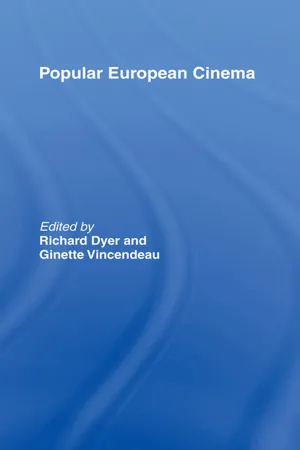
Popular European Cinema
About this book
Popular European Cinema examines the reasons why films that are most popular with audiences in any one European countha are seldom successful eslewhere. Audiences themselves represent diverse class, gender and ethnic identities that complicate th equestoin of national cinema, not least with recent developments in formerly communist Eastern Europe and post-colonialist Western Europe. THrough their individual studies, the contribuitots ehr oven up a new area of study, using the medium of film to fucus a wider discussion of popular European culture.
Tools to learn more effectively

Saving Books

Keyword Search

Annotating Text

Listen to it instead
Information
1
Family Diversions
French popular cinema and the music-hall
Dudley Andrew
Jean Renoir's Le Crime de Monsieur Lange (The Crime of Monsieur Lange, 1935) always rises into focus as an eloquent image helping us sort out that mélange of competing values that defined French culture at the moment of the Popular Front. While its allegory of urban labourers who succeed in a struggle against exploitation and corruption might seem naïve today, the fact that the outcome of its social drama turns on the power of popular art makes it quite sophisticated and perennially interesting. Film historians are naturally taken with a film in which the downfall of evil management by a workers' co-operative in a publishing house is modelled on the exploits of 'Arizona Jim', a legendary cowboy whose tale, read by everyone in Paris, keeps the enterprise thriving.
Because of the lightness of Jacques Prévert's script, its serious political issues (including the legitimate use of violence, even assassination, in the formation of a just society) bubble up in laughter. The film's hero, Amédée Lange, is a creative writer whose work inspires his confréres at the publishing house and soon an entire class (the workers of Paris) who await each weekly instalment of 'Arizona Jim'. Through Lange's growing social awareness and responsibility, art and life converge in a directly political act, the killing of the corrupt Batala. Thus everyday life becomes mythologized through fiction until fiction provides the model for political behaviour. Le Crime de Monsieur Lange is an unpretentious film about an unpretentious hero, a popular representation replete with popular images (dime novels, posters, a low-budget movie in the works). It deserves to be in the foreground of anything deserving the name, 'The Popular Front', the movement whose official programme was published just days before the film's première in January 1936 (Sesonske 1980: 185-6).
The exceptional achievement of Le Crime tie Monsieur Lange can best be felt by setting it alongside any of the innumerable other French films of the day that purport to treat the life of the underdogs of society. One such film, Christian-Jaque's Rigolboche (1936), premièred six months later in September 1936, might well be thought of as a twin of Renoir's film because it too concerns the rise to popular success of an exploited artist of the people. The most noticeable link between the two films is surely Jules Berry, who portrays a cardsharp named Mr Bobby, in Rigolboche, using the same inimitable hand gestures, improvised dialogue and unconcealed cunning that gave such verve to the magnificently impeccable swindler Batala, editor of the publishing house, in Le Crime de Monsieur Lange. In both films that cunning snares whatever women come in sight as well as the unsuspecting ingénues, Amédée Lange (who is but a closet novelist until Batala gives him a chance) and the naïve cabaret singer just arrived from Dakar, whom Mr Bobby christens 'Rigolboche'.
Managing their careers, Jules Berry in fact uses both grateful artists as shields to interpose between himself and the irate victims of his failed scams. In what can readily be seen as a reference to the Stavisky scandal two years previous,1 financial misdealings and illegality ultimately put the Berry character to flight, a disappearance balanced by the unprecedented rise of Lange's serial novels and Rigolboche's nightclub act until in each case the artist takes over the means of production. Ultimately Mr Bobby and his pals are edged to the side of an enterprise that has outgrown them, and Batala, in trying to reclaim command of the co-operative, is dropped by Lange's bullet amid the garbage cans of the courtyard.
For our purposes, the differences between Berry's Batala and his Mr Bobby outweigh these remarkable similarities. Because Renoir and Prevert provide no authority figure able to sort out the authentic from the sham, Batala's charm, delightful as it may be, proves genuinely dangerous and evil. Against his wiles and his power the people must become their own saviours. And they do so first by banding together and second by risking violence to protect themselves. In Rigolboche, the presence of police, detectives and a powerful nobleman keep Mr Bobby in check and ultimately form a reassuring umbrella over Rigolboche herself, even though for a time she, like Mr Bobby, must live in hiding. Having learned to survive in the murky milieu of nightclubs, he becomes a street-wise big brother to Rigolboche rather than her evil seducer.
More important is the fact that Rigolboche, unlike Lange, cannot really protect herself; she would be ruined financially were it not for her adoring Count, the man who ultimately buys her the music-hall that crowns her success. In contrast, Lange's fate falls to his peers, a hastily constituted jury at the border, that can aid or prevent his escape. Nothing like a marriage of classes lets everyone live happily ever after, for urban society in Prévert's view is a new wild west where violence may be a tool of justice in the hands of the people. A lone ranger, Lange understands that he must retire from the fledgling community he has audaciously protected with his gun. Presumably it can now govern itself.
Rigolboche on the other hand understands nothing about community, understands very little at all. A survivor, she is at the mercy of forces both above and beneath her (the Count and a blackmailer from Dakar). Her success depends upon her winning ways, her smile and open goodness of heart. Even if she is exploited by Mr Bobby and others, such is the message of the film that this smile and goodheartedness will protect her in a world where traps are too numerous to avoid but where faith in humanity, especially when infectiously expressed in song, will ultimately extricate you. Taken under the wing of smitten father figures, Rigolboche feels no allegiance to her class or its culture. Rather, she treads unfalteringly up the ramp of money and power that extends from club to cabaret to magnificent music-hall. Compared to the vibrant courtyard that Amédée Lange shares with the laundresses, labourers and even the cranky concierge, a courtyard that no amount of financial success can make him abandon, the increasingly glitzy entertainment sites in Rigolboche harbour a depressingly bourgeois view of society, a 'social climber's' view no doubt held by the majority of the film's spectators.
A comparison of these films shows something at stake more subtle than the obvious contention between regressive and progressive social visions; it points to a competition between modes and technologies of entertainment that in themselves carry (and engender) their own versions of Utopia. Counterpoised to pulp fiction and to the modest scribbler Lange (played by the mild, winsome Rene Lefevre) is highlife spectacle and the extroverted Rigolboche who is portrayed by the most famous music-hall performer of the era: Mistinguett.
Yet Mistinguett understood the film medium well enough not to overwhelm the audience immediately with the extraordinary pyrotechnics of her art. Instead, with calculated intimacy she sets out to seduce us into identifying with her as an ordinary and very vulnerable young woman. Thus when she sings her son to sleep behind the curtains of their modest home, she delivers the kind of song all of us have sung. In this way the stunning décor and intricate technological precision of the music-hall scene on which the film concludes serve to amplify her humanity and the natural human voice that made it special. And so the film justifies power and money through a story of the 'natural origins' of its heroine (and of Mistinguett),
In fact the him tells its rags-to-riches tale on more than one level, building a myth, as we shall see, of the music-hall itself. A key to this process is the hidden story of the title of the film and its heroine. Here is how it works: pressed by a nightclub owner to introduce his latest 'discovery', Mr Bobby, who has picked up Mistinguett, scans the walls of the office and lights on an antique poster with the curious name 'Rigolboche' displayed; thus is the heroine baptized. Although the film does not gloss this reference, the original Rigolboche was a beggar named Marguerite, who became a symbol of the rise of the people. In 1841 she found her way onto the stage of the Chartreuse, later to become the Closerie des Lilas. Just prior to the great age of the café-concerts, this coffee house, according to a contemporary habitué,
allowed on stage whoever wanted to sing or recite, especially students who felt they had musical or poetic genius. They would execute their compositions to great effect on a crowd sensitive to freedom and instinct. I heard things there that were amusing and of an unusual and bizarre originality.
(de Banville 1933: 307)
The most remarkable performance this man heard there was that of Rigolboche before she gained her fame.
Hardly beautiful, thin and pale, she spent the day sitting on the floor in a corner of the attic. You could see her mending secondhand clothes she had found. In the evening, having thrown together some kind of dress with her fairy's needle, she sang at the Chartreuse! She hadn't learned composition or verse, but she understood them instinctively, and her couplets often had the ingenious and primitive grace of popular songs.
(de Banville 1933: 307)
In its very title, then, the film calls on the central myth of the music-hall, that it grew from the unschooled and 'natural expressiveness' of Parisians singing in local cafés. This is doubly a myth, for it is a tale of origins and it also masks the truth. Specifically, the film displays Mistinguett who adopts the name and role of an early singer whose authentic popular origins and appeal are distinctly opposed to this twentieth-century star. For Mistinguett was known not for rags magically stitched together but for costumes weighing kilos, full of feathers and jewels. In this film, such sumptuousness is represented as a mere amplification of a natural style visible in the character's humble origins and private lullabies just as the music-hall itself is presented as simply enlarged space for intimate and personal expression.
In fact there was nothing ordinary or personal in the spectacular career of Mistinguett which parallels that of the music-hall itself. She made her debut at 12 years old in 1885, blossomed at the Eldorado in the first years of this century, and was the mainstay of the Folies-Bergère during its heyday; she could still be seen on the stage after the Second World War. From 1910 to 1940 she was unquestionably France's dominant performing artist, 'a national treasure', as Colette called her. A host of younger stars from Maurice Chevalier in 1912 to Fernandel in 1933 would be graced to trail behind her into the stage lights. One virtually needed her blessing to succeed
Mistinguett was destined to run smack into the cinema. A woman of extraordinary 'presence', whose personal vibrancy counted far more towards her success than her mediocre voice and dancing, or her fabled legs and costumes, she was lured to the silent cinema where she played in nearly a dozen features. But the sound film troubled her deeply, as it did the entertainment form of which she was the queen. For here a recording was meant to replace a living encounter. In 1932 when her colleague Georges Tabet began making records, she scolded him for bartering away the spontaneity of performance (Tabet 1979: 155). She knew instinctively that her own success depended on the way she could measure and play an audience, seducing them anew each night, but she did not know how to seduce the camera and the microphone, and so she literally refused to play to them, at least until 1936 and Rigolboche.
For her sound him première Mistinguett demanded a script in which cinema is made to show off the particular possibilities of music-hall. She insisted that the story be such as to allow her to change station (and costume) over and over; this way audiences could ride with her from poverty and anonymity to the heights of wealth and glory. She demanded a melodrama in which she could be both a doting mother and a seductive woman of the cabarets. Naturally her shifts in fortune would be marked by the mise-en-scène of the production numbers that were the real reason for the film in the first place. For three weeks she worked on the script with Christian-Jaque until she was satisfied that she could dominate the film and its audience.
And she succeeded, by achieving a moral superiority founded on her status as faithful but indigent mother alone in Paris with a young son. Her tender lullaby to him guarantees the authenticity of singing as the medium of pure communication while it establishes the family unit as its original source. Mistinguett, we may now go on to believe, has us in mind, tucks us in our seats in the cinema, as she performs at her nightclub and eventually on the ornate staircase of her very own music-hall.
Le Crime de Monsieur Lange treats spectatorship very differently. When his writing attains the summit of popularity, Amédée Lange agrees to a movie version of 'Arizona Jim', effectively inviting his diegetic reading public to shift attention, but not allegiance, to the medium that we, the actual public, have already chosen, the cinema. In fact the 'Arizona Jim' film permits all the members of the courtyard to participate in their own allegory, dressing in western costumes and acting out the moral dramas of their everyday life. This amounts to a playful, satirical cinema, close to the skits Prévert wrote for the Groupe Octobre, like L'Affaire est dans le sac (It's in the Bag, 1933). As in Brecht's theatre, the audience for such films is meant to sense themselves as a community that applauds or shouts down characters and actions. The crude filmic technique, like Lange's unsophisticated prose, addresses the public as an extended community of equals and gains its assent through the modesty and justness of what it shows.

Plate 1 Glitzy sexual display: Mistinguett in the ...
Table of contents
- Cover
- Title
- Copyright
- Contents
- List of plates
- Notes on contributors
- Acknowledgements
- Introduction
- 1 Family diversions: French popular cinema and the music hall
- 2 La ley del deseo: a gay seduction
- 3 Immigrant Cinema: national cinema — the case of beur film
- 4 Images of 'Provence': ethnotypes and stereotypes of the south in French cinema
- 5 Author, actor, showman: Reinhold Schünzel and Hallo Caesar!
- 6 'We were born to turn a fairy-tale into reality': Svetlȳĭ put’ and the Soviet musical of the 1930s and 1940s
- 7 Studying popular taste: British historical films in the 1930s
- 8 Was the cinema fairground entertainment? The birth and role of popular cinema in the Polish territories up to 1908
- 9 The Finn-between: Uuno Turhapuro, Finland's greatest star
- 10 The inexportable: the case of French cinema and radio in the 1950s
- 11 The other face of death: Barbara Steele and La maschera del demonio
- 12 Popular taste: the peplum
- 13 National romanticism and Norwegian silent cinema
- 14 The Atlantic divide
- 15 Early German cinema — melodrama: social drama
- 16 'Film stars do not shine in the sky over Poland': the absence of popular cinema in Poland
- 17 Valborgsmässoafton: melodrama and gender politics in Swedish cinema
- 18 A forkful of westerns: industry, audiences and the Italian western
- Index
Frequently asked questions
Yes, you can cancel anytime from the Subscription tab in your account settings on the Perlego website. Your subscription will stay active until the end of your current billing period. Learn how to cancel your subscription
No, books cannot be downloaded as external files, such as PDFs, for use outside of Perlego. However, you can download books within the Perlego app for offline reading on mobile or tablet. Learn how to download books offline
Perlego offers two plans: Essential and Complete
- Essential is ideal for learners and professionals who enjoy exploring a wide range of subjects. Access the Essential Library with 800,000+ trusted titles and best-sellers across business, personal growth, and the humanities. Includes unlimited reading time and Standard Read Aloud voice.
- Complete: Perfect for advanced learners and researchers needing full, unrestricted access. Unlock 1.4M+ books across hundreds of subjects, including academic and specialized titles. The Complete Plan also includes advanced features like Premium Read Aloud and Research Assistant.
We are an online textbook subscription service, where you can get access to an entire online library for less than the price of a single book per month. With over 1 million books across 990+ topics, we’ve got you covered! Learn about our mission
Look out for the read-aloud symbol on your next book to see if you can listen to it. The read-aloud tool reads text aloud for you, highlighting the text as it is being read. You can pause it, speed it up and slow it down. Learn more about Read Aloud
Yes! You can use the Perlego app on both iOS and Android devices to read anytime, anywhere — even offline. Perfect for commutes or when you’re on the go.
Please note we cannot support devices running on iOS 13 and Android 7 or earlier. Learn more about using the app
Please note we cannot support devices running on iOS 13 and Android 7 or earlier. Learn more about using the app
Yes, you can access Popular European Cinema by Richard Dyer,Ginette Vincendeau in PDF and/or ePUB format, as well as other popular books in Social Sciences & Media Studies. We have over one million books available in our catalogue for you to explore.