- 368 pages
- English
- ePUB (mobile friendly)
- Available on iOS & Android
eBook - ePub
About this book
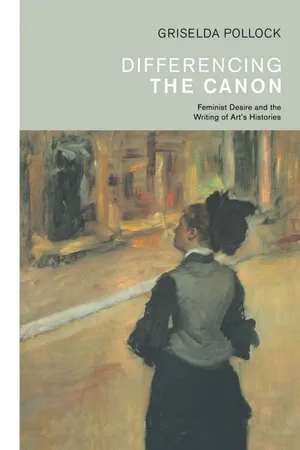
In this major book, Griselda Pollock engages boldly in the culture wars over `what is the canon?` and `what difference can feminism make?` Do we simply reject the all-male line-up and satisfy our need for ideal egos with an all women litany of artistic heroines? Or is the question a chance to resist the phallocentric binary and allow the ambiguities and complexities of desire - subjectivity and sexuality - to shape the readings of art that constantly displace the present gender demarcations?
Tools to learn more effectively

Saving Books

Keyword Search

Annotating Text

Listen to it instead
Information
Topic
ArtSubtopic
Media StudiesPart I
Firing the Canon
As canons within academic disciplines go, the art historical canon is among the most virulent, the most virilent, and ultimately the most vulnerable.
Nanette Salomon, 'The Art Historical Canon: Sins of Omission', 1991
1
About Canons and Culture Wars

Fig. 1.1. Johan Zoffany (1733/4-1810), The Tribuna of the Uffizi, 1772-7/8, oil on canvas, 123.5 x 155 cm. London: Her Majesty Queen Elizabeth II
The term canon is derived from the Greek kanon, which means 'rule' or 'standard', evoking both social regulation and military organisation. Originally, the canon had religious overtones, being the officially accepted list of writings that forms the 'Scriptures'. The first canonisation exercise was the selection of the Hebrew Scriptures, made by an emergent priestly class around the seventh century BCE, of which the historian Ellis Rivkin has argued that the choice was 'not primarily the work of scribes, scholars or editors who sought out neglected traditions about wilderness experience, but of a class struggling to gain power'.1 Canons may be understood, therefore, as the retrospectively legitimating backbone of a cultural and political identity, a consolidated narrative of origin, conferring authority on the texts selected to naturalise this function. Canonicity refers to both the assumed quality of an included text and to the status a text acquires because it belongs within an authoritative collection. Religions confer sanctity upon their canonised texts, often implying, if not divine authorship, at least divine authority.
With the rise of academies and universities, canons have become secular, referring to bodies of literature or the pantheon of art (Fig. 1.1). The canon signifies what academic institutions establish as the best, the most representative, and the most significant texts — or objects — in literature, art history or music. Repositories of trans-historical aesthetic value, the canons of various cultural practices establish what is unquestionably great, as well as what must be studied as a model by those aspiring to the practice. The canon comprehensively constitutes the patrimony of any person wanting to be considered 'educated'. As Dominick LaCapra comments, the canon reaffirms a 'displaced religious sense of the sacred text as the beacon of common culture for an educated elite'.2
Historically, there has never been just one, single canon. Art historically, there are competing canons. During the great era of art historical activity in the nineteenth century, many artists as well as schools and traditions were rediscovered and revalued. Rembrandt, for instance, was reclaimed in the nineteenth century as a great religious and spiritual artist instead of being dismissed, as he had been in the eighteenth, as a sloppy painter of low subjects, while Hals, long avoided as a minor Flemish genre painter of no great skill or distinction, became an inspiration to Manet and his generation of modernists in search of new techniques of painting 'life'.3
Always associated with canonicity as a structure, however, is the idea of naturally revealed, universal value and individual achievement that serves to justify the highly select and privileged membership of the canon that denies any selectivity. As the record of autonomous genius, the canon appears to arise spontaneously. In 'What is a Masterpiece?' the art historian Kenneth Clark acknowledged the fluctuations of taste according to social and historical vagaries that allowed Rembrandt to be disdained in the eighteenth century or artists that we no longer value to have been highly rated in the nineteenth. None the less, Clark insists that 'Although many meanings cluster around the word masterpiece, it is above all the work of an artist of genius who has been absorbed by the spirit of the time in a way that has made his individual experiences universal'.4
The canon is not just the product of the academy. It is also created by artists or writers. Canons are formed from the ancestral figures evoked in an artist/writer/composer's work through a process that Harold Bloom, author of the major defence of canonicity, The Western Canon (1994), identified as 'the anxiety of influence', and I, in another mode of argument, the avant-garde gambit of 'reference, deference, and difference'.5 The canon thus not only determines what we read, look at, listen to, see at the art gallery and study in school or university. It is formed retrospectively by what artists themselves select as their legitimating or enabling predecessors. If, however, artists — because they are women or non-European — are both left out of the records and ignored as part of the cultural heritage, the canon becomes an increasingly impoverished and impoverishing filter for the totality of cultural possibilities generation after generation. Today, the canons are settled into well-known patterns because of the role of institutions such as museums, publishing houses and university curricula. We know these canons — Renaissance, modernist, etc. through what gets hung in art galleries, played in concerts, published and taught as literature or art history in universities and schools, gets put on the curriculum as the standard and necessary topics for study at all levels in the educating — acculturating, assimilating —process.
In recent years the culture wars have broken out as new social movements target canons as pillars of the established elites and supports of hegemonic social groups, classes and 'races'.6 Canonicity has been subjected to a withering critique for the selectivity it disavows, for its racial and sexual exclusivity and for the ideological values which are enshrined not just in the choice of favoured texts but in the methods of their interpretation — celebratory affirmations of a world where, according to Henry Louis Gates Jnr., 'men were men and men were white, when scholar-critics were white men and when women and people of colour were voiceless, faceless servants or laborers, pouring tea and filling brandy snifters in the boardrooms of old boys' clubs'.7 Critique of the canon has been motivated by those who feel themselves voiceless and deprived of a recognised cultural history because the canon excludes the texts written, painted or composed and performed by their social, gender or cultural community. Without such recognition, these groups lack representations of themselves to contest the stereotyping, discriminating and oppressive ones which figure in that which hasn been canonised. Henry Louis Gates Jnr. explains the political implications of enlarged canons that accommodate the voice of the Other:
To reform core curriculums, to account for the comparable eloquence of the African, the Asian, and the Middle Eastern traditions, is to begin to prepare our students for their roles as citizens of world cultures through a truly human notion of the 'humanities' rather than — as Mr. Bennett [Secretary for Education under Ronald Reagan] and Mr. [Harold] Bloom would have it — as guardians of the last frontier outpost of white male western culture, the keepers of the master's pieces.8
The 'discourse of the Other' must of necessity 'difference the canon'. Yet it reveals a new difficulty. However strategically necessary the new privileging of the Other certainly is in a world so radically imbalanced in favour of the 'privileged male of the white race', there is still a binary opposition in place which cannot ever relieve the Other of being other to a dominant norm.
Different kinds of moves have been necessary even to imagine a way beyond that trap. Toni Morrison has argued that American literature, whose canon so forcefully excludes African American voices, should, none the less, be read as structurally conditioned by 'a dark, abiding, signing Africanist presence'.9 By identifying this structurally negative relationship to African culture and Africans within the American canon of white literature, notions of excluded others are transformed into questions about the formation of Eurocentric intellectual domination and the resultant impoverishment of what is read and studied. This argument can be compared with that Rozsika Parker and I first advanced m 1981 in opposition to an initial feminist attempt to put women into the canon of art history. We used the apparent exclusion of women as artists to reveal how, structurally, the discourse of phallocentric art history relied upon the category of a negated femininity in order to secure the supremacy of masculinity within the sphere of creativity.10
In the early 1990s, the issue of the total gender asymmetry in the canon, implicit in all feminist interrogations of art history, became an articulated platform through a panel organised by Linda Nochlin, Firing the Canon, in New York in 1990 and through the critical writing of Nanette Salomon on the canon from Vasari to Janson, cited at the head of Part I .11 Feminist critics of the canons of Western culture could easily critique the all-male club represented by Ernst Gombrich's Story of Art and the original editions of H. W. Janson's History of Art that featured not one women artist.12 Feminists have shown how canons actively create a patrilineal genealogy of father-son succession and replicate patriarchal mythologies of exclusively masculine creativity.13 Susan Hardy Aiken, for instance, traces the parallels between the competitive modelling of academic practices, the Oedipal stories narrated by canons, the rivalries that serve as the unconscious motor of intellectual or cultural development, all of which produce the coincidence of the 'noble lineage of male textuality, the parallel formation of canons and the colonizing projects of western Europe organised rhetorically around the opposition civilisation and barbarism'. She concludes:
These links between priestly authority, the implications of 'official' textuality, and the exclusionary and hegemonic motives within canon formation have obvious significance for the question of women and canonicity ... Woman ... becomes a profanation, a heretical voice from the wilderness that threatens the patrius sermo, — the orthodox, public, canonical Word — with the full force of another tongue — a mother tongue — the lingua materna that for those still within the confines of the old order must remain unspeakable.14
Is feminism to intervene to create a maternal genealogy to compete with the paternal lineage and to invoke the voice of the Mother to counter the text of the Father enshrined by existing canons? Susan Hardy Aiken warns: 'one might, by attacking, reify the power one opposes.'15 Against the closed library, from which, in her famous feminist parable on the exclusivity of the canon, A Room of One's Own (1928), Virginia Woolf so eloquently showed women to be shut out, we might propose more than another bookroom. Instead we need a polylogue: 'the interplay of many voices, a kind of creative "barbarism" that would disrupt the monological, colonizing, centric drives of "civilisation" ... Such a vision lives, as Adrienne Rich has taught us, in a re-vision: an eccentric re-reading, re-discovering what the canon's priestly mantle would conceal: the entanglements of all literature with the power dynamics of culture.'16
Theoretical Models for the Critique of the Canon: Ideology and Myth
The critique of canons has been made on the basis of an inside/outside opposition. The canon is selective in its inclusions and is revealed as political in its patterns of exclusion. We might, therefore, approach the problem of the canon as critical outsiders with one of two projects in mind.
The first is to expand the Western canon so that it will include what it hitherto refused - women, for instance, and minority cultures (Fig. 1.2). The other is to abolish canons altogether and argue that all cultural artefacts have significance. The latter appears inherently more political in its totalising critique of canonicity. Strategically, however, I suggest we need a more complex analysis if we are not to end up in a position where insiders — representatives of Western masculine European canons — gird themselves to defend truth and beauty and its traditions against what Harold Bloom dismisses as the School of Resentment,17 while former outsiders remain outsiders, 'the voices of the Other', by developing 'other' subdisciplinary formations — African American or Black Studies, Latino Studies, Women's Studies, Lesbian and Gay Studies, Cultural Studies and so forth. There can be no doubt how necessary and creative

Fig. 1.2. Faith Ringgold (b. 1930), Dancing in the Louvre, from The French Collection, 1991, acrylic on canvas with painted fabric. 183.7 x 200 cm. Private Collection
such commitment of scholarship, resources and acknowledgement is to areas hitherto ignored and understudied. But this cannot avoid the danger, so evident in fundamentally, and often overtly, racist and sexist class societies, that these initiatives may unwittingly reproduce the very segregation — ghettoisation — which excluded groups aim to challenge by demanding intellectual and educational equal rights for tjieir own excluded minority.
Following Teresa de Lauretis, the opposition between inside and outside can be displaced. De Lauretis locates the critical project of feminism as a 'view from elsewhere' which is, however, never outside that which it is critically 're-viewing'.
For that 'elsewhere' is not some mythic distant past or some Utopian future history; it is the elsewhere of discourse here and now, the blind spots, or the space-off, of its representations. I think of it as the spaces in the margins of hegemonic discourses, social spaces carved in the interstices of institutions and in the chinks and cracks of the power-knowledge-apparati.18
The movement is not from the spaces of existing representation to those beyond them, 'the space outside discourse', for there can be no such resource. Rather Teresa de Lauretis means 'a movement from the space represented by/in a representation, by/in a discourse, by/in a sex-gender system to the space not-represented yet i...
Table of contents
- Cover Page
- Half Title page
- Series Title page
- Title Page
- Copyright Page
- Dedication
- Contents
- List of illustrations
- Preface
- List of Contributors
- Acknowledgements
- Part I Firing the Canon
- Part II Reading against the Grain: Reading for . . .
- Part III Heroines: Setting Women in the Canon
- Part IV Who Is the Other?
- Epilogue
- Bibliography
- Index
Frequently asked questions
Yes, you can cancel anytime from the Subscription tab in your account settings on the Perlego website. Your subscription will stay active until the end of your current billing period. Learn how to cancel your subscription
No, books cannot be downloaded as external files, such as PDFs, for use outside of Perlego. However, you can download books within the Perlego app for offline reading on mobile or tablet. Learn how to download books offline
Perlego offers two plans: Essential and Complete
- Essential is ideal for learners and professionals who enjoy exploring a wide range of subjects. Access the Essential Library with 800,000+ trusted titles and best-sellers across business, personal growth, and the humanities. Includes unlimited reading time and Standard Read Aloud voice.
- Complete: Perfect for advanced learners and researchers needing full, unrestricted access. Unlock 1.4M+ books across hundreds of subjects, including academic and specialized titles. The Complete Plan also includes advanced features like Premium Read Aloud and Research Assistant.
We are an online textbook subscription service, where you can get access to an entire online library for less than the price of a single book per month. With over 1 million books across 990+ topics, we’ve got you covered! Learn about our mission
Look out for the read-aloud symbol on your next book to see if you can listen to it. The read-aloud tool reads text aloud for you, highlighting the text as it is being read. You can pause it, speed it up and slow it down. Learn more about Read Aloud
Yes! You can use the Perlego app on both iOS and Android devices to read anytime, anywhere — even offline. Perfect for commutes or when you’re on the go.
Please note we cannot support devices running on iOS 13 and Android 7 or earlier. Learn more about using the app
Please note we cannot support devices running on iOS 13 and Android 7 or earlier. Learn more about using the app
Yes, you can access Differencing the Canon by Griselda Pollock in PDF and/or ePUB format, as well as other popular books in Art & Media Studies. We have over one million books available in our catalogue for you to explore.