Advertising: Critical Approaches explores a broad range of critical theories and perspectives to shed new light on the organisation, workings and effects of the advertising industry today.
Chris Wharton presents the social, cultural and economic role of advertising across history, with chapters tracking the process of advertising from production to reception.
Split into three sections covering Foundations, Frameworks and Applications, the book's chapters explore a range of areas central to an insight into the development of modern advertising, including:
advertising history
cultural, critical and political economy approaches to advertising
texts in advertising
the reception of advertising
advertising in the home and outdoor advertising
consumer culture.
Case studies explore the diversity in the uses of advertising throughout history, from Ostia and the Square of the Corporations in the ancient Roman world to the UK Border Agency's 'Go Home' campaign and contemporary City branding throughout Europe.
Assessing the impact of the works of key critical thinkers including Marx, Morris, Lyotard, Barthes, Saussure, Williams and Hall have had on our understanding of consumption and advertising's societal impact, Advertising: Critical Approaches illuminates and enhances our understanding and engagement with one of the most vital cultural and economic forces in contemporary society.
Trusted by 375,005 students
Access to over 1.5 million titles for a fair monthly price.
This chapter looks at the importance of history to an understanding of advertising. The history of advertising is first and foremost about uncovering advertising as it occurred in the past. Identifying the form that it took as an arrangement of words or pictures and the messages it conveyed is an important aspect of this too. So also is a wider understanding of advertising’s economic and social purpose in different places and at different times. Advertising often refers to the process of promoting things, the wider activity of representing commodities to the public, whereas advertisements are the outcome of this process, the apparent visible and sometimes audible references to brands and products. Many writers on advertising make the point that what happened in the past and how, why and when people decided to advertise their products, services or ideas to ‘the public’ is an interesting area of enquiry. Advertisements from the past are often encountered as reproductions in history books and as objects of interest in local art galleries and museums. The Museum of Brands, Packaging and Advertising in Notting Hill, London is specifically dedicated to advertising and its history. Other museums, such as the Museum of Roman Civilization in the city of Rome, include examples of historical advertising among their many exhibits. A more recent addition to the collection of historical advertising can be found at the History of Advertising Trust’s online gallery (www.hatads.org.uk).
Advertising and advertisements from the past are not only confined to museums and galleries. Past advertisements can still be glimpsed in the places they were first installed, for instance in the streets we walk down on our way to the shops or to our place of work. Advertisements painted on the outside of buildings in the nineteenth and early twentieth centuries, creating what were at the time vibrant images and texts, are now fading from view. These have become known as ‘ghost signs’. In addition, radio and television advertising slogans from the twentieth century, such as ‘Go to work on an egg!’, created for the Egg Marketing Board, or ‘Don’t forget the fruit gums, Mum!’ for Rowntree’s, still exist as recordings and echo through lived memory. Important developments in the history of advertising, such as the formation of advertising agencies in the nineteenth and twentieth centuries and the division of labour between visualizers and copywriters, still have a presence in the contemporary practice of advertising production.
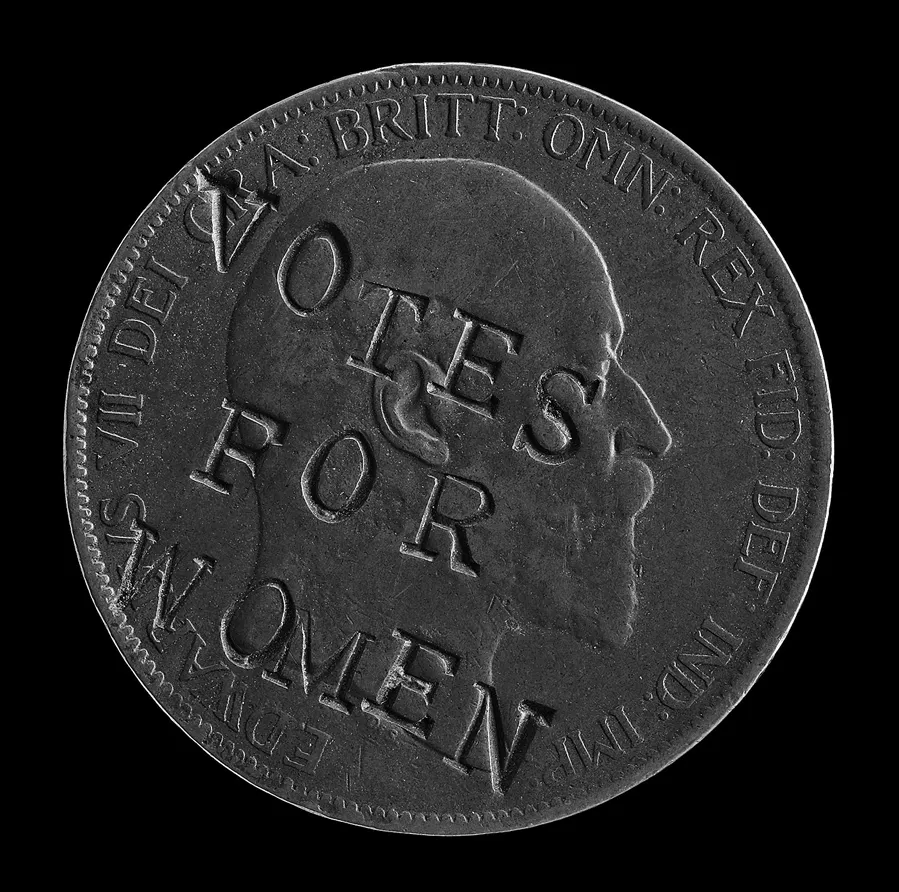
Quite often promotions and advertisements created in the past speak to the modern world with a perplexing combination of the familiar and the strange. Penny coins from 1903 displayed in the British Museum have the Suffragette slogan ‘Votes for women’ stamped on the coin face and serve as an example of historical political advertising that circulated on the loose change of the day. In addition to what are still today important and ongoing global political questions, the coins raise issues about what might be included in a history of advertising and promotion. Do they count as an element of advertising or merely as a form of political promotion? This is one of the questions that the history of advertising poses. Advertising history also has to take account of the wider changes and developments that have occurred over time, and it is also about continuity. The history of advertising is a rewarding and important area of enquiry and this is reflected in the numerous studies that have been produced (Elliott 1962; Hindley & Hindley 1972; Williams 1980; Nevett 1982; McFall 2004; Tungate 2007). This and the next chapter make reference to these.
Figure1.1 ‘Phillips Charles’, wall sign, Liverpool, 2012. Photographed by the author.
In considering change and continuity we come to appreciate the extent to which contemporary advertising has been shaped by the past. In addition to the crucial questions that a history of advertising might pose about what happened in the past, when it occurred and who was involved we might include additional enquiries about why these things occurred and what consequences they have for contemporary and future society? For instance Liz McFall in her book Advertising: A Cultural Economy explores the idea that as advertising developed its techniques and expanded into new promotional areas across the nineteenth and twentieth centuries it became more persuasive over time. The ‘persuasiveness thesis’, as it is termed, became a widely held view of advertising, emphasizing the difference between an advertising based on information and one based on persuasion (McFall 2004: 46). By considering the evidence, and the way historians have handled that evidence, McFall is able to challenge the idea that ‘Persuasiveness is widely characterised as an index of all the ways in which contemporary advertising is supposed to be different from its historical antecedents’ (McFall 2004: 45). In doing so McFall not only casts a light on the nature of advertising in times gone by, she also opens up an enquiry into the nature of contemporary advertising.
Figure1.2 Penny coin with Suffragette slogan ‘Votes for women’, 1903. Reproduced courtesy of the Trustees of the British Museum.
In addition to exploring advertising and advertisements as history, this chapter also considers questions of historiography. By this we mean that the chapter not only concerns itself with the story that the history of advertising tells, but asks questions about how that story is put together, how it is written and therefore what kind of story it tells. The chapter offers an overview of some of the different approaches taken and looks briefly at some existing histories. It considers issues of method, the significance of different kinds of source material and the nature of historical evidence.
Understanding the past
One of the key requirements for the study of advertising is to recognize what we mean by the term ‘advertising’. What are we including in the activity that we call advertising and what are we excluding? Defining our terms in order to survey and understand current practices – the advertising of our own times – is a complex enough operation. To do so in order to identify and comprehend activity from the past is more difficult. Caution is required in applying today’s terms or ideas retrospectively. Which activities and events that occurred in the past might be explained by the modern, widely used term advertising? In current use, as has already been suggested, the word refers to a large-scale industry that includes research as well as creative practice. It also refers to a range of advertising texts and images, communicated across a range of media, from handbills to handhelds. It is worth considering that forms of promotion which occurred in the past might not have been labelled as advertising.
Indeed the use of language to describe the activities and the announcements associated with the promotion of goods and services might be the beginning of a historical enquiry. When was the term advertising first used? In what context did it appear and what did it indicate? The word appears in the title of several early writings by philosopher and essayist Francis Bacon. For example, his essay An Advertisement Touching the Controversy of the Church of England, written in 1589, articulated ideas about religion and its organization rather than referring to the promoting of products. The word also appears in the plays of William Shakespeare. Troilus and Cressida is the tragic story of a pair of lovers set in the ancient conflict between Greece and Troy and was most likely written in 1602. The word advertised is used by the Trojan prince Hector, who has challenged the commanders of the Greek forces encamped outside Troy to engage in battle. Discovering that this is not to be the case he announces that ‘I am advertised their great general slept.’ In this instance ‘advertised’ appears to correspond to something like advised or informed in the sense of ‘I have been made aware of’. This is of interest in the context of a drama that makes great play on the nature of ‘value’, ‘worth’ and ‘price’, both in terms of people and things. These themes are explored – not in the setting of Shakespeare’s play or in the context of the Elizabethan audience for whom they were written – but in relation to contemporary advertising in subsequent chapters of this book.
In the past a variety of English words were used to refer to what we are likely today to call advertising in one or other of its various forms. Early adverts were often referred to as puffs, bubbles, blasts, devices or even impertinences. So we can see that a wide variety of words carrying a range of different connotations were used to indicate an advertisement. A consideration of the context in which these terms were used and by whom adds to our understanding of their use. The term advertiser was being used in the late seventeenth century and advertisement by the eighteenth century (Elliott 1962). Indeed Dr Johnson’s Dictionary of the English Language, produced in 1755, refers to an Advertiser as ‘he that gives intelligence or information’ but also as the name of a ‘paper in which advertisements appear.’ Johnson’s famous aphorism, published in 1759, is worth quoting here not only as an example of the use of the term but for the sentiment it expresses, which still feels true today: ‘Promise, large promise, is the soul of an advertisement’ (Johnson quoted in Williams 1980: 172). The more general term campaign, with less emphasis on the single advert and more on the wider process of promotion of goods and services, became common in the early twentieth century (McFall 2004: 154–7). In recent years the term branding has in many circumstances come to be used instead of advertising (Danesi 2006).
Language is important to our historical understanding. It labels and describes processes, objects and people. In our enquiry the ‘process’ is that of advertising, the ‘objects’ are advertisements and of course it is people who do the advertising. The activity of promotion and advertising – not just the naming of it – has occupied a considerable number of people over the years. This activity is intrinsically linked to economic activity – investing capital and securing incomes, status and social position. It is also associated with culture and leisure. There is a close relationship between advertising and language and more widely between art, culture and advertising (Wharton 2013). Advertising relies on art, design, music and fashion, along with cinema, television and other technologies for the skills and ideas people bring to the industry. At the same time culture and the arts, such as the theatre, galleries and opera, benefit from the income advertising provides and the publicity it generates for events and activities. Furthermore we need to take seriously the close link between advertising and culture because advertising has over time used culture to give meaning, status and often legitimacy to its products and also to the way in which it promotes them. For instance advertising draws on familiar works of art, styles and themes as sources of creativity and as a way of attaching cultural authority to the promoted product. This can be seen in the use of Pablo Picasso’s signature to market the Citroïn Picasso car and, combined with humour, in Persil’s use of the Impressionist painting style to sell its washing powder in the 1990s. Culture refers not only to galleries and theatre companies such as the Royal Shakespeare Company and Tate Modern or to the artistic practices or works of art they present. In a more prosaic manner culture refers to the way people live their lives. An attempt to understand culture is one of the keys we hold in unlocking the advertising past.
In the same vein, the close link between advertising and various media technologies needs to be acknowledged and explored as part of historical enquiry. It is difficult, for example, to imagine contemporary advertising without the newsprint media or the electronic media of television and radio. So before we can pose our important historical questions – such as ‘when did advertising first occur?’ – we might need to consider a range of qualifying questions. For instance in the case of identifying the earliest advert we would need to define an advertisement, what form it takes and what activity it involves. In order to do this we would need to compare and contrast our ‘advert’ with other contemporary objects, activities and technologies.
The history of advertising – like any history – raises a number of questions. Indeed the questions of what should be included in a history of advertising and why are perhaps two of the most important questions we can pose. This chapter opens up a discussion of these issues so that our understanding of advertising history, and any historical enquiry we may subsequently undertake, can develop in a critical and questioning manner.
History and historiography
In this section of the chapter we deal with some of the wider issues that underpin the foundation of the history of advertising. Historiography is the term given to these kinds of issues, considerations and concerns. The term is used in two ways. First, historiography can refer to a body of work, a set of histories: books, articles, web pages and even popular cultural representations about a specific and specialized area of human endeavour, in this case, advertising. Second, the term historiography refers to the methods we use to explore the past and the sources we drawn on. In other words it is how we go about history and how the history of advertising is compiled.
We like to think – in our everyday commonsense understanding of the world – that history exists independently of the questions we ask about the past. In this view advertising history is a series of facts – out there, in the past, just waiting to be discovered. But a history is as much the creation of the nature of the questions we ask as it is a series of facts, objects, events or even people who have had a significant presence in the past. As the historian E.H. Carr put it: ‘facts of history cannot be purely objective, since they become facts of history only in virtue of the significance attached to them by the historian’ (1961: 120). A concern with the ‘facts’ of history is similar to the questions posed in advertising research about the objects of research enquiry. So we can say that the accumulated historical questions and the answers that are forthcoming are an important part of the construction of history, of our understanding of advertising’s past. This is what Spalding and Parker refer to as the ‘distinction between the past and a description of it’ (2007: 1). Such issues are explored in the academic world as questions of historiography and in this chapter as the historiography of advertising.
Different histories of advertising have approached their subject in different ways. For example, Mark Tungate’s Adland: A Global History of Advertising (2007) gives us an insight into advertising’s past. It is also a useful example of the way a history of advertising can be structured and written. Tungate’s book ...
Table of contents
Cover Page
Half-Title Page
Title Page
Copyright Page
Table of Contents
List of illustrations
Note on contributor
Acknowledgements
Introduction
Part I Foundations
Part II Frameworks
Part III Applications
Bibliography
Index
Frequently asked questions
Yes, you can cancel anytime from the Subscription tab in your account settings on the Perlego website. Your subscription will stay active until the end of your current billing period. Learn how to cancel your subscription
No, books cannot be downloaded as external files, such as PDFs, for use outside of Perlego. However, you can download books within the Perlego app for offline reading on mobile or tablet. Learn how to download books offline
We are an online textbook subscription service, where you can get access to an entire online library for less than the price of a single book per month. With over 1.5 million books across 990+ topics, we’ve got you covered! Learn about our mission
Look out for the read-aloud symbol on your next book to see if you can listen to it. The read-aloud tool reads text aloud for you, highlighting the text as it is being read. You can pause it, speed it up and slow it down. Learn more about Read Aloud
Yes! You can use the Perlego app on both iOS and Android devices to read anytime, anywhere — even offline. Perfect for commutes or when you’re on the go. Please note we cannot support devices running on iOS 13 and Android 7 or earlier. Learn more about using the app
Yes, you can access Advertising by Chris Wharton in PDF and/or ePUB format, as well as other popular books in Business & Marketing. We have over 1.5 million books available in our catalogue for you to explore.