The Essentials
Supporting Young Children with Disabilities in the Classroom
- English
- ePUB (mobile friendly)
- Available on iOS & Android
About this book
Create an inclusive environment that promotes the success of all young learners
Every year, the number of children with developmental delays or disabilities in early childhood programs and classrooms is increasing. What do you need to know to support them? This guide is filled with practical information that will help educators who work with children ages birth through 8 teach children with disabilities alongside their peers. Learn the essentials of what you need to know:
- What developmental delays and disabilities are
- How special education laws apply to you and your program or school
- The process of referral, assessment, IFSP/IEP development, and service delivery
- Which supports and interventions can help children be successful socially and academically
- How to work with families, special education professionals, and the medical community
- Information about specific disabilities, including speech and language impairments, autism spectrum disorder, physical disabilities, and attention-deficit/hyperactivity disorder
All children thrive in high-quality programs that recognize and support their individual strengths, interests, and needs. Use the information in this book to help children meet their potential.
Trusted by 375,005 students
Access to over 1 million titles for a fair monthly price.
Study more efficiently using our study tools.
Information

6 Speech and Language Impairments
Jose is worried about his son, Michael. His second birthday was almost two months ago, and he still isn’t talking much. His older sisters talked early, and once they started talking, they never seemed to stop. Michael is quieter and a bit shy. He communicates mainly by pointing, and his sisters often speak for him.Jose takes Michael to the park to make sure he plays with other children his own age. Jose notices that the other 2-year-olds often use two words together when they talk, and he can understand most of what they say. The other parents at the park tell him not to worry, that Michael will start talking any day now, but Jose is still concerned.At Michael’s next checkup, Jose shares his concerns about Michael’s speech with the pediatrician, Dr. Rose. He tells her that Michael really only uses the words no and cookie, and that sometimes he uses cookie to mean other things—if he is thirsty, sees something else he wants to eat (like french fries), or wants a toy. He does say other words, but he doesn’t use them spontaneously; he only repeats them after someone else says them to him.Jose also explains that Michael does not seem to understand when he asks him to do something that has two steps, like “Put the truck away, and go get your coat.” After listening to Jose, Dr. Rose smiles at Michael and gives him a few directions. Although he readily follows her one-step requests (“Bring me the book, please”), he shows confusion when the doctor gives him a more complex direction (“Bring me the kitty, and then sit down by Daddy”). At the end of the visit, she gives Jose the contact number for the local early intervention program so he can have Michael evaluated.Jose calls right away for an evaluation. A speech-language therapist from the program finds that Michael does have a delay in speech and language, and she begins speech therapy with him twice a week at home. She also offers suggestions for Jose to use during his daily interactions with his son, such as reading with Michael every day and narrating what he and Michael are doing throughout the day. The therapist explains to Jose that it is important to give his son plenty of time to respond to questions and to encourage him to speak, even if it’s only part of a word or phrase.At the therapist’s recommendation, Jose enrolls Michael for a few days a week in a community program for 2-year-olds to give him more social interaction and exposure to language from other children. He shares what he has learned from the therapist with the program teacher, who begins to incorporate some of the same strategies in her daily routines with Michael.Within a few months, Jose notices that Michael is talking more and that it’s a lot easier to understand what he is trying to say. Michael understands more complex language and even holds short conversations with others. Now when everyone tells Jose that his son will be fine, he believes they are right.
What Are Speech and Language Impairments?

Possible Reasons for Speech and Language Impairments
Impact of Speech and Language Impairments on Development and Learning
Identifying Speech and Language Impairments
Strategies for the Classroom
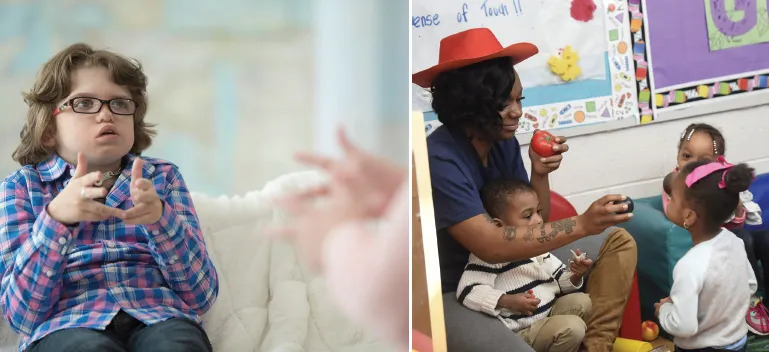
Promoting Communication Skills
Table of contents
- Cover
- Title Page
- Copyright
- Contents
- About the Book
- Disabilities and Young Children
- Specific Disabilities
- Conclusion
- Glossary
- References
- Resources
- Acknowledgments
- About the Author
Frequently asked questions
- Essential is ideal for learners and professionals who enjoy exploring a wide range of subjects. Access the Essential Library with 800,000+ trusted titles and best-sellers across business, personal growth, and the humanities. Includes unlimited reading time and Standard Read Aloud voice.
- Complete: Perfect for advanced learners and researchers needing full, unrestricted access. Unlock 1.4M+ books across hundreds of subjects, including academic and specialized titles. The Complete Plan also includes advanced features like Premium Read Aloud and Research Assistant.
Please note we cannot support devices running on iOS 13 and Android 7 or earlier. Learn more about using the app