
- 256 pages
- English
- ePUB (mobile friendly)
- Available on iOS & Android
eBook - ePub
People and Self Management
About this book
People and Self Management leads the reader through all the skills needed for today's supervisor/team leader, including:
* how to assess and improve your workplace performance;
* the essential skills of effective self management;
* the management of change.
The Team Leader Development Series is an essential tool towards gaining the Supervisory Management Award. Consisting of four practical and interactive textbooks, this series will be invaluable not only to students, but also as a guide individuals and organisations seeking to improve their business performance at the first level of management.
Key learning features:
* Learning Objectives to enable the reader to assess the knowledge gained throughout the series.
* Activities to put the learning into practice.
* Case studies - 'true-life' scenarios!
* Workbased Assignments which will provide evidence for S/NVQ portfolios.
* Language is straightforward and direct, contextualised to relate to team leaders and supervisory managers working in a wide range of industry sectors.
* Influential protagonists in the field will be alluded to as appropriate to support the learning.
* Action plan to take the learning forward.
1The job of a team leader
Learning objectives
On completion of this chapter you will be able to:
• describe the term ‘team leader’
• describe the key managerial tasks that make up the job of a team leader
• appreciate the importance of setting smart objectives
• describe the organizational hierarchy of objectives and plans
• differentiate between different types of plans
• explain the planning cycle
• describe the benefits of planning
• describe the stages in organizing
• understand the importance of monitoring and controlling plans.
Introduction
As a team leader you will have first line responsibility for people within your organization. Many of you will not only be responsible for leading your team but also be involved in day-to-day operations, so you are not only involved in managing the team but also in making the product or delivering the service. Your role as a team leader means that you are part of the management team and so there are many managerial aspects to your job. You are at the front line of management and have a major responsibility for seeing that work is done by others. Team leaders are involved in supervisory management; you are the link between more senior managers and the operatives that work in the organization. You will probably have noticed that there are fewer layers of management in organizations these days. As this process of reducing the number of management levels has taken place, the team leader has taken on more responsibility. In this chapter we will examine the management elements of a team leader's role.
What team leaders do
As a team leader you are concerned with making sure the work is done. Your manager will give you the information you need about what you have to achieve and your job is to get the team organized to produce the work.
Activity 1 | What do you think are the main activities of a team leader? Compare your answers to the key managerial functions shown in Figure 1.1. |
Like all managers at every level within the organization you need to carry out key managerial functions. These are illustrated in Figure 1.1.
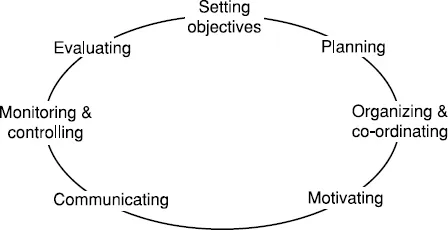 | ||
Figure 1.1 Managerial Function |
Figure 1.2 gives more detail on each of the managerial functions as they apply to a team leader.
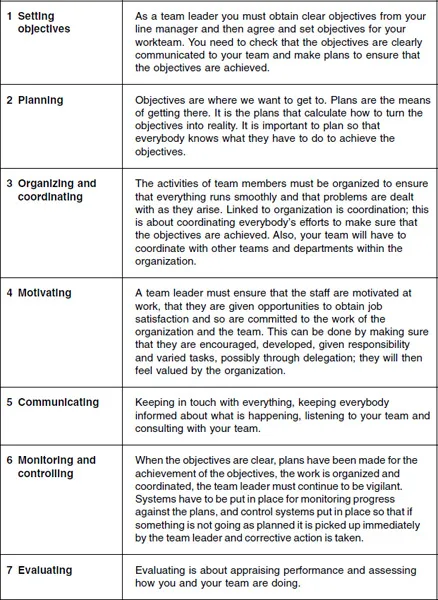
Figure 1.2 Managerial functions and the job of a team leader
Activity 2 | Consider your job as a team leader and complete the table below. | ||
Managerial element | Example of an activity carried out by me, in my role as a team leader in my organization, that demonstrates that this is part of a team leader's role | ||
1 Setting objectives | |||
2 Planning | |||
3 Organizing and coordinating | |||
4 Motivating | |||
5 Communicating | |||
6 Monitoring and controlling | |||
7 Evaluating | |||
We will now look at each one of these key functions in more detail.
Setting objectives
You need to obtain clear objectives from your line manager. If your team is to perform well, you will need to agree and set objectives with your workteam. Setting objectives involves three main stages:
• clarifying the overall purpose of the team
• identifying the objectives that will have to be achieved by the team in order to achieve the overall purpose
• deciding what tasks will have to be completed to achieve the team objectives and purpose.
Your job is to is to clarify the team purpose and set clear objectives. You will need to keep a record of performance against the objectives which will help you to monitor the situation and keep your team and your line manager informed of progress.
Good objectives are SMART:
• Specific – everybody needs to know what has to be achieved. It is better if each objective consists of a single idea.
• Measurable – you need to consider how to measure the objective so that you will know how successful you have been.
• Achievable – objectives should stretch and develop the team members and yet be achievable.
• Realistic – the objective needs to be realistic; you can ensure this by using information to assess what has been achieved in the past and to predict what is realistic for the future.
• Timed – you need to be clear about the timescale within which the objective should be achieved.
(See Activities Management, Chapter 2, for more details.)
Planning
Objectives are where we want to get to; plans are the means of getting there. Plans show how you are going to turn the objectives into reality. Planning will help to ensure that the organizational and team objectives are achieved. Good planning means that everybody knows what they have to do to achieve the objectives. Good planning is essential for personal and organizational effectiveness. Planning is the most basic and probably the most important management function. Organizing, monitoring and controlling are linked to good planning. Organization and coordination turn plans into action, and monitoring and controlling keep plans on course.
Planning is about designing future action to cope with forecast situations. Planning sets down ...
Table of contents
- Front Cover
- Halftitle
- Title Page
- Copyright
- Contents
- Introduction
- 1 The job of a team leader
- 2 Team leaders and organizations
- 3 Workteams
- 4 Recruiting and selecting your team
- 5 Leading your team
- 6 Training and developing your team
- 7 Assessing and developing your own performance
- 8 Managing yourself
- 9 Managing individuals
- 10 Decision making and problem solving
- 11 Working with others
- 12 Managing change
- References
- Further Reading
- Index
Trusted by 375,005 students
Access to over 1.5 million titles for a fair monthly price.
Study more efficiently using our study tools.
Frequently asked questions
Yes, you can cancel anytime from the Subscription tab in your account settings on the Perlego website. Your subscription will stay active until the end of your current billing period. Learn how to cancel your subscription
No, books cannot be downloaded as external files, such as PDFs, for use outside of Perlego. However, you can download books within the Perlego app for offline reading on mobile or tablet. Learn how to download books offline
Perlego offers two plans: Essential and Complete
- Essential is ideal for learners and professionals who enjoy exploring a wide range of subjects. Access the Essential Library with 800,000+ trusted titles and best-sellers across business, personal growth, and the humanities. Includes unlimited reading time and Standard Read Aloud voice.
- Complete: Perfect for advanced learners and researchers needing full, unrestricted access. Unlock 1.5M+ books across hundreds of subjects, including academic and specialized titles. The Complete Plan also includes advanced features like Premium Read Aloud and Research Assistant.
We are an online textbook subscription service, where you can get access to an entire online library for less than the price of a single book per month. With over 1.5 million books across 990+ topics, we’ve got you covered! Learn about our mission
Look out for the read-aloud symbol on your next book to see if you can listen to it. The read-aloud tool reads text aloud for you, highlighting the text as it is being read. You can pause it, speed it up and slow it down. Learn more about Read Aloud
Yes! You can use the Perlego app on both iOS and Android devices to read anytime, anywhere — even offline. Perfect for commutes or when you’re on the go.
Please note we cannot support devices running on iOS 13 and Android 7 or earlier. Learn more about using the app
Please note we cannot support devices running on iOS 13 and Android 7 or earlier. Learn more about using the app
Yes, you can access People and Self Management by Sally Palmer in PDF and/or ePUB format, as well as other popular books in Business & Business General. We have over 1.5 million books available in our catalogue for you to explore.