- 157 pages
- English
- ePUB (mobile friendly)
- Available on iOS & Android
eBook - ePub
The Holiday Makers
About this book
The Holiday Makers is thought-provoking and profound in its analysis of the present and future patterns of work and leisure.
The author analyses the different forms of tourism, examines the effects on the indigenous countries and their people, and outlines positive steps to reconcile people's holiday requirements with the world's economic and social structures.
Trusted by 375,005 students
Access to over 1.5 million titles for a fair monthly price.
Study more efficiently using our study tools.
The model of life in industrial society Work – Home – Free Time – Travel
Since the Renaissance we have been constantly trying to go beyond our limits. Today we are trying to determine those limits. We have in fact reached the point where we have to ask, what lies beyond these newly identified limits.
Erhard Eppler
This is precisely the question of the century.
Michael Ende
An outline of the model
DOI: 10.4324/9780080939032-1
At the beginning of this book I shall try to put the subject of leisure and travel in a broader perspective. I shall also immediately outline my standpoint, show from what angle I am presenting my arguments, what my philosophy of life is, what I believe the social system we should be striving for looks like and thus lay my cards on the table so that everything is clear from the very outset. This will make it easier to understand what I am writing about. Figure 1 will serve as a skeleton for our purposes.
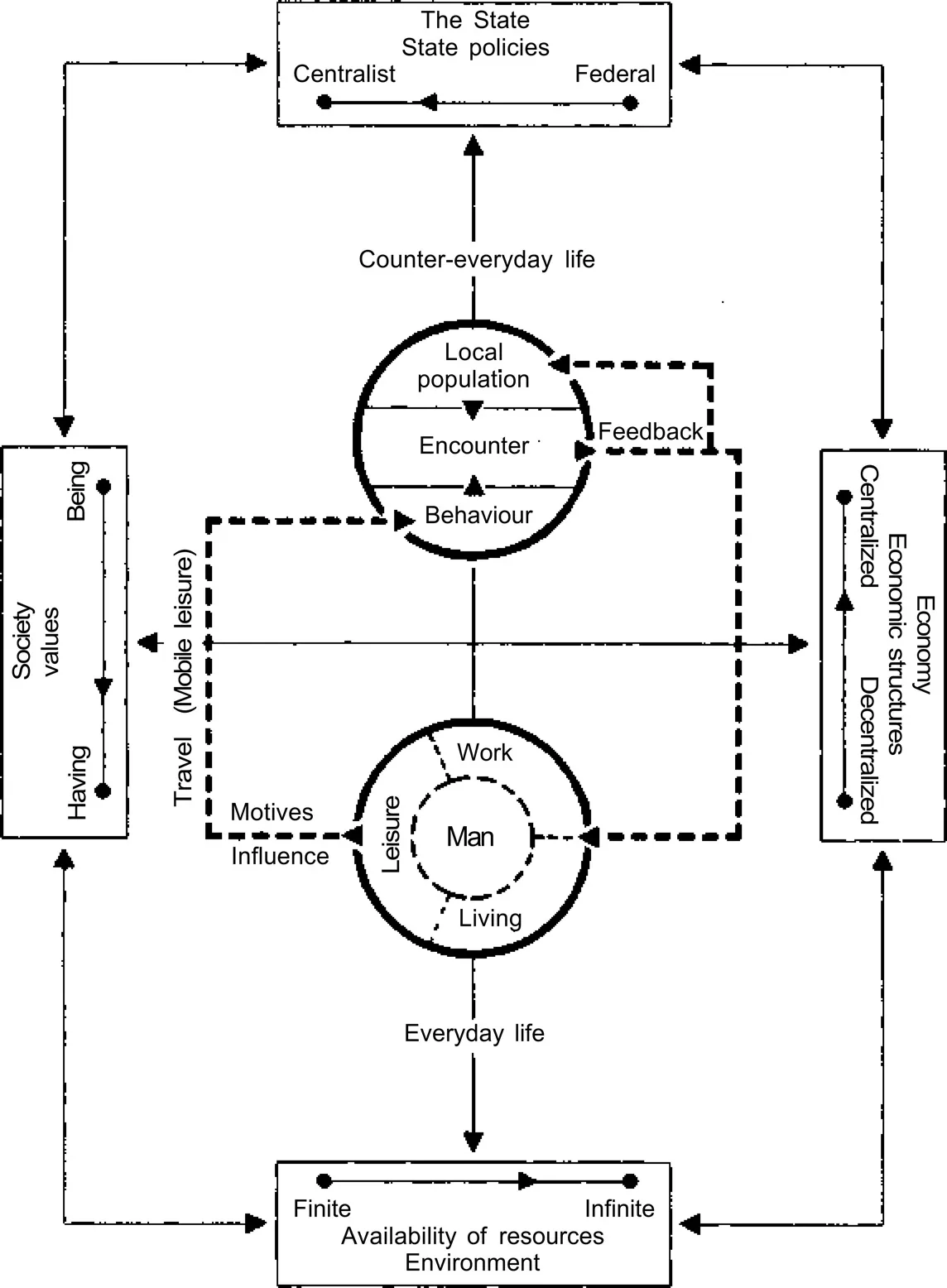
This diagram presents a kind of overall system. Its centre represents the focal point of our considerations: the recreation cycle of man in industrial society. The cycle begins with man and the spheres of everyday life – work, home and free time. Part of the free time is mobile leisure spent in travelling. This serves as an outlet or break from everyday life and is itself characterized by particular influences, motives and expectations. The tourist destination form the other pole. They represent what we shall call counter-everyday life or counter-routine. Of especial interest here is the behaviour and experience of travellers, the situation of the host population and their environment and the encounter between the visitors and the locals. Finally, tourism has an impact on, as well as repercussions for, the country and people of the host areas and for the situation at home. This pendulum movement between everyday life and counter-routine with its manifold interactions is the main theme of our book.
The structure: work – home – free time – travel is embedded in a broader framework and it is from there that it is shaped and influenced. In that framework four forces are operating, connected by a complex network of interactions. Those forces are:1 society with its values (the socio-cultural sub-system); the economy and its structure (the economic sub-system); the environment and its resources (the ecological sub-system); the state and its policies (the political sub-system). Taken as a whole, these sub-systems represent the stage on which our life is set. Figure 1 shows the general direction in developments and trends in these four spheres during the past thirty years or so.
In our society the values of ‘being’ have been superseded by those of ‘having’: possession, property, wealth, consumption and egoism have taken precedence over community, tolerance, moderation, sensibility, modesty, honesty.
The economy is characterized by growing control of business in the hands of a few; by an increase, that is in the number of huge consortiums with more and more economic power at the cost of independent small- and medium-sized businesses, which are now struggling for survival. There is also increasing division of labour and specialization together with rapidly disappearing self-sufficiency.
The environment is being treated and used as if resources were inexhaustible. Science and technology are continually providing new means of stretching the limits of the ecosystem; that is, of how much waste can be dumped back into the earth. This creates the illusion that the negative side-effects of economic growth can always be overcome and eliminated by modern technology.2
Lastly, there is no industrialized country in which state bureaucracy, the scope of state interests and expenditure – and consequently the tendency to more centralism in government – have not increased. The state is forced to develop an increasingly expensive infrastructure for the growing economic apparatus (transport, supply, public utilities), provide for regularity mechanisms (’booster injections’, subsidies for ‘lame-duck’ industries) and ensure the smooth functioning of the growing economy. Public services must also be continually expanded: health care, education, help for fringe groups, protection of the threatened environment. All of these are indispensable services which only the state can provide.3
Even this brief description of the framework in which our lives are set will show us that many important aspects of the system are missing from the diagram: the system does not function as harmoniously as the diagram would have us believe. In reality the elements do not have such equal weight or status as they do on paper and each has to be measured by a different yardstick. The dominant ones exist at the expense of those given less importance. Instead of being complementary, the various parts are to a certain extent mutually exclusive and exist in opposition to each other.
Under the dictates of the economy
DOI: 10.4324/9780080939032-2
Ruling supreme over our present-day civilization is the economy. It is the driving force, end and means, all in one. It dictates the course of things. The utilization of natural resources, social values and the policies of the state are all in its powerful grip. An ‘economization’ of all spheres of life has taken place. Every one of our activities, from birth to burial, runs the risk of being marketed.
Since the beginning of the seventies, our modern and prosperous civilization has entered a serious crisis. Having thrived for decades, the industrial-social system is today shaking in its very foundations. Whether we want to accept it or not: we have pushed development, especially in the second part of the twentieth century, to its economic, social and ecological limits. The economic crisis, the growth crisis, the work crisis, the environmental crisis, the state crisis and the intellectual crisis which many people are going through, are more than temporary and passing fits of weakness. Rather, they indicate a deeper cause for alarm. We therefore have sufficient reason for pursuing this subject further, even if it seems to go beyond the scope of this book.
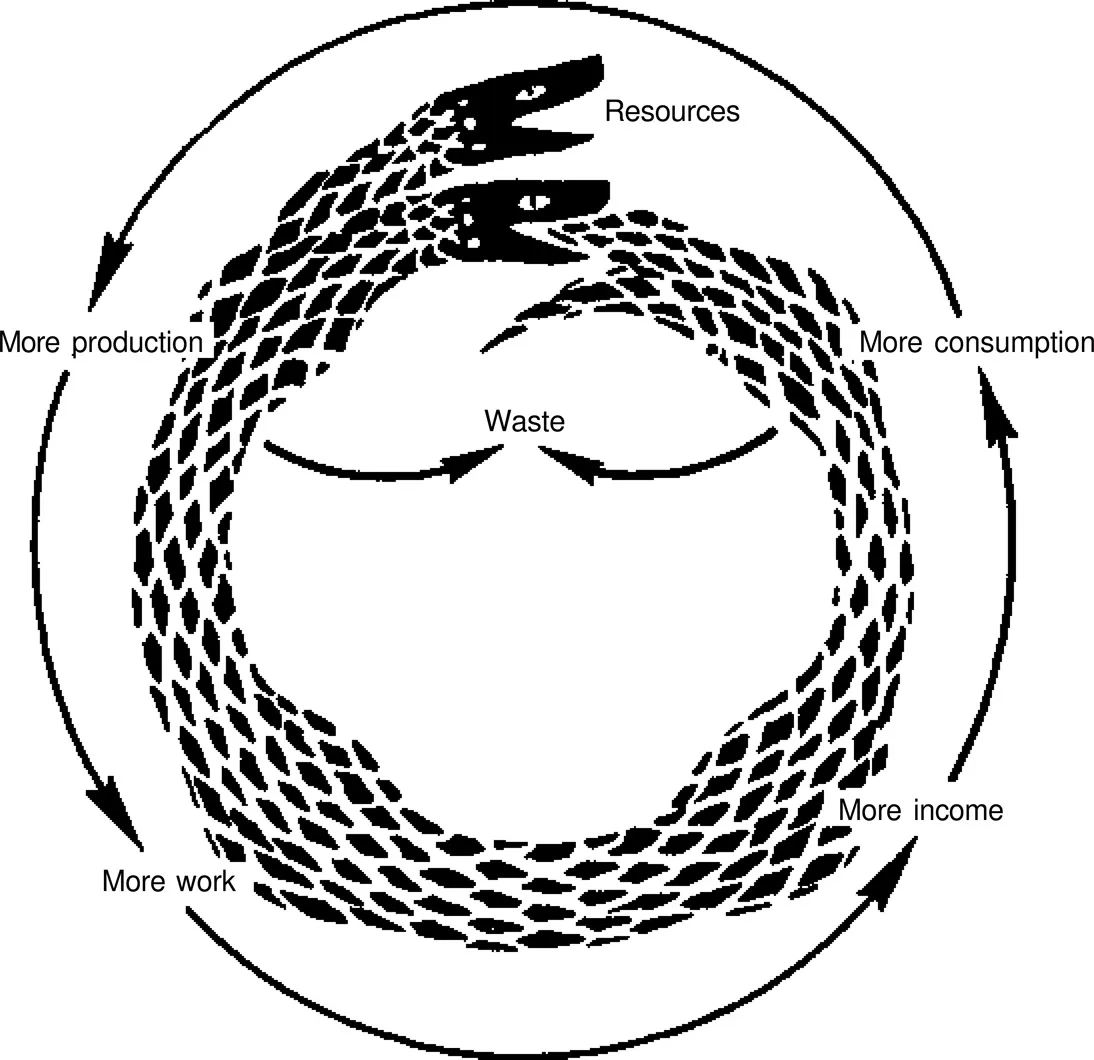
Initially our modern industrial society was fired by scientific and technical progress. It set in motion the industrialization of the economy, it brought about and spread methods of mass production and the worldwide exchange of goods – not to mention that of people. ‘Prosperity for many through economic growth’, is the catchphrase behind our high living standards. It was a recipe that worked very well for many years. It is said that about two-thirds of the total value of all products ever produced (the total world social product since the beginning of human existence) has been created in the short period of time between 1950 and 1980.4 Believers in growth take as their (to them irrefutable) credo, the ‘growth cycle’ (see Figure 2): more production creates more work → more work creates more income → more income allows more consumption → more consumption requires more production → and so on. Or the other way round: more production calls for more consumption etc. One value is by necessity linked with the other. The one can always be justified by the other. Simple, logical and convincing. A cycle without end – this is what growth ideologists still believe and hope for, staring in fascination at the annual growth rates, spellbound at the figures for the so-called gross national product, the golden calf of prosperity statisticians. They deliberately overlook how false and deceitful this yardstick can be. An estimate based on the national product is a cost estimate and not a benefit estimate. The higher our total costs, the better off we shall allegedly be.
- The faster things break, wear out, go out of fashion, get thrown away,
- the greater the cost of disposing of the increasing quantities of waste,
- the more we spend to control air and water pollution and reduce noise,
- the more accidents we cause,
- the more chemicals we spray on our fields and the more drugs we take,
- the greater the number of patients in our hospitals,
- the more things we produce, even if we use them very little (a very good case in point is the over-supply of hotels and other tourist facilities, most of which are occupied for little more than two months in a year)5 or even have to destroy because there are too many of them,
- the more … and so on and so forth …
… the more impressive is the gross national product and the more assured the claim of specialists in economic accounting that we are rich.6 All this is presented as growing prosperity and progress, although the ‘progress’ figures are increasingly attributable to expenditure aimed at reducing the negative effects of economic growth.
‘And now let's get down to work and increase our gross national product!’ All those who fill their lungs and sing this song at the tops of their voices see nothing but the sweet fruit the explosive economic growth has brought us all. The very high price we have had to pay for it, the immense consequences, some of which are still latent and will manifest themselves to their full extent in a few years or decades and will have to be borne by coming generations, are of no consequence to these growth enthusiasts. Neither the irreparable damage to the environment nor the damage to the individual person or even bankrupt nations can shake them in their belief. They do not see the symptoms of the crisis, and, following the old-established method, they want to fight increasing unemployment with a further increase in production. We have thus reached the point where the official jargon no longer says that work creates production but that production creates work. We no longer work in order to produce – we produce in order to work.7 In the name of job creation, Amen. Simple, stirring stuff. But the magic formula ‘more production, more work’ no longer functions. The latest technologies in the field of microelectronics, for instance, make it possible to reduce the human labour force and achieve even higher productivity. Also, it is more than probable that certain consumption limits have already been reached or will be reached in the near future. They certainly cannot be simply pushed further and further back at will. And yet, people cling to the ‘magic circle’ and declare they are acting in accordance with the forces of circumstance, which are growing stronger day by day.
The industrial social system, so successful for a long time, threatens to degenerate into a vicious circle. The once magic circle is turning into a snake with two heads. One head devours natural resources in the form of raw materials and energy, the other head has already begun gnawing away at its own tail. This serpent is now producing an ever-growing mountain of excrement, of non-renewable waste: matter and energy, which cannot be channelled back into the circle – which cannot be served up as fodder to head number one. Thus, it is lost forever and represents an encroachment and burden on the environment. It is argued that with the help of new conservation and protection technologies, the negative ecological effects could be reduced and the danger averted. But the argument goes on and says that in order to secure the necessary funds, further economic growth is needed more than ever before. Growth! So that we may pay for the costs of growth – and this not only where the environment is concerned!
Table of contents
- Cover Page
- Half Title Page
- Title Page
- Copyright Page
- Contents
- Preface
- Introduction
- Part One The model of life in industrial society Work – Home – Free Time – Travel
- 1 An outline of the model
- 2 Under the dictates of the economy
- 3 The credo for a new harmony
- Part Two The holiday machine or: the recreation cycle
- 4 The motives of the mobile leisureman — travel between norm, promise and hope
- 5 Behaviour and experiences while travelling
- 6 The host population – what they expect and what they get from tourism
- 7 The encounter between tourists and locals
- 8 The return and the feedback
- 9 Indications for a more critical understanding of tourism
- Part Three For a humanization of everyday life
- 10 Everyday life in working society – work, home and leisure time in a bottleneck
- 11 Changing values: opportunities for a new society
- Part Four Proposals for the Humanization of Travel
- 12 The strategies and their philosophies
- 13 About the concept of a balanced tourist development
- 14 Ghetto or no ghetto – that is the question
- 15 Conscious travel – advice and exercises for a different travel behaviour
- 16 School for a more human tourism
- References
- Index
Frequently asked questions
Yes, you can cancel anytime from the Subscription tab in your account settings on the Perlego website. Your subscription will stay active until the end of your current billing period. Learn how to cancel your subscription
No, books cannot be downloaded as external files, such as PDFs, for use outside of Perlego. However, you can download books within the Perlego app for offline reading on mobile or tablet. Learn how to download books offline
Perlego offers two plans: Essential and Complete
- Essential is ideal for learners and professionals who enjoy exploring a wide range of subjects. Access the Essential Library with 800,000+ trusted titles and best-sellers across business, personal growth, and the humanities. Includes unlimited reading time and Standard Read Aloud voice.
- Complete: Perfect for advanced learners and researchers needing full, unrestricted access. Unlock 1.5M+ books across hundreds of subjects, including academic and specialized titles. The Complete Plan also includes advanced features like Premium Read Aloud and Research Assistant.
We are an online textbook subscription service, where you can get access to an entire online library for less than the price of a single book per month. With over 1.5 million books across 990+ topics, we’ve got you covered! Learn about our mission
Look out for the read-aloud symbol on your next book to see if you can listen to it. The read-aloud tool reads text aloud for you, highlighting the text as it is being read. You can pause it, speed it up and slow it down. Learn more about Read Aloud
Yes! You can use the Perlego app on both iOS and Android devices to read anytime, anywhere — even offline. Perfect for commutes or when you’re on the go.
Please note we cannot support devices running on iOS 13 and Android 7 or earlier. Learn more about using the app
Please note we cannot support devices running on iOS 13 and Android 7 or earlier. Learn more about using the app
Yes, you can access The Holiday Makers by Jost Krippendorf in PDF and/or ePUB format, as well as other popular books in Business & Hospitality, Travel & Tourism Industry. We have over 1.5 million books available in our catalogue for you to explore.