- 400 pages
- English
- ePUB (mobile friendly)
- Available on iOS & Android
eBook - ePub
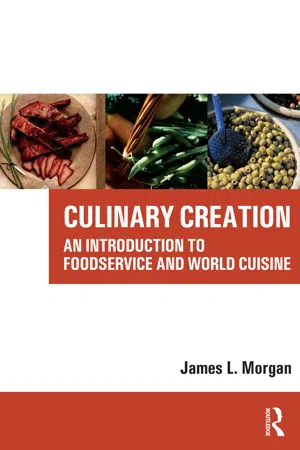
Culinary Creation
About this book
The book seeks not to present a detailed history and discussion, but instead is intended to provide the student with an appreciation of the idea that all cuisines of the world have something unique to offer to a menu. The author strongly believes that foods of other nations (and even other areas of the United States) are too often given short shrift by culture-bound students and chefs, and that every attempt should be made to open their minds to the unlimited possibilities available. The word "foodism" is introduced to refer to biases against foods outside your culture.
Trusted by 375,005 students
Access to over 1 million titles for a fair monthly price.
Study more efficiently using our study tools.
Information
Topic
Art1 Overview of World Food and Foodservice
DOI: 10.4324/9780080476940-1
Learning Objectives
By the end of the chapter, you should be able to
- Explain how a culture-bound attitude can hinder your creativity in the kitchen
- Name major culinary developments in Europe and the people who brought them about
- Name some of the effects African cultures had on European cuisine
- Describe some of the major foods of selected African, Asian, Caribbean, and Latin American nations
- Describe some of the mechanisms by which culinary ideas have crossed national boundaries
- Name the terms for commercial kitchen personnel and describe their responsibilities
“The discovery of a new dish does more for human happiness than the discovery of a new star.”—Jean Anthelme Brillat–Savarin (1755–1826), culinary writer
In this, our opening chapter, we will discuss “foodism”—that is, prejudice against the foods of others. We’ll also talk about the history of food in various regions of the world and give you some of the details regarding foods in those regions. We’ll introduce you to the organization of the modern kitchen, and introduce you to the job titles and duties in the brigade system used in many modern kitchens.
Today, more than at any time in the history of the world, food is a focal point of almost every activity (Fig. 1-1). What’s a movie without a buttery tub of popcorn and a nest of cheesy nachos? What’s a football game without a carefully planned tailgate party? What’s a wedding without the lavish banquet? Admit it. The quantity, quality, and even just the downright availability of food at a function can make the difference between a memorable event and a boring obligation.

With few exceptions, food is beloved by the vast majority of humanity. Food often acts as the central focus for our social interactions; it gives structure to our daily lives. Our fondest family memories and traditions are most often food related. Eating is something to be anticipated and enjoyed. It is far more than just a means of taking in nourishment. Imagine what life would be like if we just passively absorbed nutrition through our skin as we went about our normal business. Wouldn’t that be boring? Instead of such a situation, the human race has developed the ability to distinguish among and enjoy thousands of different flavors, textures, colors, temperatures, and aromas, making food consumption a very stimulating experience.
Furthermore, to most people, food is abundant and affordable—so much so that, for the first time in human history, overeating is a bigger problem than starvation. The business of food is booming.
The Chef
Today, food has become a recognized medium of creativity, an art form in its own right. The chef—the person who is able to create and guide the creation of cuisine (Fig. 1-2) at a high degree of proficiency and profitability—is being held in higher and higher esteem around the world.

The chef holds one of the highest positions of trust in our society. Think of it. Other than those in the medical field, the chef is the only professional whom we allow to prepare substances that we take into our bodies. Not to put too much of a philosophical spin on it, but what the chef creates actually becomes part of us.
To invent ingenious and beautiful new cuisine, the chef is expected to have a basic knowledge and open-minded curiosity about the foods of all cultures. The successful chef needs to be a total professional, a person who enjoys learning about foods and cooking techniques from around the world and using that knowledge as a springboard to create unique and delicious dishes.
With the growing popularity and availability of foods from every corner of the globe, it is crucial that chefs and managers in the hospitality industry constantly acquire information about cuisines not only from Europe, but Asia, the Pacific Rim, the Middle East, Africa, and the Americas as well. This task is made somewhat easier today with the advent of the Internet, allowing us to travel the world at our desks to get data on any selected cuisine. (But it’s still better to visit the places if you can.)
At the end of this chapter, you’ll be introduced to the various types of chefs who work in the industry, and you will become acquainted with the responsibilities of each.
The Culture-Bound Attitude
“I want to know if you are genuinely interested in food. I don’t want to spend time training someone who has food limitations, who doesn’t like this or that. A chef must be open-minded. If you have restricted ideas about food, then this is not the industry for you.”—Chef Andre Guerrero, Max Restaurant, Los Angeles, California, USA
Every cuisine in the world has something unique to offer to a menu. Foods of other nations (and even foods from diverse areas within a single nation) are often given little regard by biased students and chefs. Those who have such biases are said to be culture bound—that is, they believe everything within their particular culture to be correct and proper, and everything outside their culture to be abnormal. All nations and groups include some members who are culture bound.
Biases are especially strong and hard to overcome in the area of cuisine. Everyone has a tendency to think the food on which they were raised is “right,” and everyone else’s food is “wrong.” Such beliefs might be called foodism: prejudice against the foods of other cultures.
How readily do you accept unfamiliar foods? How tolerant are you toward the likes of others if they conflict with your dislikes? Let’s find out if you are a foodist. How do you emotionally react to the following dishes?
| Boiled peanuts | Head cheese |
| Peanut butter and jelly | Eel |
| Rare steak | Well-done steak |
| Steak tartare (chopped raw steak) | Fried grasshoppers |
| Lobster | Crawfish |
| Sushi | Salty licorice |
| Kraft Miracle Whip® | Mayonnaise |
So, what happened when you read this list? Some of you probably reacted with “Yuuukkk!” and some of you said, “Yuuummm!” to the same foods. What does that tell you about being culture bound? Are you a foodist?
When judging others’ food tastes, keep in mind that somebody, somewhere finds foods to be delicious that others find repellent. Is food bias the result of reason and knowledge, or more about how and where a person was raised?
To illustrate how perceptions may vary, here are a few observations about some of the items listed.
- Boiled peanuts are an extremely popular snack in the Southeastern United States. They have a completely different flavor and texture than roasted peanuts, but they can be just as addictive.
- Head cheese, a loaf of seasoned shredded meat set in gelatin and sliced as an appetizer or luncheon meat, is a very popular, even beloved, food item in many parts of the world, and in some regions of the United States. In Swedish tradition, for instance, it is called sylta (SIL-tuh).
- People in some cultures are repelled by the notion of peanut butter, especially when served with jelly. They find the texture to be disgusting.
- The Pilgrim colonists of New England, a fairly conservative bunch, thought eels were the only fish tasty enough to be worth eating. So why aren’t eels more popular today? The major thing working against the eel’s popularity as a food item is that it looks like a snake. But it isn’t. It’s a fish. The flesh of the eel is actually quite rich and delicious.
- People are adamant about how steak should be cooked, aren’t they? Furthermore, some people will ridicule those who like steak cooked to any other degree of doneness than what they prefer.
- Lobsters, crawfish, and grasshoppers are all arthropods. What makes one a more legitimate food than another?
- Sushi (SOO-shee) is seasoned rice to which things are sometimes added. Sushi is not raw fish. Sashimi (sah-SHEE-mee) is raw fish. But some of you said, “Yuuukkk!” based on what you thought “sushi” meant, didn’t you?
- Salty licorice, called drop (...
Table of contents
- Cover
- Halftitle Page
- Title Page
- Copyright Page
- Dedicated
- Contents
- Series Foreword
- Foreword
- Preface
- 1 Overview of World Food and Foodservice
- 2 Keeping Your Customers and Employees Safe
- 3 Your Tools
- 4 Introduction to Culinary Techniques and Principles
- 5 Planning and Documenting Your Culinary Creations
- 6 The World of Stocks, Sauces, and Soups
- 7 Finger Foods: Appetizers and Sandwiches
- 8 Creating Salads
- 9 Creating with Meats
- 10 Creating with Poultry
- 11 Creating with Seafood
- 12 Creating with Vegetables
- 13 Creating with Dairy Products and Eggs
- 14 Basic Baking Principles
- Bibliography
- Glossary
- Index
Frequently asked questions
Yes, you can cancel anytime from the Subscription tab in your account settings on the Perlego website. Your subscription will stay active until the end of your current billing period. Learn how to cancel your subscription
No, books cannot be downloaded as external files, such as PDFs, for use outside of Perlego. However, you can download books within the Perlego app for offline reading on mobile or tablet. Learn how to download books offline
Perlego offers two plans: Essential and Complete
- Essential is ideal for learners and professionals who enjoy exploring a wide range of subjects. Access the Essential Library with 800,000+ trusted titles and best-sellers across business, personal growth, and the humanities. Includes unlimited reading time and Standard Read Aloud voice.
- Complete: Perfect for advanced learners and researchers needing full, unrestricted access. Unlock 1.4M+ books across hundreds of subjects, including academic and specialized titles. The Complete Plan also includes advanced features like Premium Read Aloud and Research Assistant.
We are an online textbook subscription service, where you can get access to an entire online library for less than the price of a single book per month. With over 1 million books across 990+ topics, we’ve got you covered! Learn about our mission
Look out for the read-aloud symbol on your next book to see if you can listen to it. The read-aloud tool reads text aloud for you, highlighting the text as it is being read. You can pause it, speed it up and slow it down. Learn more about Read Aloud
Yes! You can use the Perlego app on both iOS and Android devices to read anytime, anywhere — even offline. Perfect for commutes or when you’re on the go.
Please note we cannot support devices running on iOS 13 and Android 7 or earlier. Learn more about using the app
Please note we cannot support devices running on iOS 13 and Android 7 or earlier. Learn more about using the app
Yes, you can access Culinary Creation by James Morgan in PDF and/or ePUB format, as well as other popular books in Art & Hospitality, Travel & Tourism Industry. We have over one million books available in our catalogue for you to explore.