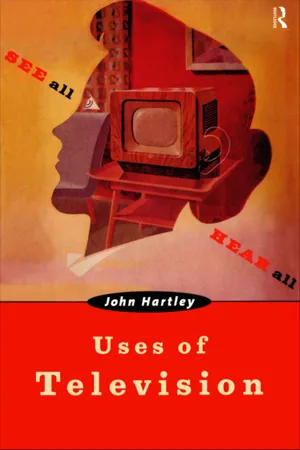
How does television function within society? Why have both its programmes and its audiences been so widely denigrated? Taking inspiration from Richard Hoggarts classic study The Uses of Literacy, John Hartleys new book is a lucid defence of the place of television in our lives, and of the usefulness of television studies.
Hartley re-conceptualizes television as a transmodern medium, capable of reuniting government, education and media, and of creating a new kind of cultural teaching which facilitates communication across social and geographical boundaries. He provides a historical framework for the development of both television and television studies, his focus ranging from an analysis of the early documentary Housing Problems, to the much-overlooked cultural impact of the refrigerator.
- 256 pages
- English
- ePUB (mobile friendly)
- Available on iOS & Android
eBook - ePub
Uses of Television
About this book
Information
1 (PRE-SCRIPT)
PER-SONA
Selves, knowledge, books
Dim moon-eyed fishes near
Gaze at the gilded gear
And query: ‘What does this vaingloriousness down here?’
Gaze at the gilded gear
And query: ‘What does this vaingloriousness down here?’
(Thomas Hardy, 1930: 289)
KNOW BUSINESS LIKE SHOW BUSINESS
In 1958, Penguin Books issued the popular (Pelican) edition of Richard Hoggart’s The Uses of Literacy: aspects of working-class life with special reference to publications and entertainments. Twenty years later John Fiske and I published Reading Television. Both of these books are still in print and, while Hoggart’s is much the more important in its social reach and its intellectual achievement, both books were trying to make sense of contemporary popular-cultural media from the point of view of the ‘reader’ or audience; both are about media ‘literacy’ in a period of social change and democratization, and both were written by authors trained in literary and textual techniques of analysis, rather than in the methodology of the social sciences. As I write this, it is twenty years later again. In the two decades between Hoggart’s and ours (1958 to 1978) very few books were published that tried to take television seriously in textual terms (Newcomb, 1974; Williams, 1974), although there was a branch of sociological analysis that sought to describe the ‘uses and gratifications’ of ‘mass media’ for individual viewers (Blumler and McQuail, 1968; McQuail, Blumler and Brown, 1972; Blumler and Katz, 1974; Blumler and Katz, 1975). But in the two decades since then (1978 to 1998), books about television have become much more common, and there is, as there was not twenty or forty years ago, something that might be called ‘television studies’.
In 1978 it was easy to justify a new general book on TV. Now, when the cup of the student of television studies is getting close to overflow, it is easier to ask why (yet) another one is needed.
On textbooks
The reason is partly institutional or entrepreneurial: to maximize sales academic publishers encourage textbooks rather than more specialized monographs (they prefer teaching to research); while, for their part, institutions of higher education need to be able to direct students to books while, for their part, institutions of higher education need to be able to direct students to books for basic instruction and guidance. The democratization of higher education in the period since Hoggart has meant that such introductory teaching cannot always be afforded in the traditional form of live tutors and lecturers with specialist skills. Now teaching must be provided on an industrial scale to knowledge ‘consumers’ whose disciplinary ‘literacy’ cannot be assumed in advance, but whose individual needs have to be catered for. As always, one answer to this problem is technology; teaching is done by ‘virtual’ means, including textbooks.
Textbooks themselves serve different purposes. Generally, a textbook calls a readership into being to promote a branch of knowledge or a specialism, and it explains what the new field of study ought to look like. Classically a textbook identifies its object of study, gives a theoretical rationale and a survey of major theorists from the scholarly archive, outlines methodology and arguments, presents an archive of research documents, information or findings, and suggests useful further reading. Usually, the assumed reader of such a thing is the beginning student; someone it would be tactless to assume had an already-tutored ear for the specialist language, the disciplinary conversations or the received wisdom of the specialism in question.
However, in the early period of a particular branch of learning, such a textbook can be as original and innovative as the most erudite scholarly monograph, particularly if the readership it calls into being is made up of other writers, researchers and critics who go on to rework the topic and apply it to their own specialist interests. Such has proven to be the case in television studies. Some of the most influential writings in TV studies’ own prehistory have been textbooks, from Ferdinand de Saussure’s Course in General Linguistics (1974) and Roland Barthes’s Elements of Semiology (1968) to Richard Hoggart’s The Uses of Literacy (1958) (written to assist tutors working in adult education), or Terence Hawkes’s Structuralism and Semiotics (1977) and Fiske’s and my Reading Television (1978). Books like these served as essays—trials of a new vehicle of thought. They are not instruments of standardization and normalization of knowledge, but of exploration and experiment.
Later, when a topic is institutionalized in the way that cultural, media and communication studies have established in formal education the meaning-based study of television, many more textbooks come to the market, and these may take on the more familiar form of an introductory simplification of an existing field of knowledge for institutional apprentices such as first-year undergraduates (and their graduate instructors).
Now, in these days of Research Assessment Exercises, Research Activity Indices and other forms of public monitoring of academic research productivity, a textbook is not a ‘research returnable’ document. This means that there’s little incentive for ‘research active’ academics to write them, since they are categorized as mere digests of existing knowledge, rather than as contributions to the dynamic development of inter- and post-disciplinary intellectual innovation. So here’s another reason why another textbook has to be justified; you get no institutional credit for doing it.
Nevertheless this hasn’t stopped people writing them. Introductory texts in TV studies have proliferated so much since 1978 that publishing another one cannot be justified only by reference to the object of study itself. The importance of the subject matter is already understood. The credentials of the analyst (or the analytical approach) are not in question. In a crowded field a new book must justify itself by reference to a third party; it must prove itself useful to the ‘end user’—to the reader.
It is here that I believe the present book differs from others. It is interested in readers, readerships and in what counts as ‘useful’ in that context. It is interested in how ‘useful’ TV is for its own ‘end users,’ especially the public-as-audience, but not forgetting my own constituency—those in intellectual, academic, critical or governmental positions who ‘use’ television for thinking about other problems, such as the state of culture, politics and modernity.
More importantly even than these users, however, this book is interested in the ‘usefulness’ of television seen from a long-term historical and broad social perspective: what is the use of television to the species? What has it been ‘for’? Part of the answer to such improbably large questions lies outside of television itself. Television has been put to uses determined beyond its own institutional and semiotic forms, and counted as useful (or not) according to criteria established elsewhere, often before it was even invented. And so this book is curious not only about the ‘uses of television’ but also about the ‘uses of TV studies’, and thence about the ‘usefulness’ of TV studies to its readers, who are themselves all ‘readers’ of television.
TV studies is taken to be a social and historical fact just as much as is television itself; so there’s a triangular relationship between television, readers and television studies, and potential utility in each axis of this relationship:

In fact, television producers, TV studies and TV audiences are converging towards one another; no longer are they mutually unknowable and incomprehensible alien beings, but increasingly porous to one another’s ideas, personnel and interests.
On gathering new readers
Academic textbooks must nowadays be user-friendly, reader-oriented, population-gathering initiatives. In this respect, they have become more and more like their object of study, television itself, whose overriding characteristic is its need to gather populations (audiences or ratings), bringing together people and groups who may have little in common with each other beyond their co-presence as the audience of a given media performance, be it textbook or talkshow. Such ‘users’ have no prior commitment to engage with that text, no training in ‘reading’ it, no acculturated ‘professional’ predisposition to maintain a ‘critical’ curiosity about unfamiliar material; they have no resources beyond their found demographic propensities and individual preferences. How to get non-committed ‘audiences’ to take a ‘tutored’ look at things they don’t like or haven’t seen before—where ‘tutored’ ought to mean impersonal, non-subjective, scrupulous, systematic, sustained, non-intuitive, non-anecdotal, non-magical, critical, informed, practised understanding? This is a problem for TV, as for other popular media like journalism; and nowadays it’s a problem for ordinary jobbing academics who want to write about television. Indeed, it’s a problem of teaching.
However, it is not a new problem. Modern print culture is strewn with names of those who’ve dedicated themselves to improving knowledge, critical thinking and methodical reading or analytical practices among wide or popular readerships, from Peter Ramus in the sixteenth century onwards (Ong, 1958). While popular media literacy is improved by serious media popularizers—from editors like Tom Hopkinson to TV-stars like David Attenborough—it also falls to the writers of textbooks to holler for new recruits to the pleasures of literacy in a given cultural form and its analysis, curiosity about how things work in the world, and thence to the practice of systematic thinking in new subject areas.
Such potential recruits are much more plentiful in 1998 than they were in 1958 because of the increase in the number of people going on from school to take degree courses in higher education. In fact, the media and the academy have now begun to compete seriously for the same hearts and minds. The democratization of culture, taste, literacy and knowledge has developed over more than a century In the period between 1958 and 1998 it has rolled on past popular politics and media into new areas, including fashion, travel and, at last, higher education itself. When I went to university in the late 1960s and early 1970s, I remember frequent mention being made of the ‘fact’ that students were the ‘top’ 2 or 3 per cent of the British population; a figure that has since multiplied tenfold to 30 or 40 per cent, in line with more enlightened countries. Before this expansion, academic specialists were confident that they and their students could speak about a general population to which they themselves in no cultural sense belonged—‘dons’ tutored their students in the tradition (and often in the very language) of the imperial officer-class and administrator-sahibs. By now, in contrast, we are not studying to lead or to manage society, but to join it. Now we are what we analyze; products of and participants in the popular-knowledge-producing apparatus of internationalized consumer society. Scholarship and specialist knowledge are no longer enough; part of the challenge of this sort of popularization is to get readers to see the connections between what they are studying, the institutions and techniques by means of which they are studying it, and their own identities, everyday lives and personal circumstances.
To be useful in this context turns out to be quite a delicate and difficult trick, for we are studying nothing other than ourselves. It may seem that little is ‘useful’ about that—no matter how interesting it may be. But in fact the convergence between the formerly very distinct and often mutually hostile worlds of intellectual inquiry and popular culture is part of the justification for television studies. Indeed, it is a matter of family resemblance: the triad ‘author/book/reader’ is structurally similar to “lecturer/subject matter/studen’, and in a period of ‘mass’ higher education both are coming to resemble a familiar triad belonging to the object of study—‘producerl”text”/audience’.
See Table
Higher education is part of a much larger cultural and economic sector which can be called the knowledge or information industry; a sector that includes the information-gathering and communicative functions of government. On a global and historical scale of analysis, even if it doesn’t feel like it in a tutorial room, the ‘know-business’ is getting more like ‘showbusiness.’
CONVERGENCE (OF THE TWAIN)
On convergence
This is a process that in the foreign currency business is called ‘sustainable convergence’. The present is a period of historic convergence, not only between cultural/knowledge producers and audience/reader consumers, and not only between communications technologies, as telephony, television and computers begin to integrate, but also at the socio-institutional level, between three large-scale social institutions that have previously been understood as distinct, even hostile to each other:
- government
- education
- media
There is a growing family resemblance between academic author and TV producer, between textbook and TV show, between student and audience. Commercially catered knowledge-for-entertainment leads the way; computer encyclopaedias like Encarta or Dorling Kindersley habituate even very young children to a screen-based visualization and segmentation of knowledge, and a click-link mode of information exploration. There’s a very intense dialogue between print and screen media in this context, with educational books for children showing more and more convergence with TV characteristics: the Dorling Kindersley (DK) ranges of Eyewitness or Action Books and CDs, for instance, are ‘authored’ like a TV show, with a special credit for the writer(s), but a final product resulting from the work of a team of editors, designers, photographers, picture researchers, illustrators and picture engineers, and a WWW address, all subservient to the corporate ‘author’ with the real name-recognition, DK itself. Within such books, there is an interactive, illustrative, informative atmosphere, based not on the word but on brilliant photographs, illustrations and design, to which the words are an attractive adjunct. Readers are conducted through the books not by authors but, in the case of the DK Action Book Discover the Titanic, published just ahead of the Hollywood film (Kentley, 1997), by three ‘expedition leaders’. Afterwards ‘readers’ (who become makers) get to assemble a ‘spectacular, easy-to-make 3D model’ of the liner, complete with iceberg, supplied with the book; it’s got ‘pull-out and lift-the-flap sections’ that will ‘help children explore’. Readers are tutored not in narrative or print literacy but in visual/tactile screen and computer literacy, and in action-learning conducted through hand—eye co-ordination, even while they read a book:
You have been selected to go on a salvage trip to the wreck of the Titanic. Join the team that will take you on an amazing journey down to the bottom of the ocean. Find the wreck by satellite navigation. Travel down to the wreckage site in a submersible. Learn about the history of the Titanic as you explore. Raise and restore the Titanic’s treasures.
Supports the National Curricula for England, Wales, Scotland and Northern Ireland.
(Kentley, 1997: cover blurb)
The habits of commercial media consumption are ‘tutored’ as a literacy, while simultaneously literacy is represented as an exciting pleasure. Media and education coalesce, and the government is in there too, promoting officially-sanctioned knowledge for schools, and hence helping DK to promote books that ‘support’ the National Curriculum. More traditional educational textbooks are competing in the same market, as are governmental discourses, from party manifestos to tax returns.
Since this convergence is in process, rather than historically complete, it would be useful to understand how the three great social institutions that have grown up around the sites of knowledge-production and meaning-exchange are themselves converging:
GOVERNMENT MEDIA EDUCATION
Each needs to be analyzed within sight of the others these days, since their activities are inexplicable viewed in isolation. The great social functions of government, media and education are insitutionalized forms of self-realization:
See Table
In other words, the public part of the self, the part that in classical Greek political science was held to inhere within each free person and so to constitute them as selves, has been ex-somatized, taken out of the body; and socialized, erected into institutions. Each aspect of self-realization has been institutionalized separately in a functional division of labour that has historically produced what look like quite distinct and mutually untranslatable phenomena—government, media, education. But nowadays, at the latter end of the democratic era of modernity, it seems that these aspects of the social self are re-converging.
However, they are not re-converging on the physical selves of the assembled citizens; instead these aspects of self-representation are virtualized—and the place where one can observe the process most directly is where it ‘hinges’, as it were, wher...
Table of contents
- COVER PAGE
- TITLE PAGE
- COPYRIGHT PAGE
- FIGURES
- ACKNOWLEDGEMENTS
- 1: (PRE-SCRIPT): PER-SONA: SELVES, KNOWLEDGE, BOOKS
- 2: WHAT ARE THE USES OF TELEVISION STUDIES?: A MODERN ARCHAEOLOGY
- 3: TV STUDIES AS CROSS-DEMOGRAPHIC COMMUNICATION
- 4: TELEVISION AS TRANSMODERN TEACHING
- 5: TEACHING NOT POWER: IDEOLOGICAL ATROCITIES AND IMPROPER QUESTIONS
- 6: KNOWLEDGE, TELEVISION AND THE ‘TEXTUAL TRADITION’
- 7: BRIEF ENCOUNTERS, KHAKI SHORTS AND WILFUL BLINDNESS: TELEVISION WITHOUT TELEVISION
- 8: HOUSING TELEVISION: A FILM, A FRIDGE AND SOCIAL DEMOCRACY
- 9: DEMOCRACY AS DEFEAT: THE SOCIAL EYE OF CULTURAL STUDIES
- 10: SCHOOLS OF THOUGHT: DESIRE AND FEAR; DISCOURSE AND POLITICS
- 11: PEOPLE WHO KNEAD PEOPLE: PERMANENT EDUCATION AND THE AMELIORATION OF MANNERS
- 12: DEMOCRATAINMENT: TELEVISION AND CULTURAL CITIZENSHIP
- 13: INFLUX OF THE FEARED: DEMOCRATIZATION, SCHOOLING, CULTURAL STUDIES
- 14: CLUELESS? NOT!: DIY CITIZENSHIP
- 15: (POST-SCRIPT): SUBURBANALITY: (IN CULTURAL STUDIES)
- APPENDIX 1: GLOSSARY OF CONCEPTS AND NEOLOGISMS
- APPENDIX 2: DO-IT-YOURSELF TV STUDIES
- REFERENCES
Trusted by 375,005 students
Access to over 1.5 million titles for a fair monthly price.
Study more efficiently using our study tools.
Frequently asked questions
Yes, you can cancel anytime from the Subscription tab in your account settings on the Perlego website. Your subscription will stay active until the end of your current billing period. Learn how to cancel your subscription
No, books cannot be downloaded as external files, such as PDFs, for use outside of Perlego. However, you can download books within the Perlego app for offline reading on mobile or tablet. Learn how to download books offline
Perlego offers two plans: Essential and Complete
- Essential is ideal for learners and professionals who enjoy exploring a wide range of subjects. Access the Essential Library with 800,000+ trusted titles and best-sellers across business, personal growth, and the humanities. Includes unlimited reading time and Standard Read Aloud voice.
- Complete: Perfect for advanced learners and researchers needing full, unrestricted access. Unlock 1.5M+ books across hundreds of subjects, including academic and specialized titles. The Complete Plan also includes advanced features like Premium Read Aloud and Research Assistant.
We are an online textbook subscription service, where you can get access to an entire online library for less than the price of a single book per month. With over 1.5 million books across 990+ topics, we’ve got you covered! Learn about our mission
Look out for the read-aloud symbol on your next book to see if you can listen to it. The read-aloud tool reads text aloud for you, highlighting the text as it is being read. You can pause it, speed it up and slow it down. Learn more about Read Aloud
Yes! You can use the Perlego app on both iOS and Android devices to read anytime, anywhere — even offline. Perfect for commutes or when you’re on the go.
Please note we cannot support devices running on iOS 13 and Android 7 or earlier. Learn more about using the app
Please note we cannot support devices running on iOS 13 and Android 7 or earlier. Learn more about using the app
Yes, you can access Uses of Television by John Hartley in PDF and/or ePUB format, as well as other popular books in Social Sciences & Media Studies. We have over 1.5 million books available in our catalogue for you to explore.