eBook - ePub
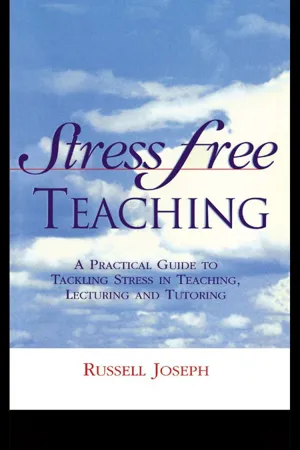
Stress Free Teaching
A Practical Guide to Tackling Stress in Teaching, Lecturing and Tutoring
- 155 pages
- English
- ePUB (mobile friendly)
- Available on iOS & Android
eBook - ePub
Stress Free Teaching
A Practical Guide to Tackling Stress in Teaching, Lecturing and Tutoring
About this book
This manual provides advice on dealing with stress in teaching. It seeks to combine self-help guidance with a core of professional reality to provide solutions that are effective and tailored to the demands of the educational sector. There are case studies from both the UK and abroad.
Trusted by 375,005 students
Access to over 1.5 million titles for a fair monthly price.
Study more efficiently using our study tools.
Information
Topic
EducationSubtopic
Education General1
Is there stress in education?
Chapter goals
This chapter focuses on change and questions the existence of stress in education. It introduces the possibility of contributory factors including:
- changes in society;
- technological developments;
- changing student needs;
- the new business culture of education;
- teaching being a paradigm.
The arrival of the twenty-first century and the millennium celebration have given us the perfect opportunity to reflect on the past. We see that the world we live in is changing. The fundamental rules that we live by have been altered dramatically. What was right in the seventies and eighties may be inappropriate now. Conversely, what we now view as acceptable may have been out-of-line with the world in the 1960s. Some examples of these changes include:
- the development and necessity of the mobile phone;
- the emergence of information as a key resource;
- the loss of respect for politicians, royalty and the police;
- cohabitation instead of marriage;
- gay parenting;
- digital television;
- smaller and faster personal computers;
- new pricing strategies amongst airlines;
- safe sex;
- the Internet.
But what do all these changes mean? Anticipating change would have given countless opportunities. At the very least there would be less ‘future’ shock as the changes come about. Society works within boundaries—what is acceptable and what is not. Changes are less likely to cause shock if they are foreseen or expected. They are less painful if they are deemed necessary; if they are seen as appropriate.
The boundaries surrounding education are no different. These boundaries include:
- the student;
- the parents;
- employers;
- education managers;
- the government;
- administrators;
- assessments;
- grading;
- league tables;
- inspections.
All the above boundaries want the best for students—the achievers of tomorrow. Yet in many cases they fail to provide them with the resources, and support, to carry out their tasks.
Education is a vocation. It is a job with a difference. In most organizations, whether service or product orientated, the process begins with a raw material. This raw material then goes through a transition using a variety of resources, tools or equipment until it reaches an end product; in education, a successful student. The main tools, resources and equipment involved in adding value to the student are called teachers, tutors and lecturers. Throughout the process of adding value to the students, the ‘resources’ are bombarded with the human element including student behaviour, staff contracts, new courses, new assessment procedures and paperwork.
Most jobs have elements of difficulty, yet research has shown that jobs in the service sector, ie jobs involving meeting members of the public, are prone to more stress than most.
Education is now a business. More so than at any time in the past. As a result, one of the most significant changes is the need to keep students no matter what the level of behaviour and ability. Visions of financial opportunity abound, the cash register rings with the hope of a full-time student progressing through the census points for funding methodology. This role change, the development of corporate responsibility, self-management and ‘supervised’ rule, has brought about huge advances and a ‘mission’ leading to change and the next millennium.
So where now? Culture, environment, strategy, human resource policy and management style all change and by their nature affect staff. But change and the management of change is a significant catalyst for an ever-increasing problem caused by these changes.
If a teacher could visualize the journey, it would be on several tracks leading to the same destination. The emerging bureaucracy called education has ensured that there is little time for teaching and preparation and many more administrative tasks. To be successful many teachers find themselves constantly ‘chasing their tail’—juggling tasks, following up. Changing courses and developments demand that programmes are continually reviewed, monitoring the environment to ensure commercial activities are not missed. Further and higher education try to work alongside industry to develop short, full-cost courses to improve financial prospects.
In many areas, especially inner cities, a further problem is that students have less enthusiasm and willingness than before. They have higher expectations, but these are based on what they should be given in return for very little effort. Where does this stem from? Can we lay the blame on the whole education system? Or is life in general moving so fast that we don’t have time for ourselves and our children?
So teachers who have to ‘chase their tail’, cope with students and their changing needs, deal with a fast moving and changing environment, adopt new standards and qualifications, may find themselves in stressful situations. Teaching is a stressful profession and the radical changes currently occurring within the education system are likely to increase rather than decrease the levels of stress.
Is stress a fad? Is the individual to blame?
There is a danger that stress is seen as a fad—a pathological state, where there must be something wrong with the individual. Most middle managers’ jobs are quite stressful; many work in excess of 60 hours a week. Many don’t get long holidays to recuperate. So what makes teaching different? Could it be that, when the middle managers were in schools and colleges, the culture of education was significantly different? The difference is this: all teachers experience stress to some degree and this is the result of their interaction and interdependence with the environment in which they work.
To answer whether this is simply a personal problem, there are two questions that need to be answered: what makes teaching as a profession stressful and what makes some teachers become stressed?
The answer is clear—one is situational and one personal. If everything goes well, parents and employers think their students are good pupils, but if things go badly, they think the teacher is bad! Not only bad teachers experience stress and not only good teachers avoid stress—it will undoubtedly depend on the conditions and environment in which teachers work, or in their own ability to cope with varying situations.
Education is undergoing great changes in all areas of its contextual environment. Each of the component parts in the example below could establish an area for investigation. While managers have time, opportunity and experience to deal with these changes, many of the implications are being experienced by those delivering the programmes and systems of work. The success of the acceptance of these changes, and the embedding of these new developments, play a part in the future growth of schools, colleges and universities. Co-ordinating a few changes requires time and patience, but changes on the scale which the education sector is experiencing may bring increased levels of confusion, anxiety and occupational stress. There is a clear requirement to develop a strategy to implement change effectively and efficiently while considering the needs of those who deliver its primary purpose, education.

Figure 1.1 The environment of the further education college
Is teaching a paradigm?
Before answering this question, it is firstly necessary to understand what a paradigm is. There are several definitions but broadly speaking a paradigm is a set of rules—a framework by which people operate; a framework of thought. Some people refer to a paradigm as a method of perception—the way in which we see things. If you look up the word in a dictionary you discover that it comes from the Greek pamdeigma, which means ‘model, pattern, example’.
Proof that teaching is a paradigm is this: teaching is now stressful. It hasn’t always been and it might not always be. There are reasons for this in Chapter 3 and these are the boundaries in which teaching operates. This is the paradigm. Slowly, negative stress is being recognized as a problem. Education exists within a thought process of what is right and what is wrong, what is acceptable and what is not. The rules of teaching have changed and the boundaries are in a different position. Teaching lives in a world of paradigm shifts. Paradigms are the key not just to change, but also to innovation and development. This has been what teaching is all about. The rules have changed and will change again. Meanwhile teachers need to be open to looking to the changes, exploring them for their implications and creating a support climate. Suggestions to help do this can be found in Chapters 7 and 8.
How can we increase effectiveness?
To promote effectiveness in education, it is necessary to:
- To promote effectiveness in education, it is necessary to:
- understand the implications of positive and negative stress;
- enable employers and individuals to recognize stress;
- recognize the symptoms of stress in education;
- classify an individual’s reaction to stress;
- identify situations in education highlighting stress;
- identify the common causes of stress in education;
- identify current coping strategies for stress in education.
The hypothesis
The ability of the education sector to generate positive stress, while experiencing major changes, will lead to more successful methods of teaching, raise student results and improve employee relations.
Do we need stress?
Stress is the dynamic force that makes us live. It causes us to stand, sit, speak, cry, work harder, work less and many other daily routines. It is not necessarily a negative emotion but has become a scapegoat to cover a number of situations. Stress is a relatively new concept in our culture and yet has quickly become recognized because professionals have been able to measure many physiological, biomechanical and clinical responses to it. They also understand why some people are more responsive and vulnerable to it. Those not able to cope with stress and stressful situations may suffer from diseases which, although not wholly attributed to stress, are often exaggerated by it.
Stress is part of normal life. Everyone suffers from it at some time and yet it is our ability to channel it which determines whether we are affected and to what extent. The degree of stress may be determined by external events and a person’s perception of them. To one person, a situation may seem stimulating, but to another a heavy burden, and for this reason employers need to realize the difference between the effects of positive and negative stress.
2
Identifying stress
Chapter goals
This chapter deals with identifying stress in an individual and pays par...
Table of contents
- Cover Page
- Half Title page
- Title Page
- Copyright Page
- Contents
- Preface
- Acknowledgements
- Introduction
- Chapter 1 Is there stress in education?
- Chapter 2 Identifying stress
- Chapter 3 Occupational stress
- Chapter 4 The law
- Chapter 5 Management issues to reduce stress in teaching
- Chapter 6 Reducing stress in teaching
- Chapter 7 Other approaches to stress reduction
- Appendix 1 Case studies
- Appendix 2 Measure your own stress at school, college or university
- Appendix 3 Research
- Index
Frequently asked questions
Yes, you can cancel anytime from the Subscription tab in your account settings on the Perlego website. Your subscription will stay active until the end of your current billing period. Learn how to cancel your subscription
No, books cannot be downloaded as external files, such as PDFs, for use outside of Perlego. However, you can download books within the Perlego app for offline reading on mobile or tablet. Learn how to download books offline
Perlego offers two plans: Essential and Complete
- Essential is ideal for learners and professionals who enjoy exploring a wide range of subjects. Access the Essential Library with 800,000+ trusted titles and best-sellers across business, personal growth, and the humanities. Includes unlimited reading time and Standard Read Aloud voice.
- Complete: Perfect for advanced learners and researchers needing full, unrestricted access. Unlock 1.5M+ books across hundreds of subjects, including academic and specialized titles. The Complete Plan also includes advanced features like Premium Read Aloud and Research Assistant.
We are an online textbook subscription service, where you can get access to an entire online library for less than the price of a single book per month. With over 1.5 million books across 990+ topics, we’ve got you covered! Learn about our mission
Look out for the read-aloud symbol on your next book to see if you can listen to it. The read-aloud tool reads text aloud for you, highlighting the text as it is being read. You can pause it, speed it up and slow it down. Learn more about Read Aloud
Yes! You can use the Perlego app on both iOS and Android devices to read anytime, anywhere — even offline. Perfect for commutes or when you’re on the go.
Please note we cannot support devices running on iOS 13 and Android 7 or earlier. Learn more about using the app
Please note we cannot support devices running on iOS 13 and Android 7 or earlier. Learn more about using the app
Yes, you can access Stress Free Teaching by Russell Joseph in PDF and/or ePUB format, as well as other popular books in Education & Education General. We have over 1.5 million books available in our catalogue for you to explore.