- 368 pages
- English
- ePUB (mobile friendly)
- Available on iOS & Android
eBook - ePub
The Project Management Scorecard
About this book
Return on Investment (ROI) remains one of the most challenging and intriguing issues facing human resource development and performance improvement professionals. Drawing on their expertise in developing and implementing ROI programs in human performance and training, Jack J. Phillips, Ph.D., Timothy W. Bothell and G. Lynn Snead demonstrate how you can effectively apply ROI to project management.
Today, almost every industry requires employees to manage multiple projects with competing priorities, critical deadlines, and unexpected interruptions—rendering everyone a project manager in some respect. Most employees feel the pressure of juggling any number of key projects simultaneously. Organizations have responded by investing large amounts of both time and money to improve project management, and most strive to justify the efforts and resources dedicated to improving this goal.
'The Project Management Scorecard' is a welcome relief for anyone managing a project or multiple projects, as well as the trainers, human resource development staff, or supervisors charged with measuring, evaluating, and managing project managers.
Project Management is one of the hottest topics in business management today, affecting nearly every individual in any organization across the globe. Let three HRD experts show you how to apply the hugely popular ROI process to the key organizational issue of successful project management including:
* Project management issues and challenges
* Measuring reaction and satisfaction
* How to calculate and interpret ROI
* Capturing business impact data
* Measuring skill and knowledge changes during the project
* Monitoring the true costs of the project solution
* Converting business measure to monetary values
* Forecasting ROI
The authors' step-by-step approach allows you to begin the ROI process immediately. Start measuring the success of your project management results today.
Trusted by 375,005 students
Access to over 1 million titles for a fair monthly price.
Study more efficiently using our study tools.
Information
Subtopic
Business GeneralIndex
BusinessPart I Setting the Stage
Chapter 1 Project Management Issues and Challenges
DOI: 10.4324/9780080515212-1
Together, failed and poorly managed projects cost U.S. companies and government agencies an estimated $145 billion per year (Field, 1997). The estimated costs for failed projects in the United States is more than twice that of the estimated amount of money spent on all training and performance improvement efforts combined in the United States in 1999, which was $62.5 billion (Training Magazine, 1999). Of the estimated $62.5 billion spent on training and performance improvement efforts, about 17 percent was spent on project management training (Training Development Magazine, Jan. 2000). Thus, on average in the United States, organizations spend approximately $10 billion to fix a $145 billion per year problem. How can a problem so large receive such little attention?
Some employees feel that they are not project managers or that project management failures are not a problem within their fields or disciplines. However, all employees are project managers, and some to a greater extent than others.
There are numerous examples of failed projects. Some disciplines suffer from more failures than other disciplines. For instance, within the information technology field, an estimated 40 percent of IT application development projects are cancelled before completion (Field, 1997).
Today, competition and a global marketplace have created a demand for better, faster, and more cost-effective projects. Yet in many organizations, there are no formal processes or methodologies for the effective selection and management of projects. In the past, project management was about “figuring it out as we go,” or about relying on just a few within the organization who were inherently good at managing projects. Today, this is not acceptable. With the high cost of project failure, it is not smart business to let individuals and teams “figure it out as they go,” with the hope that they will be good at it.
There are many drivers behind the need for improved project management. Robert Happy, founder and president of the Project Consulting Group of Novato, California, described some of these drivers when he said:
As the world economy progresses and globalization becomes a way of life for all of us, there is extraordinary pressure for organizations to be more proactive and to respond more quickly than ever before to market and customer needs. While the demand for customized solutions increases daily, time to market and shorter product development life cycles are the key to obtaining and maintaining market share. Add to this the requirement by management to do more with less and it becomes clear why Project Management is growing fast.
The demand to do more with less places pressure on a wide variety of individuals to be part owners in managing projects. A project is defined as “a complex series of non-routine tasks directed to meet a specific goal” (Franklin Covey, 1999).
While an employee's job title may not be that of project manager, each individual in an organization is, in essence, a project manager, even if what that person is managing is simply a piece of a larger project. More employees than ever before need better project management skills. Tom Peters, in Reinventing Work: The Project 50, points out that projects are a significant part of what makes up most employees' jobs and that these employees should be creating what he calls “WOW projects”—projects that matter and in which participants are passionate about the outcome (Peters, 1999).
Twenty years ago, it was common to have a job where the responsibilities from one day to the next were often routine and predictable. Now, every day can be unique. A greater percentage of an employee's daily responsibilities is made up of a unique series of non-routine tasks called “projects.” Because of these trends, every organization should be contemplating questions like those in Figure 1-1.
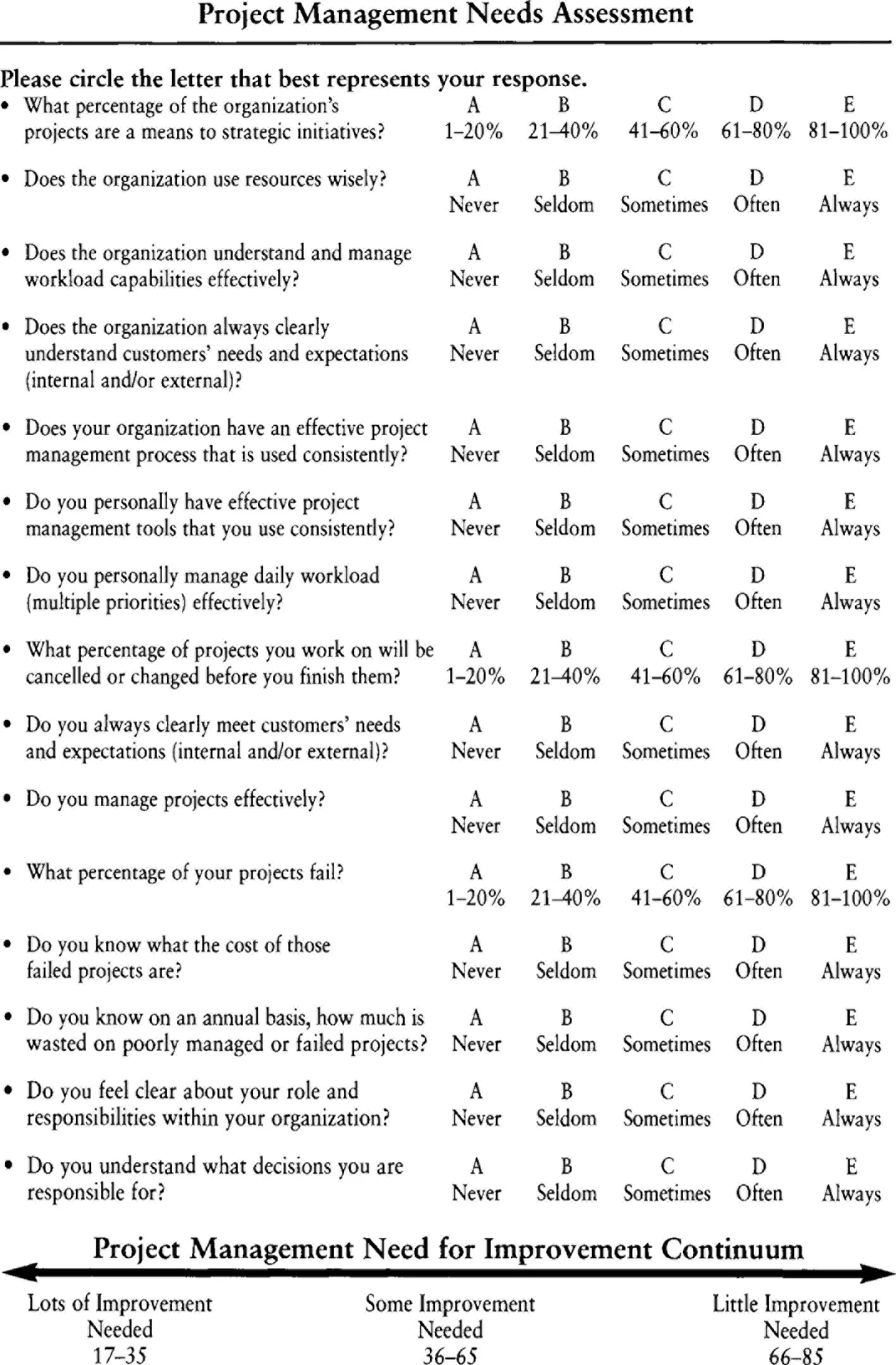
Scoring for Figure 1-1: Give yourself 1 point for each “A” you marked, 2 points for each “B” you marked, 3 points for each “C” you marked, 4 points for each “D” you marked, and 5 points for each “E.” Then, total your scores. Use your total score to see where on the need for improvement continuum you fall.
Reasons for Failed or Poorly Managed Projects
Why do projects fail in an organization? Here are the top reasons most people give—regardless of the type of business environment they come from:
- Lack of a clear or common vision or goal
- Changing direction mid-project
- Conflicting priorities
- Unrealistic expectations
- Not enough resources (time, money, equipment, knowledge, or expertise)
- Poor communication
- Unmet customer expectations
- Poor planning or no planning
- No clear methodology
- No clear understanding of what needs to be done (who is going to do it, by when, and at what price)
- Scope change
- No buy-in and support from key stakeholders
- Poor leadership
Projects do not fail because technically oriented project management procedures did not work. Almost never do workers say, “We failed because we didn't do our PERT diagram correctly.” Projects fail because of what some call “soft” issues; however, there is nothing “soft” about the cost of failed projects.
What Is the Cost of a Failed Or Poorly Managed Project?
This is an important question that rarely gets a clear answer. Yet, the answer to this question can be costly. The following cites some examples:
- A major restaurant chain manages a routine project to revise its menu in hundreds of restaurants around the United States. Because of poor project definition up front, lack of a clear work breakdown, missed deadlines, and not understanding the impact of last-minute changes, a project that should have cost $500,000 costs over $2 million. (Client preferred not to be identified.)
- A component manufacturer bids a project at $150,000 that ended up costing $450,000 to complete. Because no change documentation existed, the manufacturer was responsible for the price difference. The client told them that if they had clearly understood at the beginning of the project what the actual cost would be, they would have been willing to pay that cost. (Client preferred not to be identified.)
- A joint undertaking between Marriott Corp., Hilton Hotels Corp., Budget Rent a Car, and AMR Information Services (AMRIS) was begun to create a computer system called Confirm. Four years later, after complaints around the product definition, missed deadlines, overwhelming numbers of changes, poor project management skills and poor communication practices, AMRIS wrote off $213 million in expenses related to the project and then litigation began. AMRIS sued Marriott, Hilton and Budget for $70 million, Hilton countersued for $175 million, Marriott for $65 million, and Budget for over $500 million. The participants settled the differences out of court (Flowers, 1996).
The cost of failed or poorly managed projects in an organization may or may not be of this magnitude, but the relative effects remain the same.
In addition to the direct costs of a failed project, there are possible hidden costs or lost opportunity costs of project failures, and associated consequences of simply not doing a project well. These can include:
- Excessive use of resources
- Unmet client needs
- Low employee morale
- High employee turnover
- Longer time to market
- Less successful projects in a year than should be possible
Often these hidden costs or lost opportunity costs may be difficult to pinpoint, but the costs are there, directly or indirectly. Projects fail because of poor project management practices such as:
- Poor creativity and visioning skills
- Poor communication skills
- Poor interview skills
- Poor planning skills
- Over-allocating resources
- No clear work breakdown
- Ineffective workload management skills
- Poor delegation and follow-through practices
- Poor tracking, monitoring, and managing skills
- No common process or methodology
Success Factors
Although managing projects may appear to be a “soft skill,” these socalled “soft” skills, when ineffectively practiced, can consistently result in poor or failed projects. In fact, the failure to use effective project management skills can double, or even triple, the costs of a project. Thus, what is the savings for managing a project well? The savings could be tremendous.
Determining whether an organization is working on the right projects at the right time is a key success factor. The following questions may help determine whether it is the right project at the right time:
- Are resources being wasted in the organization by work being done on low-priority projects?
- Are ideas that are not clearly defined, being prematurely tossed over the wall as assignments to an already busy staff?
- Are projects being implemented that are not in support of the organization's mission, vision, values, and strategic initiatives?
- Does the organization practice the prioritization technique known as “last one over the wall is the highest priority”?
- Can the organization afford to cancel projects in the implementation stage that never should have been started in the first place?
Wasted resources, undefined ideas, projects unaligned strategically, and misunderstood priorities can choke the resource capabilities within many organizations and contribute to high stress, low morale, and poor project performance.
Strategic Planning Pyramid
What is missing in most organizations is an understanding of the organization's highest priorities. Operating practices that ensure that decisions and activities focus on those priorities are essential to successful projects. A model, called the Strategic Planning Pyramid™, can be used by any organization to clarify and communicate priorities, aid in decision-making, and focus activities on priorities (Franklin Covey, 1999).
As Figure 1-2 shows, the Strategic Planning Pyramid™ starts with a clear understanding of an organization's mission, vision, and values (what is most important to the organization). It then clarifies long-range goals and/or strategic initiatives, specifies projects required to accomplish those goals and initiatives, and focuses activities to complete the resulting projects.

The foundation of the model is based upon clarifying statements in terms of what is most important to the organization. While the language can vary from one organization to the next, typical terms for these statements are:
- Mission: A statement of who or what the organization is—its purpose
- Vision: A statement of what the organization wants to be in its future
- Values: Principles and qualities that guide the organization's decisions, behaviors, and operations
The next level in the model clarifies long-range goals to help in the realization of the mission, vision, and values. Some organizations call these strategic initiatives. For the purpose of this book, long-range goals and strategic initiatives are used interchangeably. The important thing to realize about goals and initiatives at this level is that they are often large, long-range, and “big-picture” oriented. For work at this level to be ...
Table of contents
- Cover Page
- Half Title Page
- Series Page
- Title Page
- Copyright Page
- Contents
- Preface
- Acknowledgements
- Part I Setting the Stage
- Chapter 1 Project Management Issues and Challenges
- Chapter 2 The Project Management Process
- Chapter 3 Project Management Solutions
- Chapter 4 The Project Management Scorecard
- Part II The Seven Measures
- Chapter 5 How to Measure Reaction and Satisfaction
- Chapter 6 How to Measure Skill and Knowledge Changes During the Project
- Chapter 7 How to Measure Implementation, Application, and Progress
- Chapter 8 How to Measure Implementation, Application, and Progress
- Chapter 9 How to Calculate and Interpret ROI
- Chapter 10 Identifying Intangible Measures of a Project Management Solution
- Chapter 11 Monitoring the True Costs of the Project Solution
- Part III Key Issues with the Measures
- Chapter 12 How to Isolate the Effects of Project Management Solutions
- Chapter 13 How to Convert Business Measures to Monetary Values
- Part IV Challenges
- Chapter 14 Forecasting ROI: How to Build a Business Case for the Project Management Solution
- Chapter 15 How to Provide Project Feedback and Communicate Results to the Client
- Chapter 16 Overcoming Resistance and Barriers to the Project Management Scorecard
- Appendix: Establishing an Effective PM Culture
- Index
- About the Authors
Frequently asked questions
Yes, you can cancel anytime from the Subscription tab in your account settings on the Perlego website. Your subscription will stay active until the end of your current billing period. Learn how to cancel your subscription
No, books cannot be downloaded as external files, such as PDFs, for use outside of Perlego. However, you can download books within the Perlego app for offline reading on mobile or tablet. Learn how to download books offline
Perlego offers two plans: Essential and Complete
- Essential is ideal for learners and professionals who enjoy exploring a wide range of subjects. Access the Essential Library with 800,000+ trusted titles and best-sellers across business, personal growth, and the humanities. Includes unlimited reading time and Standard Read Aloud voice.
- Complete: Perfect for advanced learners and researchers needing full, unrestricted access. Unlock 1.4M+ books across hundreds of subjects, including academic and specialized titles. The Complete Plan also includes advanced features like Premium Read Aloud and Research Assistant.
We are an online textbook subscription service, where you can get access to an entire online library for less than the price of a single book per month. With over 1 million books across 990+ topics, we’ve got you covered! Learn about our mission
Look out for the read-aloud symbol on your next book to see if you can listen to it. The read-aloud tool reads text aloud for you, highlighting the text as it is being read. You can pause it, speed it up and slow it down. Learn more about Read Aloud
Yes! You can use the Perlego app on both iOS and Android devices to read anytime, anywhere — even offline. Perfect for commutes or when you’re on the go.
Please note we cannot support devices running on iOS 13 and Android 7 or earlier. Learn more about using the app
Please note we cannot support devices running on iOS 13 and Android 7 or earlier. Learn more about using the app
Yes, you can access The Project Management Scorecard by Jack J. Phillips,Timothy W. Bothell,G. Lynne Snead in PDF and/or ePUB format, as well as other popular books in Business & Business General. We have over one million books available in our catalogue for you to explore.