Radical Orthodoxy is a new wave of theological thinking that aims to reclaim the world by situating its concerns and activities within a theological framework, re-injecting modernity with theology.
This collection of papers is essential reading for anyone eager to understand religion, theology, and philosophy in a completely new light.
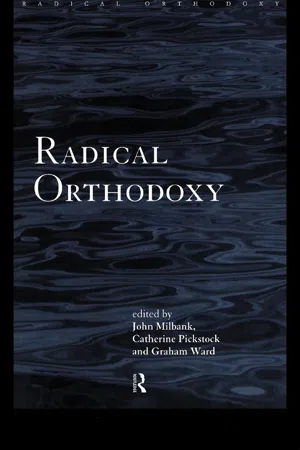
eBook - ePub
Radical Orthodoxy
A New Theology
- 304 pages
- English
- ePUB (mobile friendly)
- Available on iOS & Android
eBook - ePub
Radical Orthodoxy
A New Theology
About this book
Information
1
KNOWLEDGE
The theological critique of philosophy in Hamann and Jacobi
John Milbank
Modern theology on the whole accepts that philosophy has its own legitimacy, its own autonomy, apart from faith. Philosophy articulates categories of being in general, or else of what it is to know in general, but speaks only obscurely, if at all, of God. Theology reserves to itself the knowledge of God as a loving creator who has also redeemed the human race. But various currents of ‘liberal theology’ seek to articulate this knowledge in terms of philosophically derived categories of being and knowing, the legitimacy of which liberal theology has forfeited the right to adjudicate. In the case, by contrast, of various currents of neo-orthodoxy, an attempt is made to articulate this knowledge in terms of categories proper to theology itself: usually this means granting a methodological priority to the full revelation of God in Christ, with all its narrative specificity, over the seemingly more general and abstract acknowledgement of God as creator. And yet what often remains unclear here is the degree to which these theological categories are permitted to disturb a philosophical account of what it is to be, to know and to act, without reference to God. In the case of Karl Barth, a broad acceptance of a post-Kantian understanding of philosophy is turned to neo-orthodox advantage, in that he can insist that natural reason discloses nothing of God and yet that this opens the way to a renewed and, indeed, now more radical recognition that only God discloses God in the contingency of events as acknowledged not by reason but by faith.
But, here one might ask, does not this leave behind a certain liberal residue, a certain humanistic deposit? For it seems that natural reason can recognise certain features of the created order—whether ontological or epistemological—in their pure finitude, without reference to any ratio of finite and infinite, as well as certain features of the fallen created order, which it nonetheless fails to decipher as fallen. Moreover, this liberal deposit arguably looms large, like an enormous slag-heap, undermining the intent of neo-orthodoxy, and obscuring its gaze upon the transcendent. For if philosophy determines what it is to be and to know, then will it not pre-determine how we know even Christ to be, unless we allow that the structure of this event re-organises also our ordinary sense of what is and what we can know, in such a way that the autonomy of philosophy is violated. The danger here is, as is well exemplified in Barth, that if we fail to redefine being and knowledge theologically, theological difference, the radical otherness of God, will never be expressible in any way without idolatrously reducing it to our finite human categories. Hence Barth is confined to a Christomonism, in which Christocentricity reduces to a focus on an enormous black hole, so radically other that it cannot be at all pictured or conceptualised as the new characteristic practice of the Church under the guidance of the Holy Spirit. And, worse still, Barth’s continued and heterodox reduction of Christ’s personal, and expressively imaging, character to a mere conveyance of the Paternal will betrays the fact that he projects God as the supreme instance of what a post-Kantian philosophy, as Fichte correctly realised, must logically understand human existence to be: namely, a willed positing of reality without other constraining grounds of necessity. Therefore, while the Barthian claim is that post-Kantian philosophy liberates theology to be theological, the inner truth of his theology is that by allowing legitimacy to a methodologically atheist philosophy, he finishes by construing God on the model, ironically, of man without God.1
We are left, then, with a double question: has there really been in this century, at least within Protestantism, any post-liberal theology? And would not such a theology have to challenge, at least in some sense, the autonomy of philosophy, and articulate a theological account of what it is to be and to know in general? But these two questions can immediately merge with an historical observation: in his account of the history of eighteenth- and nineteenth-century Protestant theology, Barth so set things up that an era of treacherously humanistic theology was brought to an end only with his own endeavours. In doing so he either ignored or travestied the work of a group of thinkers, whom one can inadequately dub ‘radical pietists’, at the end of the eighteenth century: the most important of these were Johann Georg Hamann, Franz Heinrich Jacobi, Thomas Wizenmann, and, in a certain way, Johann Gottfried Herder.2 These thinkers did produce a theological critique of philosophy construed as the autonomy of reason, but in Barth’s work, as in those of later commentators, this central characteristic of their work is passed over, watered down, or else seen as an illegitimate confusion of faith with reason which betrays the pure word of God. But the result of these evasions and misconstruals is that we are left with a seriously impoverished account of the genesis of much of modern thought itself. Until recently, we have failed to see that it was the radical pietist assault on philosophy which forced Kantianism to be so quickly abandoned, and both provoked and made in turn to collapse in quick succession the defences of critical reason by Fichte, Hegel and Schelling, culminating in an astonishing reassertion of the radical pietist vision by Søren Kierkegaard. Moreover, even their idealist opponents, from Kant onwards, were forced by the pietists to find a way of including Christian faith as knowledge within their accounts of reason itself, from Kant’s ‘rational faith’, through Hegel’s crucified
logos to Schelling’s ‘philosophy of revelation’. Hence in all this long history of ideas theology remained central, and not at all merely reactive in relation to philosophy; on the contrary, it is to the essentially theological contributions of the radical pietists that one can trace many of the most potent themes of modern philosophy: for example, the priority of existence over thought; the primacy of language; the ‘ecstatic’ character of time; the historicity of reason; the dialogical principle; the suspension of the ethical; and the ontological difference. Is it not eccentric, in the face of this consideration, to make Schleiermacher pivotal for the history of modern theology? One does so, I would suggest, only because one has already assumed a liberal sundering of philosophy from theology, and because it was Schleiermacher who first defined, for modern times, a discrete theological domain and method. Yet from another perspective one might rather argue that Schleiermacher produced a diluted and compromised version of the themes of radical piety, one which was insufficiently critical of both Romanticism and rationalism. It is not that I am suggesting, like Balthasar, that Hamann might have been, instead of Schleiermacher, the pivotal figure for the nineteenth century, or that Hamann and Jacobi are neglected because they sadly had little influence. Rather, I suggest that their influence was tremendous: subterranean and concealed perhaps, yet still objectively traceable.3
So far, then, I have implied one perspective under which we might today view Hamann and Jacobi. They are the source not of neo-orthodoxy, but of a more genuinely anti-liberal radical orthodoxy, which does not hesitate to argue even with philosophy itself and which, just because it is more mediating, is also less accommodating than the theology of Barth (or even of Bonhoeffer). And as such ancestors, they were not entirely without heirs, and a legacy, although today we need to re-assemble its fragments. There is also, however, a second historical perspective in which we need to view both Hamann and Jacobi, this time looking backwards rather than forwards. There is absolutely no doubt as to the Lutheran character of both these thinkers: what they articulate is a kind of theory of ‘knowledge by faith alone’ to complement the notion of ‘justification by faith alone’.4 However, it is a mistake to view them only within Lutheran and German horizons: they are European thinkers—first of all geographically, since they are as much indebted to English, Anglo-Irish, Scottish, French and Italian as to German thought; and, second, historically—because we cannot understand them simply as renewing and re-expressing Luther’s vision. Indeed this would be to belittle them, and to fail to realise that they were even greater conservative revolutionaries than Luther himself.
The very phrase I have already used, ‘knowledge by faith alone’, indicates this. For Luther entertained no such project: on the contrary, he broadly accepted the framework of late medieval nominalist philosophy. Now this philosophy was itself the legatee of the greatest of all disruptions carried out in the history of European thought, namely that of Duns Scotus, who for the first time established a radical separation of philosophy from theology by declaring that it was possible to consider being in abstraction from the question of whether one is considering created or creating being. Eventually this generated the notion of an ontology and an xepistemology unconstrained by, and transcendentally prior to, theology itself. In the late Middle Ages and in early modernity, philosophy became essentially the pursuit of such an ontology and epistemology, and the Reformation did nothing to disturb this situation.5 Indeed, the Reformation was itself predetermined by it, in that once philosophy has arrogated to itself the knowledge of Being as such, theology starts to become a regional, ontic, positive science, grounded either upon certain revealed facts or upon certain grace-given inner dispositions or again upon external present authority (the Counter-Reformation model). The very notion of a reason-revelation duality, far from being an authentic Christian legacy, itself results only from the rise of a questionably secular mode of knowledge. By contrast, in the Church Fathers or the early scholastics, both faith and reason are included within the more generic framework of participation in the mind of God: to reason truly one must be already illumined by God, while revelation itself is but a higher measure of such illumination, conjoined intrinsically and inseparably with a created event which symbolically discloses that transcendent reality, to which all created events to a lesser degree also point.6
Viewed from this perspective, it is easy to see how Jacobi and Hamann, unlike Luther, tacitly called into question the entire post-Scotist legacy. It was possible for them to do so, in part because the much more scholastic character of German eighteenth-century philosophy, compared with philosophy in France or England, carried with it, as it were somewhat more clearly on view, the hidden scholastic founding assumptions of all modern philosophy: in particular, the transcendent univocity of being as manifest in the clearly knowable object and the priority of possibility over actuality (I shall elucidate this shortly).7 In two ways the legacy was questioned by Jacobi and Hamann: first, they insisted that no finite thing can be known, not even to any degree, outside its ratio to the infinite; hence they denied the validity of the enterprises of ontology or epistemology as pure philosophical endeavours, or else argued that if they were valid their conclusions would be nihilistic—and indeed it was Jacobi who first thematised the notion of nihilism.8 Second, and correspondingly, they argued (and more especially Hamann here) that if the truth of nature lies in its supernatural ordination, then reason is true only to the degree that it seeks or prophesies the theoretical and practical acknowledgement of this ordination which, thanks to the fall, is made possible again only through divine incarnation.9 Hence there can be no reason/revelation duality: true reason anticipates revelation, while revelation simply is of true reason which must ceaselessly arrive, as an event, such that what Christ shows supremely is the world as really world, as creation (this point has been well re-asserted recently by Phillip Blond).10
We can now link up these two historical perspectives on Hamann and Jacobi: one forwards and one backwards. It turns out that their apparent merging of reason and faith, and apparent fusion of nature and grace, are not suspicious traces of enlightenment, but rather the signs that they were the real conservative revolutionaries, more so than Barth in the one direction, or Luther in the other. This is not at all to deny that they did learn something positive from the generosity of enlightened universalism which prevents them from advocating any sort of simple return to the past, but nonetheless they refracted this universalism in a wholly traditional and Christian fashion. In fact we can now replace Hamann and Jacobi the neglected Lutherans with Hamann and Jacobi the supremely mediating figures: between lost tradition and postmodernity, between English and German thought, and finally between Protestantism and Catholicism.
It should be clear, from what I have already said, that it is not at all accidental that Jacobi and Hamann helped to foment the nineteenth-century Catholic revival in Germany: for what they did was to open the way to recover an earlier Catholicism more authentic than either Protestantism or Tridentine Roman Catholicism.11 On the other hand, here again they did more than simply ‘recover’: their very Lutheran insistence on the priority of faith and language points to a position that allows even less autonomy to a universal reason than that permitted by the Church Fathers, and moreover installs a wholly unprecedented sense of the final inescapabilit...
Table of contents
- Cover Page
- Title Page
- Copyright Page
- Contributors
- Acknowledgements
- Introduction: Suspending the Material: The Turn of Radical Orthodoxy
- 1. Knowledge: The Theological Critique of Philosophy In Hamann and Jacobi
- 2. Revelation: The False Legacy of Suárez
- 3. Language: Wittgenstein After Theology
- 4. Nihilism: Heidegger and the Grounds of Redemption
- 5. Desire: Augustine Beyond Western Subjectivity
- 6. Friendship: St Anselm, Theoria and the Convolution of Sense
- 7. Erotics: God’s Sex
- 8. Bodies: The Displaced Body of Jesus Christ
- 9. The City: Beyond Secular Parodies
- 10. Aesthetics: The Theological Sublime
- 11. Perception: From Modern Painting to the Vision In Christ
- 12. Music: Soul, City and Cosmos After Augustine
Trusted by 375,005 students
Access to over 1.5 million titles for a fair monthly price.
Study more efficiently using our study tools.
Frequently asked questions
Yes, you can cancel anytime from the Subscription tab in your account settings on the Perlego website. Your subscription will stay active until the end of your current billing period. Learn how to cancel your subscription
No, books cannot be downloaded as external files, such as PDFs, for use outside of Perlego. However, you can download books within the Perlego app for offline reading on mobile or tablet. Learn how to download books offline
Perlego offers two plans: Essential and Complete
- Essential is ideal for learners and professionals who enjoy exploring a wide range of subjects. Access the Essential Library with 800,000+ trusted titles and best-sellers across business, personal growth, and the humanities. Includes unlimited reading time and Standard Read Aloud voice.
- Complete: Perfect for advanced learners and researchers needing full, unrestricted access. Unlock 1.5M+ books across hundreds of subjects, including academic and specialized titles. The Complete Plan also includes advanced features like Premium Read Aloud and Research Assistant.
We are an online textbook subscription service, where you can get access to an entire online library for less than the price of a single book per month. With over 1.5 million books across 990+ topics, we’ve got you covered! Learn about our mission
Look out for the read-aloud symbol on your next book to see if you can listen to it. The read-aloud tool reads text aloud for you, highlighting the text as it is being read. You can pause it, speed it up and slow it down. Learn more about Read Aloud
Yes! You can use the Perlego app on both iOS and Android devices to read anytime, anywhere — even offline. Perfect for commutes or when you’re on the go.
Please note we cannot support devices running on iOS 13 and Android 7 or earlier. Learn more about using the app
Please note we cannot support devices running on iOS 13 and Android 7 or earlier. Learn more about using the app
Yes, you can access Radical Orthodoxy by John Milbank, Catherine Pickstock, Graham Ward, John Milbank,Catherine Pickstock,Graham Ward in PDF and/or ePUB format, as well as other popular books in Theology & Religion & Christian Theology. We have over 1.5 million books available in our catalogue for you to explore.