- 416 pages
- English
- ePUB (mobile friendly)
- Available on iOS & Android
eBook - ePub
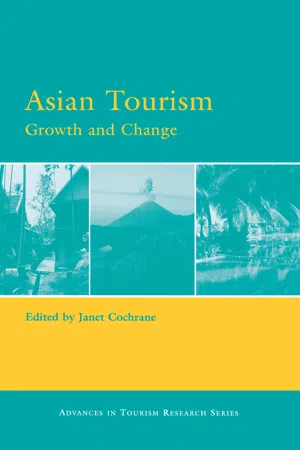
Asian Tourism: Growth and Change
About this book
Tourism in Asia is growing faster than anywhere else in the world, driven by the increasing wealth of countries like Taiwan, South Korea and Malaysia, and by the huge populations of China, India and Indonesia -the first second and fourth biggest countries in the works. Despite the significance of the tourism industry in this area it is still under researched.
Asian Tourism is a unique book and the first to addresses this imbalance by providing a high quality edited collection of chapters which explore the domestic and intraregional tourism in Asia. Divided into three sections it explores:
* Policy aspects of tourism development and the role of the public sector exploring issues such as: Cross-national tourism collaboration in Asia, The growth of aviation in Asia and Economic Corridors and Ecotourism.
* Changing markets exploring issues such as: The role of Japanese popular culture in Asian tourism, Management Challenges for Bali's Tourism Industry and religious tourism in North India.
* Destination and industry responses exploring issues such as: Tourism-Generated Employment in Cambodia, sex workers and tourism in India and responsible destination development in the Philippines.
With contributions from well respected and eminent names in the field, Asian Tourism provides a ground breaking insight into topical, industry focused issues while benefiting from academic depth and rigour and an awareness of tourism history in this region.
Chapter 1Introduction
Janet Cochrane
DOI: 10.4324/9780080556208-1
In the decade to 2007, the geography of tourism flows underwent dramatic change. International tourism movements increased by over 40 per cent from 598.6 million in 1997 to 842 million in 2006, with the most dynamic growth in Asia and the Pacific. The region overtook the Americas to become the second-most visited part of the world (after Europe) in 2002, and individual Asian countries climbed up the rankings of the most popular destinations (UNWTO, 2005, 2006, 2007). Globally, however, there is still a presumption that ‘tourists’ are Westerners, whereas the major markets in most Asian countries by now are other Asians. In a typical example, Koreans displaced Americans in 2006 as the largest group visiting the Philippines, and six out of the country's top ten source markets are Asian (NSCB, 2007). Amidst the plethora of books published on tourism, few recognise this reality as Winter (2007) also points out, the literature is still dominated by analyses by Western commentators of Western markets. This volume seeks to redress the balance by examining the current processes of tourism in Asia.
Two-thirds of the chapters in this book were initially presented as papers at the conference ‘Tourism in Asia’ held at Leeds Metropolitan University in June 2006, while the remaining third were contributed by authors whose research covers significant topics which ‘filled in the gaps’. Fourteen of the chapters are written or co-authored by Asian researchers. The great majority of the others are by people who either currently reside in Asia or have spent long periods there. These are people who have lived in remote Asian islands and learned obscure dialects, watched gamblers as they queue to take their place at the gaming tables, listened to hill-top villagers who hope to benefit from tourism, overcome business challenges to introduce innovative new products, lectured in Asian universities, negotiated with governments to introduce laws and policies which spread the benefits of tourism, and created plans to take Asian tourism forward towards the opportunities of the new millennium. All the authors have tried to understand the changes taking place in Asian tourism, the influences that shape those changes, and the impacts that result from them.
What insights into Asian tourism, then, are provided by this body of expertise? Geographically, the studies range from Sri Lanka in southern Asia to Japan in the northeast; from landlocked, mountainous Bhutan and Mongolia to the archipelagos of Indonesia and the Philippines; from the tiny, nascent destination of the Andaman and Nicobar Islands to the vast source market of China. The locus of one investigation is even the United Kingdom, although the subject matter — the temporary diaspora of Chinese international students — is firmly Asian. In subject terms the chapters are equally diverse: there are close-up studies of the socio-cultural impacts of tourism on households and communities in Cambodia and India, discussions of intraregional policy actions, and investigations into how destinations respond to new markets.
This book sets out to illustrate the diversity of manifestations of tourism in Asia, the motivation and preferences of Asian tourists, and the complexity of the processes that shape the industry, its dichotomies and challenges. The chapters are presented in three sections: the political uses of tourism and the resulting policy aspects; market responses to new opportunities; and the impacts of tourism on particular destinations or segments of the industry and their adaptation to change. A common foundation is fashioned by the force that underpins most of the world's economic activity: the power of the market.
In the free market — on which the prevailing global system of capitalism is based — the interplay between supply and demand should provide social and economic benefits while ensuring the prudent management of environmental resources through availability or scarcity. Unfortunately this scenario ignores the ambitious and expansionist tendencies of human nature, which emphasise individual gain over the collective good. Despite the collectivist nature of Asian society, demonstrated in tourism through an evident enjoyment in the ‘collective gaze’ rather than the more individualistic gaze of European tourists, weak governance in many Asian countries means that poorer communities often experience disproportionately the negative effects of tourism. Unable to be tourists themselves, they may not benefit from it economically and may suffer social disruption and environmental deterioration as a result of it. This is partly because of the unregulated struggle for profit and competition, which is experienced by the tourism industry on several levels: tour operators compete with each other for market share, hotels and resorts compete with one another within destinations, and countries jostle to differentiate themselves from others with similar products.
A competitive environment is generally good for consumers and for entrepreneurs, of course: a great array of niche products will develop in response to demand, such as with the variety of medical and wellness holidays offered across Asia (described by Laing and Weiler), the development of casino-hotels along the Sino-Vietnamese border to cater to Chinese gamblers (Yuk Wah), the growth of accommodation, tour, and transport services around religious sites in India (Shinde), and the exploitation of the ‘pop-culture’ niche (explored by Ng). But the interplay of market forces means that, left to their own devices, the most profitable enterprises will predominate regardless of any negative social and environmental consequences. This situation is most clearly demonstrated by the peculiarly Asian issues of ‘zero-fee’ or ‘zero-dollar’ tours (discussed by Ravinder, Arlt, and Fallon), a common problem across the continent as unscrupulous travel agents seize on unsophisticated new markets; ‘copycatting’ by operators who lack the imagination to develop new products but compete by trimming the margins on existing ones; and by the demand-ledgrowth of low-cost air carriers, whose environmental impacts in the longer term are set to outweigh the short-term benefits (as outlined by Cambridge and Whitelegg).
The inequalities created by unfettered market forces can reach extremes in certain circumstances: conscientious tour operators protest that their ability to make a fuller contribution to social and environmental welfare is hampered when their products are undercut by less principled operators, and the genuine participation (in the sense of having a decision-making role) of weaker elements in society is difficult to achieve. All over Asia, from the banks of the Kinabatangan river in Sabah to beach resorts in Koh Samui, people whose culture and environment are the focus of tourism find themselves marginalised by the industry. As soon as tourism shows promise, outsiders rush in to purchase land and build hotels. With few resources of expertise and capital, peasant or fishing communities can rarely gain substantial benefit from tourism under a laissez-faire system of development; some form of regulation or intervention is essential.
The key agents of intervention are the government, NGOs, and aid agencies. The government's principal role is to create the enabling environment for tourism to grow and for the benefits to be fairly spread through increasing employment and economic linkages; in other words to harness market forces and drive them in the direction of social equity. Frequently, this does not happen with much success, either because of bureaucratic inertia or incompetence (especially at provincial level) or because private interests prevail over the public good. The current vogue is for collaboration between private and public sectors and between countries, such as with the sectoral collaborative actions described by Ravinder and the geographical ones described by Wall.
NGOs are active throughout Asia in supplementing government efforts to improve tourism's benefits: amongst other actions, they train guides and tour operators, campaign in support of local communities threatened by large-scale developments, and try to bridge the divide between tourism and biodiversity conservation by sponsoring master-plans and collaborative management initiatives in protected areas. International aid agencies generally work at a more macro level, guiding policy and law formulation. The Netherlands development agency SNV has been particularly active in poverty alleviation through tourism in Asia, from advising on the management and promotion of new products in Lao PDR, to capacity-building along trekking trails in Nepal and the introduction of articles designed to facilitate pro-poor tourism into Vietnam's 2006 Law on Tourism.
Meanwhile, the Asian Development Bank (ADB) has been instrumental in creating the legislative and physical infrastructure for tourism in the Greater Mekong Subregion (GMS), as described by Sofield. This is typical of a state-sponsored discourse which sees tourism as part of its modernisation agenda, using it to develop the infrastructure and diversify from an economy based on primary agricultural products to service industries. The effectiveness of this involvement for poorer communities is questioned by Travers, who also points out the contradiction between the mass movements which will be facilitated by the GMS infrastructure creation and the smaller scale, community-based approach advocated under another ADB-sponsored programme, the adoption by the Laotian government of ecotourism as a central focus of its national strategy. Many ecotourism projects in Asia are donor-assisted, community-based enterprises which are based more on idealism than pragmatism, their development running in parallel to larger scale, conventionalforms. There is increasing awareness now amongst donor agencies that such ventures are only likely to succeed if underpinned by a strong market awareness.
While intervention and regulation are essential to support and manage tourism, attempts to over-direct or limit the market by regulating physical access by consumers, such as with the manipulation of visa regulations in Vietnam (Suntikul, Butler, and Airey) or the strict control over the dimensions of supply and the channels of distribution imposed by the Bhutanese government (Ritchie), have tended to creak or break apart under the pressure of demand. Even in Bhutan, long considered a success story because of its apparent success in maximising the benefits of tourism while minimising its negative effects, there are moves to relax entry controls in order to allow a more professional and market-orientated approach to service delivery.
A further need for government intervention is because of the environmental consequences of unregulated market forces, which commodify nature and other key elements of tourism: as they are not assigned a value, they fall outside any calculation of the true cost of goods. Thus, tourism companies treat environmental resources as ‘free’ to ensure profitability, and they become subject to the ‘tragedy of the commons’ scenario, whereby common resources are over-exploited. Since the consequences of this are now well understood, why have so few measures been taken by the tourism industry to address the environmental costs of tourism? The major issue is the lack of assigned responsibility for the resources consumed. The tourism industry is aware of its responsibilities but chooses to let host governments impose a regulatory structure: it does so because competitive practices militate against responsible practices, which can only be effective if all companies in a given geographical area or product field are obliged to behave in the same way.
The negative impacts and externalities provoked by the overwhelming strength of market forces are exacerbated in countries where countervailing forces to individual or governmental excesses are underdeveloped, and where regulations are widely flouted. Many Asian governments are still trying to establish themselves as democracies or are shrugging off the ideological constraints of communism and command economies, while others are subject to the legacy of powerful social and cultural hierarchies; in some countries both circumstances apply. The still-extant pyramidal or monolithic power structures stifle dissent, making it difficult for the communities who bear the brunt of tourism's negative impacts to protest, such as with the representation for tourism purposes of bowdlerised versions of Tibetan and other ‘minority’ Chinese cultures, as discussed in the chapters by Murakami, Bovair, and Feighery.
In the last decade several countries have shaken off their government's stranglehold over the media and embraced the revolution in communications technology to delight in freedom of speech and the sharing of knowledge. However, entrenched systems of patronage have not been easily overturned, and in the conflict between private interest and the public good the former often seems to win. Practices which would be deemed corrupt in the West, from the small-scale re-routing of national park entry fees into the pockets of poorly paid staff, to the major diversion of levies intended for tourism development into private enterprises directed by government ministers or their cronies, are still common in Asia. The dividing line between corruption and taking rational measures to support one's friends and family is not clear-cut, and is accepted as a fact of life by many; but the over-enthusiastic use of power and status for personal gain undermines social justice and wise use of environmental resources.
On the other hand, there are pockets of philanthropy and enlightened leadership which are leading to social change and illustrate the significance of human agency in creating different outcomes from otherwise similar situations. While in recent years the Philippines has struggled to distance itself from the cronyism and kleptocratic practices which stymied development under the Marcos regime, the chapter by Gray describes how power-relations can be used in a positive way when a strong leader wields influence for the benefit of society and the environment. Philanthropic actions, too, are emerging as a key driver in spreading the benefits of tourism more widely. Examples include the health, education, and reforestation programmes funded through tourism by enterprises such as the Kaliandra Foundation and the Nihiwatu Lodge in Indonesia; the efforts by the Singapore-based hotel company Banyan Tree Holdings to engage their customers in environmental regeneration; and — most striking of all — the generosity shown by the international community after the Asian tsunami, manifested in the huge amounts of cash donations and in volunteer work by individual visitors to help rebuild shattered lives. Given that other natural disasters (for instance the 2005 Pakistan earthquake, which killed over 70,000 people and rendered thousands more homeless) generated far lower levels of media interest and funds, it seems inescapable that the tsunami-affected countries fared so well because so many people in source markets felt a strong emotional link to familiar holiday destinations.
The impact of the tsunami on tourism and the role of government in revitalising the industry is discussed by Cochrane (for Sri Lanka) and by Reddy (for the Andaman and Nicobar Islands). The high levels of donations were an indication of the cross-cultural understanding generated by international tourism, a theme also explored by Hamzah in the context of Japanese school students visiting Malaysia to participate in local lives under the homestay programme, and by Rong Huang, who found that Chinese students in the UK were keen to act as ambassadors for their country as well as to understand the British better.
Several of the chapters in this volume support the concept of tourism as a rite or passage or as a contribution to social capital: by their vacation decisions, people identify with a particular group within their own society or define themselves as part of a global community. Another side of this is that while abroad, people may indulge in behaviour which would be unacceptable at home; one of the attractions of travel is that it is easier to remove oneself from social constraints in the areas of liminality which occur when people travel across cultures and geographies. Porananond and Robinson show that Thai and foreign participants alike enjoy a relaxation of social constraint during the ludic activities of the Songkran Festival in Chiang Mai, while Feng Yi Huang confirms that a motivation for both international and Asian backpacker travel is the temporary freedom from normal social ties. This includes perhaps the opportunity to explore close interpersonal relations: as White shows in her study of sex-workers at Kovalam Beach, India, some people travel to find love in one form or another. As with the issue of corruption, the dividing line between ‘romance’ and ‘exploitation’ is not clear-cut, and is subject to gendered and culturally informed interpretation.
While tourism undoubtedly engenders social dislocation, partly by providers changing their lifestyles or migrating in response to market opportunities, tourism is rarely the sole agent of change. Brickell explores the changes to intra-household relations caused by the income-generating opportunities of tourism taken up by women in Cambodia, and points out that this is part of a general diversification of rural livelihood strategies. Feigheryshows how the Chinese government is reorganising the living space of the World Heritage Site of Xi’an in its efforts to grapple simultaneously with the challenges of safeguarding cultural resources, managing growth, and meeting the needs of local residents for contemporary living. Xi’an and other ‘lived in’ World Heritage Sites, such as Luang Prabang in Lao PDR, can be carefully preserved architecturally (as reported by Travers), but maintaining the living culture is a far more difficult task: in Luang Prabang, local people are responding to the dollars wielded by foreign purchasers to move out of the Heritage Site, with its planning restrictions, to newer properties in the outskirts of the town, with the Site itself increasingly the haunt of foreign residents, most of whom can be classified as long-stay tourists.
The influence of long-stay foreigners in Asian countries — many of whom started out as tourists, even if they are no longer considered as such — is an area, which again, is under-researched. Policies designed to encourage long-term stays by foreigners (and their foreign exchange), such as the ‘Malaysia My Second Home’ programme, spring from the familiarity of Asian countries as tourism destinations. Furthermore, the thousands of Europeans, other Westerners, and migrant Asians who have fallen in love with particular countries, often marrying locally and settling down to run businesses, is an important factor in injecting capital into poor areas, raising standards, and helping to bridge the cultural divide between hosts and guests. As markets shift, this can make a significant contribution to the societal learning needed to ensure that strangers feel welcome — although it can also be a channel for the expatriation of tourism revenues and the alienation of resources from local hands. Whatever the drawbacks, learning the cross-cultural ‘language’ of expectations is also essential for success in handling new markets: as Hitchcock and Putra show, the Balinese are finding the cultural characteristics of their ‘new’ Asian visitors challenging to accommodate.
In principle, the needs of domestic tourists should be easier for destinations to understand, but t...
Table of contents
- Cover Page
- Half Title Page
- Series Page
- Title Page
- Copyright Page
- Contents
- List of Figures
- List of Tables
- The Contributors
- Preface
- 1. Introduction
- The Politics and Policies of Asian Tourism
- Market Demand and Supplier Response
- Destinations, Industry and the Forces of Change
- Glossary
- Subject Index
Trusted by 375,005 students
Access to over 1.5 million titles for a fair monthly price.
Study more efficiently using our study tools.
Frequently asked questions
Yes, you can cancel anytime from the Subscription tab in your account settings on the Perlego website. Your subscription will stay active until the end of your current billing period. Learn how to cancel your subscription
No, books cannot be downloaded as external files, such as PDFs, for use outside of Perlego. However, you can download books within the Perlego app for offline reading on mobile or tablet. Learn how to download books offline
Perlego offers two plans: Essential and Complete
- Essential is ideal for learners and professionals who enjoy exploring a wide range of subjects. Access the Essential Library with 800,000+ trusted titles and best-sellers across business, personal growth, and the humanities. Includes unlimited reading time and Standard Read Aloud voice.
- Complete: Perfect for advanced learners and researchers needing full, unrestricted access. Unlock 1.5M+ books across hundreds of subjects, including academic and specialized titles. The Complete Plan also includes advanced features like Premium Read Aloud and Research Assistant.
We are an online textbook subscription service, where you can get access to an entire online library for less than the price of a single book per month. With over 1.5 million books across 990+ topics, we’ve got you covered! Learn about our mission
Look out for the read-aloud symbol on your next book to see if you can listen to it. The read-aloud tool reads text aloud for you, highlighting the text as it is being read. You can pause it, speed it up and slow it down. Learn more about Read Aloud
Yes! You can use the Perlego app on both iOS and Android devices to read anytime, anywhere — even offline. Perfect for commutes or when you’re on the go.
Please note we cannot support devices running on iOS 13 and Android 7 or earlier. Learn more about using the app
Please note we cannot support devices running on iOS 13 and Android 7 or earlier. Learn more about using the app
Yes, you can access Asian Tourism: Growth and Change by Janet Cochrane in PDF and/or ePUB format, as well as other popular books in Business & Business General. We have over 1.5 million books available in our catalogue for you to explore.