- 320 pages
- English
- ePUB (mobile friendly)
- Available on iOS & Android
eBook - ePub
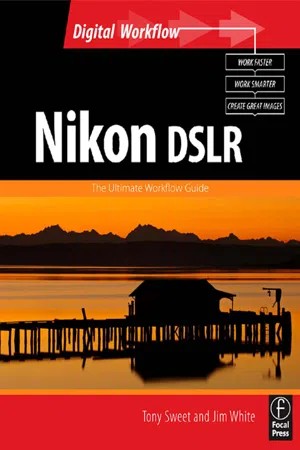
Nikon DSLR: The Ultimate Photographer's Guide
About this book
Whilst camera-specific guides provide the how-to, manual style information on how to use your particular model of camera, this manufacturer-specific guide provides you with all the information you need as a Nikon DSLR photographer to optimise your workflow and capture great images.
Jim White and Tony Sweet show you how to increase the quality of your photos, save time and work smarter, starting with the most pressing questions: Which camera should you use? Which lens is best? Which accessories are must-haves? How can you get the most out of Nikon's Capture NX Software?
In-depth, specific features of the newest Nikon DSLRs are also covered, helping you to make your camera really work for you. Complete with practical advice, key workflow solutions and detailed images that display multiple camera functions, this book is a must have for every Nikon photographer.
Part of Focal's Digital Workflow series, this is the Nikon version of the popular Canon DSLR: The Ultimate Photographer's Guide.
Trusted by 375,005 students
Access to over 1.5 million titles for a fair monthly price.
Study more efficiently using our study tools.
Information
Subtopic
Digital MediaChapter 1 The Basics
DOI: 10.4324/9780080927060-1


The Exposure Triangle
The very fact that you have purchased this book means you plan to take your photography beyond the casual point and shoot stage. Although this book isn't designed to be an introductory course in photography, it is necessary to understand some important basic concepts to fully take advantage of your Nikon Digital SLR camera. To fully understand and utilize the creative power of these incredible cameras, you need to understand the relationship of aperture, shutter speed, and ISO, or what we will call the ‘exposure triangle.’ The basic rule to remember is that all three factors control your exposure: change any one variable and one or both of the other two must be changed as well. Understanding this relationship will allow you to move beyond making technically correct photographs to capturing really great images.
Aperture
The aperture is an adjustable opening in the lens of a camera. Somewhat like the pupil of our eye, the aperture adjusts to allow more or less light to enter the lens and reach the sensor. The size of the aperture is controlled via an adjustable diaphragm that opens or closes to allow more or less light to enter. On a standard camera lens, we measure in units called‘stops.’ Each f/stop represents either double or half the amount of light, depending on whether the lens aperture is opened or closed. The inverse relationship between thef/stop number and the amount of light entering the lens is confusing to many novices. As the aperture is ‘stopped down,’ the numerical f/stop value increases and as the lens is ‘opened up,’ the numerical f/stop value decreases. We would classify a ‘fast’ lens as one with a maximum aperture (minimum f/stop number) of, say, f/1.4 or f/2.8 for example. Typically the same lens would have a minimum aperture (maximum f/stop value) of f/16 or f/22. Remember, as you open up the aperture by one stop you are allowing twice the amount of light to enter the lens, and as you close down one stop you are reducing by half the amount of light reaching the lens. You can see in the examples below the effects of one-stop difference either way.
Each of thef/stop settings below represents a one-stop difference in aperture. As the f/stop numerical value increases, the amount of light decreases. Depending on which way the aperture is adjusted, each f/stop setting either halves or doubles the amount of light entering the lens and reaching the sensor.
| f/1.4 | f/2.8 | f/4 | f/5.6 | f/8 | f/11 | f/16 | f/22 | f/32 |
Shutter Speed
Shutter speed refers to the amount of time the shutter remains open and allows light to enter and pass through the lens and strike the sensor. Shutter speed is measured in seconds and usually fractions of a second. You will often see 1/125 or 1/1000 as typically used shutter speeds for daylight photography, while 1/60 or even 1/30 is commonly used with flash or studio portrait photography. Many landscape photographers often employ shutter speeds involving several seconds.
As with the aperture, shutter speed is measured in units called ‘stops.’ Increasing the shutter speed by one stop decreases the amount of time light is allowed to strike the sensor by half. Conversely, decreasing the shutter speed by one stop allows twice as much time for the shutter to remain open allowing light to enter and strike the digital sensor. Obviously increasing or decreasing the shutter speed without making a corresponding adjustment to the shutter speed or ISO will result in an over-or underexposure of an image. (Figures 1.2, 1.3 and 1.4)


In the same way that different aperture settings affect the look and feel of a particular image, different shutter speeds can also produce various affects on the way a photograph is interpreted. A really fast shutter speed can literally ‘freeze’ action, such as a formula one car or even a bolt of lightning, while ‘dragging the shutter’ or intentionally shooting at a s...
Table of contents
- Cover Page
- Half Title Page
- Title Page
- Copyright Page
- Contents
- Chapter 1 The Basics
- Chapter 2 Setting Up Your Workflow
- Chapter 3 Common Features of Nikon Digital SLR Cameras
- Chapter 4 The Cameras
- Chapter 5 Shooting Modes
- Chapter 6 Getting Good Color and a Good Exposure
- Chapter 7 Nikon Glass
- Chapter 8 Flash Photography
- Chapter 9 Getting Your Best Shot from the Digital Negative
- Index
Frequently asked questions
Yes, you can cancel anytime from the Subscription tab in your account settings on the Perlego website. Your subscription will stay active until the end of your current billing period. Learn how to cancel your subscription
No, books cannot be downloaded as external files, such as PDFs, for use outside of Perlego. However, you can download books within the Perlego app for offline reading on mobile or tablet. Learn how to download books offline
Perlego offers two plans: Essential and Complete
- Essential is ideal for learners and professionals who enjoy exploring a wide range of subjects. Access the Essential Library with 800,000+ trusted titles and best-sellers across business, personal growth, and the humanities. Includes unlimited reading time and Standard Read Aloud voice.
- Complete: Perfect for advanced learners and researchers needing full, unrestricted access. Unlock 1.5M+ books across hundreds of subjects, including academic and specialized titles. The Complete Plan also includes advanced features like Premium Read Aloud and Research Assistant.
We are an online textbook subscription service, where you can get access to an entire online library for less than the price of a single book per month. With over 1.5 million books across 990+ topics, we’ve got you covered! Learn about our mission
Look out for the read-aloud symbol on your next book to see if you can listen to it. The read-aloud tool reads text aloud for you, highlighting the text as it is being read. You can pause it, speed it up and slow it down. Learn more about Read Aloud
Yes! You can use the Perlego app on both iOS and Android devices to read anytime, anywhere — even offline. Perfect for commutes or when you’re on the go.
Please note we cannot support devices running on iOS 13 and Android 7 or earlier. Learn more about using the app
Please note we cannot support devices running on iOS 13 and Android 7 or earlier. Learn more about using the app
Yes, you can access Nikon DSLR: The Ultimate Photographer's Guide by Jim White,Tony Sweet in PDF and/or ePUB format, as well as other popular books in Media & Performing Arts & Digital Media. We have over 1.5 million books available in our catalogue for you to explore.