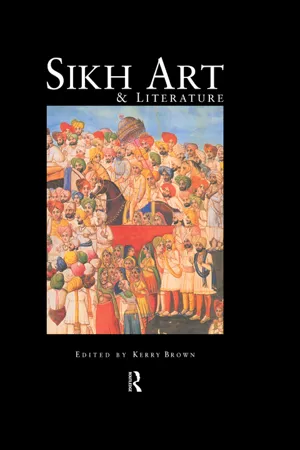
Sikh Art and Literature traverses the 500-year history of a religion that dawned with the modern age in a land that was a thoroughfare of invading armies, ideas and religions and arts of the East and West.
Essays by art curators, historians and collectors and religion and literary scholars are illustrated with some of the earliest and finest Sikh paintings. Sikh modernism and mysticism is explored in essays on the holy Guru Granth Sahib; the translations and writings of the British Raj convert, M.A. Macauliffe; the fathers of modern Punjabi literature, Bhai Vir Singh and Puran Singh; and the 20th century fiction writers Bhai Mohan Vaid Singh and Khushwant Singh. Excerpts from journals of visitors to the court of the diminutive and new translations of early twentieth century poetry add depth and originality to this beautiful and accessible introduction to the art, literature, beliefs and history of the Sikhs.
Illustrated throughout with 42 colour and 92 black and white images, Sikh Art and Literature is a colourful, heartfelt, and informative introduction to the Sikh culture.
- 264 pages
- English
- ePUB (mobile friendly)
- Available on iOS & Android
eBook - ePub
Sikh Art and Literature
About this book
Information
Chapter 1
From Gurus to Kings
Early and Court Painting
The art of the Sikhs has, in its classical expression, evoked the two primary images of Sikhs – that of saints, and that of soldiers (Plate 12, Figure 19). But the splendid imagery of these works is rooted in a set of values which goes beyond mere piety or military prowess and which shines through in the artworks we shall be examining. These values are, quite simply, an all-embracing spirituality that transcends any single faith, race, class or gender, and a soldiery that is rooted in fundamental respect for the nobility of the human spirit and for the Divine Truth that resides in all.
I would like to explore these core values and their expression in Sikh art by focusing on three key personages in Sikh history. The first is Nanak Dev, the founder of Sikhism whom the Sikhs call Guru Nanak;1 the second, the social leader, Gobind Singh, known to the Sikhs as Guru Gobind Singh; and finally, the famous Maharaja,2 Ranjit Singh of the Punjab. A review of their history, their thoughts, their motivations, their achievements and the reasons for their success, provides valuable insight into the Sikh community and the underpinnings of its art.

Figure 19 ‘Guru Gobind Singh on Horseback’, artist of Guler-Kangra schools, early nineteenth century (detail of Plate 12), 23.5 × 32.6 cm (Collection of Gursharan and Elvira Sidhu)
Origins: Guru Nanak
The origin of the Sikhs was in the Indian province of Punjab, the land of the punj (five) ab (rivers), located in the north-western reaches of the Indian sub-continent. In Europe, the struggle of the Christians and the Moors in Spain was then approaching its culmination. Christopher Columbus had yet to entice anyone into supporting his daring scheme of sailing across the Atlantic Ocean to Cathay.
The story starts in 1469, in the small town of Talwandi Rae Bhoe with the birth into a Hindu family of a son named Nanak. Before the century was out, Nanak had the revelation that led to the founding of the Sikh faith and his place in the heart of all Sikhs as Guru Nanak Devji, that is, ‘Nanak, the Respected Teacher’.
No portraits of Nanak done in his lifetime are known, and there is no certainty about the details of his appearance. Available descriptions seem tainted by mythologizing intentions. In Plate 1 he is shown in a painting done some time in the eighteenth century, perhaps in eastern India, by an artist dispersed from the dying court of the Mughals.3 This might even be the earliest naturalistic depiction of Nanak to which there is access today. With his long white beard and peaceful demeanor, there is no doubt that this is a revered person, one respected for his piety. His conspicuous cap, that of a Muslim pir (saint), and his robes of a Hindu holy man provide a notable reminder of one of his teachings – an indifference to religious differences. Who and what was Nanak and why is his mind central to all Sikh thought and belief?
Even though visual information about Nanak is lacking, it is not difficult to explore quite effectively his subtle, witty and inspiring mind through an examination of his teachings. Nanak shines through his soaring poetry, his questioning thought and his mastery of word-images. A review of Nanak’s beliefs is essential for the non-Sikh reader and can also prove revealing for the ritual-oriented minds of many Sikhs today.
From the early days of Vedic India, and certainly in the lifetime of Nanak, Indians have lived in the unrelenting grip of the caste system. Nanak was struck by the completeness with which ritual and ceremony had imprisoned human minds, and how the idolatry of Hindu practice and the iconoclasm of Islam were generating endless conflict. Nanak emerged onto this scene as a myth buster, one of the great bhakts (devotees).4 In his own words:5
The age is like a knife.
Kings are butchers.
Religion hath taken wings and flown.
In the dark night of falsehood
I cannot see where the moon of truth is rising.
(‘Majh ki Var’, GGS)6
Modesty has disappeared because falsehood reigns supreme.
The Muslim mullah and the Hindu pandit have resigned their duties,
the devil reads the marriage vows....
Praises of murder are sung and
People smear themselves with blood instead of saffron.
(‘Tilang’, GGS)
These words are even more striking in conjunction with the fact that they were uttered in 1499, a scant seven years after Christopher Columbus’ rediscovery of the Americas. In the age of the Inquisition and its reign of terror in Europe and in the Americas, here is a man who seeks the rising moon of truth, and who condemns falsehood uttered in the name of religion. Nanak goes on to say, ‘There is no Hindu, no Musulman.’ Little surprise then that he chose to wear the cap of the Muslim pir and the robes of a Hindu sant. Indeed, this painting bears the inscription in the Islamic nastaliq script tasvir-i dervish nanak shahi, ‘picture of the kingly saint Nanak’ in which Muslim terms for saint and king, dervish and shah, are applied to him.

Figure 20 ‘Guru Nanak’s Visit to Mecca’, Janam Sakhi, Unbound Set, nineteenth century (Kapany Collection)
In this simple garb, he criss-crossed northern India carrying his thoughts on truth and harmony to the ears of all who would listen. He is even reputed to have traveled to the holy places of Islam at Mecca (Figure 20) and Medina in Arabia, and at Baghdad in today’s Iraq.
Nanak crystallized his credo of truth in the mul mantra, the root incantation and opening verse of the Guru Granth Sahib:
There is one God
He is the supreme truth....
Before time itself there was truth
Even now, He is the truth
And evermore shall truth prevail.
(Japji, GGS)
One of the resonant memories of every Sikh is the daily recitation of the mul mantra and its cadence that goes Ek Oan Kar. Sat-Naam. Karta Purukh.... (There is One Being, Truth by Name, Primal Creator....). It serves as a staff of strength for Sikhs in moments of distress, tension or adversity.
Nanak’s words are full of wit and humor. I quote now from the Prabhati where he says:
When I am quiet, they say I have no knowledge
When I speak, I talk too much they say
When I sit they say an unwelcome guest has come to stay
When I depart, I have deserted my family and run away...
Nothing can I do that in peace I may spend my time.
Preserve thy servant’s honor now and hereafter, O Lord sublime.
He was not an idle philosopher-dreamer; he wrought lasting change by moving ideas into action. Among his great achievements was the breaking of the caste system. On untouchability and its foolhardy quest for purity, he reasoned impeccably, his empiricism scientific in essence:
Once we say: This is pure, this unclean,
See that in all things there is life unseen.
There are worms in wood and cow dung cakes,
there is life in the water which makes it green.
How then be clean when impurity is over the kitchen spread?
Impurity of heart is greed,
Of tongue, untruth...
(‘Asa di vaar’, GGS)
With the conviction of his words he went on to establish the community kitchen, the guru ka langar, in which all, whether Sikh or non-Sikh, regardless of caste, background or gender, prepare, serve and share food. This elegantly practical approach shattered the shackles of untouchability and tore down the entire structure of caste among Sikhs in the days of Nanak.7 The Sikhs remain a casteless community, although at times we tend to forget it. I feel that it is to our shame when we do, and a signal disrespect to Nanak’s genius and founding leadership.
The Founding of the Social Order: Guru Gobind Singh
Nanak’s vision of truth was carried forward after his lifetime by a succession of nine spiritual leaders, the Sikh Gurus. Their teachings compose the core of Sikh belief and are embodied in the Adi Granth,8 the holy book of the Sikhs. The last, and tenth of these, was born with the name of Gobind Rae in 1666. Later renamed Gobind Singh, he brought about radical and lasting change in the community.
In Plate 12 (see also Figure 19), he is shown in one of his finest portraits, painted in the early years of the nineteenth century by an artist trained in the painting traditions of Kangra and Guler, in the lower ranges of the Himalayan mountains. Pictured astride a richly appointed steed, his hunting dogs running obediently...
Table of contents
- Cover Page
- Half Title page
- Title Page
- Copyright Page
- Contents
- Figures
- Contributors
- Art Foreword
- Literature Foreword
- Acknowledgments
- Introduction
- Part I Art
- Chapter 1 From Gurus to Kings
- Chapter 2 An Illustrated Life
- Chapter 3 The Sikh Treasury
- Chapter 4 Golden Temple, Marble Forum
- Part II Literature
- Chapter 5 The Unstruck Melody
- Chapter 6 The Western Gateway to Sikhism
- Chapter 7 Poetry Urges Poetry
- Chapter 8 Critical Ecstasy
- Chapter 9 Old Culture, New Knowledge
- Chapter 10 A Mirror to Our Faces
- Appendix I The Ten Sikh Gurus
- Appendix II Contributors to the Guru Granth Sahib
- Appendix III Music and Structure of the Guru Granth Sahib
- Appendix IV Collections of Sikh Art
- Glossary
- Further reading
- The Sikh Foundation
- Index
Trusted by 375,005 students
Access to over 1.5 million titles for a fair monthly price.
Study more efficiently using our study tools.
Frequently asked questions
Yes, you can cancel anytime from the Subscription tab in your account settings on the Perlego website. Your subscription will stay active until the end of your current billing period. Learn how to cancel your subscription
No, books cannot be downloaded as external files, such as PDFs, for use outside of Perlego. However, you can download books within the Perlego app for offline reading on mobile or tablet. Learn how to download books offline
Perlego offers two plans: Essential and Complete
- Essential is ideal for learners and professionals who enjoy exploring a wide range of subjects. Access the Essential Library with 800,000+ trusted titles and best-sellers across business, personal growth, and the humanities. Includes unlimited reading time and Standard Read Aloud voice.
- Complete: Perfect for advanced learners and researchers needing full, unrestricted access. Unlock 1.5M+ books across hundreds of subjects, including academic and specialized titles. The Complete Plan also includes advanced features like Premium Read Aloud and Research Assistant.
We are an online textbook subscription service, where you can get access to an entire online library for less than the price of a single book per month. With over 1.5 million books across 990+ topics, we’ve got you covered! Learn about our mission
Look out for the read-aloud symbol on your next book to see if you can listen to it. The read-aloud tool reads text aloud for you, highlighting the text as it is being read. You can pause it, speed it up and slow it down. Learn more about Read Aloud
Yes! You can use the Perlego app on both iOS and Android devices to read anytime, anywhere — even offline. Perfect for commutes or when you’re on the go.
Please note we cannot support devices running on iOS 13 and Android 7 or earlier. Learn more about using the app
Please note we cannot support devices running on iOS 13 and Android 7 or earlier. Learn more about using the app
Yes, you can access Sikh Art and Literature by Kerry Brown in PDF and/or ePUB format, as well as other popular books in Theology & Religion & Asian Art. We have over 1.5 million books available in our catalogue for you to explore.