![]()
CHAPTER ONE
MATERALS
Masterful drawings can be produced with ordinary newsprint paper and a charcoal or Wolff's carbon pencil. You will have to draw and throw away hundreds of drawings before you have to start worrying about their longevity and passing into museum collections so do not worry about not drawing on expensive acid-free archival paper for a while.
Remember, whenever you change the type of paper you draw on you generally have to change the pencil you draw with – and if you change your pencil you will generally have to change the paper. In most cases it will take time to adjust to a different kind or degree of pencil. Be patient and do not despair as this is normal.
You will find that one combination of pencil and paper will work better for you than another depending on your purpose. As an example you will have to use a hard pencil if you are making a linear drawing and a much softer one if you're doing a full value rendering.
What we are looking for is maximum control – we do not want the pencil to slip and slide all over the paper. We want a combination of pencil and paper that will produce a slight drag. We want a pencil that makes a line that we can go over and alter another line or value without slipping – a line that can vary from a hairline to a broad stroke in one sweep – one that will respond to our every thought and nuance of touch. For these reasons paper with a slick surface and graphite pencils are not recommended for our learning drawings.
The act of drawing should be approached with love, energy and enthusiasm. It should be enjoyable not drudgery.
You will not learn as much if you draw with a bored attitude or are uninterested in what you're doing. The paper or pad should be clipped onto and backed by a hard stiff board, such as masonite, that does not bend. You cannot have maximum control holding your pad in your hand or resting your paper on a wobbly bent surface. Don't make problems for yourself.
Your pencil should be sharpened with a single-edged razor blade and given a wedge with a sandpaper block. Before the model starts posing you should be practicing many strokes and variations of strokes, much in the way musicians practice on their instruments before performances. These warm-up exercises will loosen you up and aid you in making skillful lines when you get into the actual drawing.
ABOUT MATERIALS
PENCILS: There are dozens of name brand pencils on the market, some very old, some new. I think on the whole pencils were much better in the past. This is probably due to today's increased production costs and the conformance to environmental laws which prohibit certain manufacturing processes. Today you may buy a top-rated brand pencil and find all of a sudden it feels like you are drawing with a cinder of coal. There is also less consistency in their designations.
Pencils are designated "H" for hard and "B" for soft. The basic grades of General's charcoal pencils are H, HB, 2B, 4B and 6B, 6B being the softest. Wolff's carbon pencils which have been used by draughtsmen and artists for generations range from H the hardest to BBB the softest. Graphite pencils, which are not recommended for our type of learning drawing range all the way from 9B the softest to 9H the hardest. The range is 9B, 8B, 7B, 6B, 5B, 4B, 3B, 2B, B, F, H, 2H, 3H, 4H, 5H, 6H, 7H, 8H and 9H.
The designations for hard and soft pencils are not universally standardized so an HB, say in the Ritmo brand, may be the equivalent to a 4B in the General's charcoal brand.
The pencils I prefer most for the learning drawings and drawings in general are Wolff's BB or BBB, General's charcoal 2B, 4B or 6B and Ritmo HB and 3B. These work very well on ordinary newsprint. You will have to try out many pencils to find the one that suits you best and that will change as you progress in your work.
Do not drop pencils as they will crack throughout and will be difficult and in many cases impossible to sharpen. Keep your pencils, razor blades and erasers in a small box where they cannot bounce around.
I have previously mentioned that it is important to keep your interest and enthusiasm up when drawing and for that reason you may want to try drawing with a sanguine or sepia pencil or a combination of sanguine and charcoal pencil for a change, but only after you are sufficiently advanced.
PAPER: For all practical purposes use a fairly smooth newsprint. Avoid a heavily textured newsprint as it might hinder your pencil stroke. I prefer the student use an 11" x 14" size pad. I suggest you make one drawing to a page as you will be better able to concentrate on proportions, shapes and proper placement. You should also have a 9" x 12" newsprint pad for making smaller studies of individual parts of the figure and drapery
DRAWING BOARD: Your drawing pad or paper should be firmly clipped to a piece of 1/4" thick masonite at least 18" x 16" or any other convenient size. This will give you maximum control. If you are drawing on separate sheets of paper you will get better results by using several sheets together rather than one sheet over the masonite. In this way you will have some "give" on the surface of the paper which allows for better strokes.
SHARPENER: Use a single-edged razor blade or a multipurpose snap-off cutter to sharpen your pencils. Single-edged razor blades are much cheaper when purchased in a box of a large quantity.
ERASER: Make sure to purchase a kneaded rubber eraser, not a plastic one. The kneaded rubber eraser is good for rubbing out large areas and can be molded to a point to take out small areas. It is especially useful when making a full-value charcoal drawing to create tones and highlights.
SANDPAPER BLOCK: A sandpaper block is needed to refine your pencil point and to put a wedge on it – which is recommended in this book for the execution of learning drawings.
![]()
CHAPTER TWO
LINE
There is much to be learned about the use of line and how it can be achieved with an ordinary pencil. Simply sharpening a pencil to a point and drawing with it will not give you the maximum potential of line.
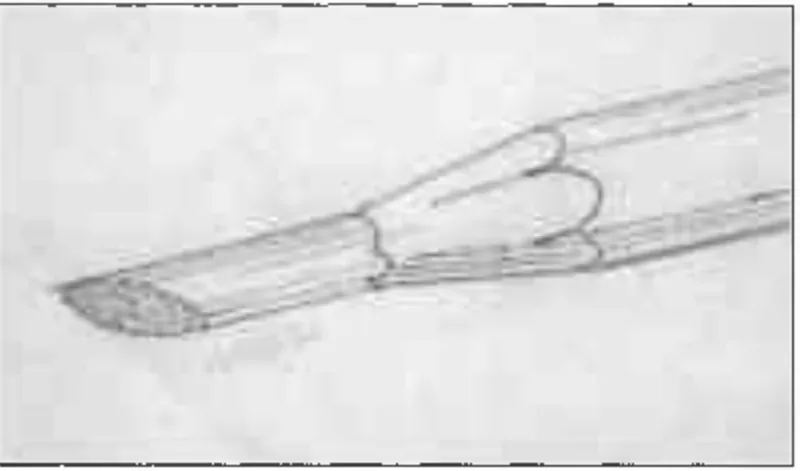
Figs, 1a.b.c.d. and e. show how the pencil is prepared for our type of learning drawing as well as many other types of drawing. You will have greater control and variety of line with a short pencil and therefore it is advisable to cut the pencil in half. A short pencil can be contained in the palm of your hand held by your thumb and forefinger. In this way the pencil can be twisted or turned to make a great variety of lines and strokes.
Fig. la. Lay the pencil on a flat, solid surface. Gently push an industrial type single-edge razor blade into the pencil at the halfway mark.
Fig. b. With the razor blade still into the pencil roll it back and forth until the cut encircles the entire pencil. Do not make this cut too deep.
Fig. c. Using a razor blade or knife and starting about 1/2 inch behind your cut line cut a wedge down to the carbon or charcoal, stopping at the cut line. Do this all around the pencil.
Fig. d. Now, holding the entire pencil down with the palm of your hand use your razor blade to cut completely through. You now have two short pencils. Continue to sharpen the pencil to a fine point and then sharpen the other half pencil.
Fig. e. You now have a sharp pencil point. Rub it on a sandpaper block at an angle to create a wedge. This wedge is what one draws with, and the angle of it will gradually adjust itself to each individual.
Fig. f. Typical lines made with th...