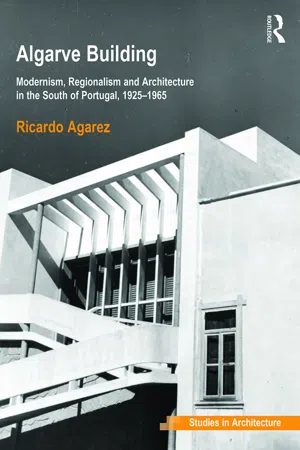
The Algarve is not only Portugal's foremost tourism region. Uniquely Mediterranean in an Atlantic country, its building customs have long been markers of historical and cultural specificity, attracting both picturesque driven conservatives and modernists seeking their lineage. Modernism, regionalism and the 'vernacular' – three essential tropes of twentieth-century architecture culture – converged in the region's building identity construct and, often the subject of strictly metropolitan elaborations, they are examined here from a peripheral standpoint instead.
Drawing on work that won the Royal Institute of British Architects President's Award for Outstanding PhD Thesis in 2013, Algarve Building challenges the conventional inclusion of Portuguese modern architecture in 'Critical Regionalism' narratives. A fine-grain reconstruction of the debates and cultures at play locally exposes the extra-architectural and widely participated antecedents of the much-celebrated mid-century shift towards the regional. Uncelebrated architects and a cast of other players (clients, officials, engineers and builders) contributed to maturing a regional strand of modern architecture that, more than being the heroic outcome of a hard-fought 'battle' by engaged designers against a conservative establishment, became truly popular in the Algarve.
Algarve Building shows, more broadly, what the processes that have been appropriated by the canon of architectural history and theory – such as the presence of folk traditions and regional variation in learned architecture – stand to gain when observed in local everyday practices. The grand narratives and petites histoires of architecture can be enriched, questioned, revised and confirmed by an unprejudiced return to its facts and sources – the buildings, the documents, the discourses, the agents and the archives.
Trusted by 375,005 students
Access to over 1 million titles for a fair monthly price.
1 Regional Formulae on Vernacular Material Stereotyping the Algarve
DOI: 10.4324/9781315566573-1
The Algarve, the southernmost province of Portugal, was a well-defined regional entity at the start of the twentieth century – a ‘historical’ region with specific geographical features, culture and economy, peculiar within the country and the continent. This small territory (160 km by 40 km) was still seen in 1855 as ‘the smallest kingdom in Europe’,1 for it retained a special autonomy: finally dominated by the Christians in 1249 after 500 years under the rule of the Umayyad caliphate and its successor states,2 the Algarve was associated with (but not absorbed by) the kingdom of Portugal, whose sovereigns became kings of both countries. It had its own governor general (as Portuguese overseas possessions did) from 1595 to 18083 and, on its border with Portugal, taxes were levied upon imports and exports until the late eighteenth century4 (Figure 1.1).
Figure1.1 Kingdom of the Algarve, c.1760.
Tucked between the sea to the west and south, the river Guadiana and Spain to the east, and a mountain range to the north separating it from the Alentejo region, the Algarve was hardly connected with Portugal by land till very late. In the mid-nineteenth century, as no passable roads existed between Alentejo and Algarve, communication and trade were mostly by sea and river.5 A railway from Lisbon was first established in 1889, but fully completed only in 1906. Modern roads date to as late as 1932 (the central route from Faro to Beja in Alentejo), 1936 (the western littoral route) and 1947 (the eastern, Guadiana route).6 By making access easier, the national public infrastructure programme behind these new roads brought about an enhanced impression of the region’s different character in the 1930s, for domestic and foreign visitors.
Twentieth-century authors generally agreed on including the Algarve and Alentejo in the Mediterranean world, while considering the rest of the country as markedly Atlantic.7 Yet the Algarve’s particular climate, vegetation and land use seemed to exacerbate such condition, making it a region consensually seen as diverse even from Alentejo. Revived by the exchanges maintained through Portuguese military settlements in North Africa and ‘the long-standing contacts between the peoples of the “Portuguese-Spanish-Moroccan gulf”’,8 Moorish heritage persisted in coastal and midland Algarve (Barrocal) in features such as the irrigated vegetable gardens, dryland orchards and dispersed farmhouses erected with local materials (rammed-earthand stone) and traditional techniques. In fact, sources insisted, in the early twentieth century the Algarve was isolated but not closed off: compared to other provinces it was well populated and prosperous thanks to the internal and external trade of fish, fruits and cork.
The apparent fertility of the land (artificially enhanced) and its exotic produce captivated visitors: if the Algarve, unlike Andalusia, had few remains of Moorish monuments and ‘little to engage the attention of the antiquary, … to the naturalist it is the most interesting of all the provinces of Portugal’.9 There was a strong sense of unfamiliarity, of a reality misplaced within a well-known territory (Europe), consistently expressed in the parallel with fertile, Mediterranean Africa and the contrast to the rough, dry Iberian Peninsula. Even to a Portuguese author, ‘Both in its towns and villages and in its natural features, the Algarve always leaves the impression of being an extra-European country.’10 In 1963, the American geographer Dan Stanislawski (1903–1997) still noted: ‘In its physical nature and in some of its present ways of life, it is as African as it is European.’11
This fascination with groves of orange, carob, almond and fig trees, waterwheels and veiled peasants in colourful carts was extended to the buildings (Figure 1.2). ‘The cottages in this kingdom’, as Neale put it, ‘are generally much neater and cleaner than in other parts of Portugal, and the manner of building chimneys is quite peculiar and by no means untasteful.’12 These were the features of building tradition that impressed writers and travellers and provided grounds for analysis and speculation: neatness, that is, not only tidily arranged interiors but also simple, pure, pleasing volumes and shapes; cleanness, materialised in the all-encompassing use of whitewash in walls and roofs and ceramic tiles in floors; and a rooted taste for decorative detail, epitomised in what became, later, an identity symbol for the region – the chimney (Figure 1.3).
Figure1.2 The fishing village of Olhos d'Água, Albufeira, c.1980.
Figure1.3 A cottage in the Algarve countryside, c.1940.
As it happens, the accounts of non-architects contributed significantly to the emergence of a built identity construct of the Algarve in the first half of the twentieth century: an enduring, implicit paradigm for a regional built form, which architects were forced to relate to. While scholarly texts recorded the physical, economical and cultural components of the place, contemporary impressions of writers, travellers and journalists reported experiences of living in or visiting the region. A discourse on buildings emerged outside the circles of architectural thought and practice, as the first step in a process that can be read as an arc: the perception of (apparently) vernacular artefacts was subsequently filtered by Geography and Ethnography; simplified by Literature and, through it, disseminated by Journalism and Propaganda, such artefacts became popular references and material for Architecture. Through the combined action of architects and non-architects, the elements of this construct were returned to the context where they originated, stylised to a smaller or larger extent, and closer to the common language and tools of everyday building. They became available to be used in new-built vernacular, while retaining formal characteristics that in fact exclude them from this category – the process therefore not being fully circular: the vernacular did not revert back to the (strictly) vernacular. This chapter will focus on the section of the arc extending from the existing buildings to the dissemination of stereotypes in predominantly metropolitan sources; subsequent chapters will discuss the effects of this process on local building practices.
‘The Smallest Kingdom' in Literature, Ethnography and Human Geography
Accounts of the Algarve’s built environment generally highlight its paradoxical, foreign-looking combination of essential forms and elaborate ornament, while acknowledging that such idiosyncratic features compensate for a limited monumental heritage. Naturalist writer and politician Júlio Lourenço Pinto (1842–1907) followed Neale in recommending the Algarve not for its monuments but for its picturesque, original features ‘in sheer contrast with the rest of the country’, and identified the typical Algarvian village with Faro, the regional capital where he served as provincial governor (1892–1893): sprawling low-rise houses, openings furnished with timber-lattice screens (reixas) ‘which allow one to see without being seen’ (Figure 1.4), predominantly terraced roofs, everything under a ‘beaming whiteness, and buzzing over it all a jungle of those small chimneys in Moorish style that are a luxury of the Algarve, elegant and graceful as minarets’.13
Figure1.4 Door with wood lattice panels in Albufeira, c.1965.
Moorish, minarets, North Africa – Olhão. Pinto’s description of this fishing town 10 km east of Faro contained all the elements that would make it a magnet for foreigners and nationals alike, and provide grounds for scholarly debate:
Olhão’s structure, perhaps more than that of any other Algarvian village, evokes the sight of a Moroccan settlement; … most houses stick to the ground-floor, as white as they can be … uniformly crowned with terraces, twin siblings of the African azoteas.14
Authors generally noted the town’s exceptionality in the Algarvian context, not taking it as representative of the region as a whole; few, however, refrained from describing it as a fragment of Africa in European soil (Figure 1.5).
Figure1.5 The skyline of Olhão, c.1930.
With his chapter on domestic architecture in Notas sobre Portugal (1909), art historian João Barreira (1866–1961) produced the first systematic approach to housing types in Portugal, thus marking the ‘Casa Portuguesa’ debate on the original ‘Portuguese house’ (see Chapter 2). There was no one single national type of house, he argued, but as many as the ways Man found shelter in different contexts. In the Algarve, as in other ‘limestone regions’ of the country, ‘climate favours joyful motifs, tradition exults in them, and thence the landscape is so picturesquely illustrated with decorative notes’. Moorish traces could be seen there more than in any other part of the country, in building customs closely associated with farming and fishing traditions, resulting in specific ‘spontaneous elements’: roof terraces, sharp edges ‘as in enormous dice of lime’, delicate chimney tops or the silhouette of a watchtower emerging as a ‘veiled and curious head looking out over the turquoise sea’.15 Ornament, Barreira insisted, was the key to specific regional expression: whether in the ‘folk’s deepest strata’ or transformed by erudite interpretation and the ‘aesthetic inclination of the local architect’, decoration was ‘the most spontaneous and intimate element of domestic building’.16 Writing for a non-specialised audience, Barreira stressed ‘the picturesque factor and the poetic side’ of Algarvian buildings.
José Leite de Vasconcelos (1858–1941), a pioneer of Portuguese anthropology, published the results of his expeditions to the s...
Table of contents
Cover Page
Half Title Page
Title Page
Copyright Page
Dedication
Contents
List of Figures
List of Abbreviations
Acknowledgements and Picture Credits
Archives Consulted
Foreword by Adrian Forty
Introduction: ‘To Turn the Witchcraft Against the Wizard’
PART I: FROM THE CENTRE
PART II: FROM THE REGION
The Stock and the Graft. Notes on Modern Architecture, Regionalism and Regional Identity
Bibliography
Index
Frequently asked questions
Yes, you can cancel anytime from the Subscription tab in your account settings on the Perlego website. Your subscription will stay active until the end of your current billing period. Learn how to cancel your subscription
No, books cannot be downloaded as external files, such as PDFs, for use outside of Perlego. However, you can download books within the Perlego app for offline reading on mobile or tablet. Learn how to download books offline
Perlego offers two plans: Essential and Complete
Essential is ideal for learners and professionals who enjoy exploring a wide range of subjects. Access the Essential Library with 800,000+ trusted titles and best-sellers across business, personal growth, and the humanities. Includes unlimited reading time and Standard Read Aloud voice.
Complete: Perfect for advanced learners and researchers needing full, unrestricted access. Unlock 1.4M+ books across hundreds of subjects, including academic and specialized titles. The Complete Plan also includes advanced features like Premium Read Aloud and Research Assistant.
Both plans are available with monthly, semester, or annual billing cycles.
We are an online textbook subscription service, where you can get access to an entire online library for less than the price of a single book per month. With over 1 million books across 990+ topics, we’ve got you covered! Learn about our mission
Look out for the read-aloud symbol on your next book to see if you can listen to it. The read-aloud tool reads text aloud for you, highlighting the text as it is being read. You can pause it, speed it up and slow it down. Learn more about Read Aloud
Yes! You can use the Perlego app on both iOS and Android devices to read anytime, anywhere — even offline. Perfect for commutes or when you’re on the go. Please note we cannot support devices running on iOS 13 and Android 7 or earlier. Learn more about using the app
Yes, you can access Algarve Building by Ricardo Agarez in PDF and/or ePUB format, as well as other popular books in Architecture & Architecture General. We have over one million books available in our catalogue for you to explore.