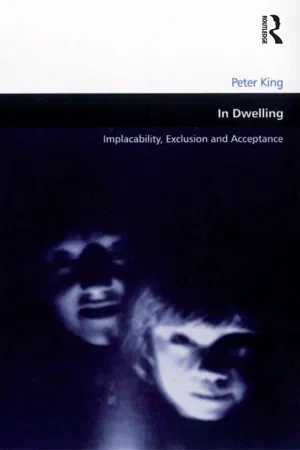
- 170 pages
- English
- ePUB (mobile friendly)
- Available on iOS & Android
eBook - ePub
About this book
A 'dwelling', or the physical space we call a house, is full of meaning for us. It can be implacable, in that it can work for or against us, depending on how we are able to access and use it. This means that we have to learn to accept dwelling as it is and find some accommodation with our surrounding environment. This book develops a new approach to looking at dwelling and how we use it. It explores the manner in which we use housing to exclude others and so protect our privacy. It also argues we need to exclude others in order to protect and nurture our loved ones. The book combines philosophical analysis and literary and film criticism to put forward an innovative and insightful new approach to looking at housing. It draws on the work of thinkers as diverse as Aristotle, Derrida, Kierkegaard, Nussbaum and Scruton and the films of Chaplin, Bergman, Lynch, Tarr, Teshigahara and Van Sant to construct a new theoretical approach to housing research.
Trusted by 375,005 students
Access to over 1 million titles for a fair monthly price.
Study more efficiently using our study tools.
Information
Chapter 1 Closed
DOI: 10.4324/9781315588100-1

An outline
I want to offer an outline here, like a child’s drawing, a simple sketch, a naïve and open picture, of my position, that will point to some of the key ideas, arguments, themes and concepts that will pre-occupy me. And like a child’s drawing this outline will be both simplified and archetypal: it will only provide the most basic elements, but these, I hope, will all be recognisable. For once we have the basic shape, a clear outline, and we have understood it as such, we can then start to add some complexity to the picture: we can start to deal with variation and speculate on different forms and functions. Once we have an outline we can add light and shade.
Children, so it appears, have a particular image of the house: we have all seen it and probably done it ourselves. It is simple and archetypal. The house is square, topped with an isosceles triangle for a roof, and probably with a chimney from which smoke spirals up lazily. It will have a door and a window on the ground floor and two windows above, all neat and ordered symmetrically. It will be surrounded by grass and flowers and a fence, with a path leading to the front door. The sun will be shining and birds will be flying across the blue of the sky.
What does this suggest to us? First, of course, that we have a particular image of the dwelling, which may well be ethnocentric, idealised, and it may certainly be unreal for many of us. Yet undeniably there is this image, and it has been consistent for generations: I drew these pictures, just as my children have. It is a common image used to convey a particular association, perhaps of rurality, of a garden idyll, or of security, or regularity and comfort. It is a symbol of how we might like to live, how we feel we do live, and indeed it is used as such. So, for instance, the Housing Corporation in England uses such a naïve symbol as its logo: it even has the sun shining in the background. This childlike image is therefore instantly recognisable as the way we want to live. It operates as a symbol to represent something meaningful for us individually and collectively. It is an object of solidity: a block, a cube, a square, as wide as it is tall, enclosed and enclosing, detached from others, yet presented as a common image of a type of dwelling. It is a physical shape, a recognisable representation of an object, yet not of something that has been built or has existed. It is an image – the image, perhaps – of private dwelling.
Perhaps this is part of its derivation: that we live as distinct units, centred on a dwelling, focussed on partners, parents and children; we are alone together in our house, distinct from any other, where we all do similar things differently (King, 2004). The image we have then is of a separate unit, isolated from others, where there is no encroachment on this idyll of domesticity, of being alone together.
I do not find it insignificant that the house is invariably drawn as an isolated object, which is separate from any others. It will normally be the only house in the picture. It is the house, not one of a terrace, not connected in any way to another, except, of course, in the sense of it being the archetype. This ideal house is always detached. This is not, I feel, a concern for status or class – children have little idea of or interest in house prices, location or the desirability of a dwelling – but the sense of a house as a discrete and separate entity.
This sense of separation is enhanced by a further aspect: the house is bounded. There is a definite boundary to it. It has sharp edges and a definition, so that the inside is separate from the outside. The fence keeps things in and other things out. The house is distinct, even if it is deliberately not distinctive. It is therefore an image of regularity, of symmetry, as well as enclosure.
What this childish image also shows is that we see the house as an object, and I mean this in the sense of something that has a representational quality, that denotes something: it is of a type, with a meaning that is extensive, so that we can move beyond this singular entity into a sense of the common and the ubiquitous. It is not just a house, but the house. It is something prototypical, something which we can associate with, whose meaning is given: the house, so to speak, stands for something foundational.
But does it matter where this meaning comes from? Can we ever do much more than speculate, or indulge in conjecture about where these representations derive from; can we ever avoid being mired in ideology when we try and locate the source of significance for those objects that are around us? All we can do, as Stanley Cavell (2005) reminds us, is to offer a testament to things and the world, to those entities that we have not ourselves created:
I do not make the world that the thing gathers. I do not systemize the language in which the thing differs from all other things in the world. I testify to both, acknowledge my need for both. (p. 244)
We do not ourselves create the significance of things, we merely recognise that they have meaning for us and declare it in the only way we can. We can speak beside them, perhaps on their behalf. We can talk of them, but only with borrowed words, whose meanings have already been asserted by others that came before us. But, of course, it is precisely because of this antecedence that we wish to join in the conversation.
Things have a meaning for us, and we can assert this – offer a testament to it – regardless of where that meaning comes from, regardless of whether others have felt it before, whether others still do, and whether others will do in the future; and regardless of whether we can fully articulate it, whether we write a wordy treatise or draw a naïve picture. And the triteness of what we enjoy does not make the object any less meaningful, and this is because what matters is who is aware of that meaning and not the fact that this meaning is widely shared, or how it might be articulated. Meaning is not determined by those who seek to judge it or offer external criteria. Banality does not set limits on the subjective signification of the thing; it is merely a testament – if this is the right word to show it – of the lack of sympathy of the observer. Our regard for the object, and our testament to it, is often not a matter of judgement or taste, but of utility and meaningfulness.
But here is a paradox: one person’s object, what I want to call my house, is a mere thing for another person, a thing of little significance and of no great regard. And others demonstrate this disregard of mine through their testament to their dear object. Their ability to ignore the mere things of others is a function of the meaningfulness of a significant object: that object they too are able to call ‘my house’. And so a mutual, yet benign, indifference is maintained through the significance we give to a certain object and not to all things. What this suggests about the derivation of the significance of the object ‘house’ is that it comes out of our own signification with my house. The relationship we have with our dwelling is never in the third person. So when we generalise we abstract from the subjective. It is the active association of the specific to the general; the attachment of personal significance on to something we know to be common. That it is common to us means we can extend that commonality to all and therefore see the house as the prototypical object, typical of a relation we have with what we call mine, and to which the word mine can be so applied over and over again, in all its typicality and distinctiveness.
The place we live in becomes mine not because, or not only because, we own it, but because we are there, those we love are there, and it is where we want to stay. It is precisely, then, the first-person relation that is important here: it is that I am in the midst of it; it is my ordinary environment (King, 2005). It is the use, as an ongoing activity through time, and the meaning that develops from this, which makes it mine. This may appear the wrong way round: it would be more likely, we might think, to suggest that I can use it because it is mine, but we must not take up this simplistic position, we must not fall into this epistemological trap. In fact, it is the reverse position that holds: it is because of its utility and meaning – that it allows us to meet, or strive for, our ends – that we see it, and properly consider it, to be mine. Owning can help, but this is not sufficient, or are we to suggest that tenants cannot feel attached to where they live, and that children cannot connect with their dwelling just because it is owned by their parents?
If we consider the relation that children have with their dwelling, with what they call mine, we can begin to understand this significance more fully. Children rarely if ever choose where they live. The dwelling may be a place which predates their memories: it might be the only place they have known, the only place they have lived in. Or, if they have moved, they would have had little say in why, where and when that move might have occurred. So their attachment to their dwelling is not linked to choice, or their ability to pay, or because they are the legal owners. Yet they still see it as theirs, they use the words my and mine as readily, and as legitimately, as their parents who do own it and who pay the bills. We need to understand what this is about and why this can be. It may be because it is all they know: as far as dwelling goes, this is the limit of their experience. They know that there are other houses, that people behave differently in them, and that their houses are different, but this house is still their only place.
But this answer is to an extent question-begging, and we need a more fundamental explanation. I would argue that the attachment does not come from choice, but from the commitment which the dwelling has for them. By this I mean that the attachment derives from what the dwelling accepts from them and allows them to do. It is the relational position of the dwelling, in its exact specificity with an individual subject, which matters here. Of course, there are the human relations within the dwelling, with parents and siblings. But there is also the longevity of the relation with the dwelling itself; this is where we live permanently. This place forms our ordinary environment, and as such there has occurred some moulding of the dwelling to fit us. We can now take the dwelling for granted; it is our space, our stage, our platform (King, 2005). Of course, we could commit to another space, and we would settle in other dwellings given the time and the opportunity and if the right conditions pertained, namely, that we were with those we love and that there was some promise and actuality of longevity. But, at the present, as it would now and foreseeably appear to us, this particular dwelling is mine because it is where I am and where I want to be.
This brief discussion has started to show some of the themes I wish to explore in this book. First, there is the concern with objects and the meaning of objects, with the use of objects and how they stop being mere things and become objects for us: of why the little word my and its cognates are so important in all this. And so we are studying the meaning of objects – of objects-for-subjects. This calls for a phenomenology of why a thing stops being just anything and becomes this thing, this object that is mine, not something, but the sum of things. This is an approach concerned with the finiteness of the object, and this means we need to appreciate that objects are enclosed and enclosing, why we have them enclose us, and how we cease to see them and take them for granted, even as we continue to revere them through their use. So, second, we are concerned with the only one, the very thing, the singular object we no longer see; with what it is to be singular, to be alone within the object and alone together, to use this object, that we cease to see, that becomes transparent, as the thing that hides us; how it can be transparent to us but not to those outside. For those on the outside the dwelling is opaque: it offers a block to their gaze.
What I seek to do is to integrate the physicality of the house, the dwelling, into the subjective appreciation of dwelling as an activity; to recognise that the objective quality tempers, moderates, qualifies and quantifies the subjective. Indeed without the object there can be no subjective. Yet the object is not beyond, or outside the subjective: it cannot, properly speaking, exist for us without this overriding subjectivity.
And yet the dwelling does still hold us and we need to know why it can, why it does, and why we want it to. The third issue, then, relates to what the object, now seen in its singularity, does for us. It is the object that insulates us, that holds us apart so that we can be alone together with those special to us, so we can enjoy the intimacy of those we choose to care for and share with. But we must also look at the consequences of insularity, with the isolation it might bring. Dwelling can allow us to withdraw from the world and we need to understand what this means and why it matters, in what ways it damages us and others, but also why it might be positive, why it might indeed be necessary for us to isolate ourselves at times. We may seek solitude as a flight from responsibility, as a means of avoiding the world.
The implacable dwelling
Søren Kierkegaard (1980) portrays anxiety as the consequence of both freedom and finitude. We are free to make and take decisions, we have choices and we can be capable of making changes to our lives. Yet we are also aware of our finitude, of the inevitability of our own end. We are aware that we are mortals who have only so much time in which to play out our lives. What this draws out for us, what it makes all too explicit, as Jean-Paul Sartre tell us in both Being and Nothingness (1990) and Nausea (1965), is that choices have consequences. The freedom we have can take us down avenues – or one-way streets – and we must accept the responsibility for what we find there: we must take the consequences of our decisions. Yet, for both Kierkegaard and Sartre these consequences may well be things which we cannot entirely account for. We set things in motion, perhaps for the most arbitrary of reasons, but once they are started we cannot determine where they will lead, and so we fear that we might not retain control and that events will overtake us. So we have something of a fear of freedom, which creates an anxiety within us, a generalised ache inside us which makes us beware of change. We become all too aware that the world around us can make us pay for our choices. In other words, we see that the world is implacable to us, in that it responds to us neutrally, and that it may work for us at one time, but may then turn against us as circumstances change. This sense of a neutral world adds an edge to our responsibility: we begin to appreciate that things are open, and this is an opportunity and a threat, a possibility and a potential bottomless pit, so that what appeared open is now closed to us.
One way of dealing with this apparent implacability is to withdraw into that which is known to us, to that place we see as secure and private. We can therefore see dwelling as helping us to deal with anxiety, as protecting us from the threat posed by neutrality. Yet hiding away may just feed the lack of responsibility: running and hiding means we never face the problem or come to terms with it. Accordingly, the world remains strange and hostile, and we abnegate any responsibility for dealing with it.
Now we find things turning in on themselves: in order to deal with the implacability of the world outside we withdraw into dwelling. But what this means is that we come to depend upon the implacability of dwelling, of its capability to repel the outside world, and that it stands solid against all others. It is precisely this quality – the exclusivity – that lies at the heart of the dwelling’s welcoming of us. It is not just its solidity, or that it works any differently for us than for others. Rather it is because it is mine, I can have it, and I determine how it can be used, and as long as this solidity holds, this implacability works for me and I can rely on it.
Yet there is nothing intrinsic to the dwelling that ensures this benefit – the dwelling can work against me just as effectively and implacably as it can for any other. So we need to add a nuance to this argument to make it hold. What is important here, the intrinsic element in this phenomenology of dwelling, is the subjective and meaningful relation we have with the object, and this depends on the implacability of dwelling, on the solidity of its standing for me as the one who possesses it as mine. So it is not the implacability we cling to but our confidence in the reliability of this implacability, and perhaps this is what subjectivity really amounts to.
So we are concerned, above and beyond all else, with the implacability of an object, but one that is imbued, soaked, in our subjectivity: the implacability of that which is mine, that which exists for me, which can work for me and only me, but which does not complain when I leave it, that cannot be spurned but which can work just as well for you as it does for me. The book is essentially a study of implacability and subjectivity, of how something that is mine and only mine can hurt me and ignore others, just as I can use it to ignore others in case they want to hurt me. And so I am concerned with subjects who need objects, and with objects that are for subjects.
It is implacability that links all the parts of this discussion together. It connects the concept of objects-for-subjects – the fact that objects have meaning for us, but are still palpable, hard, physical objects – with the consideration of insularity, which shows how the implacable nature of dwelling helps and hinders us. This sense of the implacable reinforces the subjective yet palpable and concrete nature of the object.
To say that something or someone is implacable is to say that it or they cannot be appeased or pacified; they appear to us as inexorable, relentless, as things or people who cannot be persuaded by request or entreaty to change their position or yield to us. Something that is implacable shows an inflexibility and an intractability to our position: there is no possibility here of a compromise being reached. There is an impression of hardness in this concept and a sense in which we are thrown against something that is unyielding and which we have no opportunity to reason with. This might appear to be a rather odd concept to mix with the subjective: in precisely what way is our meaning moderated by this sense of the unyielding? Indeed what is it that is being implacable and unyielding here?
What I want to suggest is that implacability arises out of the context in which we can and do use our dwelling, or, to put it another way...
Table of contents
- Cover Page
- Half Title Page
- Title Page
- Copyright Page
- Table of Contents
- Dedication
- Preface: Retracing Our Steps
- Acknowledgements: Standing Together
- 1 Closed
- 2 In and Around Dwelling
- 3 From Machines to Mine
- 4 The Confinement of Sense
- 5 Hiding in the World
- 6 Open
- Coda: Out and back
- Bibliography
- Films
- Index
Frequently asked questions
Yes, you can cancel anytime from the Subscription tab in your account settings on the Perlego website. Your subscription will stay active until the end of your current billing period. Learn how to cancel your subscription
No, books cannot be downloaded as external files, such as PDFs, for use outside of Perlego. However, you can download books within the Perlego app for offline reading on mobile or tablet. Learn how to download books offline
Perlego offers two plans: Essential and Complete
- Essential is ideal for learners and professionals who enjoy exploring a wide range of subjects. Access the Essential Library with 800,000+ trusted titles and best-sellers across business, personal growth, and the humanities. Includes unlimited reading time and Standard Read Aloud voice.
- Complete: Perfect for advanced learners and researchers needing full, unrestricted access. Unlock 1.4M+ books across hundreds of subjects, including academic and specialized titles. The Complete Plan also includes advanced features like Premium Read Aloud and Research Assistant.
We are an online textbook subscription service, where you can get access to an entire online library for less than the price of a single book per month. With over 1 million books across 990+ topics, we’ve got you covered! Learn about our mission
Look out for the read-aloud symbol on your next book to see if you can listen to it. The read-aloud tool reads text aloud for you, highlighting the text as it is being read. You can pause it, speed it up and slow it down. Learn more about Read Aloud
Yes! You can use the Perlego app on both iOS and Android devices to read anytime, anywhere — even offline. Perfect for commutes or when you’re on the go.
Please note we cannot support devices running on iOS 13 and Android 7 or earlier. Learn more about using the app
Please note we cannot support devices running on iOS 13 and Android 7 or earlier. Learn more about using the app
Yes, you can access In Dwelling by Peter King in PDF and/or ePUB format, as well as other popular books in Política y relaciones internacionales & Política pública de planificación local y regional. We have over one million books available in our catalogue for you to explore.