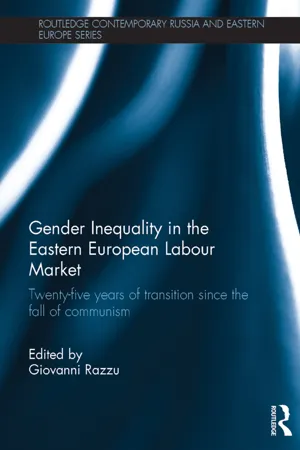
Under communism there was, in the countries of Eastern Europe, a high level of gender equality in the labour market, particularly in terms of high participation rates by women. The transition from communism has upset this situation, with different impacts in the different countries. This book presents a comprehensive overview of gender and the labour market since the fall of communism in a wide range of Eastern European countries. Each country chapter describes the nature of inequality in the particular country, and goes on to examine the factors responsible for this, including government policies, changing social attitudes, levels of educational attainment and the impact of motherhood. Overall, the book provides an interesting comparison to the situation in Western developed countries, outlining differences and similarities. No one single Eastern European model emerges while, as in Western developed countries, a range of experiences and trends is the norm.
eBook - ePub
Gender Inequality in the Eastern European Labour Market
Twenty-five years of transition since the fall of communism
- 276 pages
- English
- ePUB (mobile friendly)
- Available on iOS & Android
eBook - ePub
Gender Inequality in the Eastern European Labour Market
Twenty-five years of transition since the fall of communism
About this book
Trusted by 375,005 students
Access to over 1.5 million titles for a fair monthly price.
Study more efficiently using our study tools.
Information
1
The wider context
In this chapter, we describe key facts with the aim of providing the reader with the relevant context to interpret the more detailed country-focused analyses that follow in the subsequent chapters. We will focus on two kinds of facts: first, we will present the wider economic and development context, describing trends over the time period since the fall of the communist regimes in 1989–1990, in economic growth as well as in economic inequality and in human development; second, we will concentrate on crucial labour market variables from a comparative perspective.
As said in the prologue, one of the objectives of this book is to understand the extent of the changes in gender equality in the labour market the countries under analysis have gone through over the past 25 years. Although we cannot assume they all started from a similar gender equality situation around 1990, when the centrally planned economies collapsed, as we will see in subsequent chapters, the Eastern and Central European countries discussed here did share one characteristic: they were united by a similar set of ideological principles about gender equality. This set of principles could be traced back to Friedrich Engels’ work on the interaction between the family, private property and the state, according to which, once the means of production pass into common property, private housekeeping is socialized and “the care and education of children becomes a public matter” (Engels, 1884). Although it can be argued that echoes of this can be seen in modern legislation on gender equality as well as in various policy initiatives on women and work in Western and economically advanced countries with no socialist or communist past, it is certain that an explicit commitment to gender equality from the state was common to our Eastern EU countries before the transition to a market economy. Moreover, this commitment was to be pursued through economic independence of women and active participation in the labour market, facilitated by direct provision of childcare facilities and the “socialization” of household duties.
Naturally, this political commitment was accompanied by specific economic policies, and in particular those associated with a centrally planned approach whereby, for instance, wages were set in each sector of the economy. In some instances, the extent of gender inequality in the labour market during the totalitarian period was also determined by a recognition of the need to industrialize what had been traditionally rural societies: female participation was therefore required with the promise of equal pay for equal work (Brainerd, 2000).
However, despite the fact that women in the former communist countries of Eastern Europe drove tractors, the socio-economic system did not prevent gender inequality in work, as will be evident in the country analyses when, for instance, we look at gender segregation, the division of labour within the household and, in some instances, the gender pay gap.
As already pointed out, one aim of this book is to compare the experience of the Eastern EU countries during the past 25 years. Comparisons about changes over time are hampered by lack of consistent data on labour market outcomes for the earlier period around the fall of the centrally planned economic systems in 1990. This is one of the reasons we have opted for detailed assessments of individual countries’ experiences, within a mostly common framework. Therefore, in the remaining part of this chapter, we will provide a brief overview of the wider economic context and changes over time for a set of key variables for which consistent data for the earlier period can be presented with a degree of confidence. However, for the labour market variables, in this chapter we have to report changes over a shorter period of time, mostly from the beginning of the second half of the 1990s when consistent Eurostat data become available. This lacuna, however, will be more than compensated for in the individual chapters, which can fill the gap with national data sources and provide a detailed picture of changes over time.
We start with the wider context, particularly the economic one. Although there is a tendency to group these countries together – a tendency sometimes justified by the fact they all shared a similar political regime and economic policy approach – an initial look does reveal this is a set of heterogeneous countries in many respects.
Table 1.1, for instance, shows these were countries of different population size: Poland and Romania were large countries with populations of around 37 and 23 million people, respectively. Estonia, Slovenia and Lithuania were instead small countries, with populations of between 1.5 and 3.7 million people. In between, we find Hungary and the Czech Republic, with around 10 million people in 1990. The latest available data show that, by 2014, three countries (Slovenia, the Czech Republic and Poland) experienced positive, although very limited, population growth, while the others saw their populations decrease over the past 25 years, the most pronounced decreases occurring in Lithuania, Bulgaria, Estonia and Romania.
Figure 1.1 shows the age distributions of the populations both in 1990 and in 2014. We have focused on three main age groups: the young (below 17), the main working-age population (18 to 59 years old) and those older than 60. Two main points emerge from this figure: first, no major differences are seen between the countries in the proportions of the three groups, in both years. Second, all countries experienced a reduction in the proportion of young people aged below 17 – which represented around a quarter of the total population in 1990 and around 18 per cent in 2014 – and an increase of the older population aged 60
Table 1.1 Total population at the beginning of the year, 1990–2014


Figure 1.1 Population by age group, 1990 and 2014
Source: Transmonee 2015 database
or older – which was 16–17 per cent of the total population in 1990 and became almost a quarter in 2014.
The size of the population contributes not just to the overall size of the economy, but also to the per capita GDP, which we show in Table 1.2, also in terms of the gap from the average EU countries.
Table 1.2a GDP per capita (constant 2005 US$, PPP), gap from EU, 1990–2014

Table 1.2b GDP per capita (constant 2005 US$, PPP), gap from EU, 1990–2014

In order to facilitate comparisons, we use GDP per capita at 2005 prices in US$. Unfortunately, the earliest comparable data we have for Slovenia and Estonia is for 1995, 4 years after Slovenia split from Yugoslavia and Estonia left the Soviet state and became independent countries. Using this indicator, again we can see that the extent of economic development in 1990, compared to the average in the European Union, varied widely across the countries we study here. The Czech Republic had a GDP per capita, at 2005 prices, equal to almost half that of the EU average, while Bulgaria and Romania had GDP per capita equal to 13 and 18 per cent of the EU average, respectively. In 1995, 5 years after the collapse of the centrally planned economy, the GDP per capita of Estonia was equal to 21 per cent of that of the European Union, similar to that of Poland. The table shows clearly that, for all countries (but Poland) for which we have data, GDP per capita, relative to the European Union, fell in the first 5 years of economic transition. For Lithuania, the fall in this measure of living standard was particularly marked. However, the latest data available show that the progress these countries have made in this respect has been mostly disappointing: although, overall, they have all started to fill some of the gap with the EU average GDP per capita, progress over the past 25 years has been almost nil for the Czech Republic but also negligible for Romania, Bulgaria, Lithuania and Hungary. Estonia and Poland have instead covered much more ground and increased their GDP per capita compared to the EU average by 19 and 13 percentage points.

Figure 1.2 Gini coefficient, 1990 and 2014
Source: UNU-WIDER, World Income Inequality Database (WIID3.0b), September 2014
With Figures 1.2 and 1.3 we move beyond narrow measures of economic growth to show, first, the extent to which income is distributed among the population and, second, the extent of human development, and also changes over time in the two indicators. The Gini coefficient is a widely used measure of income inequality. As income can be measured in various ways, it is difficult to

Figure 1.3 HDI, 1990 and 2013
Source: HDRO calculations based on data from UNDESA (2013a)
construct a consistent and standard measure for the countries and the whole period under consideration here. Eurostat provides a standardized measure from around 2000. For the preceding 10 years since 1990 we use an average of various coefficients collected by UNU WIDER; the average has been computed on a set of coefficients for the years around 1990, using the same source as far as possible, excluding outliers and considering coefficients based mostly on household income. Although imperfect, these data suggest two main points: income inequality was low in the Eastern EU countries around the fall of communism in 1990 and relative to the EU-15; moreover, income inequality has grown in all the countries, and in some of them, such as Bulgaria, Romania and Lithuania, the increase has been substantial enough to have reached in 2014 higher income inequality than that in the EU-15 countries. The Human Development Index (HDI) is a composite indicator measuring average achievement in three basic dimensions of human development: a long and healthy life, knowledge and a decent standard of living. It is interesting to note, from data presented in Figure 1.2, not just shows that the HDI increased for all our countries between 1990 and 2013, but that the extent of human development in these countries has always been very high. Both in 1990 and 2013, the HDI of the countries we study here is much closer to that of the very high HDI countries, including the EU-15, than to that of the high HDI countries. Therefore, in terms of human development, the Eastern EU countries have had and have maintained a very high ranking, not dissimilar to that of the EU-15.
This brief overview of some macro indicators reveals that the Eastern EU countries we are studying here are characterized by heterogeneous experiences of economic development and more homogenous experiences in terms of income inequality and human development, the former low and the latter high.
In what follows we focus on the labour market outcomes that will be analyzed in more details...
Table of contents
- Cover
- Title
- Copyright
- Contents
- List of figures
- List of tables
- List of abbreviations
- List of contributors and affiliations
- Prologue
- 1 The wider context
- 2 Bulgaria
- 3 Czech Republic
- 4 East Germany
- 5 Estonia
- 6 Hungary
- 7 Lithuania
- 8 Poland
- 9 Romania
- 10 Slovenia
- Epilogue
- Index
Frequently asked questions
Yes, you can cancel anytime from the Subscription tab in your account settings on the Perlego website. Your subscription will stay active until the end of your current billing period. Learn how to cancel your subscription
No, books cannot be downloaded as external files, such as PDFs, for use outside of Perlego. However, you can download books within the Perlego app for offline reading on mobile or tablet. Learn how to download books offline
Perlego offers two plans: Essential and Complete
- Essential is ideal for learners and professionals who enjoy exploring a wide range of subjects. Access the Essential Library with 800,000+ trusted titles and best-sellers across business, personal growth, and the humanities. Includes unlimited reading time and Standard Read Aloud voice.
- Complete: Perfect for advanced learners and researchers needing full, unrestricted access. Unlock 1.5M+ books across hundreds of subjects, including academic and specialized titles. The Complete Plan also includes advanced features like Premium Read Aloud and Research Assistant.
We are an online textbook subscription service, where you can get access to an entire online library for less than the price of a single book per month. With over 1.5 million books across 990+ topics, we’ve got you covered! Learn about our mission
Look out for the read-aloud symbol on your next book to see if you can listen to it. The read-aloud tool reads text aloud for you, highlighting the text as it is being read. You can pause it, speed it up and slow it down. Learn more about Read Aloud
Yes! You can use the Perlego app on both iOS and Android devices to read anytime, anywhere — even offline. Perfect for commutes or when you’re on the go.
Please note we cannot support devices running on iOS 13 and Android 7 or earlier. Learn more about using the app
Please note we cannot support devices running on iOS 13 and Android 7 or earlier. Learn more about using the app
Yes, you can access Gender Inequality in the Eastern European Labour Market by Giovanni Razzu in PDF and/or ePUB format, as well as other popular books in Social Sciences & Ethnic Studies. We have over 1.5 million books available in our catalogue for you to explore.