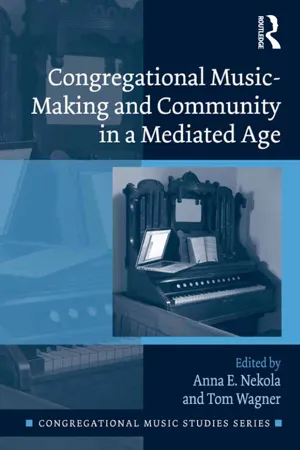
Congregational music can be an act of praise, a vehicle for theology, an action of embodied community, as well as a means to a divine encounter. This multidisciplinary anthology approaches congregational music as media in the widest sense - as a multivalent communication action with technological, commercial, political, ideological and theological implications, where processes of mediated communication produce shared worlds and beliefs. Bringing together a range of voices, promoting dialogue across a range of disciplines, each author approaches the topic of congregational music from his or her own perspective, facilitating cross-disciplinary connections while also showcasing a diversity of outlooks on the roles that music and media play in Christian experience. The authors break important new ground in understanding the ways that music, media and religious belief and praxis become 'lived theology' in our media age, revealing the rich and diverse ways that people are living, experiencing and negotiating faith and community through music.
Chapter 1 Music as a Mediated Object, Music as a Medium: Towards a Media Ecological View of Congregational Music
Tom Wagner
Introduction
The purpose of this chapter is to view congregational music from the perspective of media ecology – that is, as something that is both a media object and a form of media.1 Consider the following vignette, drawn from my PhD fieldwork at the London branch of the Australian transnational network church Hillsong Church (Wagner 2014a):
As I exit the Tottenham Court Road tube station on a brisk Sunday afternoon in early 2012, a giant golden statue of Freddy Mercury greets me from atop the entrance to the Dominion Theatre in London’s West End. The statue has invited theatregoers to experience Ben Elton’s We Will Rock You musical six nights a week for over a decade.2 On Sundays, though, Mercury bears witness to a different dominion – the dominion of God – as Hillsong London, which has called the theatre home since 2005, transforms the theatre into a church. I pass under the Hillsong London signs hung overhead and through the glass doors held open by fresh-faced greeters in jackets emblazoned with the Hillsong logo. Inside, I am confronted by a flat screen television playing a video loop advertising Hillsong’s upcoming European conference. Images of the worship band flash across the screen. The lobby’s soundscape is a hubbub of friends greeting each other, Hillsong tourists snapping selfies and Hillsong worship music piped in over the theatre’s public address system.
After making small talk with some acquaintances, I climb the steps to the foyer, grab a cup of coffee and proceed into the theatre to find a seat. Below me, dry ice drifts across a proscenium stage bathed in deep blue and purple lights. Strains of ambient music can be heard in the background. The screen behind the stage reads ‘Welcome Home’. At 3:30 on the dot, the theatre lights drop. Images of London, church members and scripture flash across the screen. The worship band takes the stage, its sound seamlessly cross-faded into the front of house mix by sound engineers at the rear of the auditorium. During the next hour and a half, music is almost constantly present, shaping and informing the experience of corporate worship.
The service, which is simulcasted to Hillsong London’s Surrey campus, concludes at almost precisely 5pm with an upbeat number from Hillsong’s latest CD. Back at the foyer’s resource centre, I peruse a range of Hillsong CDs, DVDs and books on offer. These are also available on the Internet through Amazon, iTunes or the church’s publishing company, Hillsong Music Australia. Furthermore, on the Internet I can watch Hillsong music videos on YouTube, or connect to other Hillsong churches through Facebook, Twitter, Instagram or the church’s website.
The worship service described above is easily recognizable to anyone familiar with highly mediatized, networked evangelical Christianity (for example, Campbell 2013, 2015; Coleman 2000). It is an expression of faith in what media theorist Henry Jenkins calls ‘convergence culture’, where ‘every important story gets told, every brand gets sold, and every consumer gets courted across multiple media platforms’ (2006, 3). For Jenkins, convergence culture is an always-evolving set of logics and practices that shape how media operates within media environments. They are best understood as the relationship among three concepts: convergence, participatory culture and collective intelligence (Jenkins 2006, 2).
The concept of convergence has been around since 1983, when Ithiel de Sola Pool’s Technologies of Freedom proposed that one day a single, integrated common carrier would meet all media needs. In the mid-1980s, new media technologies supporting multiple forms of the same content emerged. Around the same time, cross-media ownership became the norm. These two factors created the conditions and the imperatives for convergence (Jenkins 2006, 11). Convergence has since been noted in a variety of social, cultural, technological and industrial spheres. For example, Habermas (1992) and Sennett (2003) noted the convergence of the public and private (although they saw it more as transformation of the former into the latter), a theme that has recently been taken up with respect to the Internet (for example, Graham and Khosravi 2002; Rettberg 2008). Others have noted the convergence of producer and consumer (Ritzer and Jurgenson 2010; Toffler 1980; Xie et al. 2008), and of the organizational and communicative techniques of religious and business organizations (Einstein 2008; Twitchell 2004, 2007). Convergence culture is located at the nexus of these changes.
Participatory culture is one in which the lines between producer and consumer are blurred, where information is no longer distributed but rather circulated in networks that (re)shape, (re)make and (re)mix it to serve the personal and collective interests of its participants (Jenkins, Ford and Green 2013, 2). Participatory culture is therefore one in which ‘consumers are encouraged to seek out new information and make connections’ (Jenkins 2006, 3). However, participation depends on resources, knowledge and access that are still mostly controlled by corporations, as opposed to individuals or groups of consumers; thus participation is asymmetric (Jenkins 2006, 3). This does not mean, however, that corporations dominate convergence culture.3 Indeed, the personal agency that constitutes networks is increasingly valuable to industry and therefore the way that collective meaning-making occurs within networks is beginning to change how institutions operate. Collective intelligence, then, refers to the way in which consumption can be understood as a collective communicative process that is an ‘alternative source of media power’ (Jenkins 2006, 4).
Media ecology is the study of how dominant forms of communication in a media environment affect the ways people relate to the world. A media ecology view of congregational music, especially at transnational megachurches such as Hillsong, considers how music functions relative to the dominant communicative norms and cultural logics of the networked environments of convergence culture.4 In this chapter, I begin with the assumption that the ‘dominant’ mode of cultural communication for churches that operate in convergence culture is marketing. However, my task is neither to lament it as somehow ‘killing’ religion nor celebrate it as an evangelical ‘magic bullet’; both of these perspectives are well documented. Rather, I suggest that marketing should be understood as communication bound up with the socio-cultural practices and logics of highly mediatized (and materialized) convergence culture. Furthermore, marketing should be understood as a social practice that is simultaneously sensorial, symbolic and generative. This foregrounds both how and why people engage with media as they work to realize spiritual ambitions in their everyday lives.
This chapter is presented in three parts. Part 1 introduces the core ideas that make media ecology a useful theoretical perspective from which to approach congregational music. To understand how congregational music functions as both a media object and as a medium music, media and religious experience must be viewed as embedded in a matrix of socio-cultural life that is at once sensorial, symbolic and generative. Part 2 presents Hillsong Church’s annual
(cross equals love) Easter media campaign. Consistent with the practices and logics of convergence culture, the campaign utilizes cross-platform communication to spread the church’s Easter message. Part 3 situates the
campaign’s use of music in a larger socio-cultural matrix where music is part of a marketing gestalt. I suggest that the spiritual efficacy of the campaign depends on material concerns such as the production, distribution and marketing of the musical product. Following Birgit Meyer’s notion of ‘sensational forms’ (for example, Meyer 2008, 2011), I propose that a media ecology view of congregational music sees marketing as inseparable from – and essential to – the immediacy of the religious experience in convergence culture.
Part 1 – Congregational Music: A Mediated Object and Medium
Since congregational music is both a (religiously)-mediated object and (religious)-medium, it should be approached from a theoretical perspective that views religion and media as embedded in a matrix of cultural life. Peter Horsfield and Paul Teusner suggest that:
Every expression of Christianity, every experience of spirituality, every Christian idea, is a mediated phenomenon. It is mediated in its generation, in its construction and in its dissemination. In the process of its mediation, it is incarnated with particular grammar, logic, validations, sensibilities, frames, industrial requirements, cultural associations and structures, power relationships, opportunities and limitations that give it nuances that contest with other mediations of the same faith (though deciding which different mediations are the ‘same’ faith or a different faith is in itself a political exercise). (Horsfield and Teusner 2007, 279)
Horsfield and Teusner are essentially advocating a media ecology view. Media ecology views media as environments and environments as media (Lum 2006, 31). It arises from early twentieth century ecological concerns about the interrelationship between natural and built environments, our senses and human culture (for example, Geddes 1915; Mumford 1938, 1961) as well as linguistic and cultural investigations into the way symbolic systems shape how we interact with the world (for example, Langer (1942) and Whorf (1956)) (Lum 2006, 28). It takes into account functional, interpretative, cultural and critical theories. It looks at language, message and meaning, as well as technology and contexts, and examines the interaction of political, economic, religious and cultural norms. In short, media ecology attempts to construct a holistic understanding of the role media play in how we become human.
Casey Man Kong Lum’s (2006) discussion of media ecology’s view of the relationship between the sensorial and symbolic is a useful starting point. From the media ecology perspective, the sensorial and symbolic do not exist separately; furthermore, no medium stands alone, but is always part of a multi-media environment (30–31). In other words, although we may examine the sensorial-symbolic implications of a given medium (such as music) in abstraction, in reality its role is always contingent upon interactions with other media in a dynamic system.
Viewing media as sensorial environments has physiological-perceptual implications (Lum 2006, 28–9). We experience ourselves relative to the constant flow of information from our external world and our internal states. According to McLuhan (2001), every medium engages the user’s senses differently, and thus embodies a unique set of sensory characteristics. For example, reading primarily engages our visual senses, while listening to the radio primarily engages our auditory capabilities. McLuhan’s student, Walter Ong (2012), suggested that a society’s dominant communication medium determines which of its people’s senses are most acute, and this has far-reaching cultural implications because it influences the way people comprehend the world around them. Thus, media as sensorial environments are profound influences on the ways we experience the world and ourselves.
Media can also be thought of as symbolic environments (Lum 2006, 29–30). From this perspective, every medium is ‘systemically constituted by a unique set of codes and syntax’ (Lum 2006, 29). For example, the use of English as a communication medium requires an understanding of (and facility with) its vocabulary (that is, its symbols and their assigned meanings) as well as its grammar (that is, its syntax and rules that govern the construction of meaning) (Lum 2006, 29). Similarly, the way congregational music is ‘understood’ requires familiarity with the cultural codes that give it meaning in a given context. As Moberg (this volume) points out, this is complicated because the way music is culturally coded is always already intertextual. Furthermore, the relative mastery of these codes, especially in the actual making of music, has implications for who can participate and how (see Goddard, this volume).
What emerges from this discussion is that the sensorial and the symbolic are mutually generative processes. Media scholars traditionally talk about media in terms of delivery devices. From this view, technologies mediate but are not themselves media. However, this ignores how the symbolic structures of socio-cultural environments influence the role of technologies in the production of the cultural. Seeing environments as media clarifies this. For example, a church is a multi-media environment that employs its own vocabulary and rules that shape how its participants conduct themselves and relate to one another internally and externally. Participants’ actions both affect and are affected by, and are thus generative of, the socio-cultural field of communication that is the environment; therefore, the environment itself can be thought of as medium (Lum 2006, 31–2).
A media ecology approach to congregational music can thus be described as (following Musa and Ahamdu 2012) ‘techno-cultural’ in that religion, music, technology and culture are treated as mutually transformative parts of a media environment. As noted, a central tenet of media ecology is that our thinking and behaviour changes in relation to the dominant communication technologies of the media environment. Here, the term ‘technology’ should be understood in the broadest sense, as ‘the total knowledge and skills available to any human society’.5 This includes technologies of storage, retrieval and (re)production of information. Musical examples of this might include the human body, printed scores, microphones or mp3s (Frith 1996, 226–45). ‘Technology’ should also include Foucauldian ‘technologies of self’ that configure and govern the human subject in socio-cultural ‘matrices of reason’ (Foucault 1988). Technologies evolve, but the introduction of new technologies (in whatever form) does not necessarily mean previous ones will be discarded or forgotten. Rather, new technologies reorient the way their predecessors and other technologies are used and valued in relation to one another, culture and society. Furthermore, they reorient the ideologies, values and structures of the culture itself. When thinking about congregational music from a media ecology perspective, then, we should view it as both a mediated object and a medium, attending to the socio-cultural practices and logics of the media environment of which it is part. For churches such as Hillsong Church, this environment is convergence culture.
Australia’s Hillsong Church offers a rich picture of congregational music’s role in a convergent media environment. Hillsong’s media ecosystem is a complex network of branded communication platforms that afford participants different, mutually informing ways of knowing (Wagner 2014a). This network of platfor...
Table of contents
Cover Page
Title Page
Copyright Page
Contents
List of Figures and Tables
Notes on Contributors
Acknowledgements
Introduction: Worship Media as Media Form and Mediated Practice: Theorizing the Intersections of Media, Music and Lived Religion
PART I TECHNOLOGY, PLACE AND PRACTICE
PART II COMMUNITY CREATION
PART III EMBODIED SONIC THEOLOGIES
Afterword: Of Animatrons and Eschatology: Congregational Music, Mediation and World-Making
Index
Trusted by 375,005 students
Access to over 1.5 million titles for a fair monthly price.
Study more efficiently using our study tools.
Frequently asked questions
Yes, you can cancel anytime from the Subscription tab in your account settings on the Perlego website. Your subscription will stay active until the end of your current billing period. Learn how to cancel your subscription
No, books cannot be downloaded as external files, such as PDFs, for use outside of Perlego. However, you can download books within the Perlego app for offline reading on mobile or tablet. Learn how to download books offline
Perlego offers two plans: Essential and Complete
Essential is ideal for learners and professionals who enjoy exploring a wide range of subjects. Access the Essential Library with 800,000+ trusted titles and best-sellers across business, personal growth, and the humanities. Includes unlimited reading time and Standard Read Aloud voice.
Complete: Perfect for advanced learners and researchers needing full, unrestricted access. Unlock 1.5M+ books across hundreds of subjects, including academic and specialized titles. The Complete Plan also includes advanced features like Premium Read Aloud and Research Assistant.
Both plans are available with monthly, semester, or annual billing cycles.
We are an online textbook subscription service, where you can get access to an entire online library for less than the price of a single book per month. With over 1.5 million books across 990+ topics, we’ve got you covered! Learn about our mission
Look out for the read-aloud symbol on your next book to see if you can listen to it. The read-aloud tool reads text aloud for you, highlighting the text as it is being read. You can pause it, speed it up and slow it down. Learn more about Read Aloud
Yes! You can use the Perlego app on both iOS and Android devices to read anytime, anywhere — even offline. Perfect for commutes or when you’re on the go. Please note we cannot support devices running on iOS 13 and Android 7 or earlier. Learn more about using the app
Yes, you can access Congregational Music-Making and Community in a Mediated Age by Anna E. Nekola, Tom Wagner, Anna E. Nekola,Tom Wagner in PDF and/or ePUB format, as well as other popular books in Theology & Religion & Music. We have over 1.5 million books available in our catalogue for you to explore.