- 294 pages
- English
- ePUB (mobile friendly)
- Available on iOS & Android
eBook - ePub
Conduct Books for Girls in Enlightenment France
About this book
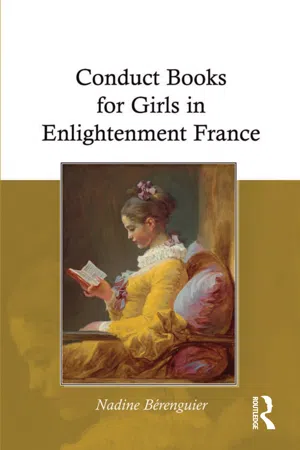
During the eighteenth-century, at a time when secular and religious authors in France were questioning women's efforts to read, a new literary genre emerged: conduct books written specifically for girls and unmarried young women. In this carefully researched and thoughtfully argued book, Professor Nadine Bérenguier shares an in-depth analysis of this development, relating the objectives and ideals of these books to the contemporaneous Enlightenment concerns about improving education in order to reform society. Works by Anne-Thérèse de Lambert, Madeleine de Puisieux, Jeanne Marie Leprince de Beaumont, Louise d'Epinay, Barthélémy Graillard de Graville, Chevalier de Cerfvol, abbé Joseph Reyre, Pierre-Louis Roederer, and Marie-Antoinette Lenoir take up a wide variety of topics and vary dramatically in tone. But they all share similar objectives: acquainting their young female readers with the moral and social rules of the world and ensuring their success at the next stage of their lives. While the authors regarded their texts as furthering the common good, they were also aware that they were likely to be controversial among those responsible for girls' education. Bérenguier's sensitive readings highlight these tensions, as she offers readers a rare view of how conduct books were conceived, consumed, re-edited, memorialized, and sometimes forgotten. In the broadest sense, her study contributes to our understanding of how print culture in eighteenth-century France gave shape to a specific social subset of new readers: modern girls.
Trusted by 375,005 students
Access to over 1.5 million titles for a fair monthly price.
Study more efficiently using our study tools.
Information
Topic
Scienze socialiSubtopic
Critica letterariaPart 1Textual Strategies
Chapter 1 Between Oral and Print Cultures
DOI: 10.4324/9781315573342-2
During the eighteenth century, the age-old debate about the impact of reading on girls that Molière had so aptly brought to life in his comedy L’Ecole des femmes (School of Wives) (1662) was alive and well and showed few signs of abating. The encouragement of female reading revealed an enlightened position vis-à-vis women and their education, as Clarissa Campbell Orr and Jennifer Popiel have shown. 1 Yet such a position was far from unanimous and marked by ambivalence. In the 1750s, even in a circle as progressive as that of the contributors to Diderot’s Encyclopédie, concerns about the potentially damaging impact of female reading lingered. In one of the articles, titled “Femme,” the physician Paul-Joseph Barthez referred to a comment made by the seventeenth-century Dutch woman of letters Anna Maria van Schurman. She had argued that “l’étude des lettres éclaire, et donne une sagesse qu’on n’achète point par les secours dangereux de l’expérience.” 2 [The study of letters enlightens and gives a type of wisdom that cannot be acquired through the dangerous assistance of experience.] A century after Schurman’s plea, Barthez expressed reservations about such a view in his reply: “Mais on pourrait douter si cette prudence précoce ne coûte point un peu d’innocence.” [But one could wonder whether this precocious prudence does not cost a bit of innocence.] The terms of the Schurman—Barthez “debate” intimately associated girls’ reading with potential threats to their morality and appropriate female behavior. The eighteenth century ended without seeing much change. In a little-known essay that he wrote on female reading, Choderlos de Laclos betrayed a similar deep-seated ambivalence. After promoting reading as a beneficial supplement to the deficient education that girls usually received, he admitted in the middle of his essay, “peut-être n’en est-il aucun [ouvrage] qu’une jeune personne puisse lire sans quelque danger, à moins qu’elle ne soit guidée dans sa manière de voir.” 3 [Maybe there is no book that a young person can read without some danger, unless she is guided in the way she approaches it.] As contributors to the volume Lectrices d’Ancien Régime have shown, the activity of reading still continued to be a source of uneasy considerations on the part of “enlightened” women in the second half of the eighteenth century. Marie-Laure Girou-Swiderski examines Anne Louise Elie de Beaumont’s Lettres du Marquis de Roselle (1764) and Isabelle de Charrière’s Sainte-Anne (1799) to illustrate the terms of this enduring debate. Marianne Charrier-Vozel and Marie-Emmanuelle Plagnol-Diéval provide evidence in their research that even when Leprince valorized female reading, she made very strict control over reading to be the sine qua non of its benefit. 4 In spite of the awareness of girls’ educational needs and of the enhanced role of books in meeting them, a tension lingered between the conviction of the worthiness of the written word and the mistrust it caused. The act of reading outside the realm of strictly religious literature posed a serious threat to such a young female audience, for whom ignorance was synonymous with innocence, the most valued of their attributes. Not only did many books transmit knowledge that was potentially detrimental to girls’ innocence, but they also introduced a new relationship to knowledge. They participated in the transition that Paule Constant evokes in Un Monde à l’usage des demoiselles from “une civilisation orale, avec tout ce que cela comporte de traditions et de savoir-faire dont les femmes tiennent le dernier bastion, à une civilisation de l’écrit proprement masculine” 5 [from a culture based on orality, with traditions and skills still in women’s hands, to a culture based on print, more specifically male]. The written word became a mediator that could not always be fully controlled. It breached the immediacy of direct communication and altered girls’ relationship to knowledge, be it moral, social, or intellectual. The worries about reading stemmed as much from the content of a particular “message” as from the acculturation that this activity represented for them.
In this chapter, after shedding light on some of the reasons for this perceived incompatibility between girls and reading, I will show how conduct books, by appearing as the written “renditions” of relationships between adults and girls, bore distinct marks of the oral culture that traditionally characterized female upbringing. Because of their different levels of experience with the education of girls, female and male authors used diverging approaches: while the women provided accounts of “actual” relationships between mothers and daughters, governesses and pupils, and female friends of different ages, their male counterparts resorted to fictions as a way to claim an experience that they had not acquired firsthand. 6 Borrowing female identities and portraying themselves as surrogate fathers were the tactics they used to “naturalize” their relationship with younger members of the opposite sex. The women and men who participated in the effort to give girls’ education an increasing presence in print culture did so while holding onto elements of the oral culture with which it had to coexist.
This powerful paradigm affected the formal choices that authors made for their texts. To replicate the familiar setting perceived as most appropriate for girls’ education, conduct-book authors favored narrative forms that privileged direct (written and oral) forms of communication between individuals: the epistolary and dialogic forms. These forms simulated the “immediacy” of relationships between mothers and girls in need of guidance and minimized the “disruption” that the mediation of writing could cause to such a bond. In some conduct books, the effort to minimize the impact of mediation went hand in hand with an attempt to legitimize the existence of the written text by way of a metaphor that connoted both the intensity of the parent-child bond and its foreseeable ending: the testament. The sanctity of the testament, as a legal document, enabled those who used this metaphor to transform the written text into an asset. By embedding in the narrative the perspective of separation, they added value to books that would prolong the mentors’ authority over their charges, as it would over the audience following in their wake.
A Problematic Readership
While women and girls were not discouraged from reading, any encouragement was usually accompanied by well-deliberated restrictions. The expansion and diversification of the book market, which made more books available to more readers, did not alleviate fears regarding female reading habits, quite the contrary. Because of the ubiquity of books, danger was lurking everywhere. The development of “a solitary and private relation between the reader and his book,” that historians such as Roger Chartier have identified, added to this perception. 7 The moral discourse that denounced the dangers of reading gained momentum in the eighteenth century when, according to Alexandre Wenger, it enrolled the help of new physiological theories. 8 In La Fibre littéraire. Le discours médical sur la lecture au dix-huitième siècle, Wenger argues that, starting in the 1740s, references to the concept of “fiber” began to proliferate, spreading even more after the publication of Albrecht von Haller’s Dissertation on the sensible and irritable parts of animals in 1753. 9 According to Wenger, Haller’s physiological theory, which distinguished “irritable” from “sensitive” fibers, had repercussions in philosophy and ethics. Sensibility began playing a determinant role in “l’appréhension des rapports entre l’homme et son contexte culturel et social” [the apprehension of relations between man and his cultural and social context] (p. 40). Physiologists argued over the definition and characteristics of fibers but agreed on two issues: the flexibility and plasticity of their fibers made adolescents—of both genders—particularly receptive to impressions (p. 76); women had weaker and more delicate fibers than men, similar to those of children, and were ontologically different from men (pp. 146–8). Much less able to use their reason than men, they fell prey to what all physiologists called their “imagination,” which was considered uncontrollable. If male adolescents could hope to reach a different state in their fibrillose constitution and acquire “reason” in adulthood, such was not the case of their female counterparts, who were “doubly” affected as women and as adolescents. The extreme fragility of their constitution turned them into the most problematic of readers because they were prone to strong reactions.

This physiological perspective on the constitution of female adolescents was not lost on those who wrote for them. Conduct-books authors were aware of the highly problematic status of their target audience. In the “Avertissement” to Le Magasin des adolescentes, Leprince openly commented on the specific difficulties of adolescence in a woman’s life:
De toutes les années de la vie, les plus dangereuses, à ce que je crois, commencent à quatorze ou quinze ans. C’est à cet âge qu’une jeune personne entre dans le monde, où elle prend pour ainsi dire une nouvelle manière d’exister. Toutes les passions, contraintes dans l’enfance, cherchent alors à se développer, à s’autoriser par l’exemple des nouveaux personnages avec lesquels elle commence à figurer. [The most dangerous of all stages in life in my opinion comes on about fourteen or fifteen. About that age a young lady is entered into the world, and takes a kind of new being. All the passions kept under restraint in the state of infancy begin to appear, and to plead in their favour the example of the new acquaintance with whom they have begun to rank.] 1010 This “Avertissement” has been reprinted in the volume Leprince, Contes et autres écrits, p. 120. All references to the French preface come from this modern edition (pp. 120–127). All English translations are provided by Jeanne Marie Leprince de Beaumont, The Young Ladies Magazine, or Dialogues between a Discreet Governess and Several Young Ladies of the First Rank under her Education, 4 vols (London: J. Nourse, 1760). This quote is in vol. 1, p. ix. Subsequent references are in the text.
Through her evocation of the risk brought by a girl’s “kind of new being,” Leprince suggested the serious impact of internal changes (unbridled “passions”) as well as the vital influence of external factors, such as new social contacts (“new acquaintance”). Undoubtedly, Leprince promoted her book as an antidote to these various dangers. With less specificity than Leprince, Epinay also conveyed her awareness of the problems faced by adolescents. In the preface to the 1774 edition of Les Conversations d’Emilie, she announced possible sequels to her current manual and declared that targeting older gi...
Table of contents
- Cover Page
- Half Title Page
- Dedication
- Title Page
- Copyright Page
- Table of Contents
- List of Illustrations
- Acknowledgments
- Introduction
- Part 1 Textual Strategies
- Part 2 Topoi
- Part 3 Reception
- Bibliography
- Index
Frequently asked questions
Yes, you can cancel anytime from the Subscription tab in your account settings on the Perlego website. Your subscription will stay active until the end of your current billing period. Learn how to cancel your subscription
No, books cannot be downloaded as external files, such as PDFs, for use outside of Perlego. However, you can download books within the Perlego app for offline reading on mobile or tablet. Learn how to download books offline
Perlego offers two plans: Essential and Complete
- Essential is ideal for learners and professionals who enjoy exploring a wide range of subjects. Access the Essential Library with 800,000+ trusted titles and best-sellers across business, personal growth, and the humanities. Includes unlimited reading time and Standard Read Aloud voice.
- Complete: Perfect for advanced learners and researchers needing full, unrestricted access. Unlock 1.5M+ books across hundreds of subjects, including academic and specialized titles. The Complete Plan also includes advanced features like Premium Read Aloud and Research Assistant.
We are an online textbook subscription service, where you can get access to an entire online library for less than the price of a single book per month. With over 1.5 million books across 990+ topics, we’ve got you covered! Learn about our mission
Look out for the read-aloud symbol on your next book to see if you can listen to it. The read-aloud tool reads text aloud for you, highlighting the text as it is being read. You can pause it, speed it up and slow it down. Learn more about Read Aloud
Yes! You can use the Perlego app on both iOS and Android devices to read anytime, anywhere — even offline. Perfect for commutes or when you’re on the go.
Please note we cannot support devices running on iOS 13 and Android 7 or earlier. Learn more about using the app
Please note we cannot support devices running on iOS 13 and Android 7 or earlier. Learn more about using the app
Yes, you can access Conduct Books for Girls in Enlightenment France by Nadine Berenguier in PDF and/or ePUB format, as well as other popular books in Scienze sociali & Critica letteraria. We have over 1.5 million books available in our catalogue for you to explore.