- 424 pages
- English
- ePUB (mobile friendly)
- Available on iOS & Android
eBook - ePub
Parish Churches in the Early Modern World
About this book
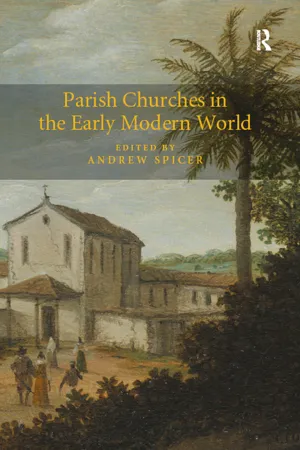
Across Europe, the parish church has stood for centuries at the centre of local communities; it was the focal point of its religious life, the rituals performed there marked the stages of life from the cradle to the grave. Nonetheless the church itself artistically and architecturally stood apart from the parish community. It was often the largest and only stone-built building in a village; it was legally distinct being subject to canon law, as well as consecrated for the celebration of religious rites. The buildings associated with the "cure of souls" were sacred sites or holy places, where humanity interacted with the divine. In spite of the importance of the parish church, these buildings have generally not received the same attention from historians as non-parochial places of worship. This collection of essays redresses this balance and reflects on the parish church across a number of confessions - Catholic, Lutheran, Reformed and Anti-Trinitarian - during the early modern period. Rather than providing a series of case studies of individual buildings, each essay looks at the evolution of parish churches in response to religious reform as well as confessional change and upheaval. They examine aspects of their design and construction; furnishings and material culture; liturgy and the use of the parish church. While these essays range widely across Europe, the volume also considers how religious provision and the parish church were translated into a global context with colonial and commercial expansion in the Americas and Asia. This interdisciplinary volume seeks to identify what was distinctive about the parish church for the congregations that gathered in them for worship and for communities across the early modern world.
Information
1
The Early Modern Parish Church: An Introduction*
The parish is the fitting and usual place to receive the sacraments of the Church. It follows that it is so much better on Sundays or particular feast days to hear the mass or the sermon or receive Our Lord in the parish than elsewhere, even in privileged places; because it is His mother, which the parishioner His son must honour. There are His commandments given; there is His spiritual father; there is the door through which he passes to God.1
This description was part of a sermon preached on 23 February 1410 by the renowned French theologian and reformer Jean Gerson (1363–1429). The sermon emphasized the importance of the parish church, as the place where the faithful received the sacraments and as the gateway to salvation. The parish priest was to teach and preach, providing spiritual nourishment for the community, as well as to administer the sacraments, hear confessions and to inter the departed. In return, the parishioners were to pay their tithes to the Church. Parishioners were required to attend their own parish church, with ecclesiastical decrees forbidding the reception of ‘strangers from another parish’.2 What Gerson was outlining was the understanding of the mutual obligations of parish priest and his parishioners that had evolved in canon law since the early thirteenth century. Members of the community were expected to attend their parish church for mass every Sunday and at the major festivals, as well as to bring their children there for baptism and the deceased for burial. The Fourth Lateran Council in 1215 had required parishioners to make their confession and receive communion every Easter at their local church. They were obliged to pay the tithe for the maintenance of the priest and the church building. Each year, the geographical extent of the parish was confirmed by a religious procession around its boundaries.3 Although the parish church lay at the heart of this community, often the most substantial building in a village, it was also separated from society by a wall or ditch enclosing the graveyard in which it stood. For this was a consecrated place, that was set apart from the secular world for the celebration of the mass and the sacraments.
In reality, this represented a somewhat idealized understanding of a late medieval parish church. Although Gerson’s sermon emphasized the ritual significance of the local church, his purpose was to defend the special role and status of the parish clergy in the ecclesiastical hierarchy; in particular he sought to emphasize their importance in the face of competition from the mendicant orders. The sermon was a response to the Papal bull Regnans in excelsis promulgated by Alexander V in 1409, which confirmed the rights of the mendicant orders regarding preaching, hearing confessions and administering the sacraments. The role of the parochial clergy was also being challenged from within the University of Paris, where Gerson was chancellor, by a Franciscan, Jean Gorel. He argued that the pastoral duties of preaching, hearing confession, administering the sacraments as well as receiving tithes were not the sole preserve of the parish clergy.4
As this controversy illustrates, the parish church was not the only place in a community where these rites could be performed, in spite of the efforts of canon lawyers and churchmen, such as Gerson, to define them in these terms. There were other locations where parishioners could hear the mass, such as chapels of ease, hospitals, confraternity chapels and mendicant houses. Some people even felt a greater affinity for these places of worship and local shrines than they did for their church.5 This was not merely a question of personal convenience or sentiment, as has been seen there were institutional challenges to the role of the parish church.6 Furthermore there were also significant regional differences in the status of local churches due to the pace at which the parochial system had been established across Europe.
In parts of northern Europe such as France and Germany, the formation of parishes can be traced back to the Carolingian reforms of the ninth century. Although the actual process has been described as ‘obscure’ and ‘hazy’, by c. 1100 their parochial structure had largely been established. The development was slower in England, which was not subject to the Carolingian legislation, but a network of parish churches had been largely established by the mid-twelfth century.7 While recognizable parishes did evolve in parts of central and southern Italy, an older form of ecclesiastical organization persisted in some northern areas. Here the term parochia referred to a larger baptismal community; the principal church (pieve) with its font was at the centre of a network of lesser churches (tituli or capellae), which were served by a college of priests who went out to minister in these subordinate places of worship. In some cities, this principal church was the cathedral with its own baptistery but by the fifteenth century the relationship with more distant communities had begun to breakdown. Affiliations to neighbouring churches, distance as well as administrative decisions to subdivide districts undermined these arrangements and gradually led to the erosion of the existing system and the emergence of de facto parish churches.8 In spite of the efforts of earlier bishops, it was only in the wake of the Council of Trent that there was a concerted effort to reform the existing system of churches but ‘parish formation’ remained a complex and slow process.9
In spite of these significant regional variations, the sheer number of parish churches meant that they were a significant and highly visible feature of the European landscape. There were around 32,000 parish churches in France; some 20,000 churches in the Spanish kingdoms; 9,500 in England and a mere 1,100 in Scotland.10 While these churches were numerous, as these figures illustrate, the density of parochial provision did vary and this had an impact on the extent to which they were able to serve the religious needs of their community. This was particularly evident in the case of urban parish churches, where there could be wide disparities between towns. Before 1477, Antwerp with a population of 40,000 formed a single parish, while Ghent, which was roughly the same size at that time, had seven parish churches. On the eve of the Reformation, Nuremberg had two parish churches serving 20,000 people; Cologne had twelve churches. Genoa had 76 in 1535, whereas London had more than a hundred.11 The limited parochial provision in some of the more populous cities had contributed to pastoral responsibility being devolved to other religious institutions within the urban community.
It was this medieval parochial landscape that was reshaped by the confessional upheavals and reforms of the sixteenth and seventeenth centuries. This introduction will provide an overview of the impact of these religious changes on the parish church and how their significance for the ‘cure of souls’ evolved during the early modern period. These religious changes led to the assertion of the parish church as the principal place for worship and the celebration of the sacraments within the community. This was true not only of Catholicism but, arguably, also in the Protestant states where the new confessions took possession of existing buildings and adapted them to their own liturgical requirements. These churches became vehicles for religious reform and educating the faithful in the principal tenets of belief. Although attitudes towards the parish and its church did vary amongst the confessions, these buildings remained at the heart of the local community. Nonetheless, this was a period in which the relationship between the church and confessional identity were tested and remoulded, sometimes leading to the creation of alternative sites of worship within the parish. The overseas expansion of the European powers posed new challenges, which again raised questions about the definition of the parish, the role of the mendicants and the provision of the sacraments. These churches developed a dual role in providing for the spiritual needs of the colonists as well as spreading the Christian message to other faiths.
I.
The Tridentine decrees made the parish and its priest the focus of its reform programme; they sought to raise the status of the clergy as well as to limit religious observance to the parish church. As part of this process, bishops were granted authority to revise the parish system so that it better served the religious needs of local communities. They were instructed to unite parishes with meagre financial resources but also to erect new churches in places ‘where parishioners can only come to receive the sacraments and attend divine offices with great inconvenience because of distance or inaccessibility’.12 This was an attempt to reform the complex arrangement of the collegiate foundations at the head of a network of churches that had persisted in parts of northern Italy. The intention was to establish parishes that were relatively equal in terms of income and parishioners, served by a priest exercising the cure of souls, which could be directly accountable to the bishop.13 In cities, where there were parishes without clear boundaries, the bishops were instructed to establish them and divide the inhabitants, so that the sacraments were not administered ‘to all who come to ask at random’ but in their local church:
… for the good spiritual state of the souls entrusted to them, to divide the people into separate and clear parishes and to assign to each for their own proper and permanent parish priest, who will be able to know them and from whom alone they may licitly receive the sacraments.14
Although there were no further details provided as to how this was to be implemented, there was an expectation that the priest would ‘know’ those coming before him, so that the parish was intended to intersect with issues of urban identity and reputation.
The decisions taken by the Council of Trent also emphasized the place of the parish church for the administration of the sacraments and teaching Catholic dogma. In upholding the sanctity and importance of the mass, the Council sought to ensure that it was celebrated with ‘full religious diligence and reverence’. This included ensuring that the mass was not said ‘in private houses, and wholly outside a church or oratories dedicated exclusively to divine worship’. The bishops were also ordered to instruct ‘their people to attend their parish churches frequently, at least on Sundays and greater feasts’.15 Priests and those charged with ‘the care of souls’ were also responsible for instructing parishioners through preaching so as ‘to feed with the words of salvation the people committed to their charge’.16 These and other reforms regularizing popular devotion and religious practice made the parish and its church an essential part of the reform and revitalization of Catholicism.17
The religious reforms had significant implications for the arrangement and furnishing of places of worship. In his own archdiocese of Milan, Carlo Borromeo sought to clear away the accretions of past generations to establish an appropriate setting for celebration of the mass, even though he antagonized the local elites in the process.18 As an aid to those undertaking visitations in the archdiocese, Borromeo published his Instructiones fabricae et supellectilis ecclesiasticae in 1577. This was largely a compendium of earlier ecclesiastical ordinances for Milan but it provided a comprehensive and prescriptive guide to the arrangement and liturgical furnishings (including details about size and materials) for a place of worship.19 The reforms ensured that the celebration of the mass at the east end was visible to the entire congregation, the altar being elevated and the sanctuary separated by a low balustrade rather than a rood screen. The Instructiones also included arrangements for preaching and, in an attempt to ensure decorum and to minimize distractions, the seating for men and women was divided by a screen.20 One church furnishing, which is particularly associated with the Milanese reforms and similarly arose out of concerns for propriety, was the confessional box.21 John Bossy argued that the spread of the Tridentine ideas across France could be traced through the erection of confessionals in parish churches, although as Trevor Johnson has shown, their introduction to the re-Catholicized Upper Palatinate was slow and even where they had been installed the custom of hearing confession in the sacristy persisted.22
The influence of Borromeo’s Instructiones in determining the way in which the parish church responded to the Tridentine reforms varied across Europe. In France, its influence seems to have been more limited than in other countries; they were only adopted by the Assembly of Clergy in 1657 as part of their attempt to combat the Jansenists. Borromeo had included the Instructiones with other episcopal measures in his Acta Ecclesiae Mediolanensis (1582). This was not printed outside Italy until the French edition was published in Paris in 1643, with later editions at Louvain (1664) and Lyon (1682). However, the text was widely circulat...
Table of contents
- Cover
- Half Title
- Title Page
- Copyright Page
- Dedication
- Table of Contents
- List of Figures
- Notes on Contributors
- Preface
- 1 The Early Modern Parish Church: An Introduction
- 2 Patrician and Episcopal Rivalry for the Milanese Parish Church: San Nazaro in Brolo during French and Spanish Rule
- 3 Exploring the Features and Challenges of the Urban Parish Church in the Southern Low Countries: The Case of Sixteenth-Century Ghent
- 4 The Counter Reformation and the Parish Church in Western Brittany (France) 1500–1700
- 5 The Body of the Faithful: Joseph Furttenbach’s 1649 Lutheran Church Plans
- 6 Staging the Eucharist, Adiaphora, and Shaping Lutheran Identities in the Transylvanian Parish Church
- 7 Parish Churches in Geneva and the Swiss Romande
- 8 ‘Which of them do belong to the parish or not’: The Changing Rural Parish in the Dutch Republic after the Reformation
- 9 Unitarian Parish Churches in Early Modern Transylvania
- 10 Heaven on Earth: Churches in Early Modern Hispanic America
- 11 Franciscans and the Parish in Early Modern Brazil
- 12 Parish Churches, Colonization and Conversion in Portuguese Goa
- 13 Dutch Churches in Asia
- 14 ‘To build up the walls of Jerusalem’: Anglican Churches in Seventeenth-Century Virginia
- 15 Parish Churches in the Early Modern World: An Afterword
- Index
Trusted by 375,005 students
Access to over 1.5 million titles for a fair monthly price.
Study more efficiently using our study tools.
Frequently asked questions
Yes, you can cancel anytime from the Subscription tab in your account settings on the Perlego website. Your subscription will stay active until the end of your current billing period. Learn how to cancel your subscription
No, books cannot be downloaded as external files, such as PDFs, for use outside of Perlego. However, you can download books within the Perlego app for offline reading on mobile or tablet. Learn how to download books offline
We are an online textbook subscription service, where you can get access to an entire online library for less than the price of a single book per month. With over 1.5 million books across 990+ topics, we’ve got you covered! Learn about our mission
Look out for the read-aloud symbol on your next book to see if you can listen to it. The read-aloud tool reads text aloud for you, highlighting the text as it is being read. You can pause it, speed it up and slow it down. Learn more about Read Aloud
Yes! You can use the Perlego app on both iOS and Android devices to read anytime, anywhere — even offline. Perfect for commutes or when you’re on the go.
Please note we cannot support devices running on iOS 13 and Android 7 or earlier. Learn more about using the app
Please note we cannot support devices running on iOS 13 and Android 7 or earlier. Learn more about using the app
Yes, you can access Parish Churches in the Early Modern World by Andrew Spicer in PDF and/or ePUB format, as well as other popular books in Theology & Religion & Early Modern History. We have over 1.5 million books available in our catalogue for you to explore.