- 166 pages
- English
- ePUB (mobile friendly)
- Available on iOS & Android
eBook - ePub
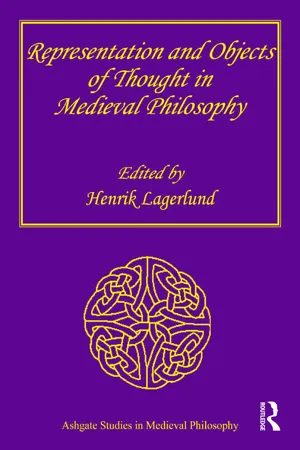
Representation and Objects of Thought in Medieval Philosophy
About this book
The notions of mental representation and intentionality are central to contemporary philosophy of mind and it is usually assumed that these notions, if not originated, at least were made essential to the philosophy of mind by Descartes in the seventeenth century. The authors in this book challenge this assumption and show that the history of these ideas can be traced back to the medieval period. In bringing out the contrasts and similarities between early modern and medieval discussions of mental representation the authors conclude that there is no clear dividing line between western late medieval and early modern philosophy; that they in fact represent one continuous tradition in the philosophy of mind.
Information
Chapter III
Abstract Truth in Thomas Aquinas*
Thomas Aquinas holds that the proper objects of intellect are the natures of material objects, conceived of universally through intellectual abstraction. This paper considers two questions regarding that doctrine: first, what are these abstracted, universal objects and second, given that the world is concrete and particular, how can such abstract, universal thoughts yield true beliefs about the world?
1 Prologue: The Objects of Intellect
A central methodological principle of Aristotelian psychology – perhaps the central principle – is that the capacities of the soul must be investigated in terms of what sort of object that capacity has. In the words of Aquinas, ‘the nature of any capacity lies in its relationship to its proper object’ (InDA, II.13.69–70). This is most obviously true for the five external senses. There are five external senses, no more and no less, because there are five kinds of sensible qualities that we need to investigate in the world around us.1 The principle holds equally of the human intellect, or at least it should. But here its application is more problematic, because it is unclear just what the object of intellect is.
Thomas Aquinas holds that the proper objects of the human intellect – that is, those things that the human intellect is naturally suited to understand – are the natures or quiddities of material things in the world around us. As we will see, this claim shapes a great deal of what he has to say about the nature of intellect. Later authors, however, would take very different views. On one account, sometimes attributed to Henry of Ghent, the proper object of the human intellect is God. What Ghent had actually claimed is that God is both the first and the ultimate object of intellect: ‘The beginning and the end of our cognition lies in God himself: the beginning, with respect to the most general cognition of him; the end, with respect to the nude and particular vision of him’ (Summa, 24.7c [144rH]). This claim is based on the more familiar idea that the first objects of cognition are the transcendental concepts of being, goodness, truth, etc. In virtue of having these concepts, we understand everything else. These concepts, according to Ghent, are fundamentally ideas of God, and so in that sense we begin with a very general conception of God, and work toward the clear and distinct idea of God obtained by the blessed in heaven.
Aquinas would have accepted Ghent’s claims about the primacy of transcendental concepts,2 and would also have accepted that God is the ultimate object of intellect. Yet he would have denied that this makes God the proper object of the human intellect. Now it is not obvious that Ghent himself wanted to endorse that further claim, but this is how he would later be read by John Duns Scotus. Scotus stresses that the question of the intellect’s proper object is the question of what object the intellect is naturally disposed to apprehend. That which is first, temporally, or even first and last, is not necessarily the proper object of intellect. Thus Scotus remarks, ‘the first natural object of a capacity has a natural relationship to that capacity’ (Ordinatio, I.3.1.3, n. 126). Plainly, if this is so in Ghent’s view, it is so only with respect to God’s most general attributes, the transcendental attributes that apply to all being. But Scotus then reasons: If God is the proper object of intellect only under his general attributes, then it is really those attributes, rather than God, that are the proper objects of intellect. This seems right. In general, when the intellect apprehends the universal attributes of some particular thing, we do not say that the particular thing is the object of intellect. Instead, we think of those attributes themselves as the object of intellect.3
Part of what makes it attractive to identify God as the proper object of the human intellect is that this ties our proper cognitive object into our ultimate (hoped for) cognitive destiny. If the end of human life is to achieve a face-to-face vision of God, then there would seem to be something plausible about thinking of God as what our intellect is naturally suited to apprehend. There is, in the same way, something unsatisfactory about Aquinas’s account, inasmuch as the blessed in heaven would seem to be abandoning their proper intellectual object – the quiddities of material objects – in favor of something else, God. If that is our ultimate destiny, and if life on earth is just a brief prologue to the eternity of our life to come, then it is hard to understand Aquinas’s insistence that the material world is what our intellect is naturally suited to apprehend. Scotus brings this point out quite effectively in arguing against Aquinas’s view.
We identify the first object of a capacity as that which is adequate to it by reason of the capacity, not that which is adequate to the capacity in a certain state – just as the first object of sight is not held to be that which is adequate to sight solely when it is in a medium illuminated by a candle, but that which is naturally suited to be adequate to sight in its own right, with regard to the nature of sight. (Ord., I.3.1.3 n. 186)
Trapped in a dark cave, we might see only shades of gray, but that does not make gray the object of sight, even if we spend our entire lives in a cave. So too, Scotus argues, for the human intellect. Even if in this life we have cognitive access only to the material world, that does not mean that material objects are the proper object of intellect.
Scotus therefore proposes an alternative account, that the proper object of the human intellect is being (ens). This is to say that there is no one aspect of the world that the intellect, in its own right, is especially suited to apprehend. Everything that exists is a potential object of intellect, and the intellect is equally suited to grasp all of those things, insofar as they are beings.4 This might look like a disappointingly bland conclusion, because Scotus is in effect simply denying the whole premise of the discussion, that our intellect has something to which it is especially attuned, in the way that each of the senses has its own proper object. But in denying that premise, Scotus is actually making quite a striking claim, that there is nothing intelligible to any intellect that is unintelligible to us. Whatever any mind can know, our minds can know, at least in principle.5 (Even God’s essence is intelligible, albeit never completely, to the blessed in heaven.) This has the negative methodological implication that there is no special object of the human intellect that can give us a grip on what the nature of our intellect is. But it has the exciting positive implication that our intellect is qualitatively the same in its nature as all other intellects. We may lack the information that angels have, since we are not illuminated by God in the way that they are, and our minds might anyway lack the capacity to grasp such illumination fully. But despite these quantitative differences in how much we know and how smart we are, our minds are fundamentally the same in kind as the minds of God and the angels. I have not found Scotus explicitly saying quite that, but this is the view that he would have to take, if he is to abide by the Aristotelian tenet that capacities are distinguished in virtue of their objects.
Here it may begin to seem as if Scotus’s view is implausible. In insisting on our intellect’s connection to the material world, Aquinas of course has in mind our constant reliance on the senses. Surely it is reasonable to suppose that this constant downward orientation makes for a fundamental difference between our intellects and those intellects that are not attached to any body. Scotus is entirely willing to grant what Aquinas has to say about our intellectual dependence on the senses in this life. He accepts that our intellect receives all its information through the senses, and accepts Aquinas’s insistence that we must continuously turn back toward phantasms in the course of our thinking. Hence he allows that ‘with respect to what moves the intellect, in this state, its first adequate object is the quiddity of a sensible thing’ (Ord., I.3.1.3 n. 187). But although this is so de facto pro statu isto, it reveals nothing about the intellect’s intrinsic nature, because ‘it is not so as a result of the intellect’s nature, that which makes it an intellect’ (ibid.).
Both Scotus and Aquinas agree that the nature of intellect should be proportioned to the nature of its proper object.6 Yet, according to Scotus, a human intellect separated from the senses would not carry with it any distinguishing features to mark it off as directed by nature at the material world. Aquinas, in contrast, is committed to the idea that there is something intrinsic to intellect that suits it to apprehend material things. It does not just happen that intellects like ours are connected to bodies. ‘It is natural for us to cognize things that have existence only in individual matter, because our soul, through which we cognize, is the form of one kind of matter’ (ST, 1a 12.4c). So he concludes that although the natures of material things are not in their own right among the easiest things to grasp, being material, these nevertheless are the things that we are most capable of understanding.7
Aquinas’s commitment to this characterization of the human intellect runs so deep that even his account of the beatific vision gets explained in these terms. The blessed in heaven, he tells us, will see the divine essence through a purely intellectual vision. But if that kind of experience is the ultimate end of human life, then why shouldn’t we agree with Scotus that facts about how the intellect operates in this life are no more significant than facts about how sight operates in a dark room? Aquinas deals with this sort of objection by incorporating his conception of the intellect’s proper object into his account of the beatific vision. Why should we suppose that the ultimate happiness for human beings is a vision of the divine essence? Because only such a vision would show us the ultimate causes behind the natural world. Without grasping the divine essence, we can know that certain things are the case, but we can never truly know why they are the case. If someone were to lack that ultimate explanation, ‘there would still remain for him the natural desire to inquire into the cause. Hence he would not yet be completely happy (beatus)’ (ST, 1a2ae 3.8c).8 Complete happiness, Aquinas claims, requires the satisfaction of all desires. That is plausible enough. What is startling is the further implication that, for the human intellect, the beatific vision is beatific because it supplies the means for us to satisfy our true intellectual goal, a thorough understanding of the material world into which we were born.
This is a very odd result. It would be as if, in leaving Plato’s cave, we took satisfaction in what we saw under the sun only insofar as that explained what we had been seeing for all those years underground. Surely, however, we would quickly lose interest in facts about the cave. Wouldn’t the same to be true for the beatific vision? If seeing God’s essence is indeed what would make us perfectly happy, surely the reward would not come from what we would learn about the natures of material things. Would learning about the different genera and species of butterflies really make us all that happy, let alone perfectly happy? There is a general question here about the heavily intellectual nature of Aquinas’s account: his assumption that our perfect happiness consists in our intellect’s perfect satisfaction.9 But even setting that aside, it is hard to see how a perfect grasp of the material world could be so satisfying. (And would it continue to be satisfying even after Judgment Day brings the end of the world as we know it?) Moreover, one might well suppose that the material world would be quite uninteresting in comparison to what we could learn about the nature of God. But the latter, Aquinas insists, is not the proper object of the human intellect.
Aquinas might diminish the impact of this criticism by stressing the deep fascination human beings do in fact have with the natural world. For a connoisseur of butterflies, seeing in the divine essence the whole order Lepidoptera surely would approach a kind of perfect happiness. And if butterflies leave you cold, that may well be just because you don’t know enough about them. The beatific vision would be like a kind of virtual reality in which you could quickly become an expert on anything, and enjoy the same kind of pleasure in that subject that an expert enjoys. Still, one might wonder whether such pleasures would really carry much weight in comparison with what we might come to learn about God. Although I have not found Aquinas addressing this question, he has a natural reply. For he repeatedly stresses that God remains incomprehensible to us, even through the beatific vision.10 This is not to say that we can know nothing about God, since Aquinas of course thinks we can know some things about God even in this life, and will know more still in heaven. But given his claim that perfect happiness requires the satisfaction of all our desires, and that intellectual desires are satisfied only when we completely grasp what a thing is, he can hardly hold that God’s nature is the principal object of inquiry in heaven. If that were what we were after, we would be doomed to failure, hence unsatisfied, and hence unhappy. It is better, then, that we seek to grasp the nature of the physical world, even once we have left that world. This is, no doubt, a less awe-inspiring object than God himself. But at least it is something that we can fully grasp.
These theological reflections illustrate just how thoroughly Aquinas is committed to his distinctive view regarding the objects of intellect. At this point, as a good Aristotelian, Aquinas should use this result to show us something about the nature of intellect itself – approaching the soul’s capacities through their objects. Indeed, since other created intellects (those of the angels) do not have material natures as their objects, we might anticipate that Aquinas will now have something really interesting to say about how our minds are fundamentally different from the minds of the angels. Alas, we never get quite that far, because Aquinas thinks we are not now in a position to say very much about the intellect’s inner nature.11 What we can do, however, is say something interesting about how the intellect operates: we can say that it operates through the process of abstraction from sensible data. To go only this far is still very much in the spirit of the governing Aristotelian methodology, according to which ‘acts and operations are conceptually prior to their capacities … and prior to these are their objects, (De anima, II.4, 415a18–20). Instead of leaping all the way from the intellect’s objects to its very nature as a capacity, ...
Table of contents
- Cover Page
- Title Page
- Copyright Page
- Contents
- List of Contributors
- Foreword
- I Introduction
- II The Terminological and Conceptual Roots of Representation in the Soul in Late Ancient and Medieval Philosophy
- III Abstract Truth in Thomas Aquinas
- IV Representation in Scholastic Epistemology
- V Rethinking Representation in the Middle Ages: A Vade-Mecum to Medieval Theories of Mental Representation
- VI William Ockham and Mental Language
- VII The Matter of Thought
- VIII Objective Being in Descartes: That Which We Know or That By Which We Know?
- Index of Names
Trusted by 375,005 students
Access to over 1.5 million titles for a fair monthly price.
Study more efficiently using our study tools.
Frequently asked questions
Yes, you can cancel anytime from the Subscription tab in your account settings on the Perlego website. Your subscription will stay active until the end of your current billing period. Learn how to cancel your subscription
No, books cannot be downloaded as external files, such as PDFs, for use outside of Perlego. However, you can download books within the Perlego app for offline reading on mobile or tablet. Learn how to download books offline
Perlego offers two plans: Essential and Complete
- Essential is ideal for learners and professionals who enjoy exploring a wide range of subjects. Access the Essential Library with 800,000+ trusted titles and best-sellers across business, personal growth, and the humanities. Includes unlimited reading time and Standard Read Aloud voice.
- Complete: Perfect for advanced learners and researchers needing full, unrestricted access. Unlock 1.5M+ books across hundreds of subjects, including academic and specialized titles. The Complete Plan also includes advanced features like Premium Read Aloud and Research Assistant.
We are an online textbook subscription service, where you can get access to an entire online library for less than the price of a single book per month. With over 1.5 million books across 990+ topics, we’ve got you covered! Learn about our mission
Look out for the read-aloud symbol on your next book to see if you can listen to it. The read-aloud tool reads text aloud for you, highlighting the text as it is being read. You can pause it, speed it up and slow it down. Learn more about Read Aloud
Yes! You can use the Perlego app on both iOS and Android devices to read anytime, anywhere — even offline. Perfect for commutes or when you’re on the go.
Please note we cannot support devices running on iOS 13 and Android 7 or earlier. Learn more about using the app
Please note we cannot support devices running on iOS 13 and Android 7 or earlier. Learn more about using the app
Yes, you can access Representation and Objects of Thought in Medieval Philosophy by Henrik Lagerlund in PDF and/or ePUB format, as well as other popular books in Philosophy & Philosophy History & Theory. We have over 1.5 million books available in our catalogue for you to explore.